Lancia
Lancia Prisma
 |
|
|
Production period: |
1982 to 1989 |
|
Class: |
Motor Car |
|
Body versions: |
compact |
|
Engines: |
|
|
Length: |
4180 mm |
|
Width: |
1620 mm |
|
Height: |
1385 mm |
|
Wheelbase: |
2475 mm |
|
Curb weight: |
950-1050 kg |
|
successor |
Lancia Dedra |
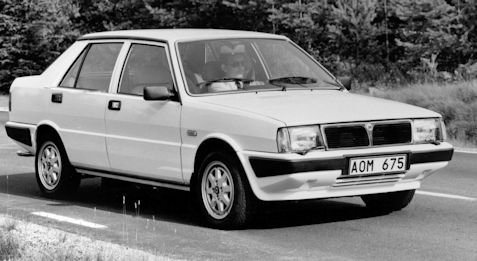
The Lancia Prisma is a car mode from the 1980's by the Italian automaker Lancia and the notchback version of the Delta starting from November 1982. As with the Delta used Lancia the Fiat Ritmo, but with the Lancia engineered Camuffo rear axle.
During its construction period, five gasoline engines with outputs between 55 kW (75 hp) and 85 kW (115 hp) and two diesel engines with 48 kW (65 hp) and 59 kW (80 hp) were available.
In May 1986, the prism received a discreet facelift along with the Delta. The wheel discs, interior and radiator grille were adapted to the then design line. The 1.6-liter gasoline engine was now also offered with electronic injection and thus made 79 kW (108 hp). The new 2.0 ie had all-wheel drive.
In April 1989, he was replaced by the Dedra, which was from mid-1994 as a station wagon.
Engines
All engines have two valves per cylinder, which are operated by bucket tappets of toothed belt driven, overhead camshafts. For the two smaller gasoline engines and the diesels, the valves are parallel, while the other engines are arranged in a V-shape.
Options
light alloy wheels: electric windows: tinted glass; sunroof; central door locking: metallic spray; trip computer; folding rear seats; check control.
Lancia Musa
 |
|
|
Production period: |
2004 to 2012 |
|
Class : |
Motor Car |
|
Body versions : |
minivan station wagon |
|
Engines: |
Gasoline : 1.4 liters (57-70 kW) |
|
Length: |
3985-4037 mm |
|
Width: |
1698-1703 mm |
|
Height: |
1688-1684 mm |
|
Wheelbase : |
2508 mm |
|
Curb weight : |
1230-1350 kg |
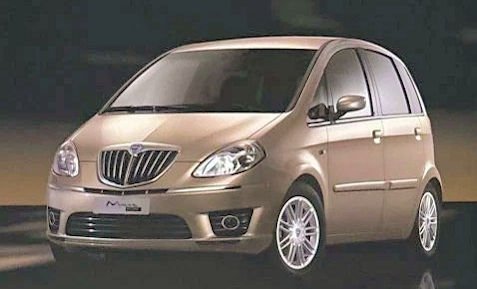
The Lancia Musa is a minivan of the Italian car manufacturer Lancia, which was manufactured between spring 2004 and summer 2012.
The musa was the first vehicle of this type and size from Lancia. This was also referred to by the manufacturer as a compact van or compact MPV (Multi-Purpose Vehicle). The presentation took place in March 2004 at the Geneva Motor Show, then the sale started in late summer.
The Musa was created together with the sister model Fiat Idea, but was better equipped. For example, there were seat covers made of a leather Alcantara combination, chrome trim, navigation system and a Bose sound system as an option. The Musa is on the one hand an independent model, but act as a replacement for a five-door version of the then Lancia Ypsilon. The Musa was produced at the Lancia Mirafiori plant in Turin and carries the internal type designation 350.
At the 64th International Film Festival in September 2007 in Venice, the revised Musa celebrated its world premiere. Changes include; the front bumper and the grille have also been modified. Similarly, the tailgate, rear skirt and taillights have been redesigned, which are now equipped with LED lights.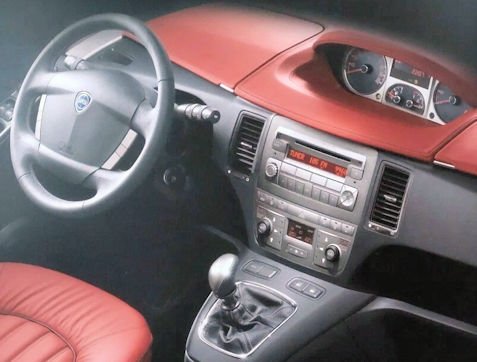
The "Nuova Musa" also featured a new wheel design and new exterior paintwork, again offering various bi-color finishes. In the interior, the luggage compartment volume could be increased by 75 l by lowering the loading floor. There were also other colors for the seat covers and the dashboard.
In July 2012, the production of Musa was completed without successor.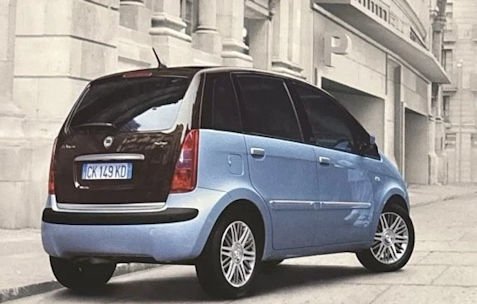
Launch LC1 Race Car
 |
|
|
Constructor |
Lancia |
|
Type |
Group 6 World Sports Prototype Championship |
|
Class |
Race Car |
|
Team |
Martini Racing |
|
Designed by |
Dallara |
|
Substitute |
Lancia Beta Montecarlo Turbo |
|
Replaced by |
Launch LC2 |
|
Chassis |
aluminium monocoque |
|
Motor |
4-cylinder in-line Lancia, 1,425 cm³ turbocharged |
|
Transmission |
manual gearbox, 5 speeds, rear wheel drive |
|
Length |
4700 mm |
|
Step |
2500 mm |
|
Weight |
665kg |
|
Tyres |
Pirelli |
|
Debut |
1982 |
The Lancia LC1 was a competition car (sports prototype type) built by Lancia to compete in the 1982 season of the World Sports Prototypes Championship.
History
Lancia had dominated the two previous editions of the championship with the Lancia Beta Montecarlo Turbo, entered among the Group 5 silhouette cars. Still managed by Cesare Fiorio, Lancia Corse had intended to develop its turbo engine, but the new regulations awarded points for the constructors' title only to the newly formed Group C and Group B and put Beta Montecarlo out of action. Lancia did not have a competitive Group C sports-prototype engine, so it aimed only at the drivers' title by taking advantage of the FIA sporting regulations which to fill the field only for the 1982 season, allowed prototypes built according to the old Group 6 regulations to still be deployed (among others), as long as they had a displacement of less than 2.0 litres. Lancia LC refers to two-seat prototypes - racing cars used by Lancia in long-distance races from the 1982 season, following the Group C rules newly introduced by the FIA.
In the 1982 season came in the World Sportscar Championship numerous rule changes in force the previous groups 1-6 by the newly created (and newly regulated) groups A, B and C replaced. In Group C, the fuel consumption of sports cars was limited, the engine design, however, almost arbitrary.
Lancia as brand world champion of the years 1980 and '81 initially had no competitive car due to these changes in the regulations, since the heavily modified Lancia Beta Montecarlo was no longer allowed under Group 5 regulations, i.e., a touring car. The minimum weight of Group C cars was 800 kg, while Group 6 was only 600 kg. Although Group 6 cars were still allowed to race in 1982, they were not subject to the new gasoline limitation, which made them favourites for overall victories, but they were only eligible for points in the drivers' championship, not for the World Championship.
Lancia therefore quickly built parts of the existing Group 5 technology in two based on the rules of the previous Group 6, built by Dallara open sports car with a new lightweight chassis. This chassis was similar to the design of the former Monoposto Formula 1, but was made wider to allow the installation of the prescribed two seats and weighed only 55 kg including roll bar. To further reduce weight, the engine and transmission have now been designed as load-bearing parts for the rear suspension. The Lancia LC1 baptized car reached a weight of 640 kg and was thus 140 kg lighter than the Lancia Beta Montecarlo Turbo Group 5, Unlike the Lancia Beta Montecarlo Turbo Group 5, the engine on the LC1 is also longitudinal and not transverse to the vehicle axle.
Thanks to the lower weight, the low consumption and the stability of the proven Group 5 engines, he was also - at least theoretically - an absolute winner. The problem that the 1.4-liter 16V four-cylinder turbo engine overheated easier, and never got properly under control.
designed and built by Dallara was built around the 1,425 cm³ engine (equal to 2 litres thanks to the factor 1.4) of the " Montecarlo Group 5 " (but rotated 90° to be mounted longitudinally): with a tub chassis conventional monocoque, it was very light - it weighed 640 kg (25% less than its opponents in Group C), which, combined with a power of around 450 HP, gave it an excellent weight/power ratio. Furthermore, in the Group 6 regulations the miniskirts were allowed to touch the asphalt, ensuring more effective ground effect when braking and cornering. The cars were not subject to the consumption limitations of the "Group C", a fundamental element for example at Silverstone, with its 700 hp it was slowed down by excessive consumption. The gearbox was a Hewland TG 300 derived from Formula 1. The front suspension was a deformable wishbone, with a single upper arm and double lower arms, external spring-shock absorber units and anti-roll bar. At the rear there were deformable quadrilaterals, but they had wider lower arms and external spring-shock absorber units, like at the front; There is an anti-roll bar. The Pirellis, after three years of collaboration with Lancia, were specific to the car both in the race and in qualifying. The bodywork had a long tail that covered the rear wheels, while two versions of the nose were available: a concave one for greater aerodynamic load, for slow circuits, and a convex one for fast circuits.
Performance:
Maximum power (in competition): 430 HP at 8500 rpm (1.5 bar supercharging)
Maximum power (in qualifying): 460 HP at 8500 rpm (1.65 bar supercharging)
Limiter: 9300 rpm
Like the Beta Montecarlo, the LC1 also had Martini Racing colours, associated with the MS cigarette brand. Unpainted aluminium rear wing and matt black wheels. The race numbers 50, 51 and 52 were retained throughout the championship.
Achievements
The pole position in Monza as well as victories in Silverstone and at the Nürburgring spoke a clear language - one had first the nose ahead of the competitors, who developed completely new vehicles, the Porsche 956 and the Ford C100. The riders were also selected: Riccardo Patrese, Michele Alboreto and Teo Fabi were three active Formula 1 drivers, Piercarlo Ghinzani and the two Germans Rolf Stommelen and Hans Heyer.
The goal was, of course, a success at Le Mans, where the factory Porsche had back in 1981, and should dominate the next few years. In 1982, Lancia, with great financial help from Martini & Rossi, the former Porsche sponsor, came with two cars to the Sarthe. The car with the number 51, driven by Alboreto, Stommelen and Fabi, fell after 92 laps with a defective intercooler. Not much better was the second car with the start number 50, driven by Patrese, Ghinzani and Heyer. After several repairs, the vehicle stopped after 152 driven laps in the Mulsanne with a major engine failure.
The 1982 season
Cesare Fiorio reconfirmed the drivers from the previous season: Riccardo Patrese, Michele Alboreto, Teo Fabi and Piercarlo Ghinzani.
The first race was the 1000 km of Monza on 18 April, where the concave-nosed cars qualified on the front row. The Patrese/Alboreto car led the race for four hours, before retiring due to a faulty distributor, and the other car was slowed down twice due to the tires and a puncture in the radiator, which was then replaced. He eventually retired due to the distributor.
At the 6 Hours of Silverstone (16 May), given the layout of the track, the convex nose was used. In qualifying Ghinzani was the best of the team, second behind the Porsche 956 Group C of Jacky Ickx. Patrese and Alboreto led the first part of the race, before stopping in the pits to change tires and repair the tail damaged during an overtaking. Ghinzani and Fabi took the lead for the next 2 hours until the engine broke, leaving the victory to Patrese although his clutch failed towards the end.
For the 1000 km of the Nürburgring on 30 May, which was still run on the Nordschleife , the concave nose was returned to obtain more load. The official Porsche squadron was not participating: busy preparing for the 24 Hours of Le Mans, the German brand was represented only by private individuals. Patrese suffered a terrible accident in practice when he went off the road but emerged unharmed. Due to the accident, Fiorio shuffled the crews, which were now Alboreto/Fabi and Ghinzani/Patrese, with the latter driving only for the central part of the race. At the start Ghinzani ran away, but a puncture forced him to the pits and his subsequent comeback, which was interrupted by a broken gearbox. Fiorio then decided to assign Patrese the last shift of driving the other car still in the race, to give him points in the drivers' championship. The victory of the Alboreto/Fabi/Patrese crew led the latter to achieve three victories in three consecutive weekends in the two major FIA championships: on 16 May the 6 Hours of Silverstone, (with Brabham) and the 1000 km of the Nürburgring on 30 May.
The 24 Hours of Le Mans was held on the weekend of 19-20 June and the Lancia Corse team lined up its cars with convex noses equipped with headlights and installing a specific rear wing, with less downforce and greater penetration, in search of maximum speed on the very long Hunaudières straight. Patrese/Ghinzani/ Heyer on the nº50 and Alboreto/Fabi/ Stommelen on the nº51.
After qualifying in fourth and fifth place, fuel pump problems for both cars meant the race got off to an uphill start. Alboreto remained stationary for an hour along the circuit before managing to bring the car back to the pits, while Patrese lost almost an hour in the pits to resolve the problem: after an hour of racing the two Lancia’s were 52nd and 53rd and had covered the just one lap. Alboreto, Fabi and Stommelen continued to race for another seven hours, but retired with an exploded engine while they were 26th. Patrese, Ghinzani and Heyer maintained a frenetic pace for 15 hours, but the turbo betrayed them when they were in 22nd place. The Porsche hat-trick almost completely made up for the deficit in the standings. The championship began again on September 5th: 4 races in 6 weeks.1000 km the Lancia LC1s had to bow to the Porsche 956s, who scored a one-two with Jacky Ickx / Jochen Mass and Derek Bell / Vern Schuppan and left third place to Patrese and Fabi; Alboreto and Ghinzani retired, stopping along the track without fuel due to a faulty fuel gauge.
Two weeks later the 1000 km of Mugello took place, in which the official Porsches did not take part and where the Lancia’s instead dictated the law: first Ghinzani and Alboreto and second Alessandro Nannini and Corrado Fabi, Teo's brother; in third place Bob Wollek, Hans Heyer and Henri Pescarolo in the Porsche 936C of the Joest Racing team.
On 3 October the 6 Hours of Fuji was held in Japan: in testing the performances of the official cars were equal, but in the race the Lancia’s were slowed down by various problems. Ickx/Mass won, with Teo Fabi and Patrese second by two laps. On 17 October the eighth and final race took place: the Brands Hatch 1000km. Porsche already had the constructors' title in its pocket and was not willing to enter the race, but its driver Ickx was still competing with Patrese for the drivers' title and convinced them to compete. Under the downpour that afflicted the race weekend, the Ford C100s stood out in testing , followed on the grid by the Lancia’s of Patrese/Fabi in 3rd place and Alboreto/Ghinzani in 4th At the start of the race the Fords immediately took the lead and in this initial phase the two American cars ran side by side, with the aim of both staying out of the cloud of water raised by those in front, but the two cars eliminated each other, careening in middle of the track and forcing the race director to suspend it: Ickx had about 6.3 seconds ahead of Patrese .
At the restart Hans Stuck led the race in his Sauber, followed by the Ford C100 of Marc Surer, the Porsche 935 of the British John Fitzpatrick, Ickx, Bob Wollek in the Porsche 936C and by Teo Fabi, while Alboreto was delayed. It stopped raining, but the track was very wet and in the space of a few laps the two cars fighting for the title took the lead, but the Porsche consumed more fuel and an extra refuelling forced it to make up a delay of over a minute on a track that was drying out and whose grip changed from lap to lap. Ickx began a frenetic comeback and passed under the checkered flag with a delay of only 1.6 seconds and then won the race by sum of times with 4.7 seconds of advantage: the first Endurance drivers' world title went to Jacky Ickx (95 points), Patrese second with 87 points.
The 1983 season
The 1983 World Endurance Championship no longer allowed Group 6 cars to compete, so the three-remaining chassis (chassis #1 was destroyed in the Nürburgring accident) of the LC1s were converted to Group C. By regulation the bodywork was transformed into a coupé and the minimum weight was increased from 640 kg to 810 kg, with the same engine as the previous year, thus losing the advantage in terms of agility and weight/power ratio. They were brought into the race by Scuderia Sivama Motors and entrusted mainly to Oscar Larrauri and Massimo Sigala, but, given the poor results the best was 5th at the 1000 km of the Nürburgring, at the end of the season they were restored to their original state and sold to collectors.

Lancia Theta
 |
|
|
Production period: |
1913 to 1919 |
|
Class: |
Motor Car |
|
Body versions: |
Touring car, Phaeton, Limousine |
|
Engines: |
Gasoline 4.9 litres (51 kW) |
|
Length: |
4650 mm |
|
Width: |
1615 mm |
|
Wheelbase: |
3100-3378 mm |
|
Curb weight: |
1060 kg |
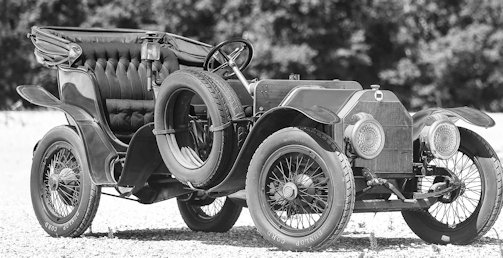
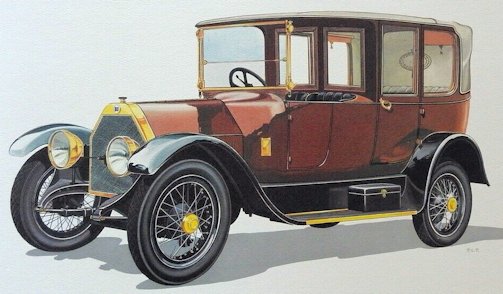
The Lancia Theta is an automobile of the manufacturer Lancia and was produced from 1913 to 1918. It is a revision of the Lancia Epsilon.
History
The designation followed the nomenclature of the manufacturer to name the car after the Greek alphabet. The chassis was available with two wheelbases, the most popular body shape, the Lancia Theta Torpedo Coloniale, in the then-customary torpedo shape. The Lancia Theta, also known as Lancia 25/35 HP or Lancia Tipo 61, is a car produced from 1913 to 1918 by the car manufacturer Lancia. It was the first production car to feature a complete electrical system and the first Lancia model to exceed a thousand units produced, with 1,696 examples. The Theta was the first car in Europe to have a 6-volt electric system from Charles Kettering and was also the first car with a starter and a lighted cockpit. the installation of the starter was initiated by Vincenzo Lancia, who wanted to do away with the hassle of cranking before driving. Other patents that were applied for the first time were a three-way adjustable steering column, a chain-operated transmission brake and a novel drum brake.
Less innovative was the drive, a four-cylinder engine, which was taken over by the commercial vehicle Lancia IZ and made possible with 70 hp a top speed of 120 km / h.
It was exhibited at the London Motor Show in autumn 1913 and put on the market at the end of the same year. The car was destined to have a rather long existence for the time: in fact, it survived the First World War, remaining in production for around 5 years, until 1918 (for a total, not insignificant for those times, of 1696 units). It was replaced by the Lancia Kappa when industrial production resumed after the conflict.
The first Lancia product of irrefutable international success, powerful and fast, the Theta was destined to go down in history as the first European car marketed with a complete electrical system offered as standard equipment. The system, made in America (Rushmore), worked with a voltage of 6 volts and included, among other things, the starter motor (with pedal control), a generator, two 50- candle headlights, two additional lights, a rear light and even dashboard lighting and a horn button. included dynamo lighting Lancia also shares with Hispano-Suiza the distinction of introducing electric starters to Europe, and the pedal-operated Rushmore unit was standard equipment on all Thetas. Equally advanced was the layout of the switches: not only the ignition, but also the lamps, the electric klaxon, and the panel light were controlled from the steering-wheel, while the steering-column was adjustable for rake. Lancia's prosperity was reflected in sales to Argentina, Australia, Ceylon, Cuba, France, the Netherlands, India, Malaya, Morocco, New Zealand, Rumania, Russia, South Africa, Switzerland, and the U.S.A.
The Theta's specification embraced full-pressure lubrication, a four-speed unit gearbox, and a dry multi-disc clutch, and output was 70 b.h.p. at 2,200 r.p.m., which gave it a brisk performance on a 3•26: 1 axle ratio. Vincenzo Lanciahe was so convinced of the goodness of the new system that he opted to eliminate the front starter crank (which survived only as an accessory and was supplied with the tools).
Engine performance
Power : maximum HP 70 at 2,200 rpm
Speed : (max speed in the various gears: 26 in 1st, 52 in 2nd, 77 in 3rd, over 120 in 4th) approximately 120 km/h
Braking was also improved: the braking system was always made up of the usual two-system scheme (the lever that acted on the rear wheels and the pedal that acted on the transmission) but the effectiveness was increased thanks to a Lancia patent on the basis of which the gearbox, modified for this purpose, was equipped with a chain to push the lining against the drum with uniform pressure over the entire braking surface.
The engine mounted on the Theta, although not innovative (it was essentially the 4- cylinder of almost 5 litres of displacement already adopted on the 1Z truck in 1912) was nevertheless reliable and powerful (it delivered around seventy horsepower) and, despite a very heavy chassis significant, he managed to push the car up to reach and sometimes exceed 120 km/h.
The robust Theta chassis could be chosen between two wheelbase sizes (310 or 337 cm) while the inclination of the steering column (thanks to one of the many mechanisms patented by Lancia) could be varied on three different values (34°, 37°, 40°).
Altogether 1696 vehicles of this type were created. Chassis numbering: from n° 1800 to n° 5154 (the numbering includes, in addition to the Theta, the Jota and Djota trucks; a total of 1696 Theta examples were built)
Lancia Epsilon
 |
|
|
Production period: |
1911 to 1913 |
|
Class: |
Motor Car |
|
Body versions: |
Various |
|
Engines: |
Gasoline 4.1 litres (59 kW) |
|
Length: |
4200 mm |
|
Width: |
1615 mm |
|
Wheelbase: |
3227 mm |
|
Curb weight: |
920 kg |
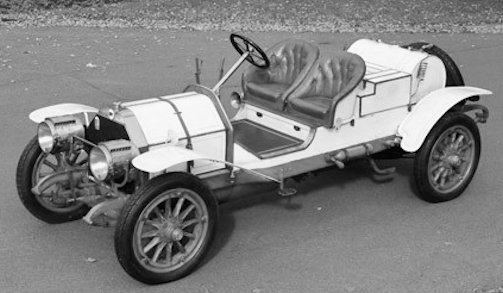
The Lancia Epsilon (internal: Type 58) was a two-seater vehicle of the company Lancia, which was produced from 1911 to 1913.
History
The Lancia Epsilon also known as the Lancia 20/30 HP Passo Lungo or Lancia Tipo 58 was based on the previous Lancia Delta, which it replaced. The production expanded once the company took over a factory previously used Fides-Brasier manufacturer. The first new models produced there were the Delta and Didelta, and soon the Epsilon which used a reworked version of the 20 30 engines, mounted in short and long chassis and variety of bodies the chassis were supplied to specialist coach builders. The Chassis numbering is between no. 862 and no. 1799 (the numbering includes, in addition to the Epsilon model, the Eta and Zeta models; according to some sources, the numbering of the Epsilon model would start from the number 862 and end with the number 1212; the examples However, there are 351 built)
The "Type 58 - Epsilon" is similar to the Delta, and for the 1911 model The Gamma Of 1909 and the Delta of 1910 led to the model designated by the next fifth letter of the Greek alphabet, it essentially represented the extended wheelbase version, indispensable for accommodating larger bodywork. About 350 copies were made. Successor was the Lancia Theta.
Apart from a dry multi-plate clutch, there was nothing radical about this Epsilon over previous models. The engine was a Monoblock four-cylinder unit; it was also to be used in the Theta with 4080 cc and an output of 80 hp at 1800 / min. The top speed was 115 km / h. The chassis and suspension were Conventional. The track width was 1330 mm at the front and 1330 mm at the rear and 3227 mm at the wheelbase wire wheels were an option. The top speed was 115 km / h. The track width was 1330 mm at the front and 1330 mm at the rear and 3227 mm at the wheelbase. The chassis and suspension were Conventional type.
Performance:
maximum power 60 HP at 1,800 rpm
maximum speed (with the longest gear ratio) approximately 70 mph/115 km/h
max speed in the various gears: 30 in 1st, 48 in 2nd, 71 in 3rd, approximately 115 in 4th