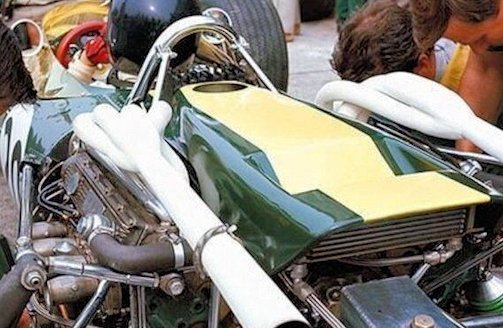
Lotus
Lotus 56 56B Race Cars
 |
|
|
Constructor: |
Lotus |
|
Class: |
Race Car |
|
Years: |
1968 to 1969 |
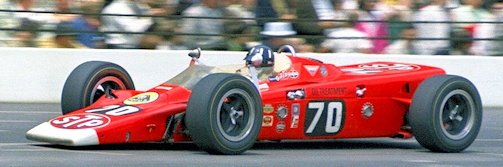
The Lotus 56 was a four-wheel-drive gas turbine racing car, which was developed built in 1968 by the British motorsport team Lotus.
History
The Lotus 56 was developed in 1968 to the Lotus 38 to replace, with Jim Clark in 1965, the 500-mile race at Indianapolis had won. Chief designer Maurice Philippe created an innovative extreme wedge- shaped racing car powered by a Pratt & Whitney ST6 gas turbine. So that the thrust of the gas turbine could be brought to the ground, the 56 also received a four-wheel drive.
In 1967, Andy Granatelli of the STP Corporation ran a gas-turbine-powered four-wheel drive car at Indy and very nearly won the race. For the following year he hired Lotus to build a team of turbo-cars, and the dramatic wedge-shaped four-wheel-drive Type 56 was the result.
The cars did not have a lot of power, but they handled supremely well. They were heading for an historic success when, with only nine laps of the 200 remaining both Art Pollard and leader Joe Leonard were side-lined by fuel-pump failure. Graham Hill's car had lost a wheel.
For 1969 the American track establishment reacted by effectively banning turbine power and eventually four-wheel drive, while spin-offs from the Lotus 56 programme included a flurry of unsuccessful four-wheel-drive Grand Prix cars and in 1971 an uncompetitive Type 56B gas-turbine Formula 1 car.
The first test drives with Jim Clark at the wheel were successful, but Clark crashed in the spring of 1968 with the Lotus 48 in a Formula 2 race at Hockenheim deadly. Substitute Mike Spence crashed in qualifying for the 500-mile race with the 56 deadly. He lost control of the car, hit heavily into the concrete wall of the track boundary and was then hit by his right front wheel on the helmet. A few hours later he succumbed to his severe head injuries at the hospital. Lotus Graham Hill, Joe Leonard and Art Pollard reported for the race.
In training, the turbine was driven only with 80% of the possible power. The pilots had to brake hard in front of the corners so that the turbine could rewind to full power when the pedal was released. Through this process, the full turbine power could be called up on the straight and the delayed response of the turbine could thus be prevented. Joe Leonard put his 56 with a cut of 274.49 km / h his 56 promptly on the pole position, In the race had to be dispensed with this trick, because the braking in front of the curves had led to unrhythmic driving and the discs would not have held this for 200 laps. Before the race but was loud criticism of the turbine cars loud. Aircraft engines should not displace the conventional piston engines. The officials therefore insisted that the three Lotus had to start with normal premium gasoline and not be allowed to fall back on the special aviation fuel. The reduced power and the deceleration of the turbine in heavy traffic slowed the three Lotus sustainable. Although Joe Leonard briefly took the lead, but all three vehicles failed with defects. Leonard was rated as twelfth and Pollard as 13th of the United States Automobile Club banned both turbines and four-wheel drive in 1969 and the Lotus 56 was no longer developed.
Colin Chapman took the four-wheel drive technology into the Lotus 63 and had the Indy replacement car converted for Formula One. The car was used in 1971 in some races. Emerson Fittipaldi drove the car at the Race of Champions at Brands Hatch. In training Fittipaldi rode in the rain superior time. In the race, this time on a dry track, the Brazilian did not get beyond a midfield spot. The second Lotus factory driver Dave Walker drove the car at the Grand Prix of the Netherlands in Zandvoort, Walker had already moved from tenth place on 22nd when he had to leave the track and give up. Fittipaldi drove the 56 still at the Italian Grand Prix, where he finished eighth, and at a Formula 5000 race at Hockenheim, which he finished second behind Frank Gardner. Then Chapman gave up the work on the all-wheel drive and the gas turbine finally and focused on the development of the Lotus 72.
Lotus 56B
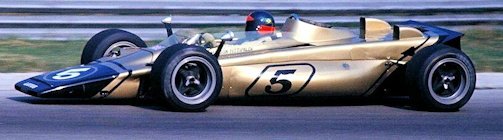
Although it had originally been intended to race a Formula One gas turbine car in 1969, the 56B, developed from the 1968 Indianapolis cars, was not raced until 1971. The wedge-shape, four-wheel-drive and the double wish-bone suspension with the coil spring damper units mounted inboard were developed from the 1968 car, but the engine was extensively modified. This was a Pratt & Whitney unit built in Canada and to comply with the FIA equivalency formula one of the axial compressor stages was eliminated and the area of the high-pressure nozzle was reduced. The car had a fuel capacity of 62 gallons contained in side tanks.
The car ran in a number of non-Championship Formula One races during the year; it was driven Prix (he crashed) and by Fittipaldi in the Italian Grand Prix (he finished
wedge-shaped bodywork that appeared eighth). In addition, Fittipaldi drove at the Daily Express Trophy race. It the car into second place in the Preis was an experimental car and entered der Nationen (a Formula 5000 race) at Hockenheim.
Lotus 51 Race Car
 |
|
|
Constructor: |
Lotus |
|
Class |
Race Car |
|
Years |
1967 to 1968 |
|
Designer: |
Colin Chapman |
|
Chassis: |
space-frame |
|
Wheelbase: |
90 inches |
|
Engine: |
Ford |
| Width: | 59 inches |
| length: | 152 inches |
| Weight: | 410 kilos |
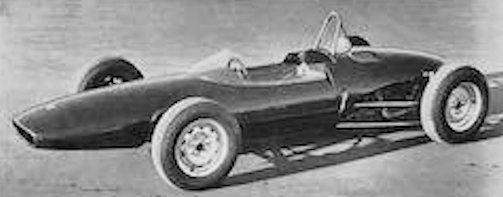
The Lotus 51 was a Formula Ford racing car, built in 1967 by the British motorsport team Lotus .in the late 1960s.
History
The Lotus 51 1967 was a bestseller for Colin Chapman and the Lotus team. with around 200 vehicles were built and sold. The price of a vehicle was £955. A 1967 space-frame car for Formula Ford racing based on the Mk 31 the body Resin bonded colour impregnated glass fibre in three sections, comprising undertray, nose section and rear engine cover.
Perspex windscreen is fitted and the car comes complete with removable moulded glass fibre bucket seat..The brakes are mounted outboard on all wheels and the system includes an adjustable balance bar to allow variation in the front to rear braking ratio.
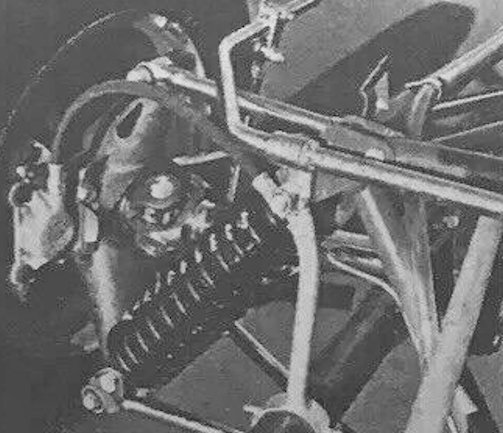
With Lotus modified Renault 4 speed syncromesh gearbox complete with reverse gear driving via a single plate Cortina GT diaphram clutch. suspension at the front unequal length wide based wishbones with outboard spring/damper units and adjustable anti-roll bar the rear twin radius arms, inverted wishbones and top links with outboard spring/damper units and adjustable anti-roll bar.
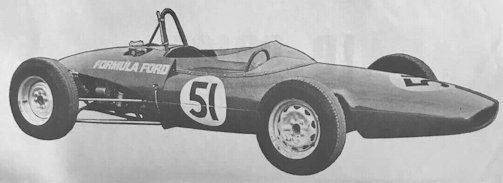
The 1968 version was known as the Mk 51A The car was based on the Lotus 31, a Formula 3 vehicle from Lotus. The 1600 c.c. Ford Cortina GT cross—flow unit fitted with single downdraft Weber carburettor and specially constructed four branch exhaust system.Front mounted cross-flow radiator with integral oil cooler.Main chassis tubes carry liquids from engine compartment to radiators, the oil system being fitted with the necessary regulation catch tanks.
The race car was agile and fast, had a short wheelbase and was extremely light with a curb weight of 412 kg. In 1969, the car was replaced by the Lotus 61. In 1968, the 51R a single piece was built. The car had wider side boxes and was originally intended as a concept for a successor model. The car was sold at a price of 1095 pounds to a US collector who never used the 51R in a racing competition.
Lotus 49 Grand Prix Race Car
 |
|
|
Constructor: |
Lotus |
|
Class |
Race Car |
|
Years |
1967 to 1968 |
|
Designer: |
Colin Chapman |
|
Engine: |
Cosworth FVA |
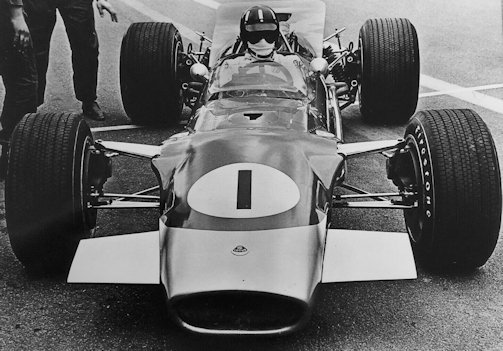
The Lotus 49 was a Grand Prix racing car, built and used by Lotus in the late 1960s.
History
The long-awaited Cosworth-powered V-8 Grand Prix car, which made its debut at Zandvoort in 1967. Although not without its teething troubles, the car soon proved itself.
The monocoque aluminium-alloy sheet chassis, with which the engine was composite, had front suspension by upper rocking levers and lower wishbone members and rear suspension by upper transverse links and lower wishbones, with coil spring/damper units front and rear. V-8 Cosworth engine of 2993 cc (85.7 x 64.8 mm) with four overhead camshafts, four valves per cylinder, Lucas port fuel injection and a power output of 400 bhp at 9000 rpm. The Transmission by ZF 5-speed and reverse gearbox in unit with the final drive which incorporated sliding roller splines in the differential.
Lotus team boss Colin Chapman brought in 1966, the two Ford technicians Haley Coop and Walter Hayes with Keith Duckworth of Cosworth together with the aim of developing a new engine for the F1. Ford intensively supported the development of the DFV (Double Four Valve) and Lotus, with an exclusive contract for use, cut the Lotus 49 to this engine.
He was an uncomplicated car with timeless lines. The 90-degree V8 engine determined the cross section of the monocoque. He was so attached behind the cockpit that he played a major role. The subframe of the rear suspension was bolted to the engine block and cylinder heads. It was expensive to change the engines, but the car had a good centre of gravity. The drivers raved about the 49, which was light and manoeuvrable and whose engine had a wide rev range.
Lotus built twelve chassis with the designation 49 (three of which were conversions of the already existing, but received a new hull number). One or the car remained an exhibit and was never driven, the other eleven were used under the Evo designations from B to T until the early 1970s. The T with a just 2.5-liter Cosworth V8 was driven only in the Tasman series (hence the T), a racing series in Oceania that was very popular in the late 1960s.
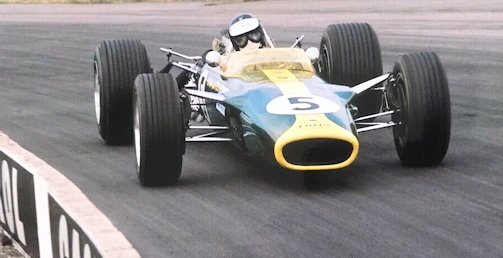
The 1968 Lotus 49B had a longer wheelbase that allowed wider wheels from this season, a slightly more wedge-shaped body and modified subframes. In order to improve the grip, the front was first provided with short wings at the rear of a tear-off edge.
In 1969, front and rear oversized wings were used, which were mounted on high supports with rubber elements directly to the steering knuckles and not as in the competition on the vehicle frame. The output forces should not act on the entire car, but only on the wheels. However, the front wing soon proved to be detrimental as the supports bent and the tires touched. At the Spanish Grand Prix, the front wings were again replaced by wing stubs on both sides of the front hood. In the race, the rear wings buckled and finally failed completely. At first, Graham Hill crashed behind a high-speed jump but was uninjured. Three laps later Jochen Rindt crashed at this point for the same reason. He hit the wreck of Hill's car and was only recovered from the bent chassis with a broken nose. After these serious accidents in Barcelona, the rear wing was dismantled. For during the training for the Grand Prix of Monaco in 1969, the Commission Sportive Internationale (CSI) finally banned all wings. From now on, stabilizing surfaces were only allowed on the sprung part of the chassis. Shortly thereafter, the regulation was clarified: rear wing maximum 800 mm high and maximum 1100 mm wide.
The Lotus 49C, which was still occasionally used in 1970, received the three-piece rear wing of the Lotus 72.
The 49B was the 1968 wedge-shaped car which appeared at Monaco and this featured an increased wheelbase by angling forward the upper rocker arms, modified rear suspension and a Hewland gearbox.
In 1969 Lotus continued to rely on the 49B and also raced the 63 four-wheel-drive car. Jochen Rindt now joined Graham Hill in the Gold Leaf Team and while Rindt's driving was fast, furious and usually ended in retirement, Hill seemed off-form all season and at the end of the year crashed badly in the United States race. As in 1968, Jo Siffert raced a car for Rob Walker. Because of aero-foil failures both Hill and Rindt crashed in the Spanish race at Barcelona and Dickie Attwood was brought in to replace the injured Rindt at Monaco only. At the beginning of the year Hill and Rindt drove 49T cars with 2500 cc engines in the Tasman races.

Although work was proceeding on the new 72 Grand Prix car for 1970, before it was ready to race and while it was being sorted out after an unsuccessful début, Lotus
continued to field the 49 cars, now in 'C' form with modified front suspension, 13-inch front wheels and new hubs. Rindt was now partnered in the team by John Miles (who had driven one of the 63 cars in 1969), Graham Hill appeared at the wheel of Rob Walker's 49C pending delivery of a 72 late in the season and American driver Pete Lovely fielded a 49B in some races. At Monaco the 49Cs had three-tier rear aerofoils of the type designed for use with the 72. This was to all intents and purposes the
last serious outing of a 49 under the works banner, but a car was entered at a few races under the name of World-Wide Racing (a Lotus subsidiary) for Spaniard Alex Soler-Roig, cars were fielded at the 1970 British and German races for Emerson Fittipaldi, Wilson Fittipaldi drove a works 49C in the 1971 Argentine Grand Prix and Tony Trimmer appeared with one of these cars at the 1971 Rothmans Trophy race at Oulton Park.
The 49 was driven by the great champions of its era. Already at the first appearance in 1967 at the Grand Prix of the Netherlands Jim Clark celebrated with it the victory. It was also the first victory for the Cosworth V8 engine at the first start. His final victory in 1968 in South Africa Jim Clark scored in a 49th For four years, the Lotus 49 was the measure of things in the Formula 1 Twelve times won drivers with these race cars in World Championship races.
Graham Hill became world champion in the 49er for the second time in his career in 1968 and, after 1963 and 1965, brought Lotus the third title of Constructor World Champion. The Lotus 49 was also the last vehicle to win a Grand Prix by a true privateer. Jo Siffert won in 1968 for Rob Walker the Grand Prix of Great Britain in Brands Hatch.
The last success for this legendary racing car entered Jochen Rindt in 1970. Rindt, who was reluctant to drive the new Lotus 72, once again hit 49 on the Monaco Grand Prix, narrowly winning after Brabham braked in the last lap of the Rascasse.
Race Successes
1967:
1st (Clark), Dutch Grand Prix; 1st (Clark), British GP; 3rd (Clark), Italian GP; 1st (Clark), 2nd (Hill), United States GP; 1st (Clark), Mexican GP
1968:
1st (Clark), 2nd (Hill), South African GP; 1st (Hill), Spanish GP The 49T was the Tasman version of the 49, with the Cosworth engine reduced to 2 litres (85.67 x 54.10
mm). Clark scored four wins with this car in the 1968 series.
1st (Hill), Monaco GP; 1st (Siffen), British GP; 2nd (Hill), German GP; 2nd (Hill), United States GP; 1st (Hill), 3rd (Oliver), Mexican GP.
Lotus won the 1968 Manufacturers' Championship
1969:
2nd, (Rindt), New Zealand GP; 1st, (Rind), 2nd, (Hill), Lady Wigram Trophy race; 1st, (Rindt). Warwick Farm 100 race; 2nd, (Rindt), Sandown Park race; 2nd, (Hill), South African GP; 2nd, (Hill), Race of Champions; 2nd, (Rindt), Daily Express Trophy race; 1st, (Hill), 3rd, (Siffert), Monaco GP; 2nd, (Siffert), Dutch GP; 2nd, (Rindt), Italian GP; 3rd, (Rindt), Canadian GP; 1st, (Rind), United States GP.
1970:
2nd, (Rindt), 1st, (Rindt), Race of Champions; Monaco GP.
Lotus 48 Race Car
 |
|
|
Constructor: |
Lotus |
|
Class |
Race Car |
|
Years |
1967 to 1968 |
|
Designer: |
Colin Chapman |
|
Engine: |
Cosworth FVA |
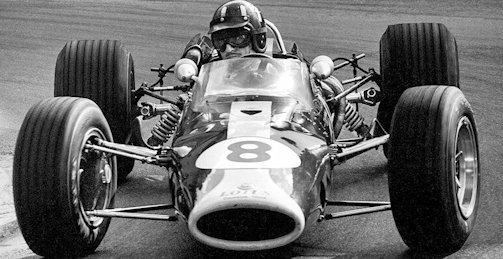
The Lotus 48 was a Formula 2 racing car, built and used by Lotus in the late 1960s.
History
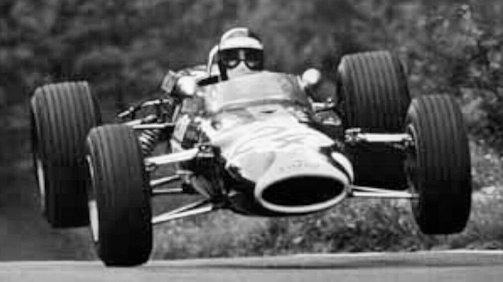
The 1967-8 monocoque Formula Two car, with 1594 cc Cosworth FVA engine and ZF gearbox raced by Team Lotus. Although the class was largely dominated by Brabham’s, Clark scored wins at Barcelona, Madrid and Kei-mola (in Finland). It was driving one of these cars that Clark was killed at Hockenheim in 1968. After Clark's death, a single car for Graham Hill was run-in Gold-Leaf Team Lotus colours, but another example was raced by Jackie Oliver and entered by the Herts & Essex Aero Club.
The model was no match for the rival Brabham’s and Matras and failed to finish in the first three in any race apart from the Circuit of Buenos Aires at the end of the year.
Lotus built a Formula 2 vehicle for the new 1.6-liter formula in 1967. The Lotus 48 had a full monocoque and an auxiliary tube frame, which received the Cosworth -FVA four-cylinder engine. The car made its debut in 1967 in the Tasman racing series and was driven in Europe during the entire Formula 2 season in 1967 by Graham Hill and Jim Clark. Clark was able to win at least three victories with the agile car against the strong competition of the Brabham Formula 2 cars.
In 1968, the car was upgraded and, now painted in the colours of the tobacco sponsor Gold Leaf, was designated 48 GLTL, with TL for "Team Lotus". The red-white-gold 48 came to sad notoriety when Jim Clark on April 7, 1968 at the Formula 2 race at the Hockenheim ring fatal accident, probably due to a flat tire. The 48 was withdrawn from the factory team at the end of the season and replaced in 1969 by the Lotus 59. In private hands ran some 48 but until 1970 in the European Formula 2 Championship. The car also had an appearance in Formula 1, as at the 1967 German Grand Prix at the Nürburgring also Formula 2 cars were at the start. Jackie Oliver reached the fifth place with a 48.
Lotus 43 Grand Prix Car
 |
|
|
Constructor: |
Lotus |
|
Class |
Race Car |
|
Years: |
1966 |
|
Designer: |
Colin Chapman |
|
Suspension: |
independent; front, lower wishbones, upper arms, coil springs; rear, |
|
Engine: |
H16 2996 cc dohc |
|
Bore and stroke: |
69.8 x 48.9 mm. |
|
Gearbox |
six-speed manual gearbox. |
|
Wheelbase: |
96 in (244 cm) |
|
Max speed: |
180 mph/ 290 kmh |
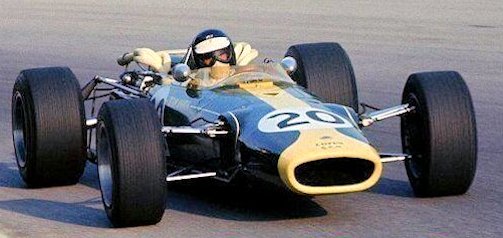
The Lotus 43 was a Formula One Grand Prix racing car, built by the British Formula One team Lotus in the 1960s.
History
The Lotus 43 was A stop-gap Grand Prix car for the 1966 season, with the BRM H-16 engine and gearbox. After a number of unsuccessful appearances, Clark scored an unexpected win in the United States Grand Prix. In 1966, the 3-liter formula was introduced in Formula 1 and Lotus had no more suitable car. The 33 was outdated even for the valid until 1965 2-liter formula, the 39 a misconstruction and the deal with Cosworth, who was the basis for the Lotus 49, only in the process of development.
Lotus had already used at the 33 partial engines of BRM. For the 43, therefore, the H-16 engines that BRM had developed for their own vehicles should be used. Already when unloading the first engines in the factory the difficulties were programmed. It took four men to get one engine from the truck at a time. The engine was too heavy and never reached the performance promised by BRM. The engine was mounted as a supporting part on a frame behind the cockpit and carried the rear suspension. The monocoque was extremely short for a Formula 1 car, Colin Chapman oriented himself on the Lotus 38, which came in Indianapolis used.
Jim Clark, Peter Arundell and Graham Hill, who returned home from BRM, struggled with the preponderance of the car throughout the year. Hill and Arundell therefore drove the 33 in most World Cup runs, the Lotus had converted to the new regulations. By the end of the season, the car seemed to be developing into a complete flop, as not a single goal finish succeeded. Only Jim Clark rescued the team from a total failure when he surprisingly won the US Grand Prix at Watkins Glen. In 1967 the car came in South Africa was used and then replaced by the highly successful Model 49. The two 43 chassis were sold and came later for some time in the Formula 5000 used.