
Leyland Motors Ltd
- Details
- Parent Category: L
- Category: Leyland Motors Ltd
- Hits: 38
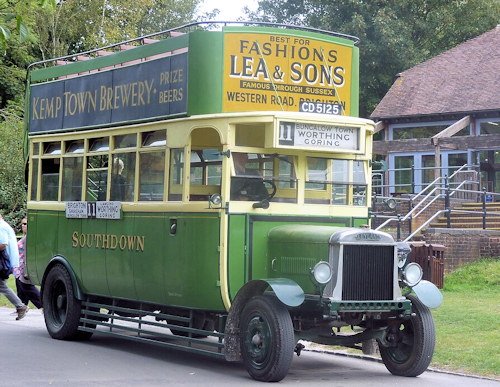
Leyland Type N Bus and lorry
 |
|
|
Manufacturer |
Leyland Motors |
|
Class |
Commercial vehicle |
|
Body type |
Bus,truck |
|
Production period |
1919 to 1921 |
|
Engine |
4-cylinder petrol |
|
Gearbox |
4-speed gate change |
The Leyland Type N are Commercial vehicles from Leyland Motors built as bus and trucks, produced from 1919 up to 1921.
History
The Leyland N Making its first appearance in 1919, the N model was of very similar design to the famous RAF type, being suitable for either passenger or goods type bodywork. Being of normal control layout.
A choice of Leyland 4-cylinder petrol engines was offered in the form of 32hp, 36hp or 40hp units. Transmission is via a cone clutch and 4-speed
gate change gearbox to an overhead worm rear axle.
Braking is by means of a handbrake operating internally on the rear drums and a foot brake which works externally, contracting on to a drum on the transmission.
Production of the N range ceased in 1921.
- Details
- Parent Category: L
- Category: Leyland Motors Ltd
- Hits: 53
Leyland Comet First generation
 |
|
|
Manufacturer |
Leyland Motors |
|
Class |
Commercial vehicle |
|
design type |
bus,truck |
|
Production period |
1947-1950 |
|
engine |
6-cylinder |
|
wheelbase |
17ft 6in |
The Leyland Comet was a Leyland Motors bus and truck produced post war from the late 1940s.
History
The Leyland Comet Introduced in 1947 was offered with a diesel or petrol engine, production has concentrated chiefly On the diesel engine at first.
The Comet Bus is a semi forward control chassis with fully floating rear axle and a wheelbase of 17ft 6in. Intended originally as an export model, this chassis also found its way on to the home market, although in a comparatively small quantity .
The Truck with gross weight at first up to 8.75 tons that was as built a tractor, chassis and flat bed or even dump truck options .The Comet truck goods range comprises three wheelbases : long, medium, for tipper work, and short, for tractor work. Models are designated CO (home) or ECO (export) followed by the number indicating wheelbase and, in the case of ECO models, by a suffix L or R indicating left or right-hand drive.Chassis and engine serial numbers, and the engine type number, are stamped On a plate fixed to the off-side chassis frame member. SPRINGS are Semi -elliptic front and rear. Spring eyes and shackle brackets bronzebushed. Shackle pins cotter-clamped. with nuts for adjusting side play. BRAKES Girling hydraulic two leading shoe with vacuum servo.Front brakes. and rear brakes on Eaton two- speed axle. operated by transverse Wheel cylinders. Rear brakes on hypid axle operated by single cylinder.
A choice of engines was available, with a Leyland 0.300, 5.08 litre 6-cylinder oil engine or Leyland 0.300, 5.08 litre 6-cylinder petrol engine.The serial number are stamped on a plate fixed to the induction manifold.

Bus Chassis fitted with seating for 33 these were classified CPOI and CPPI respectively. All were built to 7ft 6in width and fitted with 5-speed constant mesh gearboxes and vacuum hydraulic brakes. From 1949, a 2-speed rear axle was available. A similar chassis, suitable for lorry bodywork had been further developed was also produced during the same period of time, this also carrying the name Comet and later trucks weight was increased to 12 tons .
Production of the Comet first generation ended in 1950 after 4 years with a new generation.
- Details
- Parent Category: L
- Category: Leyland Motors Ltd
- Hits: 26
Leyland Swift Bus
 |
|
|
Manufacturer |
Leyland Motors |
|
Class |
Commercial vehicle |
|
Type |
bus |
|
Production period |
1987 to 1992 |
The Leyland Swift was a single deck bus chassis of the British commercial vehicle manufacturer Leyland Motors built from 1987 to 1992.
History
The Leyland Swift chassis is based on the Leyland Roadrunner light truck. In contrast to the truck, the Swift's engine was mounted behind the front axle, allowing the entry to be made through the front overhang can. The chassis was available with a 3.6 m or 4.4 m wheelbase. The main engine was a Cummins turbocharged six-cylinder diesel engine with synchronised gears, but an Allison automatic transmission was also available.
The chassis were built with bodies from different manufacturers. Both travel and city buses were produced. Wadham Stringer modified the Vanguard II setup for the Swift, securing a large number of assignments. Also popular was the Harrier construction of Reeve Burgess . The company Elme 2001 from Portugal developed not only the Orion but also a special version for disabled transport with integrated wheelchair lift . Wright in Northern Ireland put on two different body styles. Some chassis were also built as mobile libraries at the time.
The Swift with the Orion or Vanguard II construction was particularly popular on the Channel Islands of Jersey and Guernsey . They took full advantage of local size limits for buses, accommodating 43 passengers, enabling the replacement of buses built on older Bedford SB chassis. Overall, the bus was not a commercial success, it could be sold only 345 buses.
After the acquisition of Leyland by Volvo production was stopped, especially since Volvo had a similar model with the rear-engined B6 . An evolution of the Swift was produced by Cannon Coaches in small numbers.
- Details
- Parent Category: L
- Category: Leyland Motors Ltd
- Hits: 36
Leyland Leopard
 |
|
|
Manufacturer |
Leyland Motors |
|
Class |
Commercial vehicle |
|
Type |
bus |
|
Production period |
1959 to 1982 |
|
Engine |
11.1 litres |
The Leyland Leopard was a bus chassis of the British commercial vehicle manufacturer Leyland Motors . built from 1959 to 1982.
History
The Leyland Leopard engine is situated in the middle of the vehicle. It was originally designed as a replacement for the popular Leyland Tiger Cub, but both types were constructed in tandem for more than ten years. The usage of the more powerful O.600 diesel engine was the main change from the Leyland Tiger Cub. Later Leopards were fitted with the O.680 engine, which had a displacement of 11.1 litres.
In 1950, in the United Kingdom, the maximum length for buses wasraised to about 9.1 meters (30 feet). The initially manufactured versions met these specifications. Later, when the maximum permitted length was raised again, Leyland also produced the chassis in versions with a length of 10 or 11 meters. Together with the Tiger Cub , the Leopard almost completely displaced the Royal Tiger from the British market in a short time. With more than 1700 produced buses, the Leopard was one of Leyland's most successful bus models, but could not build on the sales successes of the Tiger Cub .
The Leyland Leopard was replaced from the early 1980s by Leyland Tiger . Its main competitor in the British market was the AEC Reliance although the Associated Equipment Company also belonged to the Leyland Group. The manufactured chassis received in the name initially the abbreviation L1 or L2 , later the abbreviation PSU3 (11 m in length) or PSU4 (10 m in length). The L1 and L2 differed only by the construction of the frame back, while the latter was more suitable for the construction of coaches, the former was primarily intended for the construction of scheduled buses.
Series production began in 1959 after the prototypes were unveiled at the 1959 Scottish Motor Show. Equipped were the buses with the six-cylinder diesel engineO.600 from Leyland with 9.8 l displacement and 125 bhp, The pneumatically assisted manual four-speed gearboxes synchronized the third and fourth gears. Later, the O.680 with 11.1 l displacement and 180 bhp and semi-automatic transmission was installed. The engine was located in the middle underfloor. Optionally, a rear axle with countershaft and pneumatic brakes on all four wheels could be ordered. The chassis was air-sprung. Until the 1980s, it was common for chassis and bodies for buses were made by different manufacturers. The chassis produced by Leyland were therefore completed by bodywork companies . Part of the buses received superstructures from Leyland's subsidiary Charles H. Roe in LeedsOther major bodybuilders include Alexander , Beadle , Burlingham , Crossley , Duple , East Lancs , Harrington , Marshall , Metro Cammell , Northern Counties , Nuttall , Park Royal , Plaxton , Strachan , Willowbrook and Weymann . Both coaches and city buses were built.
In England, the subsidiaries of British Electric Traction (BET) became major customers of the Leopard . For city buses and multi-purpose vehicles, which could be used both as a travel and as a city bus, BET developed a standard design for the superstructures. The superstructures themselves were primarily from Marshall and Willowbrook , occasionally also from Weymann and Metro-Cammell . Another key customer for the Leopard in England was Barton Transport of Chilwell near Nottingham . BartonOperated a fleet of 200 buses with Panorama Elite and Supreme Constructions by Plaxton . Barton used the buses for all types of passenger transport, so these buses were equipped with a wider, double-leaf door. The body styles themselves were called Express . At that time, the British government subsidized the purchase of buses if they met certain specifications and were used for a prescribed share in local traffic. Other operators also used these grants and procured Leyland Leopard manufactured to these specifications .
In Scotland, many buses were purchased by subsidiaries of the Scottish Bus Group and mostly equipped with a construction of Alexander ( Y type ) both as a travel and as a city bus.The Irish company Córas Iompair Éireann (CIÉ) also bought a large number of buses and provided them as a rule with a built in their own workshops construction.
The northern Irish counterpart to CIÉ , the Ulster Transport Authority (UTA) and its successor Ulsterbus , procured the buses with the X -type construction of Alexander. For a period of 40 years, the leopard on Northern Irish roads was a common sight. During the riots in Northern Ireland, a total of 228 leopards were stolen from their depots and publicly destroyed.The British military also deployed a number of leopards . The bus was exported to Australia and New Zealand.
- Details
- Parent Category: L
- Category: Leyland Motors Ltd
- Hits: 38
Leyland Retriever
 |
|
|
Class |
Military |
|
Type |
Truck |
|
length |
6,9 m |
|
width |
2,3 m |
|
height |
3,5 m |
|
Dimensions |
3000 kg |
|
main armament |
20 mm gun |
|
drive |
Leyland four-cylinder gasoline engine |
The Leyland Retriever was a truck that Leyland Motors produced for the British Army from 1939 to 1945.
History
The Leyland Retriever was a three-tonne payload truck. Between 1939 and 1945, 6542 were built, with some of them being utilised by the Danish army. The Leyland Terrier was used to create the retriever. The initial models had a tarpaulin-covered open cabin. A windshield and metal doors were added to later models.
The Retriever was a three-axle with two driven rear axles (6 × 4). The rear axle, which was developed on behalf of the British War Office , was required by the UK Ministry of Defense for the Retriever and all other British Army trucks produced for the British Army, including Crossley Motors IGL8, Guy Motors FBAX, Thornycroft Tartar and Karrier CK6.
The Retriever was powered by a water-cooled 5895 cc Leyland four-cylinder gasoline engine with 73 hp. The power transmission took place by means of four-speed reduction gear . The tank had a capacity of 141 liters. The spare wheel was mounted between the cab and the loading area.
In addition to the standard truck, there was also an armored version of Armor with 20 mm cannon for the defense of the military airfields in England, as well as special versions for the transport of pontoons , as mobile workshops, platform for searchlights and artillery and cranes . The crane was usually a Coles-MkVI type with gasoline electric drive, with an additional gasoline engine supplied the required power . After the end of the Second World War , the production of the retriever was discontinued.


