
Lagonda
Lagonda Rapide
 |
|
| Manufacturer | Aston Martin |
|---|---|
| Production | 1961–1964 55 produced |
| Successor | Aston Martin Lagonda |
| Class | GT car |
| Body style | 4-door saloon |
| Layout | FR layout |
| Engine | 4.0 L DOHC I6 |
The Lagonda Rapide was a 4-door GT car produced from 1961 until 1964.
History
Based on the Aston Martin DB4, it was David Brown's attempt to revive the Lagonda marque which he had purchased in 1948. It marked a revival of the Rapide model name which had been used by Lagonda during the 1930s.
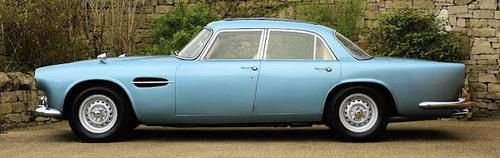
The Rapide used a 4.0 L straight-6 engine, which would later be used in the Aston Martin DB5. Other new features included a de Dion tube rear suspension which would find its way into the Aston Martin DBS.
The Rapide's body was designed by Carrozzeria Touring in Milan to detailed specifications by David Brown. At Brown's request, the car received tailfins and a cowl-shaped grille , reminiscent of the Edsel . The front end featured twin headlights, staggered and reproducing a motif called 'Chinese Eyes', popular at the time and found on cars as diverse as the Triumph Herald and the Mulliner Park Ward special edition Rolls-Royce Silver Cloud III found.
The Lagonda Rapide was introduced to the public in the summer of 1961 and was priced at £4950. It was about the same price as a Bristol 407 and was one of the most expensive cars of British origin. It remained on offer until 1965. During this time, 55 copies were made, which differed greatly in detail in order to take customer wishes into account as much as possible. Eight vehicles were left-hand drive. At least one copy was subsequently converted to a five-door Shooting Brake ; Manufacturer is "the Carrosserie Company Ltd." (rather than the Radford company , which also converted a number of Aston Martin DB5s and DB6s into Shooting Brakes in the 1960s).

The car had dual circuit, servo assisted disc brakes, and most cars were supplied with a 3-speed automatic gearbox. The exterior body panels were constructed from aluminium alloy over a Superleggera tubular steel frame. The interior was upholstered in leather and had a burled walnut dashboard.
Technically, the Rapide was based on the chassis of the Aston Martin DB4 , whose wheelbase had been extended by 400 millimeters to 2890 millimeters. A special feature compared to the starting model was the De Dion rear suspension , which was also later used in the Aston Martin DBS . Two engines were available:
The basic engine was a 3995 cc six-cylinder, which was an enlarged version of the engine known from the DB4 (with a displacement of 3.7 liters). The power output was 236 hp at 5000 rpm. This powerplant also later came into the Aston Martin DB5 .
Alternatively, the Rapide could be fitted with the (still) 3.7-litre Aston Martin DB4 Vantage engine, which featured a revised cylinder head and was fed by three carburettors; its power was 266 hp.
A three-speed automatic transmission from BorgWarner was installed as standard; the four-speed gearbox of the Aston Martin DB4 was also available on request.
The car, which weighed a total of two tons, was very luxuriously equipped. Leather upholstery, power windows, radio and picnic tables in the front seatbacks were standard equipment.

The car was built to order only and quite costly at £4,950. However, 55 vehicles were produced. Of the 55 vehicles manufactured, 48 are said to still exist today.
PERFORMANCE:
ENGINE CAPACITY: 244.33 cu in, 3995 cu cm;
FUEL CONSUMPTION: 17.6 m imp gal, 14.7 m US gal, 16 1 x 100 km;
MAX SPEED: 128 mph, 206.1 km h
max power (DIN): 236 hp at 5000 rpm
max torque (DIN): 265 1b ft, 36.6 kgm at 4000 rpm
max number of engine rpm: 6000 specific power: 64.4 hp/l
max speed in 1st gear: 52.2 mph, 84 km / h
max speed in 2nd gear: 83.9 mph, 135 km/ h
max speed in 3rd gear: 128 mph, 206.1 km/h
power-weight ratio: 16.1 lb/hp, 7.3 kg; hp
useful load: 1058 1b, 480 kg
speed in direct drive at 1000 rpm: 20.1 mph, 32.4 km/h.

Lagonda 2.6-Litre
 |
|
| Manufacturer | Aston Martin Lagonda |
|---|---|
| Production | 1948–1953 510 produced |
| Class | Luxury car |
| Body style | 4-door saloon 2-door 4-seat drophead coupé |
| Engine | 2.6 L Lagonda I6 |
| Wheelbase | 113.5 in (2,883 mm) |
| Length | 188 in (4,775 mm |
| Width | 68 in (1,727 mm) |
| Height | 61 in (1,549 mm) |
Lagonda 2.6-litre model Built: Feltham, England, from 1949 to 1953
In 1935, Lagonda encountered another of the financial crises which had afflicted them at Staines over the years. As a result, a Receiver was appointed, and control eventually passed to Alan Good, Dick Watney and W.O. Bentley. Thus revived, Lagonda became more stable, though further commercial upheavals took place during the war. Bentley's work on an entirely new car began during the war, and the Postwar Lagonda took recognisable shape by 1945. Not only did this have an interesting cruciform-style chassis frame with all-independent suspension, but it had a brand-new 2.6-litre six-cylinder twin-cam engine designed under W.O.'s personal supervision. In every way, this car was a departure from Lagonda practice of the late 1930s, and was going to need a great deal of capital for tooling. One feature of the prototype, incidentally, was the electro-magnetic Cotal gearbox. Financially, it proved impossible to put the new Lagonda into production (Briggs were originally to have supplied bodies and frames), and Lagonda was sold to David Brown in 1947.
After a great deal more development, and the substitution of a David Brown gearbox, the finalised Lagonda was put on sale in 1948/1949, after an appearance at the first postwar Earls Court Motor Show. Assembly was at the Aston Martin works at Feltham (this firm also having been taken over by David Brown), though engines and transmissions were made at the David Brown factory near Leeds, and the four-door saloon bodies were built at Feltham
By the early 1950s a drophead coupe derivative had been added to the range, and at the 1952 Motor Show the cars became Mark IIS due to a number of mechanical refinements and the use of widened bodies. However, by this time the original Lagonda styling, conceived in 1944/1945 to modified pre-war themes, was beginning to look somewhat dated, and it was also time to consider a performance boost.
Accordingly, production of 2.6-litre cars ran out after 550 examples had been built.
Specification
Engine and transmission: Six-cylinders, in-line, with twin overhead camshaft cylinder head. Bore, stroke and capacity (2.6-litre version) 78 90mm., 2580cc. Maximum power 105bhp (net) at 5000rpm.•, maximum torque 1331b.ft. at 3000rpm.
Chassis: Front engine, rear drive. Separate steel chassis frame, of cruciform layout, with I-section main members. Independent front suspension by coil springs and wishbones. Rack and pinion steering. Independent rear suspension by longitudinal torsion bars, and semi-trailing links. Four-wheel drum brakes.
Bodywork: Coachbuilt body styles, in two types. 1947-1953 models with wood framing, and light-alloy skin panels, in four-door four-seater saloon, two-door four-seater saloon, or two-door four-seater drophead coupe styles, by Aston Martin and Tickford. Length 15ft. 8in.; width 5ft. 8in.; height 5ft. 2in. (coupe 5ft. 4in.). Unladen weight (saloon) 33451b. (coupe) 34101b.
Performance: (2.6-litre saloon): Maximum speed 91mph. 0-60mph 18.2sec. Typical fuel consumption 19mpg. (2.6-litre coupe): Maximum speed 84mph. 0-60mph 18.8sec. Typical fuel consumption 19mpg.
In Film and Television
Lagonda 2.6 Litre in The Spanish Prisoner, Movie from 1997

Lagonda car history
 |
|
|---|---|
| Product type | Automotive marque |
| Owner | Aston Martin |
| Country | United Kingdom |
| Introduced | 1906 |
History
Lagonda was founded as a company in 1906 in Staines, Middlesex, by an American, Wilbur Gunn (1859–1920),a former opera singer of Scottish ancestry. He named the company after Lagonda Creek near Springfield, Ohio, the town of his birth. He had originally built motorcycles on a small scale in the garden of his house in Staines with reasonable success including a win on the 1905 London—Edinburgh trial. In 1907 he launched his first car, the 20 hp, 6-cylinder Torpedo, which he used to win the Moscow–St. Petersburg trial of 1910.This success produced a healthy order for exports to Russia which continued until 1914. In the pre-war period Lagonda also made an advanced small car, the 11.1 with a four-cylinder 1000 cc engine, which featured an anti-roll bar and a rivetted monocoque body and the first ever fly-off handbrake.
The ratchet control button on the end of a fly-off handbrake is designed to work in the opposite way to what is normally accepted. If the lever is lifted or pulled back to the "on" position, on letting go it immediately releases unless the end button is pressed and held in place before letting go of the lever. Once set, the brake is released by lifting the handbrake lever (not pushing the button) in the setting direction (up or back). This mechanism was traditionally fitted to sports cars to facilitate a racing get-away, such as at traffic lights. It can also be used to help the back wheels to slide, without the worry of the ratchet leaving the brake on.
During World War I Lagonda made artillery shells.
Between the wars
After the end of the war the 11.1 continued with a larger 1400-cc engine and standard electric lighting as the 11.9 until 1923 and the updated 12 until 1926. Following Wilbur Gunn's death in 1920, three existing directors headed by Colin Parbury took charge.The first of the company's sports models was launched in 1925 as the 14/60 with a twin-cam 1954-cc 4-cylinder engine and hemispherical combustion chambers. The car was designed by Arthur Davidson who had come from Lea-Francis. A higher output engine came in 1927 with the 2-litre Speed Model which could be had supercharged in 1930. A lengthened chassis version, the 16/65, with 6-cylinder 2.4-litre engine, was available from 1926 to 1930. The final car of the 1920s was the 3-litre using a 2931-cc 6-cylinder engine. This continued until 1933 when the engine grew to 3181 cc and was also available with a complex 8-speed Maybach transmission as the Selector Special.
A new model for 1933 was the 16–80 using a 2-litre Crossley engine with pre-selector gearbox from 1934. A new small car, the Rapier came along in 1934 with 1104-cc engine and pre-selector gearbox. This lasted until 1935 but more were made until 1938 by a separate company, David Napier and Son of Hammersmith, London. At the other extreme was the near 100 mph, 4.5-litre M45 with Meadows-supplied 6-cylinder 4467-cc engine. An out and out sporting version the M45R Rapide, with tuned M45 engine and a shorter chassis achieved a controversial Le Mans victory in 1935. Also in 1935 the 3-litre grew to a 3.5-litre.
All was not well financially and the receiver was called in 1935,but the company was bought by Alan P. Good, who just outbid Rolls-Royce. He also persuaded W. O. Bentley to leave Rolls-Royce and join Lagonda as designer along with many of his racing department staff. The 4.5-litre range now became the LG45 with lower but heavier bodies and also available in LG45R Rapide form. The LG45 came in 3 versions known as Sanction 1, 2 and 3 each with more Bentley touches to the engine. In 1938 the LG6 with independent front suspension by torsion bar and hydraulic brakes came in.
Bentley's masterpiece the V12 was launched in 1937. Along with ex-Rolls Roycers Stuart Tresillian and Charles Sewell, and design genius Frank Feeley, W.O. swallowed his distaste for the primitive conditions of Lagonda's factory, and got to work on the new engine that was to become his masterpiece, the V-12. The 4480-cc engine delivered 180 bhp and was said to be capable of going from 7 to 105 mph in top gear and to rev to 5000 rpm. The car was exhibited at the 1939 New York Motor Show: "The highest price car in the show this year is tagged $8,900. It is a Lagonda, known as the "Rapide" model, imported from England. The power plant is a twelve-cylinder V engine developing 200 horsepower."
Lagonda at war
Richard Watney was managing director of Lagonda at the start of the Second World War:
"He was Rootes' retail sales manager for the London area until 1935, when he became managing director of Lagonda, Ltd. He is a production expert, who during the war organised and controlled for Lagonda one of the largest British gun production plants, and also plants which produced 50,000 25 lb shells a day. Watney also developed and produced the "Crocodile" and "Wasp" flame-throwing equipment for armoured vehicles."
Watney finished second at Le Mans in 1930 driving a Bentley. He returned to Rootes in 1946, and posted to Australia, was killed in a car accident in Melbourne in 1949.
Aston Martin ownership
In 1947 the company was taken over by David Brown and moved in with Aston Martin, which he had also bought, in Feltham, Middlesex. The old Staines works at Egham Hythe passed to Petters Limited, in which A.P. Good had acquired the controlling interest. Production restarted with the last model from W. O. Bentley, the 1948 2.6-Litre with new chassis featuring fully independent suspension. Its new 2580 cc twin overhead cam straight 6 became the basis for the Aston Martin engines of the 1950s. The engine grew to 3 litres in 1953 and continued to be available until 1958.
Many thought that the marque had disappeared but in 1961 the Rapide name was resurrected with aluminium body by Carrozzeria Touring of Milan and 3995 cc engine capable of taking the car to 125 mph. By this time, Aston Martin-Lagonda as it now was, had moved to Newport Pagnell in Buckinghamshire. The Rapide lasted until 1965.
Between 1974 and 1976, seven Lagonda saloons were produced on the basis of the Aston Martin V8.
One more car was to appear with the large and futuristic Aston Martin Lagonda of 1976 designed by William Towns. This low, rather square, wedge shaped car was built on Aston Martin V8 components and was available, at least in theory, until 1989.
Aston Martin produced a concept car called the Lagonda Vignale at the 1993 Geneva motor show.
During 1993–1994, a handful of Lagonda 4-door saloons and shooting brakes were built on the basis of the Aston Martin Virage. They could be ordered with the 5.3 litre V8 (310 HP) or the 6.3 litre V8 (500 HP). Production numbers Lagonda Saloon (8 or 9 cars), Lagonda Shooting Brake 5-doors (1 or 2 cars).

1949 Lagonda 2.5 Litre Coup
Revival
Aston Martin said on 1 September 2008, as reported by Automotive News Europe that it will relaunch its Lagonda brand to help it expand into new markets such as luxury sedans and celebrate Lagonda's centennial anniversary in 2009.
"The Lagonda brand would allow us to develop cars which can have a different character than a sports car," said CEO Ulrich Bez in a statement. "Lagonda will have its own niche with luxurious and truly versatile products suitable for both existing and emerging markets".
"Lagonda models would be vehicles that could be used all year round in markets such as Russia where specialized sports cars such as Aston Martins could only be used for three or four months each year", said Aston Martin spokeswoman Janette Green.
The Rapide name was revived in 2010 as the Aston Martin Rapide saloon.
Aston Martin confirmed the revival of the Lagonda brand on 9 March 2011. The new range will initially consist primarily of high-end SUVs.
Lagonda concept
At the 2009 Geneva Motor Show, Aston Martin unveiled a 4WD, 4-seat SUV to commemorate the 100th anniversary of the first Lagonda car. It includes a V12 engine and 22-inch wheels.

