
Ligier
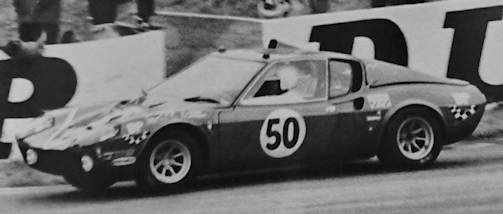
Ligier JS1 Racing sports car
 |
|
|
Production period: |
1969 to 1970 |
|
Class: |
Race Car |
|
Body versions: |
Coupe |
|
Engines: |
Ford various |
|
Length: |
155.51 in, 3,950 mm |
|
Width: |
66.14 in, 1,680 mm |
|
Wheelbase: |
90.55 in. 2.300 mm |
|
Dry weight: |
1,323 lb. 600 kg |
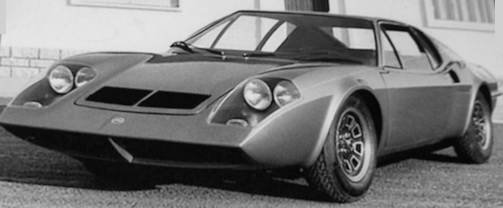
The Ligier JS1 was a racing sports car, built in 1969 by Ligier and 1969 and 1970.
History
The JS1 was presented in September 1969 at the Paris Motor Show. The car was a mid-engine racing car with a tubular frame. The racing prototype built by the French driver Guy Lgier as the basis of a limited production of high-performance touring cars gears the initials JS in memory of his close friend, the racing driver Jo Schlesser, who died tragically.
The body made of fiberglass-reinforced plastic had been developed by Pietro Frua. The Chassis a tubular frame with sheet reinforcements and independent front and rear suspension Guy Ligier himself raced in 1969 with the 1.6-liter variant a first race, but fell out at the national event with bearing damage.
The commercial version for sale has a Ford engine with larger V6 capacity of 2,500 cc but the race version a four-cylinder highly tuned Ford Cosworth for racing Originally a 1.6-liter Cosworth engine was installed, which was replaced in 1970 by a Cosworth FVC. This increased the engine output from 220 to 240 hp (164 to 184 kW).
Ligier won in 1970 with the JS1 sports car race in Albi and Montlhéry, before the team came for the first time to the 24-hour race at Le Mans. The 1970 race marks Ligier's entry into international motorsport. As a partner, Jean-Claude Andruet was obliged, who already had some success in racing. The duo qualified the car in 13th place and was among the top ten in the overall standings when the race had to be abandoned after eight hours due to persistent problems with the ignition distributor.
At the Tour de France for automobiles in 1970 Ligier sat two factory cars. Both cars received new engines. A vehicle received a 2.6-liter V6 engine from a Ford Capri, the second car was equipped with a 2.4-liter Weslake. Both cars failed, however.
Ligier built only three JS1, since 1970 was already working on the successor model, the JS2. A car has been exemplary restored and is since 2004 repeatedly seen at events for historic racing cars. The JS1 was the first race car built at Ligier. Already in 1968, Guy Ligier had the idea to develop a sports car based on the Porsche 911. But only the former Renault technician Michel Tetu, who came to Ligier in 1969, brought the project to work
Ligier JS2
 |
|
|
Production period: |
1970 to 1975 |
|
Class: |
sports car |
|
Body versions: |
Coupe |
|
Engines: |
Gasoline: 2.6-3.0 litres |
|
Length: |
4167.32 in, 4,250 mm |
|
Width: |
67.72 in, 1,720 mm |
|
Height: |
45.28 in, 1,150 mm |
|
Wheelbase: |
95.52 in, 2,350 mm |
| Ground clearance: |
5.51 in, 140 mm |
|
Curb weight: |
960-980 kg |
The Ligier JS2 was a 1970s French sports car that was built between 1970 and 1975 by Ligier.
History
The JS2 was the successor of the JS1 and was presented to the public in October 1970 at the 57th Paris Motor Show.The bodywork by Frua the car went into production in 1971. The vehicle was a proper construction of Ligier and was a mid-engine road car with a V6 engine from Maserati. The JS2 had a platform frame made of pressed steel and a polyester body.Other components and tail-lights were sourced from French brands such as Citroën and Peugeot.
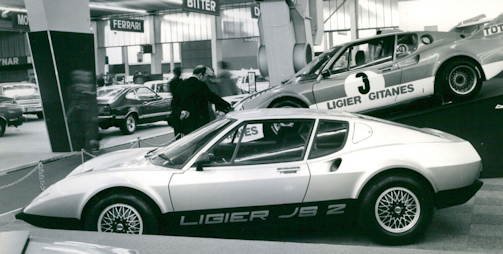
The JS2 had independent wheel suspensions on triangular wishbones on all four wheels and anti-roll bars front and rear. With rack and pinion steering.
The Maserati V6 light alloy cylinder block and head engine made 170 hp and accelerated the car to a maximum of 150 mph, 242 km/h with Weber 42 DCNF downdraught twin barrel carburettors.Quick even for those times, the JS2 consumed 24 litres per 100 km of fuel with 5 speed fully synchronized gearbox with limited slip differential optional .
PERFORMANCE: V6 2,670 cc
- Max speed: 150 mph, 242 km/h
- Max power (DIN): 170 hp at 5,500 rpm
- Max torque (DIN): 170 1b ft, 23.5 kg m at 4,000 rpm
- Max engine rpm: 6,000 64.4 hp/l
- power-weight ratio: 11 lb/hp, 5 kg/hp
- fuel consumption: 17.7 m/ imp gal, 14.7 m/ US gal
By 1973 the JS2 received a larger Maserati C114 engine which increased the displacement to 2965 cc
PERFORMANCE: 2,965 cc
- Max speed: 153 mph, 247 km/h
- Max power (DIN): 195 hp at 5,500 rpm
- Max torque (DIN): 178 1b ft, 24.5 kg m at 4,000 rpm
- Max engine rpm: 6,000; 65.8 hp/l
- power-weight ratio: 10.8 lb/hp, 4.9 kg/hp
- speed in top at 1,000 rpm: 21.7 mph, 35 km/h
- fuel consumption: 17.7 m/ imp gal, 14.7 m/US gal
Race versions
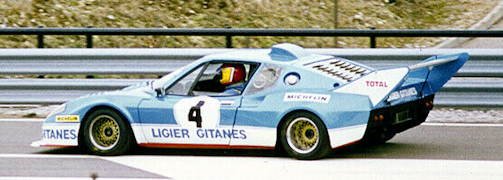
In 1972, the first racing version for the 24 Hours of Le Mans was constructed. The engine used was a 2.7-liter V6 engine from Maserati, which was already used in the Citroën SM. This replaced also in the road from 1972 Ford engine. The racing engine had a 4-way crankshaft, a cylinder head with two overhead camshafts and 24 valves (unlike the road-only engine, which had only 12 valves). At Le Mans, three vehicles were used, two works cars and one by Claude Laurent Privately used car with a 3.0-liter engine. All three race cars fell out due to engine damage, the works cars of Pierre Maublanc and Jacques Laffite held until the last hour of racing through.
In 1973, the JS2 of Laurent achieved the first goal finish in 19th place, the two works cars fell out again. 1974 saw the first arrival of a factory car, the vehicle of Laffite and Alain Serpaggi reached the ninth overall place. In the Tour de France for automobiles there was a double victory for the JS2 in the same year. The winner was Gerard Larrousse - of the control with Jean-Pierre Nicolas said - before a second JS2, the Bernard Darniche piloted.
The biggest success of the car was achieved at the 24 Hours of Le Mans in 1975, when the works car with Jean-Louis Lafosse / Guy Chasseuil at the wheel, a long duel with the two Gulf GR8, driven by Jacky Ickx / Derek Bell and Vern Schuppan / Jean-Pierre Jaussaud delivered. In the end, Lafosse / Chasseuil had to defeat the GR8 of Ickx / Bell with only one lap back.
By the end of production in 1975 a revised Series 2 was built in limited numbers, at the end of 1975, the production of JS2 was discontinued. According to the factory specification, 225 copies were built including the racing versions.

