
Lincoln
Lincoln Versailles
 |
|
|
Production period: |
1977 to 1980 |
|
Class : |
Luxury |
|
Body versions : |
lsedan |
|
Engines: |
5.0-5.8 liters (97-101 kW) |
|
Length: |
5098 mm |
|
Width: |
1892 mm |
|
Height: |
1374 mm |
|
Wheelbase: |
2791 mm |
|
Curb weight : |
1658-1721 kg |
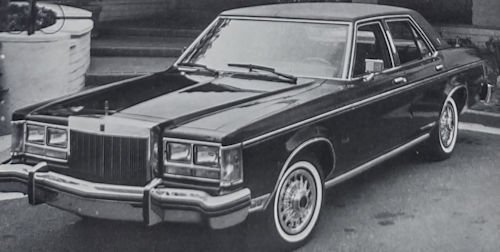
The Lincoln Versailles was a car model produced by the American car manufacturer Ford from 1977 to 1980 , which was marketed under the brand name Lincoln . The Versailles was a reaction of the Ford Group to the success of the Cadillac Seville . This was positioned in the same market segment, but far less successful than his rival General Motors .
The first oil crisis in the mid-1970s in the US led to increased interest in smaller but well-equipped vehicles. From 1975 with the Cadillac Seville for the first time a domestic construction in this segment. The Seville was, according to the American understanding, a compact vehicle. The first, from the Chevrolet Nova derived generation of this model was very successful in the market. The Ford Group owned competing Lincoln could initially oppose the Seville nothing. However, the Ford managers recognized the potential of this market niche. In early 1976, the decision was made to start a brand-name vehicle against the Seville.
History
Due to time constraints and to limit the financial risk, a completely new vehicle has not been developed; Rather, the Versailles based on the one and a half years previously introduced mid-size model Ford Granada or its identical luxury version Mercury Monarch . Unlike the Cadillac Seville, which had a completely independent body, the Lincoln Versailles basically took over the construction of the Ford Granada: passenger compartment, doors and glazing of both models were completely identical. The stylistic deviations concerned only the front and the rear end. The designer's goal was to make little Lincoln look like a Continental - at that time the brand's full-size model Accordingly, the Versailles offered some Lincoln-typical design elements. This was especially true for the radiator grille and for the trunk lid , which contained a simulated spare wheel cover, which followed a design tradition of the Lincoln Mark Series . At the front end of the Versailles wore four square halogen headlights with underlying units for turn signals and parking lights. Unlike the big Lincoln models, they were not hiding behind flaps when they were resting.
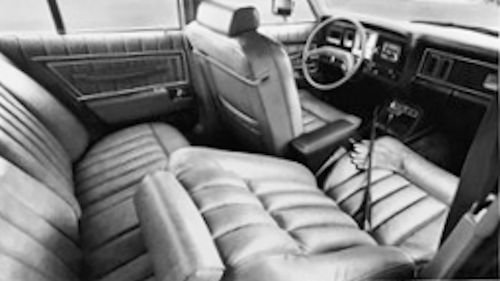
Despite these stylistic changes, the Ford relationship was clearly visible. The equipment was correspondingly extensive at the high price of 11,500 USD. Including a lushly upholstered vinyl roof , forged aluminum wheels, metallic paint, leather-covered dashboard, Cartier watch and a stereo radio included. The drive took over a 5.8-liter V8 with double carburetor and a three-speed automatic transmission . The chassis was kept rather simple with the rear axle . The factory attached great importance to extensive measures aimed at ensuring a high quality of workmanship.
In 1978, the 5.8-liter V8 gave way to a slightly more fuel-efficient, but significantly weaker 5.0-liter V8 (133 hp , first US engine with electronic engine management ), in addition there were changes to the color palette and on request .
PERFORMANCE
max power (DIN): 133 hp at 3,600 rpm
max torque (DIN): 243 1b ft, 33.5 kg m at 1,600 rpm
max engine rpm: 4,000
max speed: about 108 mph, 174 power-weight ratio: 28.3 lb/hp, 12.8 kg/hp
consumption: 21.6 m/imp gal, 18 m/US gal, 13.1 1 x 100 km.
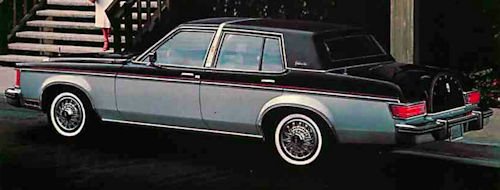
In 1979, further changes were made. A revised, 20 cm longer roof with a wider, steeper standing C-pillar increased the optical distance to the Granada. As the first car in the US, the Versailles received standard halogen headlights .
A new starter and an improved jack marked the last model year (1980) of the Versailles. In addition, there were five new colors for the body and three new colors for the vinyl roof.
Despite good reviews of the press, the Lincoln Versailles was unsuccessful, as the customers were deterred by his too clear affinity to the American Ford Granada and its sister model Mercury Monarch . One point of criticism was that the interior was just as inferior as in the original Ford model.
OPTIONAL
limited slip differential, central lever; tilt steering wheel; reclining backrests: heated rear window: leather upholstery: electric sunshine roof; vinyl roof.
Production
The Lincoln Versailles, like the Ford Granada and the Mercury Monarch, was manufactured at Ford's Wayne Stamping and Assembly Plant in Wayne , Michigan . In four years created 50,156 copies. The production is distributed as follows:
- 1977: 15.434
- 1978: 8,931
- 1979: 21.007
- 1980: 4.784
Successor
Since the late 1970s, Ford developed a technically independent successor to the Versailles. Some early design concepts had pop-up headlamps and conspicuously modeled cooling bezels . These projects were abandoned for financial reasons. The successor to the Versailles was instead introduced to the model year in 1982 Continental , which - unlike the earlier models of the same name - was not a full-size sedan, but a compact four-door by American standards. Although the new Continental was again closely related to a Ford model, he had a completely independent body, the former fashion of the Hooper Hecks followed.
Lincoln premiere Second generation
 |
|
|
Model years |
1958 to 1960 |
|
Assembly |
USA |
|
Designer |
John Najjar |
|
Body style |
2-door hardtop |
|
Engine |
430 cu in (7.0 L) MEL V8 |
|
Transmission |
3-speed Turbo-Drive automatic |
|
Wheelbase |
131.0 in |
|
Length |
227.2 in - 229.0 in |
|
Width |
80.1 in - 80.3 in |
|
Height |
56.5 in - 56.7 in |
|
Curb weight |
4,900–5,200 lb (2,200–2,400 kg) |
The Lincoln Premiere was a luxury car that was manufactured by Lincoln in the model years 1956-1960 .
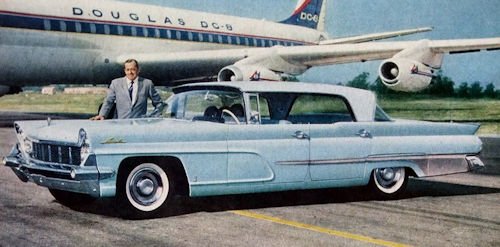
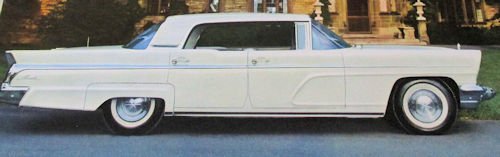
For the model year 1958, the Lincoln Premiere was completely redesigned. Instead of the previous separate frame, the vehicle now had a self-supporting body . The premiere was much longer. Its wheelbase grew to 3327 mm; the outside length increased by 125 mm. The body was completely redesigned. The grille was a bit higher, and the twin headlights were tilted. New were the sharp-cut tail fins. To adequately power the larger and heavier cars, there was a larger 7046 cc engine producing 375 bhp (276 kW) at 4800 rpm.
The model range of the premiere was limited from 1958 to a four-door sedan and a two-door coupe. The convertible was no longer offered from 1958.
For the model years 1959 and 1960, the construction of the premiere was essentially unchanged. The body was preserved; the modifications were limited to lateral trim on the fenders (1959) and new front bumpers (1960). These were round chromed bumper design.
The power of the otherwise unchanged engines was reduced in 1959 to 350 SAE - PS and 1960 to 315 hp.
The premiere occupied from 1958 the middle place in the brand hierarchy. New top model was the Continental Mark III , which was technically identical to the premiere and also used the same body, but was much better equipped. The Mark III was officially marketed not as Lincoln, but as Continental. 1959 was the top model Lincoln Continental Mark IV and 1960 Lincoln Continental Mark V . They maintained their fundamental agreement with the premiere during this time.
From 1961 there were no longer the two simpler equipped series Capri and Premiere. Only the Lincoln Continental was offered, which had a completely different body.
Lincoln Premiere First generation
 |
|
|
Model years |
1956 to 1957 |
|
Assembly |
USA |
|
Body style |
2-door hardtop, convertible |
|
Engine |
368 cu in (6.0 L) Lincoln Y-block V8 |
|
Transmission |
3-speed Turbo-Drive automatic |
|
Wheelbase |
126.0 in (3,200 mm) |
|
Length |
1956: 223.0 in (5,664 mm) |
|
Width |
1956: 79.9 in (2,029 mm) |
|
Height |
1956: 60.0 in (1,524 mm) |
|
Curb weight |
4,500–4,900 lb (2,000–2,200 kg) |
The Lincoln Premiere was a luxury car that was manufactured by Lincoln in the model years 1956-1960 .
As a starting point for the redesign of the Lincoln vehicles for the year 1956, two concept vehicles. The Mercury 800 and the Lincoln Futura . Both were from Ford's chief designer John Najjar.
The Mercury XM-800 was first shown at the 1954 Chicago Motor Show. In addition to the pioneering design, which influenced generations of automobiles of the Ford Motor Company, the non-functioning car was also constructively interesting, but his body was made of plastic.
Similar to the XM-800, the Lincoln Futura was a pure exhibit that worked, but was never allowed on the road. Bill Schmidt worked with Najjar on at Ghia in Italy handmade metallic white Cabriolet. Equipped with a V8 engine and mounted on a Continental Mark II chassis, the concept car was not only used as a showcar at fairs in 1955, but also had appearances in films.
1956
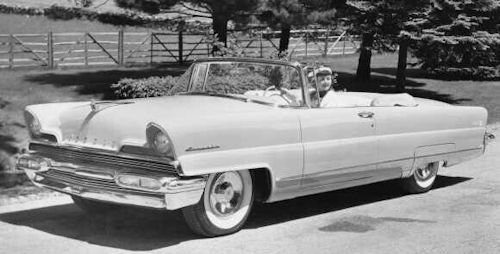
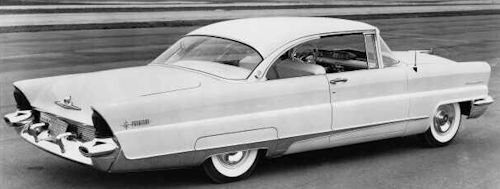
This year, the premiere replaced the Capri as a top model. The cars had been thoroughly revised. The tailfin models now had a front leaning forward, the headlights had received side chrome trim had received a Z-shaped insert at the level of the rear doors. The bodies - a four-door sedan, a two-door hardtop coupe and a two-door convertible - had increased by about 75 mm in length compared to the previous model.
Like its sister models, the premiere had a top -mounted V8 engine with 6030 cc displacement, which developed 285 bhp (210 kW) at 4600 rpm. The engine power was transmitted via a three-stage automatic transmission to the rear wheels.
1957
There are two series : Premiere and Capri each comprising 4-door sedans, 2 and 4-door hardtops and there is a convertible Premiere.
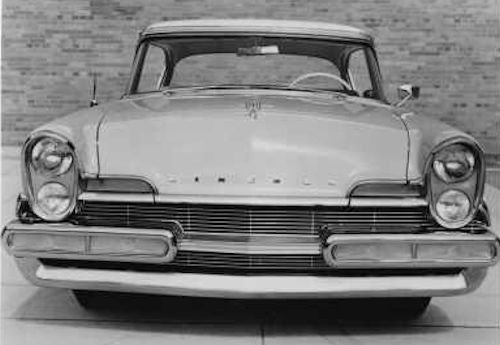
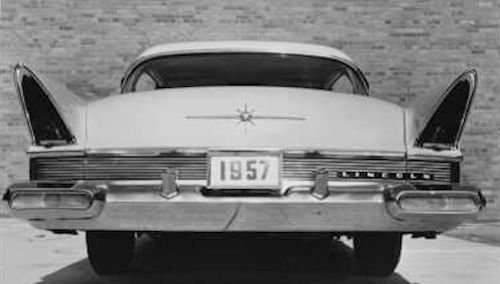
Extensive styling changes include provision for four head lamps, and side lights which Illuminate almost the whole width of the front bumper. Rear fins
are higher and sharper. There is no change in the size of the engine, which is a V-8 of 6,031 c.c., but compression is raised to 10 to 1, combustion chamber and manifolds have been improved, and power is raised to 300 b.h.p. at 4,800 r.p.m., with maximum torque of 415 lb. ft. at 3,000 r.p.m. The four-choke carburetter is redesigned for easier starting and prevention of vapour lock, and there is a new bayonet-fitting throw-away oil filter. Transmission is through a smaller all-steel torque converter with front-mounted oil radiator, and a limited-slip differential is optional.
Adjustable dampers, remote control exterior mirror, electric door locks, safety belts and pedal-controlled radio are optional.
The bodies got a significant revision. Below the main headlights, two additional headlights were used. The tail fins were dramatically increased so that the taillights were inclined at an angle of 30 ° to the rear. The side chrome strips ran straight again, but had integrated a V in the area of the rear fender ends. Front and rear windows were designed as panoramic windows. In addition to the three body styles of the previous year was a four-door hardtop sedan. Electrically adjustable seats, electric windows, power steering and brake booster were standard equipment from this year.
Lincoln Capri 1st Generation
 |
|
|
Production period: |
1952 to 1955 |
|
Class : |
Luxury car |
|
Body versions : |
Saloon , Coupé ,Cabriolet |
|
Engines: |
Gasoline 5.2-5.6 liters |
The Lincoln Capri 1st generation was a car model from the 1950s that was manufactured in the USA by Lincoln the model years over 3 build generations 1952 to 1959 In this case no relation to the Ford capri from Europe .
History
In 1952, the Capri replaced the Cosmopolitan - which, however, was still manufactured - as the top model. The fresher styled vehicles were available as a 4-door sedan, a hardtop coupe and a convertible with 2 doors each. Like its sister models, the Capri had an overhead V8 engine with 5201 cc, the 118 kW (160 bhp) at 3900 / min. developed. The engine power was transmitted via a "Hydramatic" automatic transmission to the rear wheels. While the bodies remain the same in the following year, the engine of the same size now develops 151 kW (205 bhp).
In 1954, the vehicles had increased in size and weight; they were about 25 mm longer and 25 mm wider. There was a large chrome-plated metal V under the Lincoln emblem on the hood. The engine remained the same. In 1955, the styling was slightly revised: The grille lost its chrome crossbar. There was a larger engine: From 5588 cc he drew 165 kW (225 bhp) at 4400 / min.

Continental Mark IV
 |
|
|
Production period: |
1972 to 1976 |
|
Class : |
Luxury Car |
|
Body versions : |
Coupe |
|
Engines: |
Gasoline engines : 7.5 liters |
|
Length: |
5560-5795 mm |
|
Width: |
2025 mm |
|
Height: |
1350 mm |
|
Wheelbase : |
3060 mm |
|
Curb weight : |
2630 kg |
|
previous model |
Continental Mark III |
|
successor |
Continental Mark V |
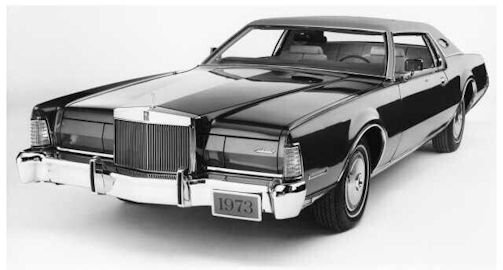
The Continental Mark IV was a full-size vehicle of the American automaker Ford Motor Company , which was produced from 1972 to 1976. It was the second generation of a series of luxury models founded in 1968 with the Continental Mark III, referred to as the Continental Mark Series, positioned above Lincoln's standard models.
Manufacturer of the Continental Mark IV was the Lincoln-Mercury Division of the Ford Motor Company . Like its predecessor Mark III, the Mark IV was also officially marketed as Continental Mark IV . With this model, Ford built on the tradition of the Continental Division , which was an independent subsidiary from 1956 to 1960 and produced high-quality luxury vehicles, including a Continental Mark IV (1959) offered in various body shapes . The reference to the Continental Division was made for marketing purposes to document the exclusivity of the Mark IV.
Misunderstandings exist in so far as Lincoln used the term Continental (without the suffix "Mark") since 1961 additionally as a pure model name for some of his models. These vehicles, which were positioned below the Continental Mark series, were given the brand name Lincoln and were called Lincoln Continental. Technically (except in the case of the later Mark VI) they had nothing to do with the Continental Mark models.
History
The Continental Mark IV was technically closely related to the 1972 Ford Thunderbird . Both vehicles used the same ladder frame and the same chassis. Externally, however, the Thunderbird and the Mark IV differed significantly.
The Mark IV took over the main design features of the Mark III: The body structure of the Mark IV again followed the "Long Nose Short Deck" pattern. The hood of the Mark IV was even longer than the Mark III, and the rear end was shorter again. The imitated spare wheel cover in the trunk lid was retained as well as the designed after Rolls-Royce front grille grille; the latter, however, became narrower. In the first model year of the Mark IV, the front bumpers were partially lowered to allow a higher grille. By the model year 1973 wide, heavy safety bumpers were introduced, which ran horizontally and no more depression allowed. The grille then became significantly lower. With the Mark IV Lincoln led the so-called " Opera Window"An, an oval window in the C-pillar. The Opera Window was an extra charge in the first model year. The buyers appreciated this detail very much, so it was from 1973 to the standard equipment. The Opera Window remained until Mark VI a distinctive feature of the Mark Series; only the later, emphatically aerodynamically designed models Mark VII and Mark VIII renounced this detail.
The drive technology remained unchanged. Lincoln continued to use the 7.5-liter eight-cylinder engine, whose performance was nominally reduced by switching to a modified, now net-worth, metering system. In 1972, the output was 212 SAE-PS, 1973 it was 208 hp, in 1974 220 hp, 1975 only 194 hp and 1976 then 202 hp. The fluctuations were due to changing exhaust emissions, to which Lincoln responded by adjusting engine performance. The power reductions were achieved by a relatively small carburetor and a correspondingly small-sized intake manifold. With restrained driving was then in theory an average consumption of about 18 liters per 100 kilometers in the third mix possible; However, German measurements showed an average consumption of 24 to 26 liters per 100 kilometers. However, the power reduction could be bypassed without much effort. By comparatively small interventions the engines could develop a performance of over 450 DIN-PS in a wide speed range.
Overall, the Continental Mark IV was a very big and heavy car. Like its predecessor, it was heavier than Lincoln's standard models. Although the Mark IV had grown significantly in the outside dimensions, he offered less passenger and trunk than the Mark III. This was due to the shortening of the passenger compartment. Due to the high lead frame also reduced the headroom. The passengers therefore had to take a strongly inclined attitude in the car. The trunk was dominated by the recumbent spare wheel, which led American correspondents to the assessment that he was "only limited use".
The American car manufacturer Clénet Coachworks built between 1977 and 1979 on the chassis of the Continental Mark IV, the Clénet Series I , a retro-style roadster, which used the passenger compartment of MG Midget .
Designer Series
For model year 1976 Lincoln introduced special trim levels associated with the names of certain fashion designers. The idea of a special designer variant goes back to the American Motors Corporation , which introduced a Hornet "Gucci" in 1971.Lincoln offered 1976 Mark IV versions of Bill Blass , Cartier , Hubert de Givenchy and Emilio Pucci on. The versions each had an independent painting and a special interior:
- The Mark IV by Bill Blass was painted dark blue and had a cream vinyl roof and cream-colored side stripes. The interior used blue velor or genuine blue leather. The surcharge for the Bill Blass version was $ 1500 (leather) or $ 2000 (suede).
- Cartier designed the Mark IV "very conservative" outside and inside in dove gray. In addition, red and white vinyl accent stripes came on the sides of the car. The surcharge for the Cartier version was the Bill Blass variant.
- The Givenchy version of the Mark IV was painted turquoise and wore a white vinyl roof. The interior was also kept in turquoise. The wood of the dashboard deviated from the standard version: Instead of the walnut wood paneling, light ash wood was used. The surcharge for the Givenchy version was 1500 euros (leather or velor finish).
- Emilio Pucci's Mark IV version was painted a dark red and was connected to a silver vinyl roof. The surcharge corresponded to the Bill Blass variant.
Distribution
The Continental Mark IV achieved higher sales than the Continental Mark III. He was in the years 1972 to 1976 Lincoln's most successful single model; In some years, twice as many Mark IVs were sold as Lincoln Continentals. The Mark IV also beat the cumbersome Cadillac Eldorado , which was located in the same market niche.
Production of the Mark IV was distributed over the model years 1972 to 1976 as follows (for comparison next to the production figures for the Cadillac Eldorado Coupe and Convertible):

