
Kia
Kia Retona
 |
|
|
Production period: |
1997-2001 |
|
Class: |
off road |
|
Body versions: |
SUV station wagon |
|
Engines: |
Gasoline : 2.0 litres (100 kW) |
|
Length: |
4000 mm |
|
Width: |
1745 mm |
|
Height: |
1835-1895 mm |
|
Wheelbase: |
2360 mm |
|
Curb weight: |
1490-1518 kg |
The Kia Retona is an off-road vehicle of the Korean manufacturer Kia Motors from the late 1990s.
History
Kia led the first presented in 1997 as the successor to the Asia Rocsta Retona, initially only in the variant with four-cylinder turbo diesel and five-speed manual transmission. In the middle of 2000, a gasoline engine with the same capacity was replaced, and in early 2001 the model was discontinued without a direct successor. It is the civilian version of the Korean military jeep built on the same chassis as the Kia Sportage. The name Retona stands for Return to Nature. Main competitors of the Kia Retona were the Suzuki Jimny and the Lada Niva.
Four-wheel drive
In normal road operation (two-wheel drive), the front wheels are disconnected from the drive train. This avoids unwanted wear of the front drive train and increased fuel consumption. The separation is done by freewheel hubs. The locking of the freewheel hubs is done either automatically or manually.
The automatic freewheel hubs work either with negative pressure or mechanically. For automatic freewheel hubs, after the four-wheel drive has been switched off, it must be moved backwards to reactivate the freewheel. This is not necessary with the pneumatic freewheel hubs controlled by negative pressure.
With manual freewheel hubs, the freewheel must be switched on or unlocked directly at the wheel hub before switching on and after switching off the four-wheel drive.
- 1997 Presentation of the Kia Retona as successor to the Asia Rocsta
- 2000 May: Introduction of 2.0-liter 16V petrol engine with 101 kW (137 hp)
- 2001 January: Production stopped without a direct successor

Asia Rocsta Jeep
 |
|
|
Production period: |
1990 to 1999 |
|
Class: |
Off road |
|
Body versions: |
Jeep Cabriolet |
|
Engines: |
Gasoline :1.8 litres (57 kW) |
|
Length: |
3580-4190 mm |
|
Width: |
1690 mm |
|
Height: |
1820-1850 mm |
|
Wheelbase: |
2130-2730 mm |
|
Curb weight: |
1220-1280 kg |
The Asia Rocsta is an off-road vehicle from South Korea from Asia Motors a subsidiary of Kia Motors built in the 1990s
History
Since March 1990, the Rocsta 102, so the official name, in the Korean Gwangju produced. Asia Motors, a wholly owned subsidiary of Kia Motors, produces mainly military and commercial vehicles and has been part of the Kia Group since 1976. Jeep-like workhorse all-roader. Instant change between two- and four-wheel drive and freewheel
hubs for better fuel economy. Tough build quality stemming from its original need to be bullet-proof, excellent off-road performance although basic to the point of crudeness when on normal roads.
The KM 410, a light multi-purpose off-road vehicle for the Korean army, which was fabricated with the old Jeep M38A pressing tools, which explains its similarity to the Jeep. The civil Rocsta 102 was developed on the basis of KM 410. In addition to some technical changes (for example, the use of 1.8-liter Mazda engines instead of the 2.0-liter Kia engines and gearboxes with longer, roadworthy translations) the Rocsta got right steel doors instead of the Jeep-typical door cut-outs, with short or long wheel base and many plastic parts in the interior (for example, dashboard) and on the body (fender flares, side skirts).
In 1991, the Rocsta was first imported to Europe just five months after its launch, the Rocsta - the first Korean 4x4 off-roader in the UK market. First to Italy, from 1993 to Holland and to England. The Rocsta was available only at certain Kia sales outlets, but was still offered by independent retailers. The American Jeep style vehicle introduced with side body
stripes, alloy wheels, front & rear mudflaps, rear lamp guards & tilt adjustable steering: Cloth & Vinyl Uphdlstery, reclining front seats, folding rear, lockable glove box, storage area under seats. Rollover bar (Soft Top only). Rev counter, digital clock, front console & 4 speaker radio cassette.
Both offered with petrol and diesel engines that come from Mazda. The petrol engine is the 1.8-liter engine (F8) from the old Mazda 626 with catalyst and electronically controlled carburettor 78 hp from 1.8 litre capacity. The 2.2-liter diesel engine (R2) comes from the Mazda Bus E2000 or Transporter. The power is 61 hp.Both came with a with five-speed manual transmission.
- Performance: 0-60mph + top speed:
1.8 21 secs/74mph,
2.2 27secs/70mph. - Fuel consumption:
1.8 20-30mpg,
2.2 27-37mpg, diesel.
Performance: 1.8L
- Max power: 57 kW (77hp) 5500/min, 31.9 kW/L (43.3 hp.'L)
- Max torque: 133Nm (13.6 mkp) 3000/min
- Vmax (factory) 127 km/h, @ 1000/min in 5.speed. 29.7 km/h
- Fuel consumption: 10/15 litre 100 km.
Performance: 2.2L diesel
- Vmax (factory) 133 km/h, V 1000rpm in 5th.
- 33.4 km/h; 0-100 km/h 27 sec
- weight/power. 24.9 kg/kW (17.6kg/hp)
- Fuel consumption: 8/12 litres 100 km.
- 53 kW (72 hp)4250/min, 24.3 kW/L (33 hp/L) 144Nm(14.7 mkp) @ 2000/min
- diesel.Maximum power 61/63/65/68/70/72 hp
- MAR 1994 Diesel 2.2 and petrol 1.8 hard and soft top variants diesel soft top in base form only, all other combinations in DX trim level. Prices range from £9500 for base to around £ 10,800 for the others.
- MAY 1994 detachable hard top to replace the soft top, side and front nudge bars, spare wheel cover, sill guards, side steps.
- AUG 1994 new suspension with six leaf springs front and four plus helper springs on the rear. Exisiting owners can have the new system retro-fitted free, indicating just how bad the original was.
The traditional suspension of beam and leaf-spring was later updated to include a new suspension system for the Rocsta which greatly improves the ride comfort both on and off-road with better axle articulation giving more wheel contact in arduous driving.With either a hard or soft-top options in addition to the standard version, there was a "DX" equipment, which included a power steering, a height-adjustable steering wheel, tachometer, clock, centre console, and alloy wheels with tires size 235/75 R 15.In 1998, under the model name Kia Rocsta once again offered a larger batch of 1.8-liter petrol models with air conditioning and closed hardtop.
Features DX
Digital clock Two spoke steering wheel. Front head restraints. Folding rear seat. Adjustable steering column. Rev counter. Centre console. Tilt slide front seats. Xenon cloth Mm. Cloth seat and door trim.
Kia Sportage Third generation Sportage (Type SL)
 |
|
| Production | 2010 to 2015 |
|---|---|
| Body style | 4-door Crossover |
| Engine | 1.6 L I4 GDI petrol 2.0 L I4 petrol 164hp 2.0 L I4 GDI (turbo) 2.4 L I4 petrol 175hp 1.7 L I4 CRDi turbo diesel 2.0 L I4 CRDi turbo diesel |
| Transmission | 6-speed automatic 6-speed manual 5-speed manual |
| Wheelbase | 2,640 mm (103.9 in) |
| Length | 4,445 mm (175.0 in) |
| Width | 1,855 mm (73.0 in) |
| Height | 1,645 mm (64.8 in) |
| Designer(s) | Peter Schreyer |
The third generation of the Kia Sportage was presented at the Geneva Motor Show in March 2010. This is technically identical to the Hyundai ix35 , which is why the Sportage also uses its engines in some cases. It is a 120 kW (163 hp) gasoline engine and a 2.0-liter common rail - diesel engine with 100 kW (136 hp). The diesel version has also been available with 135 kW (184 hp) since model year 2011.
Production began in June 2010 at the Kia plant in Žilina , Slovakia , and the market launch took place in early August 2010. Assembly also in Gwangju Plant, Gwangju, South Korea and Žilina Plant, Žilina, Slovakia Jakarta, Indonesia
The new model is longer, wider and flatter than its predecessor, and the wheelbase has also been lengthened. The design is based on the brand's new style with a large, trapezoidal radiator grille, almond-shaped headlights and a more prominent brand logo.
The light edge in the lower door area and an inwardly curved surface above the rear license plate are also typical of the design. Further characteristics are the exhibited fenders, large fog lights, a wide C-pillar as well as an all-round plastic cladding on the lower edge of the body. The contours of the bonnet are particularly emphasized, and the horizontally arranged rear lights extend into the trunk lid.
In 2011 the Sportage as well as the Kia Optima and the Peugeot 508 I received the red dot design award .
In spring 2014, the Sportage received a facelift . There were changes to the front design, taillights with LED technology, changes in the interior and on the chassis.
The 2011 Kia Sportage was released in April 2010 to Asian and European markets, followed by North and Central American markets in August. Australian models were released in October 2010. It currently uses a 2.0L CRDi 136 and 184 hp (137 kW) Hyundai R diesel engine. The engine is the same one used in the Hyundai Sonata 2.0T.
In China, the third generation, called the Sportage R, was released by Dongfeng-Yueda-Kia in October 2010, and to be built and marketed alongside the previous generation rather than as a replacement of the existing model.
The 3rd generation Kia Sportage, designed by Peter Schreyer, awarded 'Top Safety Pick' from the Insurance Institute for Highway Safety (IIHS) in the United States.In the Euro NCAP crash test in November 2010, a full 5 stars the Kia Sportage received 33 points for occupant protection, 42 points for child protection and 18 points for pedestrian protection. According to the institute, this makes it the safest car in its class.
In 2010 when IIHS added the rollover crash test, which measures roof strength and is twice as stringent as the federal requirement. To pass this test, a vehicle’s roof must be able to withstand the force of three times the vehicle’s weight (acceptable rating). The federal standard requires a roof to hold 1.5 times the vehicle’s weight
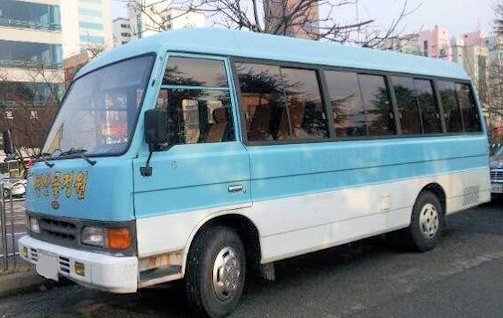
Kia Asia Combi Bus
 |
|
|
Manufacturer |
Kia Motors |
|
Class |
Commercial vehicle |
|
design type |
minibus |
|
Production period |
1984 to 2002 |
|
axes |
2 |
|
engine |
3296 cc Hyundai D4AL TD I4, 3907 cc Hyundai D4DA TD I4, 2977 cc Mazda HA Diesel I4, 4052 cc Mazda ZB Diesel I6 |
|
length |
6.3 m |
|
width |
2 m |
|
height |
2.68 m |
|
wheelbase |
4015 mm |
|
successor |
Hyundai County |
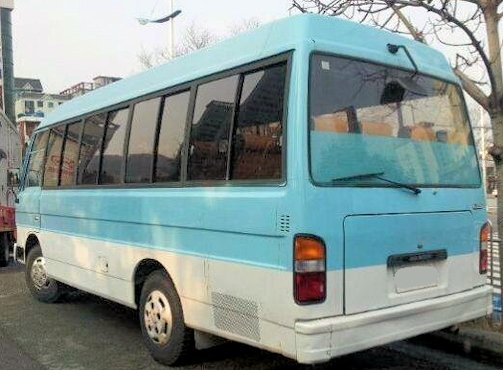
The Kia Combi, originally marketed as Asia Motors Combi, was a minibus series built between 1983 and 2002 by Asia Motors and Kia Motors.
History
Built first as the Asia Combi series for the launch of the 24-seater version Asia Motors AM805 / 807 Combi most copies came with the Mazda z.B. six-cylinder diesel engine with 4052 cc. This engine produced 100 hp (74 kW) at 3,600 rpm. Since Mazda was at that time cooperation partner of Asia / Kia, the model was based on the Mazda Parkway or Mazda Titan. 1990 was a facelift of the front with new twin headlights.
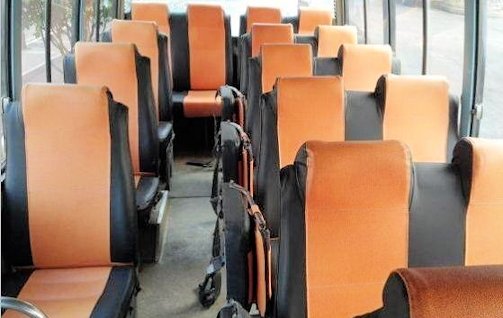
In 1996, after the cooperation with Mazda ended, Kia entered into a supply agreement with Hyundai for the supply of smaller four-cylinder Hyundai engines. In addition to a redesigned dashboard, there were now the more modern smaller four-cylinder Hyundai diesel engines with more power. The 3.3 L D4AL delivered 120 hp (88 kW) and the 3.9 L D4DA 140 hp (103 kW). Following the merger of Kia and Hyundai in 1999, the Asia Sub brand disappeared until the year 2000, and the model was now offered as a Kia Power Combi, as it had previously been in export markets. Due to stricter emissions regulations in the home market for 2003, the production of the Combi was discontinued without a successor on October 28, 2002.
Kia Sportage First generation
 |
|
| Production | July 1993 to 2004 |
|---|---|
| Assembly | South Korea: Hwaseong, Gyeonggi Germany: Osnabrück Russia: Avtotor Plant, Kaliningrad |
| Body style | 3-door convertible 5-door wagon |
| Layout | Front-engine, rear-wheel drive Front-engine, four-wheel drive |
| Engine | 2.0 L FE I4 (gasoline) 2.0 L FE DOHC I4 (gasoline) 2.0 L RF I4 (diesel) |
| Transmission | 4-speed automatic 5-speed manual |
| Lenght | 4,24 m. |
| Width | 1,73 m. |
| Height | 1,65 m. |
| Kerb weight | 1.494 kg. |
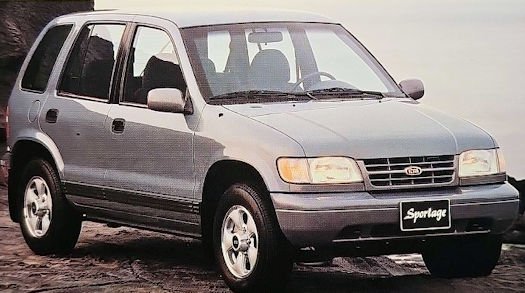
Sportage was sold in either a five-door wagon or a two-door soft-top convertible. Kia initially developed the wagon in standard length form, but in circa 1996, the company released an extended length version. This stretched model—mainly sold in Asian markets under the name "Sportage Grand"—featured a 305 mm (12.0 in) longer body utilising the same wheelbase, an increase in luggage capacity from 1,570 to 2,220 liters (55.4 to 78.4 cu ft), and the relocation of the spare wheel from the tailgate to underneath the floor.
Kia offered three Mazda-sourced engines in the Sportage, beginning with the 2.0-liter FE DOHC inline-four gasoline unit producing 95 kW (128 hp) and the 2.0-liter RF inline-four diesel rated at 61 kW (82 hp). Diesel-engined models were mostly restricted to European markets, as was the more basic single overhead camshaft (SOHC) version of the 2.0-liter FE gasoline inline-four. Delivering 87 kW (117 hp), this gasoline engine was available from 2000 onwards. In North America, the 2.0-liter FE DOHC engine produced 130 hp (97 kW) and had optional four-wheel drive. The 1998 model year Kia Sportage was the world's first production vehicle to be equipped with a knee airbag.
Performance:2.0L 16V
- Max power kW 94 (bhp DIN 128) at 5.300 rpm.
- Max torque Nm 175 at 4.700 rpm.
- Power/litre 64,1 bhp
- Power/- weight 11,7 kg/bhp.
- Top speed 166 km/h
- 0-100 km/h 14,7 sec
- Fuel consumption DIN (at 120 km/h) 11,9 litres/100 km.
This first generation model (1993–2002) sold in low numbers even domestically in South Korea, and post-Hyundai takeover models (1997–2002) were recalled twice for rear wheels dismounting while driving. The first generation Sportage was discontinued in South Korea in 2002, and in North America after the 2002 model year. By 2003, most international markets had discontinued the Sportage range, although it did remain on sale in some developing countries until its second generation replacement arrived in 2004.
The Kia Sportage scored the lowest possible result in the Australian ANCAP crashtests – one star out of five. As well as a failure of the seatbelts, the vehicle structure collapsed.

