
Jaguar
Jaguar Mark X & 420G
| 1961 to 1970 | |
|---|---|
 |
|
| Overview | |
| Manufacturer | Jaguar Cars |
| Production | 1961–1970 13,382 3.8 Litre 5,137 4.2 Litre 5,763 420G |
| Assembly | Coventry, England |
| Body and chassis | |
| Class | Full-size luxury car |
| Body style | 4-door saloon |
| Layout | FR layout |
| Related | Daimler DS420 |
| Powertrain | |
| Engine | 3781 cc XK I6 to 1964 4235 cc XK I6 |
| Dimensions | |
| Wheelbase | 120 in (3,000 mm) |
| Length | 202 in (5,100 mm) |
| Width | 76.3 in(1,938 mm) |
| Height | 54.5 in (1,380 mm) |
| Curb weight | 4,200 lb (1,900 kg) |
The Jaguar Mark X (Mark ten) was the top-of-the-range saloon car built by the British manufacturer Jaguar, primarily aimed at the United States market. The Mark X succeeded the Mark IX as the company's largest saloon model.
Body
saloon; doors: 4; seats: 6; front seat: double.
During development, the unitary construction body-shell was dubbed "Zenith," and the DS 420 Limousine used this floor pan long after the Mark X was discontinued. The Mark X was the first car to feature the new layout, which had four headlamps set into rounded front fenders with a vaned grill. The dashboard, window trim, a pair of enormous bookmatched fold out rear picnic tables, and a front seat pull-out picnic table stowed beneath the instrument cluster were all standard woodwork on the penultimate Jaguar. Later options included air conditioning and a sound-proof glass partition between the front and rear seats.

From its introduction until the arrival in 1992 of the low-slung XJ220, the Mark X stood as one of the widest production Jaguars ever built. Asked in 1972 if he thought the Mark X had grown rather too large, Jaguar chairman William Lyons, agreed that it "definitely" had: he opined that the then recently introduced and notably more compact Jaguar XJ6 was, by contrast an "ideal size".
The substantial doors required helical torsion springs inside the door pillars to enable them to be opened from the inside with an acceptably low level of effort.
Mechanical
PERFORMANCE ENGINE 3.8-litre
- FUEL CONSUMPTION: 17.1 m/imp gal, 14.2 m US gal, 16.5 1 x 100 km
- MAX SPEED: 120 mph, 193.2 km h
- max speed in 1st gear: 37.9 mph, 61 km/h
- max speed in 2nd gear: 68.9 mph, 111 km/h
- max speed in 3rd gear: 99.4 mph, 160 km/h
- max speed in 4th gear: 120 mph, 193.2 km/h
- power-weight ratio: 15.2 lb/hp, 6.9 kg/hp
- useful load: 1058 1b, 480 kg
The Mark X was the first Jaguar saloon to feature independent rear suspension. It differed from earlier large Jaguar saloons in having 14" wheels instead of the more common 15". It used a wider-track version of Jaguar's IRS unit first seen on the E Type, which was subsequently used on Jaguar vehicles until XJ-S production ended in 1996. Front suspension used double wishbones with coil springs and telescopic dampers. The car initially featured a 3781 cc version of Jaguar's XK in-line six-cylinder engine. A 9:1 compression ratio was standard, but an alternative 8:1 compression ratio was available as an option. For the London Motor Show in October 1964 the enlarged 4,235 cc unit took over, although the 3.8-litre unit could still be specified until October 1965. Triple SU carburettors were fitted, fed from an AC Delco air filter mounted ahead of the right hand front wheel.
PERFORMANCE ENGINE 4.2-litre
Engine Capacity 258.43 cu in, 4,234.89 cu cm
Fuel Consumption 17.1 m/imp gal, 14.2 m/US gal, 16.5 1 x 100 km
Max Speed 120 mph, 193.2 km/h
max power (DIN): 265 hp at 5,400 rpm
max torque (DIN): 283 1b ft, 39.1 kg m at 4,000 rpm
max number of engine rpm: 6,000
specific power: 62.6 hp/l

Transmission options were manual, manual with overdrive, automatic or automatic with overdrive. The arrival of the 4.2-litre power unit coincided with the introduction of a newly developed all-synchromesh four-speed gear box replacing the venerable box inherited by the 3.8-litre Mark X from the Mark IX which had featured synchromesh only on the top three ratios Many domestic market cars and almost all cars destined for the important North American markets left the factory with a Borg Warner automatic gear-box. The 4.2-litre engine's introduction was also marked by a transmission upgrade for buyers of the automatic cars, who saw the Borg Warner transmission system switched from a DG to a Typ-8 unit. The power train was completed by a Thornton Powr-Lok limited-slip differential. Stopping power for this heavy car came from power-assisted disc-brakes on all four wheels.Power-assisted steering was standard, the later 4.2 cars receiving Adwest Varamatic variable ratio steering boxes.
VARIATIONS AND OPTIONAL ACCESSORIES:
4-speed mechanical gear box and Laycock-de Normanville overdrive in IV (1 3.377, II 1.859, III 1.284, IV I -ov. 0.777), multiplication ratio 0.778, max speed 120 mph, 193.2 km/h, axle ratio 3.77 : 1
Borg-Warner automatic gearbox, hydraulic torque convertor and planetary gears with 3 ratios (I 2.305, II 1.435, III 1), max ratio of convertor at stall 2.15.
420G

For the London Motor Show in October 1966 the Mark X was renamed the Jaguar 420G (not to be confused with the smaller Jaguar 420). The 420G was distinct from the Mark X only with the addition of a vertical central bar splitting the grille in two, side indicator repeaters on the front wings, and a chrome strip along the wing and door panels (two tone paint schemes were also available with the chrome strip omitted). Interior changes included perforations in the central sections of the leather seats, padded dashboard sections for safety, moving the clock to a central position, and the introduction of air conditioning as an option.
A "limousine" version was available, on the standard wheelbase, with a dividing glass screen partition and front bench seat replacing the separate seats of standard cars. The wheelbase was extended by 21" with the mechanical underpinnings of the car being subtly re-bodied for the 1968 Daimler DS420. This car was built until 1992 and used by many countries in official capacities, and frequently by funeral homes; either with a saloon body for carrying mourners or a hearse body.
Despite running for the same length of time as the Mark X (5 years) the 420G sold in less than a third of the numbers: this lack of popularity and the increasing production of the XJ6 resulted in the 420G being run out of production in 1970.

Jaguar XE
 |
|
|
Production period: |
since 2015 |
|
Class : |
Motor car |
|
Body versions : |
saloon |
|
Engines: |
Petrol : 2.0–5.0 liters(147–441 kW) |
|
Length: |
4672-4713 mm |
|
Broad: |
1850-1954 mm |
|
Height: |
1410-1436 mm |
|
Wheelbase : |
2835 mm |
|
Empty weight : |
1435-1779 kg |
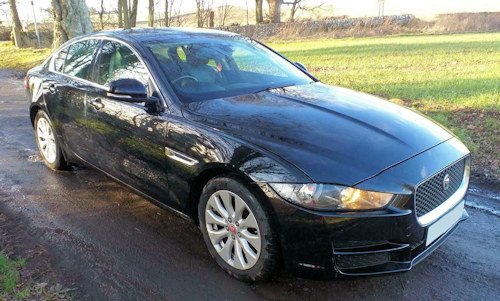
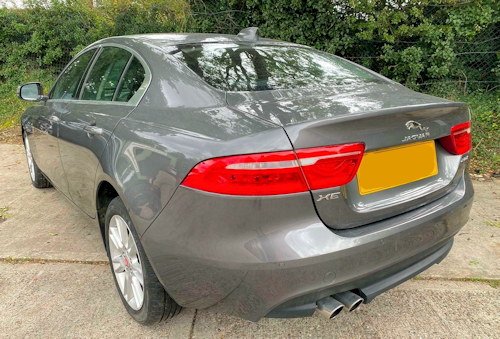
The Jaguar XE (code name X760) is a mid-range model from the British manufacturer Jaguar Land Rover , which celebrated its world premiere in September 2014.
History
The XE was announced at the Geneva Motor Show in March 2014 and was shown to the public in London on September 8, 2014 . With this model, Jaguar aims to establish itself permanently in the middle class of automobiles. In the United Kingdom.
As with the larger Jaguar XF , the XE is also available in a long version for the Chinese market. The XE L is the Chery - Jaguar Land Rover - a joint venture built and sold since November 2017.
The XE was initially produced at Jaguar Land Rover's plant in Solihull near Birmingham , England , which specializes in the manufacture of aluminum vehicles. The group also manufactures the Range Rover Sport there. In 2017, production was relocated to the Castle Bromwich plant in the UK near Birmingham. The manufacturer of the car now has a modular aluminum structure, not as in the production of the previous vehicle,this was a modified Ford - platform. Today Jaguar belongs to the Indian Tata group , which took over the company from Ford. The platform allows both a rear wheel drive plus a variant as well as all-wheel drive .
Thanks to the XE's modular aluminum architecture, the manufacturer has reduced the weight of its body-in-white to just 251 kilograms. At 75 percent, the XE has the highest proportion of aluminum in its class. For the first time, an aluminum alloy is used, which saves additional weight and contributes to the resilience of the body. Derived from the abbreviation for recycled aluminum (RC), the high-strength RC5754 alloy consists almost entirely of recycled aluminum. In Solihull, 615 robots with state-of-the-art camera systems help ensure that a new Jaguar XE rolls off the production line every 78 seconds. Due to the lightweight aluminum, the engineers at the same time achieve a weight distribution of almost 50:50. The closer the weight is to the center, the easier it is to maneuver the vehicle due to the mass moment of inertia . Since many components on the front and rear axles are made of forged or hollow-drilled aluminum, the result is a stiff and light axle . At the same time, the XE has a particularly stiff suspension , which has a positive effect on the driving dynamics and on the Noise Vibration Harshness (NVH) behavior. Due to its high aluminum content, the XE has a torsional stiffnessof 22 kNm / degree. Jaguar Land Rover uses die-cast aluminum for production in order to integrate small components in the best possible way. On a strut dome, for example, six to ten components can be saved compared to a conventional body. Another advantage of aluminum over steel is a weight saving of up to 40 percent.
The XE is powered by a 2.0 liter four-cylinder Jaguar Land Rover petrol engine or a diesel engine. The engine family is called Ingenium by the manufacturer . Two 3.0-liter V-engines are also available: an AJ gasoline engine as in the Jaguar F-Type and an AJD diesel engine as in the Jaguar XF. The XE will initially only be available with rear-wheel drive. The models are manufactured with an eight-speed automatic transmission from ZF ( ZF 8HP ) or with a six-speed manual transmission. The vehicle comes with a traction control called All Surface Progress Controlwhich is derived from Land Rover's Terrain Response System . The interior of the automobile meets the requirements of a premium product .The manufacturer offers a three-year guarantee including three-year inspections.
Infotainment and connectivity
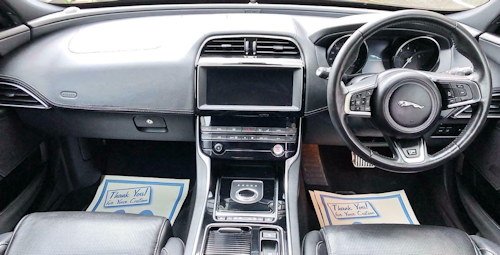
Jaguar's InControl technologies, consisting of In Control Apps, InControl Remote, InControl Secure and InControl Wi-Fi , networks the XE with the driver and the environment. InControl Apps enables smartphones with both iOS and Android -based operating systems to be integrated into the vehicle environment. Apps can be transmitted on an optional 8-inch touchscreen .
The InControl Remote app enables remote access to vehicle data and applications . A reminder SMS when the car doors are unlocked or a quick location of the parked vehicle is also possible, as is an automatic emergency call ( ECall ). InControl Secure informs the owner if his vehicle moves unauthorized and reports the location data to the responsible authorities when it is released. The vehicle's own 3G hotspot InControl-WiFi offers internet access for up to eight different devices such as smartphones, tablets or laptops .
An optional digital stereo camera system with traffic sign recognition monitors the traffic around the vehicle and shows the driver information on a laser-assisted head-up display . An autonomous emergency brake assistant detects impending rear-end collisions and warns the driver by means of acoustic and visual cues before it automatically initiates emergency braking.
XE SV Project 8
At the Goodwood Festival of Speed at the end of June 2017, Jaguar presented the XE SV Project 8, the automaker's most powerful model that has ever been built in series. After the F-Type Project 7 , this is the second vehicle developed by the Special Vehicle Operations (SVO) department . The special model, limited to 300 copies, also takes over the drive from the F-Type Project 7. The V8 - petrol engine Compared to the Roadster, thanks to new engine software, better air flow and a new exhaust system, it delivers another 18 kW (25 PS) more and thus achieves a peak output of 441 kW (600 PS). This accelerates the 1745 kg XE SV Project 8, which will only be available as a left-hand drive and with all-wheel drive , in 3.7 seconds to 100 km / h and reaches a top speed of over 320 km / h.
In autumn 2017, the XE SV Project 8 lapped the Nordschleife of the Nürburgring in 7:21:23 minutes. The vehicle thus replaced the Alfa Romeo Giulia Quadrifoglio as the fastest four-door series sedan on the racetrack.
A more roadworthy version of the XE SV Project 8 was presented in early June 2019 with the Touring . It uses the same drive train, but has a smaller rear spoiler and two seats in the rear. The top speed of the model, which is limited to 15 units, is electronically limited to 300 km / h.
Jaguar XJ13
| 1966 | |
|---|---|
 |
|
| Overview | |
| Manufacturer | Jaguar Cars |
| Production | 1966 (1 produced) |
| Body and chassis | |
| Class | Race car |
| Body style | Roadster |
| Powertrain | |
| Engine | 5.0 L DOHC V12 |
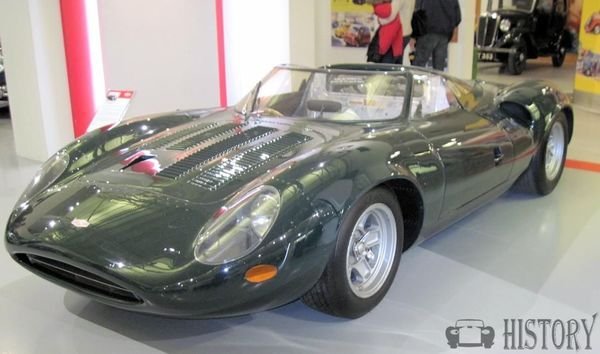
It never raced, and only one was produced. The car has not been officially valued, but a £7 million bid for it was declined by the owners in 1996.The Jaguar XJ13 was a prototype racing car developed by Jaguar to challenge at Le Mans in the mid 1960s.
Jaguar had considered the manufacture of a DOHC V12 engine as far back as 1950, initially for racing purposes, and then developing a SOHC road going version, unlike the XK which was designed as a production engine and later pressed into service for racing. The engine design was essentially two XK 6-cylinder engines on a common crankshaft with an aluminium cylinder block, although there were differences in the inlet porting, valve angles and combustion chamber shape. The first engine ran in July 1964.
The idea of a mid-engined prototype was first mooted in 1960, but it was not until 1965 that construction began, with the first car running by March 1966. The aluminium body was designed by Malcolm Sayer, the aerodynamicist responsible for the Jaguar C-type, D-type, E-type and XJS, who used his Bristol Aeroplane Company background to build it using techniques borrowed from the aircraft industry. The task of building the car was entrusted to Bob Blake - described by his contemporaries as "An Artist in Metal".William Heynes recognised as early as 1964 that a car such as the XJ13 needed an experienced race driver to help develop it. Jack Brabham was approached in this regard but the challenge was eventually taken up by ex-Jaguar Apprentice David Hobbs. David Hobbs was recruited as the XJ13's main test driver. In 1969 Hobbs was included in a FIA list of 27 drivers who were rated the best in the world. Hobbs achieved an unofficial UK closed lap record with the XJ13 which stood for 32 years. The XJ13’s main test and development driver, Hobbs, was joined at Silverstone for the XJ13’s final test at full racing speed by another racing driver (and ex-Jaguar apprentice) Richard Attwood.
The XJ13 had mid-engine format with the 5.0 litre V12 engine mounted behind the driver, used as a stressed chassis member together with the five-speed manual ZF Transaxle driving the rear wheels.
The front suspension wishbones were similar to that of the E-Type, however where the E-Type used longitudinal torsion bars, the XJ13 had more conventional coil spring/damper units. At the rear there again remained similarities with the E-Type—the use of driveshafts as upper transverse links—however the rest was quite different, with two long radius arms per side angling back from the central body tub together with a single fabricated transverse lower link.
The development of the XJ13, although treated seriously by the designers, was never a priority for company management (despite assistant MD Lofty England's Le Mans success in the 1950s), and became less so following the 1966 merger with BMC. By that time Ford had developed the 7.0 litre GT40, and so the XJ13 was considered obsolete by the time the prototype was complete. The prototype was tested at MIRA and at Silverstone, which confirmed that it would have required considerable development to make it competitive. The prototype was put into storage and no further examples were made.

MIRA crash
In 1971 the Series 3 E-type was about to be launched with Jaguar's first production V12 engine. The publicity team wanted a shot of the XJ13 at speed for the opening sequence of the film launching the V12 E-Type. On 21 January 1971, the XJ13 was taken to MIRA for the filming with Jaguar test driver Norman Dewis at the wheel. Sadly, the car was driven by Dewis at ill-advised speeds on a damaged tyre, against the instructions of Jaguar's Race Director "Lofty" England. The resultant crash heavily damaged and nearly destroyed the car, although Dewis was unharmed. The wreck of the car was put back into storage.
Some years later, Edward Loades spotted the crashed XJ13 in storage at Jaguar and made the offer to 'Lofty' England that his company Abbey Panels should rebuild the car. The car was rebuilt, to a specification similar to the original, using some of the body jigs made for its original construction and at a cost of £1,000 to Jaguar. In Jaguar's own words, "The car that can be seen today is not an exact reproduction of the original." The XJ13 made its public debut in July 1973 when 'Lofty' drove it around Silverstone at the British Grand Prix meeting. It is now displayed at the Heritage Motor Centre Museum at Gaydon, UK.

Jaguar XJR-14
 |
|||||||||
| Category | Group C | ||||||||
|---|---|---|---|---|---|---|---|---|---|
| Constructor | Jaguar Cars (Tom Walkinshaw Racing) | ||||||||
| Designer(s) | Ross Brawn John Piper Mark Thomas | ||||||||
| Technical specifications | |||||||||
| Engine | Cosworth HB 3500 cc V8. Naturally aspirated mid-mounted | ||||||||
| Transmission | manual transmission | ||||||||
| Tyres | Goodyear | ||||||||
| Competition history | |||||||||
| Notable entrants | Silk Cut Jaguar (WSC) Jaguar Racing (IMSA) | ||||||||
| Notable drivers | Derek Warwick Martin Brundle David Brabham Teo Fabi Davy Jones Arie Luyendyk | ||||||||
| Debut | 1991 430km of Suzuka | ||||||||
|
|||||||||
| Constructors' Championships | 1 (1991) | ||||||||
| Drivers' Championships | 1 (1991) | ||||||||
The Jaguar XJR-14 was a sports-prototype racing car introduced for the 1991 World Sportscar Championship season. It was designed by Ross Brawn and John Piper, and was built by Tom Walkinshaw Racing (TWR).
Design
The 1991 season marked the introduction of the FIA’s new, and controversial, 3.5 Litre Formula which replaced the highly successful Group C category that had been used in the World Sportscar Championship since 1982. However, due to a small number of entries in the new 3.5 litre formula heavily penalised Group C cars were allowed participate in the newly created C2 category for the 1991 season but Jaguar participated in the new formula.
To comply with the new regulations Jaguar produced an all-new car, the XJR-14. It was designed by Ross Brawn and John Piper, and was built by Tom Walkinshaw Racing (TWR). In the past, TWR's Jaguars had been designed under the direction of Tony Southgate, while Brawn worked with a large design staff (12 according to John Piper); a paradigm shift (albeit small) in its own right and reflective of Brawn's Formula One background.
The abandonment of the Group C fuel consumption regulations meant a change in aerodynamic design philosophy. Coupled that with vastly different packaging requirements for a small, light, normally aspirated engine meant that concerns over drag became a secondary requirement to downforce. The new design, lower kerb weight of 750 kg (1,653 lb) and higher downforce levels meant that the XJR-14 was a lot faster in corners compared to the previous Group C front runners.
Engine
The primary feature of the new regulations centred around 3.5 litre naturally aspirated engines. Although the XJR-14's predecessor, the XJR-11, used a twin turbo charged 3.5 litre engine derived from the Metro 6R4-derived JV6 engine, in order to comply with the new rules the two turbochargers would need to be removed. Naturally this wasn't a realistic option, nor was it ever considered, given the design compromises of not using a bespoke engine.
But given the Jaguar-Ford connection, it was a decided to utilise the 3.5 litre Ford HB V8 Formula One powerplant. Developed by Geoff Goddard and most notably used by the Benetton Formula One team, but now badged as a Jaguar, the Ford HB was detuned to about 11,500 rpm (compared to about 13,000 rpm) and aimed to produce slightly less power (about 650 bhp (485 kW) vs. around 700 bhp) with aims at enhanced reliability.

Race results
Three chassis were built and used for 1991: 591, 691, & 791. In the early part of the 1991 World Sportscar Championship season the XJR-14 was in a league of its own, totally outclassing its rivals and in particular the Peugeot 905 and Mercedes-Benz C291. Only the opening race went Peugeot's way, but that was seen more as a result of luck than the 905's competitiveness. The fact that Jaguar already had race proven engine certainly helped the team’s cause but the rest of the car was far superior to its rivals.
It wasn't until midway through the season that the Jaguar met its match through Peugeot's new 905B. This meant a hard fight with the new and quickly improving Peugeot squad for the rest of the season, but Jaguar was able to hold on and secure the manufacturers title with 3 victories.
At the 1991 24 Hours of Le Mans, Jaguar initially entered two XJR-14s but later decided that the XJR-14 would not be capable of finishing the distance due to unknowns in the development of the Cosworth HB to last 24 hours. Jaguar instead decided to enter three older XJR-12s which entered in the C2 class. Although the XJR-12s did not manage to win, Jaguar's decision not to run the untested XJR-14 was vindicated by the fact that Peugeot's 905 failed to finish the race. Mercedes also withdrew its C291 in favour of its older C11 models.
After 1991, Jaguar decided not to continue in Group C, believing that they had spent enough time in Group C and the instability of rules recently in the World Sportscar Championship. Jaguar decided to take the XJR-14 to the United States for the 1992 IMSA Camel GTP championship. However, without a major upgrade and with suspension that was not particularly well suited to the bumpier circuits in the championship, the XJR-14 was unable to beat the latest challengers from Toyota and Nissan, forced to finish third in the championship with only two victories. Jaguar continued to use the three updated 1991 chassis throughout the season.
Derivative
Meanwhile, TWR had reached an agreement to supply more XJR-14 chassis to Mazda, minus the Cosworth V8s but installed with Mazda-badged Judd V10s for the World Sportscar Championship. Mazda would rebadge the XJR-14s as MXR-01s. The MXR-01 was essentially a productionised XJR-14 and as there had been no ongoing development they ended up not being particularly competitive, scoring no wins and finishing third in the championship.
Several years later, TWR would resurrect XJR-14 chassis #791, which had competed in IMSA Camel GTP, for the development of a new prototype for Porsche. They renamed the car the TWR-Porsche WSC-95. Its most significant feature was that it had the roof removed, turning it into an open cockpit prototype to run under the then-new LMP regulations. The WSC-95 would carry a Porsche 3.0L turbocharged Flat-6. After chassis #791 was modified, TWR built a second WSC-95 from scratch. In both the 1996 and 1997 24 Hours of Le Mans, the TWR-Porsches were able to take the overall win. See Chassis Log.
Jaguar XJ220
| 1992 to 1994 | |
|---|---|
 |
|
| Overview | |
| Manufacturer | Jaguar Cars |
| Production | 1992–94 (275 produced) |
| Assembly | JaguarSport Jaguar/TWR joint venture Bloxham, Oxfordshire |
| Designer | Jim Randle Keith Helfet |
| Body and chassis | |
| Class | Sports car |
| Body style | 2-door coupé |
| Layout | RMR layout |
| Powertrain | |
| Engine | 3.5 L twin-turbocharged V6 |
| Transmission | 5-speed manual |
| Dimensions | |
| Wheelbase | 2,640 mm (103.9 in) |
| Length | 4,930 mm (194.1 in) |
| Width | 2,220 mm (87.4 in) including wing mirrors |
| Height | 1,150 mm (45.3 in) |
| Kerb weight | 1,470 kg (3,240.8 lb) |
| Chronology | |
| Predecessor | Jaguar XJR-15 |
| Successor | Jaguar C-X75 |
The Jaguar XJ220 is a two-seater supercar produced by British luxury car manufacturer Jaguar from 1992 until 1994, in collaboration with the specialist automotive and race engineering company Tom Walkinshaw Racing. The XJ220 held the record for the fastest production car throughout 1992 after recording a top speed of 213.1 mph (343.0 km/h), before being superseded by the McLaren F1 in 1993, and held the Nürburgring production car lap record between 1992 and 2000 with a time of 7:46.36.
The XJ220 was developed from a V12-engined 4-wheel drive concept car designed by an informal group of Jaguar employees working in their spare time. The group wished to create a modern version of the successful Jaguar 24 Hours of Le Mans racing cars of the 1950s and '60s that could be entered into FIA Group B competitions. The XJ220 made use of engineering work undertaken for Jaguar's then current racing car family as well as the engineering experience gained from the MG Metro 6R4 rally car, produced by former Jaguar sister company Austin Rover Group.
The initial XJ220 concept car was unveiled to the public at the 1988 British International Motor Show, held in Birmingham, England. Its positive reception prompted Jaguar to put the car into production; some 1500 deposits of £50,000 each were taken, and deliveries were planned for 1992.
Engineering requirements resulted in significant changes to the specification of the XJ220, most notably replacement of the Jaguar V12 engine by a turbocharged V6 engine. The changes to the specification and a collapse in the price of collectible cars brought about by the early 1990s recession resulted in many buyers choosing not to exercise their purchase options. A total of just 275 cars were produced by the time production ended, each with a retail price of £470,000 in 1992.
Conception
Jaguar were approached by racing team owner Tom Walkinshaw and encouraged to enter the Jaguar XJS into the 1981 European Touring Car Championship; they succeeded in winning the competition in 1984. Jaguar had started to provide factory support to racing team Group 44 Racing, who were using the Jaguar-engined XJR-5 in the IMSA GT Championship, supplying V12 engines from 1983 onwards and supporting a Le Mans entry in 1984. Tom Walkinshaw and Jaguar agreed to entering the FIA Group C World Sportscar Championship and developed the XJR-6, which was powered by the Jaguar V12 engine; the car was launched during the 1985 season.
TWR took over the IMSA GT Championship operation in 1988 and one model – Jaguar XJR-9 – was launched to compete in both series. The XJR-9, which retained the Jaguar V12 engine, went on to win the 1988 24 Hours of Le Mans and World Sportscar Championship in the same year. The poor fuel consumption of the Jaguar V12 combined with new rules restricting refuelling during races forced the replacement of the V12 engine in the XJR-9s successors, the XJR-10 and XJR-11. The British Leyland V64V engine, designed for the MG Metro 6R4 had recently been made redundant thanks to the Group B rally ban in 1987, and the design rights were for sale. The compact, lightweight and fuel efficient nature of the small-displacement, turbocharged engine was investigated by TWR, who considered it ideal for the XJR-10 and purchased the design rights from Austin Rover Group.
Jaguar and their Director of Engineering, Jim Randle, felt these racing cars were too far removed from the product available to the general public, especially with the rule changes that mandated the replacement of the Jaguar V12 engine in the forthcoming XJR-10 and XJR-11 racing cars. Therefore a project was initiated to design and build a car capable of winning Le Mans "in house", just as the Jaguar C-Type and D-Type had done. The groundwork for the project was undertaken by Randle over Christmas 1987, when he produced a 1:4 scale cardboard model of a potential Group B racing car.
The cardboard model was taken into the Jaguar styling studio and two mock-ups were produced. One was said to be reminiscent of the Porsche 956, the other took elements of the then current Jaguar XJ41 project and Malcolm Sayer's work on the stillborn Jaguar XJ13 racing car. The second design, by Keith Helfet, was chosen as it was "more obviously Jaguar in its look.
The project still had no official support, leaving Randle no option but to put together a team of volunteers to work evenings and weekends in their own time. The team came to be known as "The Saturday Club", and consisted of twelve volunteers. To justify the resources consumed by the project, the XJ220 needed to provide meaningful data to the engineers on handling, aerodynamics – particularly at high speeds – and aluminium structures. These requirements, together with FIA racing regulations and various government regulations governing car design and safety influenced the overall design and engineering direction of the car.
Concept car
The FIA Group B regulations steered the concept towards a mid-engine, four-wheel drive layout, with a Jaguar V12 engine as the power source. The concept car was designed and built at very little cost to Jaguar, as Randle called in favours from component suppliers and engineering companies he and Jaguar had worked with in the past. In return he offered public recognition for their assistance and dangled the possibility of future contracts from Jaguar.
The name XJ220 was chosen as a continuation of the naming of the Jaguar XK120, which referred to the top speed of the model in miles per hour. The concept car had a targeted top speed of 220 mph (350 km/h) so became the XJ220. The XK120, like the XJ220, was an aluminium-bodied sports car, and when launched was the fastest production car in the world.
Engine and transmission
Jaguar and engine designer Walter Hassan had previously created a 48-valve variant of their V12 engine specifically for motorsport use. It featured a double overhead camshaft layout with four valves per cylinder, compared with the single overhead camshaft and two valves per cylinder of the production engine, which was used in the Jaguar XJ and Jaguar XJS models at the time.
TWR and Cosworth had manufactured a number of these racing V12 engines during the 1980s and they had been raced competitively, with a 7-litre version of this engine featuring in the Le Mans winning Silk Cut Jaguar XJR-9. Five of these engines still existed, all of which were fitted with dry sump lubrication. These engines were chosen and considered to be especially useful as the dry sump would lower the vehicle's centre of gravity. The displacement of the V12 was set at 6.2 litres (6222 cc) for the XJ220. The engine fitted to the XJ220 concept had titanium connecting rods.
Jaguar had little experience with four-wheel drive systems at the time, having previously only produced rear-wheel drive cars. Randle approached Tony Rolt's company, FF Developments to design the transmission and four-wheel drive system for the XJ220, with Rolt's son Stuart running the project. Tony Rolt was the Technical Director of Ferguson Research, where he was heavily involved in the design of the four-wheel drive system used in the Jensen FF, the first sports car to be fitted with such a transmission. Tony Rolt also had a long involvement with Jaguar, winning the 1953 24 Hours of Le Mans with the factory works team driving the Jaguar C-Type.
The mid-engine complicated the design of the four-wheel drive system, and an innovative solution was needed to get drive from the rear of the engine to the front wheels. The chosen design took the front-wheel drive from the central differential on the rear transaxle and sent it through the V in the centre of the engine using a quill drive, before joining an inverted differential. The clutch was a twin-plate unit designed by AP Racing.
Bodywork and interior
The design brief for the exterior restricted the use of aerodynamic aides, and aimed for a stylish yet functional body similar to the Jaguar D-Type. Drag and lift were limited at the envisioned ground clearance for road use, but the design allowed for additional downforce when the car was set up for racing; the body produced around 3,000 lb (1,400 kg) of downforce at 200 mph (320 km/h). The design was also intended to have a variable rear wing that folded into the bodywork at lower speeds. Aerodynamic work was undertaken at the Motor Industry Research Association wind tunnel using a 1:4 scale model, as the project was unable to budget for a full-scale mock-up.
The bodywork for the concept car displayed in 1988 was hand built from aluminium by Park Sheet Metal, a specialist automotive engineering company that manufactures concept cars and low-volume, niche models for various manufacturers, including Bentley. QCR Coatings undertook final painting of the bodyshell in silver. The concept also featured electrically operated scissor doors and a transparent engine cover to show off the V12 engine.
The concept car had a Connolly Leather-trimmed interior produced by Callow & Maddox, and was fitted with front and rear heated windscreens, electric windows, air conditioning, heated electrically adjustable seats with an Alpine Electronics CD player. The dashboard was supplied by Veglia.
Chassis
The chassis was manufactured from aluminium using Alcan's bonded aluminium structure vehicle technology (ASVT), and had a wheelbase of 2845 mm. The design for the chassis featured rear wheel steering and packaged the fuel tank behind the centre bulkhead.Suspension design largely focused on road use, but a good compromise for racing use was achieved and the suspension height was adjustable. The concept car was fitted with a four-channel anti-lock braking system.
The concept car was larger than the production model at 5,140 mm (202 in) in length and 2,000 mm (79 in) wide. It weighed 1,560 kg (3,440 lb).
Launch
The concept car was completed in the early hours of 18 October 1988, the day it was due to be unveiled at the British International Motor Show, being held at the National Exhibition Centre, Birmingham. The vehicle was completed at 03:00 GMT, moved to Jaguar's stand at 06:00 GMT and unveiled at 11:00 GMT.
Jaguar's marketing department had allocated space on their stand at the motor show for the XJ220, but had not seen the vehicle until its arrival. Jaguar chairman John Egan and Roger Putnam, who was in charge of Jaguar's racing activities, were shown the vehicle the week before the motor show and signed off on the concept, allowing its unveiling. The car received an overwhelmingly positive reception by public and press, and a number of wealthy Jaguar enthusiasts handed over blank cheques to secure a purchase option should the XJ220 concept go into production. Ferrari displayed their F40 model at the same event; an estimated 90,000 additional visitors came to see the Jaguar and Ferrari cars.
The XJ220 was not initially intended to be a production car, but, following the reception of the concept and financial interest from serious buyers, a feasibility study was carried out by teams from TWR and Jaguar. Its conclusion was that such a car would be technically feasible (subject to engineering changes), and that it would be financially viable. The announcement of a limited production run of 220 to 350 cars came on 20 December 1989. The list price on 1 January 1990 was £290,000 exclusive of value added tax, options and delivery charges, but by 1992 that had increased considerably owing to indexation of contracts. The offer was four times oversubscribed, and deposits of £50,000 exclusive of Value Added Tax (VAT) were taken from around 1400 customers; first deliveries were planned for mid-1992.
Production version
Jaguar were unable to develop the XJ220 in house as their engineering resources were committed to working on the Jaguar XJ and Jaguar XJS models; the re-engineered and facelifted XJS was launched in May 1991.
Jaguar and TWR had an existing joint venture, JaguarSport Ltd, formed in 1987 to produce racing cars. Jaguar's board made the decision that subject to contractual agreement, TWR and JaguarSport would be responsible for the XJ220. JaguarSport formed a new company, Project XJ220 Ltd, specifically to develop and build the XJ220.
The team that should determine the necessary engineering work and assess the car's financial viability was put in place during mid-1989, working from the TWR workshops. Mike Moreton headed the team, joining TWR to run the XJ220 project. Moretone came from Ford Motorsports where he led the team responsible for the Ford Sierra RS500 Cosworth, and was a project manager for the Ford RS200 Group B rally car program. Richard Owen was appointed chief designer, and the remainder of the team was made up of Jaguar and TWR staff, including Pete Dodd, the only member of the group of twelve responsible for the XJ220 concept. The exterior and interior designers who had worked on the XJ220 prototype, Keith Helfet and Nick Hull, rejoined the project when it became clear that more design work would be needed.
Development
The development team looked at the two principal competitors, the Ferrari F40 and the Porsche 959. These were powered by compact, lightweight engines; both the Ferrari and the Porsche used forced induction to obtain high power outputs from small-displacement engines. Ferrari used a 2.9-litre twin turbo V8 that produced 478 PS (352 kW; 471 hp) whilst Porsche used a 2.9-litre twin-turbo flat six producing 450 PS (330 kW; 440 hp), resulting in cars that were significantly lighter and smaller than the XJ220 concept: the Ferrari was lighter by 600 kg and 710 mm shorter, whilst the Porsche was 250 kg lighter and 870 mm shorter. The Porsche's specifications were closer to the Jaguar's, with four-wheel drive and a luxurious interior. By comparison the rear-wheel driven Ferrari had a very basic interior, with no carpets, door handles or a stereo.
Engine
The production XJ220 used a 3.5-litre (3498 cc) twin turbocharged variant of the Austin Rover/TWR V64V V6 engine, replacing the Jaguar V12 engine featured earlier in the concept car. The decision to change the engine based on engine weight and dimension, as well as to environmental emission considerations. Use of the V64V engine would allow the wheelbase of the XJ220 to be shortened and its weight to be reduced; the V12 engine was definitively ruled out when it was determined it would have difficulty in meeting emissions legislation whilst producing the required power and torque.
The V64V engine chosen had a short but successful career as a purpose-designed racing car engine. It was designed by Cosworth engine designer David Wood for Austin Rover Group's Metro derived Group B rally car, the MG Metro 6R4. The engine had a 90° bank angle, four valves per cylinder and belt-driven double overhead camshafts. It shares a number of design features with the Cosworth DFV Formula One engine. TWR purchased the rights to the engine from Austin Rover in 1989 and developed it further, adding two Garrett TO3 turbochargers and increasing the displacement to 3.5 litres. This variant of the engine was first used in the JaguarSport XJR-10 and XJR-11 racing cars; its compact dimensions and low weight made it an ideal candidate for the XJ220.
The XJ 220's engine had a bore and stroke of 94 mm × 84 mm (3.70 by 3.31 inches), dry sump lubrication, Zytek multi point fuel injection with dual injectors and Zytek electronic engine management. The engine was manufactured with an aluminium cylinder block, aluminium cylinder heads with steel connecting rods and crankshaft, and in the standard state of tune, it produced a maximum power of 550 PS (400 kW; 540 hp) at 7200 rpm and torque of 475 lb·ft (644 N·m) at 4500 rpm. The XJ220 can accelerate from 0–60 miles per hour in 3.6 seconds and reach a top speed of 213 miles per hour.
The exhaust system had two catalytic converters, which reduced the power output of the engine. During testing at the Nardò Ring in Italy the XJ220 achieved a top speed of 217.1 miles per hour when the catalytic converters were disconnected; owing to the circular nature of the track, a speed of 217 mph (349 km/h) is equivalent to 220 mph (350 km/h) on a straight, level road. The V64V engine had the additional benefit of being very economical for such a powerful petrol engine, it was capable of achieving 32 mpg-imp (8.8 L/100 km; 27 mpg-US), in contrast, the smallest-engined Jaguar saloon of the time, the Jaguar XJ6 4.0 could only achieve around 24 mpg-imp (12 L/100 km; 20 mpg-US).
Transmission
Four-wheel drive was decided against early in the development process, for a number of reasons. It was thought rear-wheel drive would be adequate in the majority of situations, that the additional complexity of the four-wheel drive system would hinder the development process and potentially be problematic for the customer. FF Developments were contracted to provide the gearbox/transaxle assembly, modifying their four-wheel drive transaxle assembly from the XJ220 concept into a pure rear-wheel drive design for the production car.A five-speed gearbox is fitted; a six-speed gearbox was considered but deemed unnecessary, as the torque characteristics of the engine made a sixth gear redundant. The transaxle featured a viscous coupling limited slip differential to improve traction.
The transmission system featured triple-cone synchromeshing on first and second gears to handle rapid starts, whilst remaining relatively easy for the driver to engage and providing positive feel.
AP Racing provided an 8.5 in (22 cm) diameter clutch.
| Gear | 1 | 2 | 3 | 4 | 5 | Final Drive |
|---|---|---|---|---|---|---|
| Ratio | 3.00:1 | 1.95:1 | 1.42:1 | 1.09:1 | 0.85:1 | 3.364:1 |
Exterior
The exterior retained the aluminium body panels of the XJ220 concept, but for the production vehicles, Abbey Panels of Coventry were contracted to provide the exterior panels. The scissor doors were dropped for the production model, and significant redesign work was carried out on the design when the wheelbase and overall length of the car was altered. Geoff Lawson, Design Director at Jaguar took a greater interest in the car and insisted the design had to be seen to be a Jaguar if it was to be successful in promoting the company. Keith Helfet returned to undertake the necessary redesign work mandated by the change in the wheelbase, which was reduced by 200 mm. The turbocharged engine required larger air intakes to feed the two intercoolers. Situated between the doors and the rear wheels, the air intakes were larger on the production version of the XJ220 than on the concept car. A number of small design changes for the body were tested in the wind tunnel; the final version had a drag coefficient of 0.36 with downforce of 3,000 lb (1,400 kg) at 200 mph (320 km/h). The XJ220 was one of the first production cars to intentionally use underbody airflow and the venturi effect to generate downforce.
The rear lights used on the production XJ220 were taken from the Rover 400.
Chassis
The production model utilised the same Alcan bonded honeycomb aluminium structure vehicle technology (ASVT) as the concept car for the chassis. The chassis design featured two box section rails which acted as the suspension mounting points and would provide an energy absorbing structure in the event of a frontal impact, these were successfully tested at speeds up to 30 mph (48 km/h), an integral roll cage formed part of the chassis and monocoque, providing additional structural rigidity for the car and allowing the XJ220 to easily pass stringent crash testing.
The rear-wheel steering was dropped from the production car to save weight and reduce complexity, as was the height adjustable suspension and active aerodynamic technology. The suspension fitted to the production model consisted of front and rear independent suspension, double unequal length wishbones, inboard coil springs and anti-roll bars, with Bilstein gas-filled dampers. The suspension was designed in accordance with the FIA Group C specifications.
The braking system was designed by AP Racing and featured ventilated and cross-drilled discs of 13 in (33 cm) diameter at the front and 11.8 in (30 cm) diameter at the rear. The calipers are four pot aluminium units. JaguarSport designed the handbrake, which are separate calipers acting on the rear brake discs. Feedback from enthusiasts and racing drivers resulted in the decision to drop the anti-lock braking system from the production car. The braking system was installed without a servo, but a number of owners found the brakes to be difficult to judge when cold and subsequently requested a servo to be fitted.
Rack and pinion steering was fitted, with 2.5 turns lock to lock; no power assistance was fitted. The Bridgestone Expedia S.01 asymmetric uni-directional tyres were specially developed for the XJ220 and had to be rateable to a top speed in excess of 220 miles per hour (350 km/h), carry a doubling of load with the exceptionally high downforce at speed and maintain a compliant and comfortable ride Rally alloy wheel specialists Speedline Corse designed the alloy wheels, these are both wider and have a larger diameter on the rear wheels; 17 inches (43 cm) wheels are fitted to the front and 18 inches (46 cm) are fitted at the rear, with 255/55 ZR17 tyres at the front and 345/35 ZR18 tyres at the rear.
Interior
The interior was designed for two passengers and trimmed in leather. Leather trimmed sports seats are fitted together with electric windows and electrically adjustable heated mirrors. The dashboard unusually curves round and carries onto the drivers door, with a secondary instrument binnacle containing four analogue gauges, including a clock and voltmeter fitted on the front of the drivers door. Air conditioning and green tinted glazing was also fitted.
The luggage space consists of a small boot directly behind and above the rear portion of the engine, also trimmed in leather.

Early 1992 Jaguar-XJ220
Production
The car was assembled in a purpose-built factory at Wykham Mill, Bloxham near Banbury in Oxfordshire.HRH The Princess of Wales officially opened the factory and unveiled the first production XJ220 in October 1991.
The V64V engines used in the Jaguar racing cars were produced by Swiss engineer Max Heidegger, but delivering the number of engines required for the XJ220 program was considered beyond his capacity TWR formed a division, TWR Road Engines, to manage the design, development, construction and testing of the engines for the production cars.
FF Developments, in addition to their design work on the gearbox and rear axle assembly were given responsibility for their manufacture.The aluminium chassis components and body panels were manufactured and assembled at Abbey Panels factory in Coventry, before the body in white was delivered to the assembly plant at Bloxham. The car, including chassis and body components, consists of approximately 3000 unique parts.
The first customer delivery occurred in June 1992, and production rates averaged one car per day.The last XJ220 rolled off the production line in April 1994; the factory was then transferred to Aston Martin and used for the assembly of the Aston Martin DB7 until 2004.
Reception
Press coverage of the concept XJ220 in 1988 was overwhelmingly positive and contributed to the decision in 1989 to put the XJ220 into limited production. The production version of the car was first shown to the public in October 1991, at the Tokyo Motor Show. The first car was released for press review in autumn 1991.
Autocar reviewer Andrew Frankel was the first journalist to road-test the car and reported: "Savage acceleration really is a given here. What's really incredible about the XJ220 is its ability to provide such performance in a way that never, ever intimidates." He was particularly impressed with the throttle response, the driver's ability to control the performance of the car very precisely, and the way in which the engine delivers its power progressively rather than in one short burst.
Performance Car reviewer John Barker was also impressed with the performance as well as the ride and stability of the car, writing "The V6 has a rumbly, loping note which, in league with a remarkably supple ride, belies the speed we are travelling at. I glance to the speedo and have trouble believing that it is indicating 170 mph." Barker was also impressed with the engineering, saying "this car is catalysed, fully homologated and has passed the same tests that a Volvo needs before going on sale." before going on to discuss how the vehicle looked at home on the racetrack thanks to the design. Autocar's verdict was "Right now, the XJ220 gives us a standard by which all other fast cars can be compared. For the few who will actually own and, hopefully, use their XJ220s, the fact that they are in command of the most accomplished supercar ever made should suffice."
Critics of the car consider it underwhelming for such an expensive, powerful and high performance machine. Motoring journalists have been critical of the interior and the car itself for being too comfortable and lacking the sense of occasion present with other supercars. Commentators who approve of the interior have criticised the luggage space as being "largely useless". Journalists and other commentators often bemoaned the lack of the Jaguar V12 engine and other technical components fitted to the concept car. Contemporary reviews pondered on whether the sales performance and residual values would have been improved by sticking more closely to the specification of the concept car.
Sales performance was disappointing. Jaguar had intended to produce up to 350 cars, but production ceased in 1994 with 275 production cars produced, not all of which had been sold; some left-hand drive examples were still available in 1997 The recession left many of those who placed a deposit unable to complete the purchase. The index linking of contracts exacerbated the issue, and added almost £200,000 to the purchase price between early 1990 and mid-1992. The McLaren F1 suffered from similarly poor sales performance, with just 71 cars sold against McLaren's target of 300. McLaren's F1 program eventually turned a small profit thanks to the sale and servicing of the 28 GTR racing variants produced.
The price of collectible cars collapsed as a result of the recession over the six-year period from 1989–94; for example, a highly collectible Ferrari 250 GTO sold for just $3.5 million in 1994, an $11.1 million loss from its sale price in 1989. The Jaguar XJ220 had attracted a significant number of speculators who hoped the scarcity of the XJ220 and enthusiasm for the Jaguar marque would push up prices overnight, allowing large profits to be made over a short period of time.
The market for supercars was growing when the production XJ220 was announced, with comparable cars immediately reselling after delivery for three and four times the list price. The Ferrari F40 had been selling for more than £800,000 in 1990, but like the XJ220 it was adversely affected by the recession, and by 1992 prices had dropped to £100,000 to £150,000.
Further complicating the sales situation was the announcement by JaguarSport of a road-going version of the Jaguar XJR-9, the last of the racing cars to feature the Jaguar V12 engine. The Jaguar XJR-15 was developed by TWR and styled by Peter Stevens whilst the XJ220 was being developed at Jaguar, and featured the V12 engine and a host of other technologies not adopted for the XJ220, including carbon fibre construction and the option of a six-speed racing gearbox.It was considerably rarer and more expensive than the XJ220 when it went on sale; only 50 were built, each with a list price of £600,000 ($1 million) in 1990. It was designed primarily for racing but could be specified as a road-legal vehicle. About half were built as road-going variants, which added £55,000 to the list price.
Jaguar customers attempting to withdraw from their contracted purchases were given the option to buy themselves out of their contracts, but by 1995, the issue had resulted in legal action as buyers claimed the specification changes rendered any contracts void. Jaguar produced evidence clearly demonstrating that the vehicle specification shown in the contract matched the vehicle that was delivered, and the presiding judge, John Donaldson, quickly ruled in Jaguar's favour.The last of the unsold XJ220s were sold for £127,550 plus VAT in 1997.
The XJ220 remains popular with the contemporary motoring press; Evo journalist David Vivian, writing a head-to-head test between the XJ220 and the Lamborghini Murcielago in 2009, commented that "going ludicrously fast seems trivially easy", and acknowledged that the decision to change the V12 engine for a turbocharged V6 engine has more recently become acceptable. Vivian was impressed by the car's ride, handling and grip.
Racing
A racing version was introduced at the 1993 Autosport International motor show; given the model name XJ220-C, it was built to compete in FISA GT racing. The XJ220-C driven by Win Percy won its first race, a round of the BRDC National Sports GT Challenge at Silverstone.
Three works XJ220-Cs were entered in the 1993 24 Hours of Le Mans race, in the newly created Grand Touring Class. John Nielsen, David Brabham and David Coulthard won the GT class, beating Porsche by two laps; the other two cars retired, both through engine failure. However, the class win was revoked when the Jaguar XJ220-C was controversially disqualified for failing to run with catalytic converters. The Jaguars had passed scrutiny and completed the first day of qualifying when senior steward Alain Bertaut complained that Jaguar were not running catalytic converters. The cars had been entered under the IMSA GT category and Bertaut claimed that they needed to run with catalysts. The cars ran in the race under appeal. International Motor Sports Association (IMSA) officials wrote to the Automobile Club de l'Ouest (ACO) (English: Automobile Club of the West), organisers of the 24 Hours of Le Mans, confirming that the XJ220s had complied with IMSA rules. Jaguar won their appeal (supported by the FIA) but were nevertheless disqualified, as the ACO confirmed that the appeal had not been lodged in time.
Four cars were entered in the GT1 class for the 1995 24 Hours of Le Mans, two by PC Automotive Jaguar and two by Chamberlain Engineering, though the latter did not run their cars. Neither team had Jaguar or TWR backing; both of PC Automotive's cars were outpaced by the new McLaren F1 GTR. Richard Piper, Tiff Needell and James Weaver were holding fourth position until an engine failure during the night, ending their race, whilst the second XJ220 retired after leaving the road.
An XJ220 was also used in the Italian GT Championship, although without factory support; it raced in Martini livery.
TWR developed a further six XJ220-S road cars, featuring one-piece carbon fibre composite front and rear bodywork; the engine was tuned to 700 PS (510 kW; 690 hp). The XJ220-S models did away with the hidden headlamps of the original and instead opted for perspex covered lights. The S models were essentially road-going versions of the XJ220-C racer, and as a result featured a much simpler race-orientated interior with kevlar seats and the removal of the leather trim.Colin Goodwin, a writer for Autocar, tested an XJ220-S in June 1995 at Millbrook Proving Ground and set the lap record at an average speed of 180.4 mph (290.3 km/h).
Jaguar XJ220 Pininfarina
The Jaguar XJ220 Pininfarina is a special XJ220 built during the mid-1990s for the Sultan of Brunei and his brother Prince Jefri, who commissioned a number of rare and one-off heavily modified cars based on expensive luxury cars. This car was modified by Pininfarina, with modifications including fixed headlights, new rear lights with a redesigned double-vane rear wing, and a new interior package.
Jaguar XJ220 Cutaway view


