
Jensen
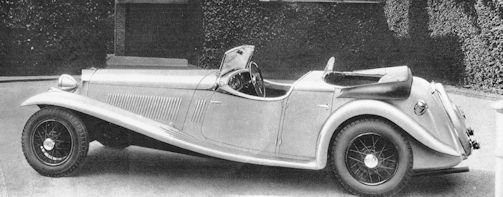
Jensen White Lady
 |
|
|
Manufacturer |
Jensen |
|
Year |
1934 to 1935 |
|
Type |
Prototype chassis number S1/3799 |
|
Successor |
Jensen 541R |
|
Class |
Sports car |
|
Body style |
4 seat tourer |
|
Engine |
Ford 3.6 litre V-8 |
|
Transmission |
3 speed manual.overdrive. |
The first Jensen car 'The White Lady ‘was a prototype car from the 1930s.
History
In 1934 the Jensen. The brothers started to design the prototype that was intended to be the first production car. The overall weight and centre of gravity are considerably lower than those of the closed type bodies. Careful attention, and great care had been taken in the design The original White Lady. had sacrificed some practicality for style this had a long aluminium-body, low bonnet line and flowing front wings along with V-sectioned radiator grille ,there also is full accommodation for four persons, for the rear passengers enter by means of the hinged panel, on which are mounted the small deflector screens.
The brothers had originally decided that their first car should be a high-quality four-seater tourer, with and excellent styling and performance, from Ford's 3.6 litre V-8 engine.
Like future Jensen cars luxurious specification and special features, it was built to the Jensen design by Rubery Owen. The main chassis members were not the usual channel-section but were boxed and braced with a robust cruciform centre section along with a steel platform formed the floor of the car This floor panel was welded to the chassis frame, making an extremely strong and very rigid assembly. And extended from the A-pillars right back to the rear cross-member. For the suspension half-elliptic leaf springs at front and rear and vacuum-operated adjustable shock absorbers. The hood is easily raised and lowered, and a full set of all-weather side curtains is provided.
The standard specification Ford engine was now fitted with two SU carburettors mounted on a light alloy inlet manifold. Power transmitted via a standard Ford three-speed gear-box. The Columbia dual-speed rear axle located by radius arms running diagonally to the central cruciform. providing a high overdrive gear. The control for the vacuum control dual axle was mounted on the dashboard fascia. For 1934 the car could perform well a top speed of 90 mph and a 0—60 mph time of just under 19 seconds.
The prototype was exhaustively tested, modified and retested and it was at last put into production on a very limited basis later in 1935.
After taking advice, they decided to produce this car changes would have to be made. Their next prototype was to be the 31/2 Litre Jensen, or the 'S' type.
This model was originally conceived as a traditional four-door saloon and was ready for 1935.The technical specification was the same as the White Lady, but the new body weighed a lot more.
Jensen Interceptor MK1
 |
|
|
Production period: |
1966 to 1969 |
|
Class: |
sports car |
|
Body versions: |
coupe |
|
Engines: |
V8 6.3 liters |
|
Length: |
188 in, 4,775 mm |
|
Width: |
69 in, 1,753 mm |
|
Height: |
58 in, 1,473 mm |
|
wheelbase : |
105 in, 2,667 mm |
|
curb weight : |
1,590 1b, 721 kg |
|
previous model |
Jensen C-V8 |
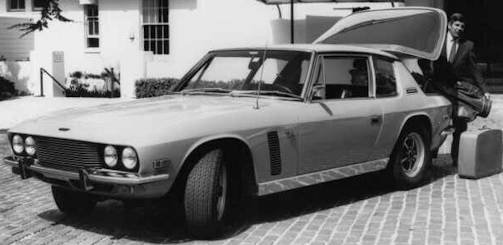
The Interceptor mark I was a sports GT car from the 1960s by the British manufacturer Jenson built from 1966 to 1969.
History
Jensen had already used the term Interceptor in 1950 for a predecessor, which is now usually referred to as the "Early Interceptor" . The Interceptor formed the basis for the Jensen SP and for the all-wheel drive Jensen FF model .
Jensen Motors was a British coachbuilder that primarily manufactured car bodies to order for high volume manufacturers. Since the 1950s, Jensen has manufactured the Austin Healey , among others . In addition, Jensen produced a small number of expensive sports cars under its own name, for which Jensen mostly used large-scale production technology. In the early 1960s, this was primarily the Jensen C-V8 , a luxury coupe with drive technology from Chrysler. The C-V8 was not successful; A major reason for this was the unusual body designed by Jensen's designer Eric Neale, which was perceived by observers as outdated and sometimes also as ugly. In 1964 considerations began for a successor to the C-V8, which finally culminated in the Interceptor presented in 1966. The development of the Interceptor was preceded by considerable controversy in Jensen's management, with Richard and Alan Jensen, the company's founders, on the one hand, and the managers of the Norcros Group, to which Jensen had majority ownership since 1957, opposing each other.
The Interceptor is believed to be the child of Kevin Beattie, a South African-born engineer who had worked for Jensen since 1960 and had since risen to Technical Director. On his behalf, Eric Neale first designed the P66 together with Richard Jensen , a two-door sports car whose market position was located below that of the C-V8. This concept did not catch on. Neither Beattie nor the managers of the Norcros group considered the P66 suitable to secure the future of the brand. Norcrosfelt that the car was too small and Beattie disliked what he considered to be the car's overly traditional bodywork. Instead, Norcros management opted for an immediate, i. H. to develop a successor to the C-V8 positioned in the same market segment, which, like the competing models from Aston Martin and Gordon-Keeble , should have a body designed in Italy.
Beattie commissioned Milan's Carrozzeria Touring to design; at the same time, their Turin competitors Vignale and Ghia were also asked for suggestions. Ultimately, the touring design was approved by Norcros . Richard and Alan Jensen, the company's founders, as well as longtime design chief Eric Neale, opposed Beattie's concept in general and the Touring design in particular. When Norcros decided to produce the Touring model, the Jensen brothers and Neale left the company after a dispute.The prototype was made by Vignale. The car made its debut at the Earls Court Motor Show in October 1966.
The Jensen Interceptor remained in production for 11 years. During this time, around 7,200 vehicles were built in three series. During the production period, the company experienced considerable economic turbulence, which was mainly triggered by the cancellation of the production order for the Austin Healey without replacement. At the beginning of the 1970s there was a change of ownership; Jensen was taken over by US entrepreneur Kjell Qvale, who continued Interceptor production without initiating the development of a successor. As a result of the first oil crisis , the company went bankrupt in 1975, after which Jensen stopped producing cars. A successor company called Jensen Parts and Service took over the supply of spare parts and service for existing vehicles and also manufactured some new vehicles in the late 1980s.
Structure and technology
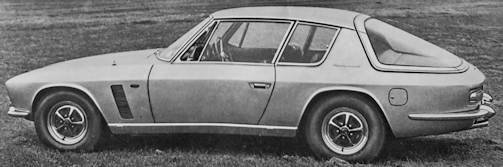
The body of the Interceptor bore neither external nor technical resemblance to the C-V8. While the body of the C-V8 and its predecessor 541 was made of glass fiber reinforced plastic , the body of the Interceptor was made of steel.
The Interceptor was created in three body versions. The basic and by far the most produced version was a closed two-door hatchback known as a saloon, whose outstanding design feature was a large panoramic rear window that also served as a tailgate. From this model, a two-door convertible .A controversy arose over the authorship of the Touring design. The Swiss Jensen importer and later sports car manufacturer Peter Monteverdi ( Automobile Monteverdi ) claimed into the 1970s that he designed the body of the Interceptor for Touring. Eventually, Monteverdi filed a lawsuit in Britain, which was unsuccessful.
Instead of the Carrozzeria Touring, which was badly hit economically and was dissolved at the end of 1966 , Vignale received the order to manufacture the prototype. The first 50 series bodies were also made at Vignale. From 1967, however, Jensen manufactured the entire vehicle itself at its plant in West Bromwich .
Chassis and drive technology
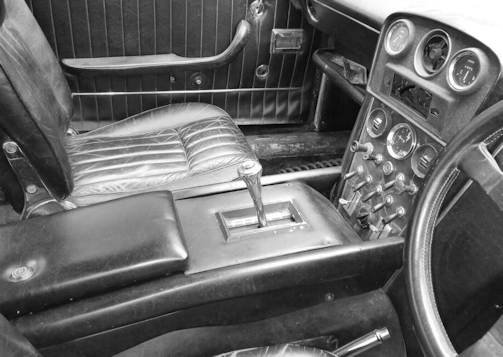
As in the previous C-V8, Jensen used a 6.3-liter eight-cylinder engine from Chrysler for the models in the first series . It delivered 330 hp at 4,600 rpm. A three-stage TorqueFlite automatic transmission, also built by Chrysler, served as standard power transmission.In deviation from this, 23 vehicles were equipped with a manually shifted four-speed gearbox at the customer's request. The vehicles of the first series were not yet equipped with power steering . Externally, the first series can be recognized by narrow, low-lying bumpers; the front turn signals were installed above the bumper.
- PERFORMANCE
- Engine capacity: 383 cu in, 6,276.22 cu cm
- Fuel consumption: 17 m/imp gal, 14.2 mlUS gal, 16.6 1 x 100 km
- Max speed: 130 mph, 209.3 km/h
- max power (SAE): 330 hp at 4,600 rpm
- max torque (SAE): 425 1b ft, 58.6 kg m at 2,800 rpm
- max engine rpm: 5,000
- specific power: 52.6 hp/l
- power-weight ratio: 4.9 lb/hp, 2.2 kg/hp
- acceleration: standing 1/4 mile 14.6 sec.
- max speeds: 48 mph, 77.3 km/h in 1st gear; 82 mph, 132 km/h in 2nd gear; 130 mph, 209.3 km/h in 3rd gear
For the Interceptor, Jensen took over the tube frame chassis from its predecessor , which was largely designed by Kevin Beattie, as well as the basic features of the suspension. As there, the front wheels were individually suspended on double wishbones with coil springs, at the rear Jensen used a rigid axle with leaf springs and Panhard rod .
As in the previous model, it was powered by an eight-cylinder engine that Jensen obtained from Chrysler . These were so-called big-block engines. Initially, Jensen used a 6.3 liter (383 cu in) B-series version. After Chrysler discontinued production of this engine, which had been introduced in 1958.The power was transmitted by an automatic three-speed gearbox from Chrysler (type Torque Flite). A fully synchronized manual four-speed gearbox was initially available for the first series saloons, but this was only ordered 23 times.
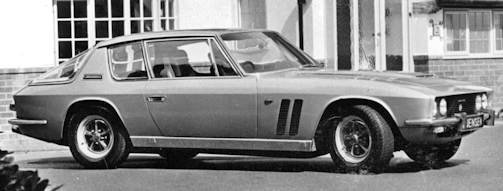
Jensen FF
The Jensen FF was the first production car with all-wheel drive and a mechanical anti-lock braking system (ABS). Formally, the FF was not an interceptor, but a separate series. The four-wheel drive required more space, so the entire stem had to be lengthened. Even if the FF looks quite similar to an Interceptor, it is easily recognizable by the modified front end with double side vents. It was built until 1971. In total 320 FFs were produced.
The production
1024 Mk1 built A total of 6640 units were manufactured, taking into account pre-series vehicles as well as SP-type vehicles.
Jensen Interceptor original
 |
|
|
Manufacturer |
Jensen |
|
Production |
1950 to 1957 |
|
Class |
Sports car |
|
Produced |
88 produced |
|
Body style |
2-door 4 seat saloon 2-door 4 seat convertible 2-door 4 seat sedan |
|
Engine |
3993 cc in-line 6 cylinder |
|
Transmission |
4 speeds with overdrive from 1952 |
|
Wheelbase |
112 in (2,845 mm) |
|
Length |
183 in (4,648 mm) |
|
Width |
66 in (1,676 mm) |
|
Height |
58 in (1,473 mm) |
|
Designer |
Eric Neale |
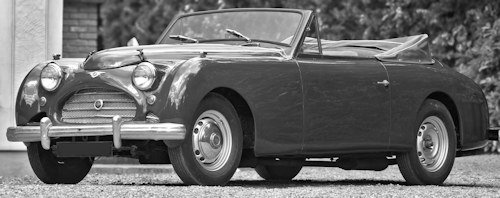
The first generation of Jensen Interceptor was built in the 1950s.
History
Available in two models a 4-5-seater saloon or a cabriolet of the same size. Both have two doors.The first generation of Jensen Interceptor was the second car to be made by Jensen Motors after World War II and was produced from 1950 to 1957. Jensen later reused the name for a different car (built from 1966 and revived several times after that). The 1950 Jensen model is entirely new.
The car was based on Austin components with a body built by Jensen and styled by Eric Neale. The engine and transmission came from the Austin Sheerline and the chassis was a lengthened version of the one used on the Austin A70 with a modified version of the independent coil sprung suspension. Jensen also made the Austin A40 Sports which was, in its styling, a scaled down version of the Interceptor.
The two-door body was available at first as a convertible and made from a mix of aluminium and steel on a wood frame. The entire front section hinged forwards to give access to the engine. Lamps and so forth, can be hinged upwards from the scuttle to give unusually easy access to the engine and forward chassis components for major maintenance work such as valve adjustment. The chassis has been made even more rigid by the addition of 5-in. diameter side tubes and the control pedals and steering wheel have been moved forward to give more room in the back seat. Ventilation of both the interior of the car and under the bonnet has been improved by the provision of carefully-sited air in-takes and the side lamps have been transferred to the top of the wings.
The new Interceptor cabriolet with striking lines, with a sweeping full- width body and modern front incorporating built-in head-lamps
and a low radiator grille. It takes the form of an extremely modern-looking two-door cabriolet, with a similar engine to the saloon but a much smaller and lighter chassis providing an exceptionally good power-weight ratio for high performance, coupled with drop-head coachwork. The use a six-cylinder engine three carburettor push-rod-operated carburettor. unit, developing 130 BHP. the use of a hypoid rear axle the chassis is a system of coil springs, radius arms and a Panhard rod at the rear, with, independent front suspension also by coil springs. the familiar Jensen radiator has been cleverly incorporated in the forward portion of the bonnet top. Of the two-door type, the body is planned as a five/six-seater with a front width of 55 ins. and a corresponding dimension at the rear of 47 ins. Thanks to a low- built chassis, it has been possible to keep down the overall height without sacrifice of head room, The hood section being arranged to drop complete into the rear portion of the body when the head is folded.
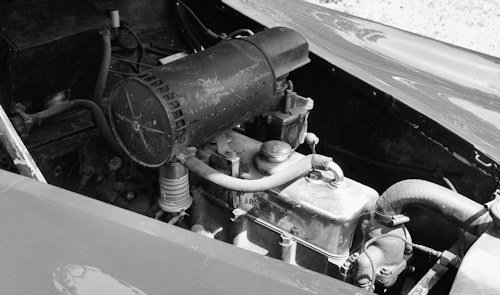
At the front a system of independent suspension incorporating coil springs and wishbones is used, but at the rear the Interceptor chassis suspension by the use of semi-elliptic springs. Brakes are of the Girling Hydro- mechanical type with two-leading shoes at the front, the Borg and Beck clutch and four-speed synchromesh gearbox with a top ratio of 3.22 to 1 optional overdrive in 1952. When the Laycock de Norman Ville overdrive was fitted a lower, 3.77:1, rear axle gearing was used.The Overdrive is engaged by a sidewaysflick of the centrally-situated, re-mote-control gear lever. You don't have to touch the clutch and the position of the gear lever is such that when you want to dis- engage the overdrive you can do so by gently pressing your left knee against the knob of the lever.
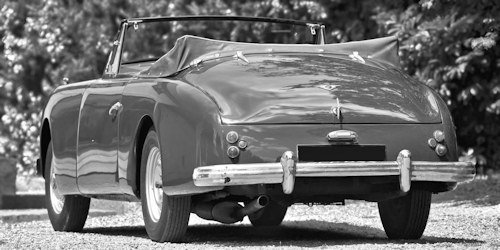
The wrap around rear window was made of rigid plastic (Perspex) and was arranged to drop down into a well for stowage when the top was lowered. In 1952 a hardtop version with fabric covered roof was launched and a few sedans version were also made.In 1952 the car cost £2645 (including tax) on the home market. The overdrive was an extra £116.Total production was 32 convertibles, 52 saloons and 4 sedans.
Jensen-Healey
 |
|
| Manufacturer | Jensen |
|---|---|
| Production | 1972 to 1976 |
| Class | sports car |
| Body style | 2-door convertible 2-door coupé |
| Engine | 1973 cc Lotus 907 engine |
| Transmission | 4 or 5 speed manual |
| Wheelbase | 92.01 in, 2,337 mm |
| Length | 161.93 in, 4,113 mm |
| Width | 63.23 in, 1,606 mm |
| Height | 47.64 in, 1,210 mm |
| Ground clearance | 5 in, 127 mm |
| Dry weight | 2,650 1b, 1,202 kg |
| Cost New | GB: £1,620. USA: $4,595. |
The Jensen-Healey is a two-seater convertible sports car that was originally produced between 1972 and 1976 by Jensen Motors, Ltd.
History
With the demise of the Austin-Healey 3000, car dealer Kjell Qvale was looking for a new product to replace it. He entered into discussions with Donald Healey and Jensen Motors, who had built the bodies for Healey's Austin-Healey cars. Kjell Qvale became a Jensen shareholder and Donald Healey became the chairman.
The Jensen-Healey was designed in a joint venture by Donald Healey, his son Geoffery, William Towns and Jensen Motors. It was hoped that Healey could help to contribute the sense of style that made the Austin-Healey a hit. The unitary body under structure was designed by Barry Bilbie, who had been responsible for the Austin-Healey 100, 100-6 and 3000 as well as the Sprite.
It was designed to be cheap to repair, with bolt-on panels, to reduce insurance premiums. In 1974, United States Government-mandated rubber bumpers were attached.Roughly 10,000 were produced at West Bromwich, England. A related fastback, the Jensen GT was introduced in 1975. Jensen Healey Mark I: March 1972 – May 1973; VIN 10000 – 13349 in total 3356 manufactured the Jensen Healey Mark II and JH5: August 1973 – August 1975; VIN 13500 – 20504 a total of 7142 manufactured Jensen GT coupe: September 1975 – May 1976; VIN 3000 – 30510 (only 511 manufactured).
Engines

During development, the use of very different motors was tested The Vauxhall 2.3 L engine met United States emission requirements but did not meet the power target of 130 hp (97 kW). Aggregates from Ford, BMW could not supply an engine in the volumes needed, Saab and Porsche were discussed. In the end, the new Lotus 907 four-cylinder engine with a displacement of 1973 cubic centimetres was chosen, which was also to be used in the Lotus Esprit from 1976. The engine with two overhead camshafts, 16 valves all-alloy powerplant and two Dell ‘Orto carburettors (for the American market Stromberg carburettors were used for emission) puts out 144 hp in the Jensen Healey.
PERFORMANCE
- max power (DIN): 140 hp at 6,500 rpm
- max torque (DIN): 130 1b ft, 17.9 kg m at 5,000 rpm
- max engine rpm: 7,000
- power-weight ratio: 19 lb/hp, 8.6 kg/hp
- acceleration: standing 1/4-mile 16 sec, 0-50 mph (0-80 km/h) 5.7 sec
- fuel consumption: 22 m/ imp gal, 18.2 m/US gal, 12.9 1 x 100 km.
- max speeds: (l) 40 mph, 64 km/h; (Il) 63 mph, 101 km/h; (Ill) 97 mph, 156 km/h; (IV) 123 mph,198 km/h
The initial transmission was a four speed Chrysler unit sourced from the Sunbeam Rapier. Later a Getrag 235 five speed was used. Interestingly on the five-speed gearbox the fifth gear is not an overdrive gear but a direct 1:1 ratio making this a Close-ratio transmission. Suspension was simple but effective with double wishbone and coil springs at the front, and a live rear axle with trailing arms and coils at the rear. Brakes consisted of discs at the front and drums at the rear. The suspension, steering gear, brakes and rear axle were adapted from the Vauxhall Firenza with the exception of the front brakes which were the widely used Girling Type 14 Callipers.

Jensen-Healey interiors started out austere and functional, with plastic centre consoles and all-black colour schemes. (Some earlier models have sport brown interiors, however.) In August 1973, aesthetic extras such as a clock, wood grain on the dashboard and glove-box and padding as well as air conditioning as an option were added. 1976 Jensen GT models went even further by offering an elaborate burr walnut wood dashboard and paisley-patterned cloth seats, with leather as an option. Inside by late 1973 as well as air conditioning as an option.
The oil crisis hit Jensen Motors hard, greatly damaging the sales of their very large V8 Interceptor model and thus degrading their financial condition as a whole. The Jensen GT was then hurriedly brought to market, requiring massive labour expense and taxing the firm's budget even further. As the Jensen-Healey continued to garner mediocre sales in the United Kingdom (though the car was relatively popular in the United States), the situation proved to be too much for the company, which, amid strike action, component shortages and inflation, proceeded to liquidate in 1975 and close their doors in May 1976.

Jensen Interceptor Mark III
 |
|
|
Production period: |
1971 to 1976 |
|
Class: |
sports car |
|
Body versions: |
Estate, coupe, cabriolet |
|
Engines: |
V8 7.2 litres |
|
Length: |
179.80 in, 477 cm (Convertible) 183.50 in, 466 cm |
|
Width: |
68.90 in, 175 cm |
|
Height: |
53.15 in, 135 cm (Convertible) 54 in. 137 cm |
|
wheelbase: |
105.12 in, 267 cm |
|
Dry weight: |
3,506 1b, 1,590 kg |
The Interceptor mark III was a sports GT car from the 1970s by the British manufacturer Jenson built from 1971 to 1976
History
The Jensen Interceptor remained in production for 11 years. During this time, around 7,200 vehicles were built in three series. During the production period, the company experienced considerable economic turbulence, which was mainly triggered by the cancellation of the production order for the Austin Healey without replacement. At the beginning of the 1970s there was a change of ownership; Jensen was taken over by US entrepreneur Kjelle Qvale, who continued Interceptor production without initiating the development of a successor. As a result of the first oil crisis, the company went bankrupt in 1975, after which Jensen stopped producing cars. A successor company called Jensen Parts and Service took over the supply of spare parts and service for existing vehicles and also manufactured some new vehicles in the late 1980s.
The body of the Interceptor was made of steel. The Interceptor was created in three body versions. The basic and by far the most produced version was a closed two-door hatchback known as a saloon, whose outstanding design feature was a large panoramic rear window that also served as a tailgate. In the English-speaking world it is often referred to as a "goldfish bowl". From this model, a two-door convertible and finally a two-door notchback coupé was derived in 1974.

The saloon was created in three series, which differed from each other technically and visually; The cabriolet and coupé were manufactured exclusively in the configuration of the third series. Standard features include reclining backrests, electrically-controlled windows, electrically- heated rear window; air-conditioning and even a warning light for worn brakes.
For the Interceptor, Jensen took over the tube frame chassis from its predecessor, which was largely designed by Kevin Beattie, as well as the basic features of the suspension. As there, the front wheels were individually suspended on double wishbones with coil springs, at the rear Jensen used a rigid axle with leaf springs and Panhard rod.
For the series III, Jensen switched to a 7.2 litre (440 cu in) eight-cylinder RB series. Comparable engines were also used by Jensen's competitors Bristol and Monteverdi. The fourth series of the Interceptor, which was manufactured in small numbers by a successor company from 1983, had a smaller eight-cylinder engine with a displacement of 5.9 litres.
PERFORMANCE
- max power (SAE): 300 hp at 4,800 rpm
- max torque (SAE): 410 1b ft, 56.6 kg m at 3,400 rpm
- max engine rpm: 5,200; 41.5 hp/l
- power-weight ratio: 11.7 lb/hp, 5.3 kg/hp
- acceleration: 0-50 mph (0-80 km/h) 5 sec; speed {in direct drive at 1,000 rpm: 26.5 mph, 42.6 km/h
- fuel consumption: 17 m/imp gal, 14.2 m/ US gal
- max speeds: (1st) 56 mph, 90 km/h; (2nd) 95 mph, 153 km/h; (3rd) 135 mph, 217 km/h
The power was transmitted by an automatic three-speed gearbox from Chrysler (type Torque Flite). A fully synchronized manual four-speed gearbox was initially available for the first series saloons, but this was only ordered 23 times.
Body styles
Saloon (GT)
The first and by far the best-selling version of the Interceptor is the closed two-door until early 1974 it was the only version. In the eleven years of construction with the third series being subdivided again. Over the course of time, the series underwent numerous detailed changes that related to the drive technology as well as the body design and the interior.
The body largely corresponded to the Mk. 2; however, the car received standard alloy wheels and a modified interior. From November 1971, Jensen also replaced the 6.3-liter engine with an eight-cylinder engine with a displacement of 7.2 litres, which was still sourced from Chrysler. Right- hand drive vehicles continued to have the engine of the previous model until May 1972. The reason for the change was the reduced performance of the engines due to the American emissions laws. Increasingly strict laws required lower compression, resulting in a significant loss of power. To compensate for this, Jensen, like other Chrysler customers, was forced to use engines with larger displacements. However, even with the 7.2 litre engine, which delivered 285 hp (210 kW), the Mk. 3 was less sporty than the early Mk. 1 models, as the larger engines were heavier and limited the vehicles' manoeuvrability.

Convertible
Jensen presented a convertible version of the Interceptor in 1974, especially with a view to the US sales market and the success of the Rolls-Royce Corniche Convertible there. The company worked against the trend. The general expectation in the automotive industry was that American safety regulations would prevent full convertibles from being approved in the foreseeable future. As a result, most American manufacturers phased out their convertible models by the mid-1970s. In fact, such a regulation was never issued.
Technically, the Interceptor Convertible corresponded to the Saloon Mk. 3. The chassis of the Saloon was only reinforced in a few places - especially on the frame of the windshield and on the rear wheel arches; apart from that it remained unchanged. The fabric roof was opened and closed by means of a hydraulic system; the process only worked when the vehicle was stationary.
The cabriolet is considered particularly elegant and is one of the most sought-after, but also most expensive models of the brand. Unlike the saloon, the cabriolet, which was tailored to the American market, was mainly sold as a left-hand drive. When it was launched in 1974, the convertible cost £9,863. The Bristol 412, which was presented at the same time, reached a price level comparable to that of the Interceptor, although it was manufactured in significantly smaller quantities.
Only around 500 copies were made by 1976, most of which were sold to the USA market.
Coupe
The rarest version of the Interceptor is the coupe, which was presented at the Earls Court Motor Show in London in October 1975, just before the company went bankrupt. Unlike the saloon, the coupé featured a notchback. It was based on the body-in-white of the Interceptor Convertible, but received a hardtop instead of the soft top. The hardtop was not manufactured by Jensen itself, but by the British small series manufacturer Panther Westwind’s.
From three different prototypes created by Panther, a hardtop was selected for series production, which was equipped with a window made of tinted polymethyl methacrylate (Plexiglas) behind the doors. The window stretched like a roll bar through the roof, which was otherwise covered with imitation leather. The rear window corresponded to that of the Jaguar XJ-C, the chrome "Coupé" lettering on the rear fenders were taken over by the Morris Marina. By the time production finally stopped in 1976, 46 according to other sources 47 or 54 vehicles had left the West Bromwich plant, of which around 40 still exist today.
Jensen SP
The Jensen SP was introduced in 1971 as the successor to the FF. The designation SP stood for "Six Pack" referring to the carburettor combination. Externally and technically, the SP fully corresponded to the Interceptor Mk. 3. The main difference was a significantly more powerful engine. For the SP, Jensen used a 7.2-litre eight-cylinder engine fitted with three twin Holley carburettors. The power was given as 385 hp (gross) or 330 hp (net), the maximum torque was 556 Nm and was generated at 3,600 rpm.
PFORMANCE: SP
- max speed: 150 mph, 241 km/h
- max power (SAE): 385 hp
- max torque (SAE): 490 1b ft, 67.6 kg m at 3,200 rpm
- power 53.4 hp/l
- power-weight ratio: 10.4 lb/hp, 4.7 kg/hp
- fuel consumption: 14 Imp gal, 11.6 m/US gal, 20.2 1 x 100 km.
The car was powerful but had a very high consumption, which averaged 28 or 35 litres per 100 km, depending on the source. In addition, the car required a lot of maintenance; the carburettors had to be adjusted on average once a month (or every 500 km). The very expensive SP could not be exported to the United States because it did not meet American emissions legislation, so it was primarily reserved for the British market. By 1973, 232 copies were built, most of which had right-hand drive.

The production
A total of 6640 units were manufactured, taking into account pre-series vehicles as well as SP-type vehicles.
In the 2013 film Fast & Furious 6, Dominic Toretto's girlfriend Letty Ortiz drives a matte Gray Jensen Interceptor. In the film "Russian Roulette", a British-Canadian production (1975), George Segal drives a Jensen Interceptor Saloon. In the first two seasons of the BBC production of Inspector Linley, the title character drives a blue Interceptor Mk. 3.


