
Isuzu
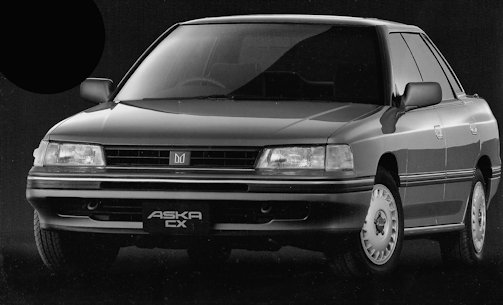
Isuzu Aska Second Generation
 |
|
|
Production period: |
1990 to 1993 |
|
Class: |
Motor Car |
|
Body versions: |
saloon |
|
Engines: |
Gasoline : 1.8-2.0 litres |
|
Length: |
4510 mm |
|
Width: |
1690 mm |
|
Height: |
1380-1400 mm |
|
Wheelbase: |
2580 mm |
|
Curb weight: |
1460 kg |
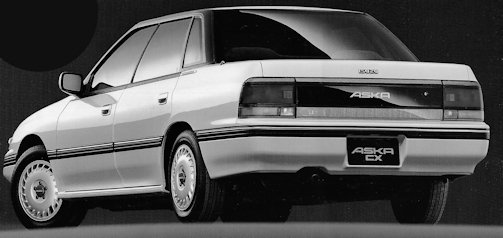
Isuzu Aska Second Generation was four-door saloon built in the 1990s based on the Subaru Legacy.
History
In 1988, a successor was presented, Isuzu had a short-lived alliance with Subaru and the model which corresponded to the contemporary Subaru Legacy from the Subaru the Aska differed only by the emblems.
Correspondingly the quantities sold were low with 1.8 and 2.0-Liter displacements Subaru EJ injection or carb engines along with optional AWD system with front independent wheels, coil springs at the rear independent, telescopic dampers and anti-roll bar.
Performance: 2.0L
- Top speed 180 km/h
- Acceleration 0-100 km/h 16,0 sec
- Fuel consumption litres 8,2/100 km.
- Max power 74 (bhp DIN 100) at 5.400 rpm
- Max torque Nm 158 at 3.000 rpm
- Power/litre 50,2 bhp.
Isuzu Bellet GT type R
 |
|
|
Produced |
1969 to 1973 |
|
Class |
Sports car |
|
body type |
2 door coupe |
|
Drive system |
FR |
|
transmission |
5-speed MT |
|
Wheelbase |
2,350mm |
|
full length |
157.68 in, 4,005 mm |
|
Height |
52.17 in, 1 ,325 mm |
|
vehicle weight |
970kg |
|
Top speed |
118 mph, 190 km/h |
The Isuzu Bellet GTR was a performance version of the Bellet built from 1969 to 1973.
History
The performance "GT-R", "GTR" or "GT typeR" PR91W, official name "GTR" for the previous model, and changed to "GT typeR" in 1970 when it underwent a minor change. The top-of-the-line model of the "Bele G" modelled after the Bellet GTX, which won the Suzuka 12-hour endurance race in August 1969.
The engine was replaced with a 1,600cc G161W DOHC twin Mikuni-Solex 40 PHH downdraught twin barrel carburettors for the 117 coupes, the suspension was reinforced with springs on both the front and rear wheels, and servos were added to the brakes.
- PERFORMANCE: Isuzu Bellet GTR
- Max power (DIN): 120 hp at 6.400 rpm
- Max torque (DIN): 105 1b ft, 14.5 kg m at 5.000 rpm
- Max engine rpm: 7,000:
- Specific power: 76 hp
- Power-weight ratio: 17.9 1b hps 8.1 kg: hp
- Acceleration: standing 1/4 mile '6.6 sec
- Fuel consumption: 28.2 m, imp gal, 23.5 m/ US gal, 10 1 x 100 km.
- Max speeds: 35 mph, 57 km/h in 1st gear: 64 mph. 103 km: h in 2nd gear; 91 mph, 147 km/h in 3rd gear; 118 mph, 190 km/h in 4th gear
The exterior features are the front bumper divided into two and fog lamps as standard equipment. A black two-tone colour and a dedicated side stripe are also available as optional colours. After minor changes in October 1971, it became a black mask style, and the tail lamps were also enlarged. It was produced until March 1973 and sold until June of the same year, but the total production was about 1,400. The "TYPE R" emblem used for this model was also carried over to the 3rd generation Gemini (including Coupe and PA Nero) Irmscher R.
Isuzu Florian Series 1
 |
|
|
Production |
November 1967 to 1977 |
|
Class |
motor Car |
|
designer |
carrozzeria gear |
|
body type |
4 -door sedan,5-door light van estate |
|
Drive system |
rear wheel drive |
|
engine |
1.6L G180 type, 1.8L C190 type |
|
Wheelbase |
2,500 mm |
|
full length |
4,430mm |
|
Width |
1,620mm |
|
Height |
1,445mm |
|
vehicle weight |
1,345 kg |
The Isuzu Florian Series 1 is a medium-sized passenger car sold by Isuzu Motors from 1967 to 1977.
History
The Florian was a medium-sized car. The styling of this car has been first commissioned to Filippo Sabine of "Carrozzeria Gear" and Giugiaro Italy 's Carrozzeria Ghia."Florian" is the name of the pure white horse of the Austrian emperor, and its name is derived from Saint Florian over Florian's unusually long production time; Overall, there were only two rather minor facelifts. The Florian was developed together with the Isuzu 117 Coupé, it was not commercially successful but was produced for over 15 years without any major improvements. The "117 Saloon", which was the base of the Florian, was exhibited at the 13th Tokyo Motor Show in October 1966 along with the "117 Sports" (117 Coupe prototype) These featured round 4-lamp front view and rear combination lamps are very different from the production model.
The model’s name range was PA20 for the 1,600cc engine model, and PA30 for the larger 1,800cc engine model, with also a diesel model as the PAD30 The initial development code 117 for the saloon and coupe both cars share the chassis.
PERFORMANCE: 1.6L
- Engine Capacity 96.66 cu in, 1,584 cu cm
- Fuel Consumption 31.4 m/imp gal, 26.1 m/US gal, 9 1 x 100 km
- Max Speed 93.2 mph, 150 km/h
- Max power (SAE): 84 hp at 5,200 rpm
- Max torque (SAE): 90 1b ft, 12.4 kg m at 2,600 rpm
- Max engine rpm: 5,800
- Specific power: 53 hp/l
- Power-weight ratio: 24.7 lb/hp, 11.2 kg/hp
- Acceleration: standing 1/4 mile 18.9 sec, 0—50 mph (0 —80 km/h) 10.6 sec
PERFORMANCE: 1.8L
- max power (DIN): 100 hp at 5,400 rpm
- max torque (DIN): 106 1b ft, 14.6 kg m at 3.000 rpm
- max engine rpm: 6.300
- acceleration: standing 1/4 mile18.1 sec
- fuel consumption: 25.7 m/imp gal, 21.4 m/US gal
There are two types of body, the 4 -door sedan and a 5-door light van. Since its introduction in 1967 to 1983, it continued for a long period of time with only two minor changes. Most of the demand was for commercial use such as cars, taxis. For this reason, the number of production units is nearly double that of the 117 Coupe. The total production volume in 15 years is 145,836 units that includes 42,625 vans.
The drive system was rear-wheel drive, which was common at the time. There are several engine and grade settings. The suspension is a four-wheel independent suspension (except for the B type) of the preceding Bellet, while this car has double wishbones + coil springs on the front wheels, rigid axles + leaf springs on the rear wheels, and recirculated. It is a very conventional specification called a ball type steering gear.
1967 November-Announced and released. With its reverse slant shape on both front and rear, the silhouette with a lowered rear end, 6-light cabin, and large irregular square headlamps, the exterior has a strong European car look. The front uses a new emblem that Isuzu began to adopt at that time, the "eye mark" (a design similar to a weight, with two vertically long ovals placed in a circle). The engine was a Bellett GT 1,600cc OHV gasoline engine that was tuned for ease of handling, but changed to SOHC in 1969. The transmission was a 3-speed MT at the time of its debut, but it was changed to a 4-speed MT the following year. The rear lamp of the sedan is a small combination lamp of a tail lamp that also serves as a brake lamp and turn signal, and a backup lamp (backup lamp), and is extremely simple.
June 1968 there was added light van. with flip-up back door by 1969 Implemented the first minor change to the design of the front grill. The sedan's rear lamp was changed to a large, three-dimensional one, and the rear turn signal was changed to an independent type with an amber lens in order to comply with the revision of the law at the time. Therefore, Florian with a small rear lamp will be produced for a short period of less than two years.

The TS version "Touring Sports", was introduced and it is fitted with twin carburettors. Initially, the 1,600cc OHV gasoline engine for the Bellett was installed as it was, but it was changed to SOHC immediately after, and in the mid-term model transition in 1970 it was completely switched to the 1,800cc SOHC gasoline engine for the 117 coupes, and the mode becomes the PA30 type. The PA20 type TS had the same image as the Bellet GT with its optional matte black bonnet and front design.
By October 1970 the Second minor change. to round 4 headlamps. Even with the same round 4 lamps. The method of replacing light bezels and grilles from metal pressed parts with large resin moulded parts to achieve both a three-dimensional shape and a reduction in the number of parts, which was difficult in the past, was seen in all automobile manufacturers of this era. The sedans shape of the backup lamps, reflectors, have changed. Both the front and rear were redesigned to make the car look bigger, but the matching with the original body line. The 1,600cc SOHC gasoline model PA20 and the 1,800cc SOHC gasoline engine model PA30 were added.

November 1973 -Implemented more minor changes. The front turn signal has been changed to the one common to the 117 coupes. The light van was also changed at the same time, but since the number of productions was smaller than that of the sedan. In November 1975 new changes due to exhaust gas regulations. The 115-horsepower sporty specification TS, which is difficult to deal with, and the 1800DX automatic finished.

Isuzu Unicab
 |
|
|
Production period: |
1967 to 1974 |
|
Class: |
motor car |
|
Body versions: |
Pickup, Cabriolet |
|
Engines: |
Gasoline : 1.3-1.6 litres |
|
Length: |
143.90 in, 3,655 mm |
|
Width: |
59.05 in, 1,500 mm |
|
Height: |
67.32 in, 1,710 mm |
|
Wheelbase: |
82.68 in, 2,100 mm |
|
Curb weight: |
2,172 1b, 985 kg |
|
Price new |
¥ 490,005 |
The Isuzu Unicab (Yunikyabu) was the first SUV that Isuzu produced from 1967 to 1974.
History
The model was first introduced at the Tokyo Motor Show 1966 and offered from July 1967 on the domestic market at a price of ¥ 490,005.
The Unicab was initially only as a pickup with 4 seats. In 1970, the model was offered with 2 side benches on the loading area, which increased the capacity to 8 seats from the KR85 type, with 2 front seats and 3 rear seats facing each other. Shortly after the launch, the model was also offered with soft top and was now available as a convertible. The windscreen could be folded, which was not allowed due to new safety standards from 1970 and was changed in production. The front and rear suspension was the company's small truck with independent, wishbones, torsion telescopic dampers and rigid axle, semi-elliptic leafsprings at the rear.
The Unicab was designed more for younger buyers than recreational vehicles and for the city and therefore had no four-wheel drive. However, the concept for the Japanese domestic market was too early to attract this kind of buyers. Accordingly, sales were low and production stopped in 1974. it was not until Six years later, that Isuzu introduced in 1980 with the Isuzu Faster Rodeo for the first time a SUV with four-wheel drive.
Initially, it was powered by a 1.3-liter gasoline engine with 1 Hitachi-Solex downdraught carburettor this early KR80 type engine was also a 1.3-liter G130 type engine for Bellett, which was later enlarged to 1.5 and 1.6 litre engines, which are also common in the Bellett and Florian.
PERFORMANCE:1.5L
max power (SAE): 68 hp at 5,000 rpm
max torque (SAE) : 82 1b ft, 11.3 kg m at 2,200 rpm
specific power; 46.2 hp/l
power-weight ratio: 32 lb/hp, 14.5 kg/hp
speed in direct drive at 1,000 rpm: 14.9 mph, 24 km/h
fuel consumption: 33.2 m/ imp gal, 27.7 m/US gal, 8.5 1 x 100 km.

Isuzu Aska First Generation
 |
|
|
Make: |
Isuzu |
|
Production period: |
1983 to 1988 |
|
Class: |
Motor Car |
|
Body versions : |
saloon |
|
Engines: |
Gasoline: 1.8-2.0 liters (77-110 kW) |
|
Length: |
4440 mm |
|
Width: |
1670 mm |
|
Height: |
1375 mm |
|
Wheelbase : |
2580 mm |
|
Curb weight : |
975-1170 kg |
The Isuzu Aska was a passenger car model of the Japanese manufacturer Isuzu . It was introduced in 1983.
History
The Isuzu Aska was built on the basis of GM developed platform J , and was thus directly related to the Opel Ascona C and Chevrolet Cavalier . The Aska was intended primarily for the Japanese domestic market, as well as for Southeast Asia and Australia (Holden JJ Camira), but was sold, for example, in Chile as Chevrolet Aska.nd LX (tinted windows, center armrests, etc.)
1985 also appeared a sports version called Aska Irmscher . The program initially included 1.8 and 2-liter gasoline engines and a two-liter naturally aspirated diesel engine. In 1985, all engines were stronger, a two-liter turbodiesel supplemented the engine range. All Aska had a standard five-speed gearbox and were partly available on request with a three-speed automatic transmission or an automated five-speed gearbox (called NAVI5).
The car was only available as a four-door notchback sedan.The equipment levels initially included: base LT, LT Extra (power steering, wide tires), LS (sports equipment)

