
Intermeccanica
- Details
- Parent Category: I
- Category: Intermeccanica
- Hits: 41
Intermeccanica Indra
 |
|
|
Production period: |
1971 to 1975 |
|
Class : |
sports car |
|
Body versions : |
Coupe , convertible spider |
|
Engines: |
Gasoline : 2.8-5.7 liters |
|
Length: |
176.38 in, 4,480 mm |
|
Width: |
70.47 in, 1,790 mm |
|
Height: |
46.46 in, 1,180 mm |
|
Wheelbase : |
98.43 in, 2,500 mm |
|
Curb weight : |
2,536 1b, 1,150 kg V8: 2,844 1b 1,290 kg. |
The Intermeccanica Indra was a sports car of the Italian car manufacturer Costruzione Automobili Intermeccanica , which was manufactured between spring 1971 and early 1975 in Turin .
History
The Indra was designed by Franco Scaglione and constructed by Erich Bitter . Like its predecessor, the Intermeccanica Italia , the Indra had a European-designed sports car body, which was associated with American drive technology from mass production The Austrian engineer Friedrich "Fritz" Indra while driving a Indra himself, but was not involved in the development, as is sometimes claimed. Depending on the source, the model name can be traced back to the Hindu goddess Indra.
Erich Bitter mediated in the course of 1970, a contact between Intermeccanica and General Motors . A short time later, the decision was made not to use components from Ford USA for the new Intermeccanica model , but to use the drive technology of the Diplomat V8 , the largest and most expensive vehicle from General Motors of European production. At the same time, General Motors was to organize the distribution of wagons in Europe via its Opel dealers. The agreement was similar to the agreement de Tomaso had with Ford for the production and distribution of de Tomaso Pantera .
The connection with General Motors was beneficial for Intermeccanica. The drive technology of the Diplomat - and in particular its 5.4-liter eight-cylinder engine - was based essentially on American designs. As a result, Intermeccanica still had simple and robust engines, which were now also easily and quickly available in Europe - through Opel dealers. Finally, Opel's large dealer network ensured secured maintenance.
PERFORMANCE: 2,784 cc 6 cylinders
- Max speed: over 130 mph, 210 km/h
- Max power (DIN): 190 hp at 6.200 rpm
- Max torque (DIN): 204 1b ft. 28.2 kg m at 4,500 rpm 68.2 hp/l
- Power-weight ratio: 13.2 lb/hp, 6 kg/hp
- Fuel consumption: 23.7 m/ imp gal, 19.8 m/ US gal
PERFORMANCE: 5,354 cc 8 cylinders
- Max power (DIN) 250 hp at 5,000 rpm
- Max torque (DIN) 322 1b ft, 44.5 kg m at 3,400 rpm 46.7 hp/l
- Max speed over 155 mph, 250 km/h
- Power-weight ratio 11.5 lb/hp, 5.2 kg/hp
- Fuel consumption 19.1 m/imp gal, 15.9 m/US gal, 14.8 1 x 100 km.
PERFORMANCE: 5,733 cc 8 cylinders
- max speed: about 162 mph, 260 km/h
- power-weight ratio: 11.9 lb/hp, 5.4 kg/hp
- fuel consumption: 14.1 m/imp gal, 11.8 m/US gal.
- max power (DIN): 280 hp at 5,600 rpm
- max torque (DIN): 301 1b ft, 41.5 kg m at 4,000 rpm 49.1 hp/l
Around this technique, the company developed a largely new chassis. New features included a DeDion rear suspension, four disc brakes and a state-of-the-art automatic transmission from General Motors.
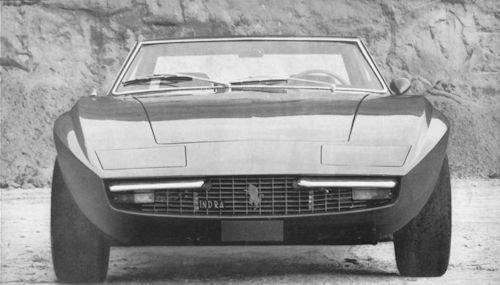
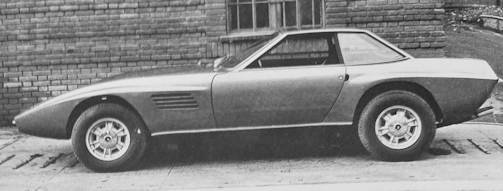
Franco Scaglione once again designed the bodywork. The basic layout of the Italia was preserved: The Indra had a long, sloping bonnet with the engine behind the front axle, a terse passenger compartment with two seats (some with two more emergency seats) and a short tail. The front end was now smoothed: Instead of the recessed round individual headlights of Italia saw a folding headlamp construction. The fenders were noticeably bulging at the front and rear, and there was also a curved line over the rear wheels. The rear bumper was high; the taillights (from the Alfa Romeo Giulia ) were mounted under it. This order cited a corresponding feature of the Lamborghini Islero .
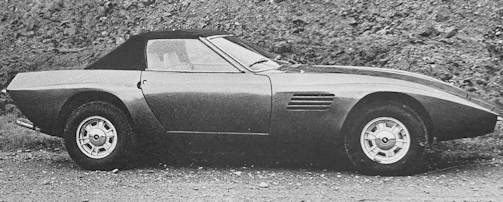
Scaglione designed three body versions:
- a two-seater convertible
- a two-seat notchback coupé with generously glazed roof construction. The coupe was basically a convertible with an attached hardtop .
- With a delay of two years also a hatchback coupe with two full-fledged and two emergency seats. The vehicle's profile bore some resemblance to the Maserati Ghibli , a successful Italian sports car of the late 1960s.
The Intermeccanica Indra was presented to the public at the Geneva Motor Show in March 1971. Immediately after the mat took Intermeccanica to mass production. The vehicles were initially distributed only in Europe. Two years later, the Indra was also presented to the American public at the New York Automobile Show . The car was received there kindly, and contemporary press releases report some orders from American customers.
During 1973, General Motors withdrew from the alliance with Intermeccanica. The reasons for this were problems with the quality of the Italian vehicles, which led to financial burdens in the warranty and repair area. Also in this respect, there is a similarity to the history of Ford with the De Tomaso Pantera . General Motors stopped supplying the company with technical components; In addition, sales through the Opel dealers ended. Even Erich Bitter separated from Intermeccanica. Shortly thereafter, he made a very similarly designed, but produced at Baur in Germany coupe called Bitter CD which was successful in Europe in the 1970s. This project was supported by General Motors.
For Intermeccanica, the separation from General Motors meant the end of Indra production in the medium term. Intermeccanica first tried to obtain the necessary parts from Opel dealers. That was, however, associated with much higher prices. In addition, since the sales was no longer secure, Intermeccanica had to stop the production of sports cars in the winter of 1974/1975, after 125 copies were created.
In 1975, the company stayed afloat with the production of some Jaguar SS100 replicas. At the same time, a few other Indra coupe with drive technology from Ford emerged as prototypes for a second series, the Intermeccanica initially wanted to produce from a new base in San Bernardino in California . One of the vehicles was shipped to California with all its production equipment; However, the project ended before its realization, as the (California) financier retired at short notice. The extent of production of Indras with Ford technology is not unequivocally clarified. The Intermeccanica Enthusiasts Clubspeaks of only two copies, of which only one has reached a running condition; assumes 15 copies that did not go into regular distribution but were auctioned off.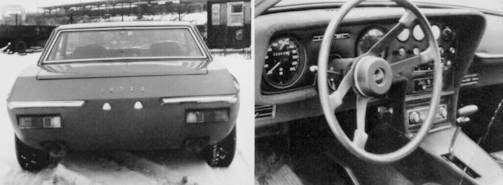
- Details
- Parent Category: I
- Category: Intermeccanica
- Hits: 53
Intermeccanica History
Founded 1959 Turin, Italy

Costruzione Automobili Intermeccanica or more simply Intermeccanica was an Italian manufacturer of automobiles. Today known as Intermeccanica International Inc.
History
Frank Reisner and his wife Paula founded the North-East Engineering Company in Turin in 1959. Later it was renamed Costruzione Automobili Intermeccanica. As a brand name Intermeccanica was chosen. First, they manufacture vehicle tuning kits. 1960 began the production of automobiles. The brand name was initially IMP for a model. Thereafter, Intermeccanica developed and partially assembled vehicles for other manufacturers, but the distance between Italy and its US partners was often a problem. In 1967 marketing began as Intermeccanica, from 1973, business was running badly. On December 25, 1974, the company was dissolved. The Reisner family moved to the USA and founded Automobili Intermeccanica in North America the products were imported by STEBRO, which marketed them under its own brand.
Vehicles
In 1960, the first complete vehicle of Intermeccanica was built. It was a Formula Junior race car with a modified Peugeot engine. He was behind the driver in front of the rear axle. Displacement was reduced to 1.1 l with liners and smaller pistons. The transmission came from Fiat (Fiat used this type in the Fiat 600), but was installed in reverse because of the central engine, so with the clutch bell forward and the top down from 1960 to 1961 there was the IMP 700 GT with the brand name IMP (for Intermeccanica Puch). This was a small coupe. A boxer engine from Steyr Daimler Puch powered the vehicles. The two-cylinder boxer engine with 80 mm bore, 64 mm stroke and 645 cc displacement provided 40 hp in the standard version. Of these, 21 vehicles were created.

Apollo and Vetta Ventura
The Apollo was a two-seat sports car. Intermeccanica made the chassis, the body and the interior, with the completion of the cars mostly at the Turin specialty Carbondio was. The finished cars were delivered to the USA. There were successively different companies that completed the vehicles and offered under their name. From 1962 to 1964 it was International Motorcars (short IMC) from Oakland in California with the brand name Apollo and the model Apollo GT. 1964 satVanguard Motors Corporation of Dallas in Texas continued the project under the Vetta Ventura brand. In 1965, the Apollo International Corporation, led by Attorney Stevens, ordered additional copies, for which the brand name Apollo again 39 Apollo from IMC, 42 Vetta Ventura and 8 Apollo from Apollo International, totalling 89 vehicles. Reported 77 are two-seater coupe, a coupe with 2 + 2 Seats and 11 convertibles. A revised version as a coupe with 2 + 2 seats was created in 1966 for Griffith Motors of New York City. Plans amounted to 1000 vehicles. Nevertheless, only six vehicles were created.
Steve Wilder took over the project and marketed it under the brand name Omega. The manufacturer was Suspensions International Corporation of Charlotte, North Carolina. In the only production year 1966 created 33 vehicles. 1965 was based on a Ford Mustang a station wagon for J. Walter Thompson. Based on a Chevrolet Corvair there was the 1966 Phoenix for John Fitch & Co. In June 1971, the four-door sedan Centaur was built on the chassis of a Chevrolet Corvette.
The presented in March 1967 as Torino car corresponded largely to the omega. In October 1967 he was renamed after objection by Ford in Italia. The Italia’s were greatly appreciated in Europe and North America, so much so that at the 1969 New York Automobile Show, Intermeccanica presented itself with 3 different stands. At the Turin Motor Show of the same year, a variant, the "Italia IMX", was also presented, which however never reached production.

The production ran until 1973. For Murena Motors from New York City Intermeccanica made the Murena GT. This was a two-door station wagon with a V8 engine from Ford. From this emerged between March 1969 and March 1971, ten vehicles. Successor of the Italia was the Intermeccanica Indra. The model was produced between March 1971 and February 1975. In collaboration with Edward Felbin Intermeccanica made from 1973 the Squire. This was a replica of the Jaguar SS100. On a ladder frame, an open body made of glass fiber reinforced plastic was mounted. A six-cylinder engine from the Ford Maverick powered the vehicles. Of these, 100 vehicles were created: 33 white, 32 yellow, 30 red and 5 green. One half had a manual transmission, the other half an automatic transmission.


