
Humber
Humber New Imperial
 |
|
|
Production period: |
1964 to 1967 |
|
Body versions: |
saloon/sedan/Pullman limousine |
|
Engines: |
Petrol 3.0 litres (94.5 kW) |
|
Length: |
187.50 in, 4,762 mm |
|
width: |
70 in, 1,778 mm |
|
Height: |
59.75 in, 1,518 mm |
|
wheelbase: |
110 in, 2,794 mm |
|
curb weight: |
3,616 1b, 1,640 kg |
The Humber New Imperial was a luxury car in the 1960s, from the British company Humber and made from 1964 to 1967.
History
In 1964, 10 years later after the previous Humber New Imperial again a new model appeared, a unibody sedan with panoramic windows and tail fins. Basically, it was a Super Snipe Series V that was better equipped with a more luxuriously interior with every possible passenger comfort has been incorporated, like West of England clothor leather upholstery. deep nylon rug. reading lights.Rich walnut finish to facia and panelling. form-contoured for comfort, with individual Fully reclining front seats fitted as standard. front Seats and four padded arm-rests.include heating and ventilating systems, separate switches in each compartment, three cigar lighters, two in the rear compartment,push-button radio and lockable glove boxfor passengers in the rear compartment include two adjuslable reading lamps and two interior lights, two fold-away tables in walnut veneer.cigar lighters. Electrically adjustable rear shock absorbers ensure a restful ride over all terrain. The, 3-litre engine with fully automatic transmission and power-assisted steering provide completely effortless motoring.limousine has adjustable bench-type front seat, leather- trimmed, with sliding glass partition.Optional Accessories .Rear seat headrests; safety belts.
COLOUR SCHEMES
- Maroon with Beige West of England cloth or Fawn leather upholstery.
- Silver Grey Metallic with Grey West of England cloth or Blue/Grey leather uphoistery.
- Royal Blue Metallic with Grey West Of England cloth or Blue/Grey leather upholstery.
- Goodwood Green Metallic with Beige West of England cloth or Fawn leather upholstery.
- Embassy Black with Beige 'West of England cloth or Fawn leather upholstery.
- Embassy Black with Grey West of England cloth.

This had a vinyl roof and a standard Borg-Warner 35 automatic transmission, with hydraulic torque convertor and planetary gears with 3 ratios + reverse. The front suspension was independent, wishbones, coil springs, anti-roll bar and telescopic dampers,with the rear suspension set had rigid axle, semi-elliptic leaf-springs, anti-roll bar, telescopic dampers that could be electrically adjustable while running.powerful front disc brakes, door warning lights in edges of all doors, dipping rear view mirror, electrically operated, safety padding to facia, etc,spotlight and foglight.
British coachbuilders Thrupp & Maberly ,whose last vehicle produced was the Humber New Imperial, made the models also for overseas. The new 6-cylinder OHV in-line engine had a displacement of 2965 cc and developed an output of 128.5 bhp (94.5 kW). The top speed of the car is given as 00 mph (161 km/h). In 1967 the model was discontinued without a successor.
PERFORMANCE
- Engine Capacity 180.92 cu in, 2,965 cu cm
- Fuel Consumption 19.9 m/imp gal, 16.6 m/US gal, 14.2 1 x 100 km
- Max Speed 100 mph, 161 km/h
- max power (SAE): 137.5 hp at 5,000 rpm
- max torque (SAE): 167 1b ft, 23 kg m at 2,600 rpm
- max number of engine rpm: 5,600
- specific power: 46.4 hp/l
- power-weight ratio: 26.2 lb/hp, 11.9 kg/hp

Humber Sceptre MK II
 |
|
|
Production |
1965 to 1967 |
|
Body style |
4-door saloon |
|
Total built |
11,983 |
|
Engine |
1725cc Straight-4 |
|
Transmission |
4-speed manual |
|
Wheelbase |
100.98 in, 2565 mm |
|
Length |
167 in, 4,242 mm |
|
Width |
63.25 in, 1,606 mm |
|
Height |
57.01 in, 1448 mm |
|
weight |
2,320 1b, 1,052 kg. |
The Humber Sceptre second generation from the 1960s was a car, that was built from 1965 to 1967.
History
The Humber Sceptre name was used over three generations of motor cars from the former British manufacturer the Rootes Group, between 1963 and 1976. The Humber Scepter was only available as a four-door sedan there was no estate station wagon.
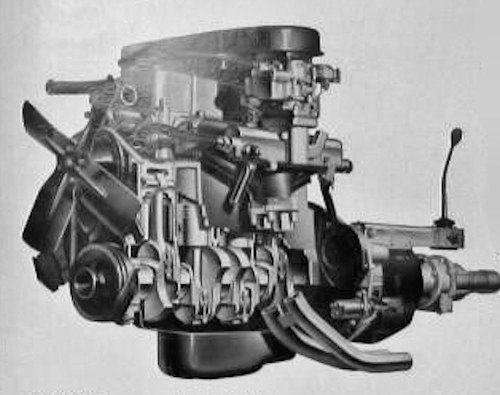
Introduced in the autumn of 1965, the Scepter Mark II differed significantly both technically and stylistically from the previous Mark I. It was powered by the in-line four-cylinder engine, enlarged to 1725 cc, with an output of 85 bhp five-bearing crankshaft unit with aluminium cylinder head and push rod operated overheadvalves incorporating large diameter valves. Solex compound carburettor with twin choke characteristics. Light alloy induction manifold.
Stylistically, the rear end remained unchanged; However, there were significant innovations at the front end.it was now based on the construction of the Hillman Super Minx. As with the significantly cheaper Hillman, the front fenders end in a canopy under which the turn signals and position lights are located this design feature is known as "cat ears”. As with the Hillman, a single round headlight is installed underneath. They are installed lower than in the Mark I and, according to the manufacturer, offer better light output. The panelling of the radiator opening extends over the entire width of the car.It consists of horizontal chrome-plated struts with a square radiator grille in the middle. Another pair of headlights is embedded giving the impression of double headlights.The petrol tank holds 103 gallons capacity, positioned in left-handrear wing. Lockable filler on top of wing.
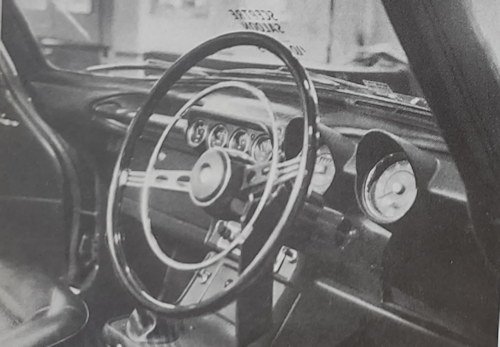
The high level of equipment included disc front brakes, overdrive, screen washers, reversing lamp, and full range of instruments Smart facia and console in non-reflective black. Padded facia, grab rail and sun visors Instrurnents include: cowled speedometer and rev. counter, ammeter, water
temperature and oil pressure gauges. Automatic transmission was available later. Whilst the Super Minx and Vogue received modernised six light styling The distribution of weight was 56% to front axle and 44% at the rear axle.Features Pressed steel wheels with ventilation slots and wide
base rims. Four wheels are embellished with chrome nave plates and wheel trim discs as standard. Spare wheel is housed in a cradle below luggage compartment.
COLOUR SCHEMES
- Lagoon Blue Metallic with Black upholstery.
- Royal Blue Metallic with Grey upholstery.
- Laurei Green Metallic with Green upholstery.
- Sherwood Green Meiallic with Black upholstery.
- Autumn Gold Metallic with Black upholstery.
- Silver Grey Metallic with Black upholstery.
- Silver Grey Metallic with Red upholstery.
- Maroon with Black upholstery.
- Maroon with Ochre upholitery
Elegant Sports styling with new frontal design. interior, beautifully appointed. Smart new trim, new amenities.for comfort independently adjustable front fully reclining Seating.Full range of instruments with clear, new vertical markings, stylish console panel.Adjustable Steering 2 1/2in. adjustment. Rally-type controls,Dual headlights, now more powerful. Amber flashers,Wrap-over Screen, wrapped-round rear for maximum Visibility.Front no—draught ventilators with padded grab rail, facia deck and Visors for Safety,hand grips above With Sliding coat-hooks. luggage compartment — With automatic light.Headlamp flasher, panel light dimmer and warning lights. Powerful dual headlights, automatic reversing lights.
Electric clock, cigarette lighter. Wide-vision front and rear screens.Wide-opening doors. Childproof locks on rear doors.All-over carpeting. Door kick pads. Heating and ventilation system with two-speed blower. Lockable glove box with interior light.
Optional Accessories 8.1 compression ratio; 57 Amp battery; Borg-Warner 35 automatic gearbox, hydraulic torque convertor and
planetary gears with 3 ratios with steering column selector lever. Also White-wall tyres, Road Speed tyres,Smiths Radiomobile, seat belts.
The 1965 Mk2 gained a new front-end shape and grille (based on the Super Minx metalwork) along with a twin carburettor version of the 1725cc engine. Production of the MK II totalled 11,983.
PERFORMANCE
- Engine Capacity 105.26 cu in, 1,725 cu cm
- Fuel Consumption 31 m/imp gal, 25.8 m/us gal, 9.1 1 X 100 km
- Max Speed 93 mph, 149.7 km/h
- max power (SAE): 91 hp at 5,500 rpm
- max torque (SAE): 106 1b ft, 14.6 kg m at 3.SOO rpm
- max number of engine rpm: 6,200
- specific power: 52.8 hp/l
- power-weight ratio; 25.6 lb/hp, 11.6 kg/hp
- acceleration: standing 1/4-mile 20.8 sec. 0—50 mph (O 80 km/h) 12.8 sec
Humber Sceptre Mk1
 |
|
|
Production |
1963 to 1965 |
|
Body style |
4-door saloon |
|
Total built |
17,011 |
|
Engine |
1,592cc Straight-4 |
|
Transmission |
4-speed manual |
|
Wheelbase |
100.98 in, 2565 mm |
|
Length |
165.47 in, 4203 mm |
|
Width |
63.27 in, 1607 mm |
|
Height |
57.01 in, 1448 mm |
|
weight |
2359 1b, 1070 kg. |
The Humber Sceptre first generation from the 1960s was a 4-door car, that was built from 1963 to 1965.
History
The Humber Sceptre name was applied to three generations of motor cars from the former British manufacturer the Rootes Group, between 1963 and 1976.
The first generation, 1963 to 1965 was a luxurious car based on the Hillman Super Minx. Generally similar to Hillman Super Minx and Singer Vogue but roof line is sleeker.It featured a unique roof, glass and upper/rear bodywork not shared with the Super Minx or Singer Vogue. two Paired, hooded head-lamps small, vertically barred radiator air-intake. With small intakes below headlamps incorporate side/direction lamps and wrap-around front body " corners ' Curved windscreen extends into rounded roof line; wrap-around, well-raked rear window. Flattened fins the line of which encloses large, vertical tail-lamp clusters. The wheel discs have visible radial slots.
It was originally intended as a four-door replacement for the Sunbeam Rapier, but was launched as a Humber, while the Sunbeam Rapier soldiered on with little modification until 1967. This made the Sceptre more sporty than traditional Humber’s. Introduced in 1963, it was positioned at the top of the mid-range Rootes cars, above the Hillman Super Minx and Singer Vogue with a larger carrying capacity of 882 1b, 400 kg.
It featured similar twin headlight styling to the Vogue and a more powerful 80 bhp version of the 1600 Minx engine.Built with an integral type chassis and rear wheel drive with distribution of weight at 56% to front axle, and 44% to rear axle. The front suspension has independent, wishbones, coil springs, anti-roll bar with telescopic dampers,while the rear suspension is rigid axle, semi-elliptic leaf-springs and telescopic dampers.
A later update known as the IA included disc front brakes, screen washers, reversing lamp, rev counter and a full range of instruments. overdrive or automatic transmission options with improved more powerful battery.
PERFORMANCE 1,592cc
- Engine Capacity 97.14 cu in, 1,592 cu cm
- Fuel Consumption 31 miles imp gal, 25.8 ml US gal, 9.1 i x 100 km
- Max Speed 90.6 mph, 145.9 kmh
- max power (SAE): 84 hp at 5,200 rpm
- max torque (SAE): 97 1b ft, 13.4 kg m at 3,500 rpm
- max number of engine rpm: 5,200
- specific power: 52.8 hp/l
- power-weight ratio: 28.4 lb/hp, 12.9 kg/hp
- acceleration: standing 1/4 mile 20.8 sec
Humber Super Snipe Mark I to IV
| 1945-1959 | |
|---|---|
 |
|
| Overview | |
| Production | 1945-1958 production 3909 (Mk I) 8,361 (Mk II) 8,703 (Mk III) 17,993 (IV) |
| Body and chassis | |
| Body style | 4-door saloon drophead coupe estate car |
| Powertrain | |
| Engine | 4086 cc Straight-6 side valve (I to III) |
| Dimensions | |
| Wheelbase | 114 in (2,896 mm) (I) 117 in (2,972 mm) (I to III) |
| Length | 180 in (4,572 mm) (I) 187 in (4,750 mm) (II) 191 in (4,851 mm) (III) |
| Width | 69 in (1,753 mm) (I) 74 in (1,880 mm) (II & III) |
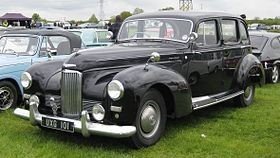
In 1946, post-war civilian production resumed and the Super Snipe evolved though several versions, each designated by a Mark number, each generally larger, more powerful, and more modern, until production ended in 1957 with the Mark IVB version.
Mk I
The Mark I was essentially an enlarged version of the 1945 Humber Hawk, itself a facelifted pre-war car. A version of the 1930s Snipe remained available, with the 1936-introduced 2731 cc engine. However, the standard Super Snipe engine was the 4086cc side-valve engine that had appeared in the Humber Pullman nearly a decade earlier, in 1936, and which would continue to power post-war Super Snipes until 1952. Throughout the years 1936 - 1952 the maximum power output of the engine was always given by the manufacturer as 100 bhp at 3400 rpm.
Mk II
For the 1948 Mark II the body was updated, headlights fitted into the wings and running-boards re-introduced. Transverse-spring independent suspension, first introduced on the Snipe and Pullman in 1935, continued to be used. A few drophead coupés were made by Tickford in 1949 and 1950. The smaller-engined Snipe was discontinued. Early Mark II Super Snipes can be distinguished by round lamps below the head lamps.The left one was a fog lamp,and the right one was a "by pass" lamp. These were dropped in 1949 in favour of rectangular side lamps which were continued in the Mark III.
Mk III
The Mk III followed in 1950 and was externally very similar but had a Panhard rod added to the rear suspensionwhich limited sideways movement of the rear wheels and so permitted the use of softer springs. The 1950 car can be readily distinguished from the previous model by the simpler dome-shaped bumpers and the rectangular stainless-steel foot-treads on the running-boards.
A Mk III tested by The Motor magazine in 1951 had a top speed of 81.6 mph (131.3 km/h) and could accelerate from 0-60 mph (97 km/h) in 19.1 seconds. A fuel consumption of 17.7 miles per imperial gallon (16.0 L/100 km; 14.7 mpg-US) was recorded. The test car cost £1,471 including taxes.
Mk IV
The Mark IV of 1952 used a 1950 Hawk Mk IV body shell lengthened by 6 in (152 mm) but with a 4138 cc 113 bhp (84 kW) overhead-valve engine based on one from a Commer truck. Chassis and suspension components were uprated to take the greater weight and power of the Super Snipe, those parts ceasing to be interchangeable with those of the Hawk. From 1955, overdrive was available as an option, followed in 1956 by an automatic gearbox.
In 1953 The Motor tested a Mk IV and found the larger engine had increased performance with the top speed now 91 mph (146 km/h) and acceleration from 0-60 mph (97 km/h) in 14.7 seconds. Fuel consumption had increased to 15.5 miles per imperial gallon (18.2 L/100 km; 12.9 mpg-US). The test car cost slightly more at £1,481, including taxes.
Humber Hawk Mark III to V
| 1948 to 1954 | |
|---|---|
 |
|
| Production | 1948 to 1954 |
| Total built | 10,040 (III) 6,492 (IV) 14,300 (V) |
| Body style | 4-door saloon,Limousine (Mk V only) |
| Engine | 1944 cc Straight-4 side-valve (Mk III) 2267 cc Straight-4 side-valve (Mk IV & V) |
| Transmission | 4-speed manual |
| Wheelbase | 105.5 inches (2678 mm) |
| Length | 174 inches (4420 mm) |
| Width | 70 inches (1778 mm) |
| Height | 64.75 in (1,645 mm) |
The Humber Hawk Mark III to Mark V (Mark 3 to Mark 5) was introduced in 1948 untill 1954 by the British company Humber .
History
In October 1948 the Hawk Mark III was introduced. The newly developed car in pontoon form, whose body had been designed by Raymond Loewy, had a new separate frame with cross bracing and the engine of the predecessor. The front wheels were individually suspended on double wishbones with coil springs. The rear rigid axle had also been revised and an axle drive with hypoid gearing was used. The body of the sedan was optionally available in two-tone or metallic paint.
The Mk III Hawk was a completely new car and was first shown at the London Motor Show in October 1948, but it still retained the earlier engine and transmission. The new body was styled by the Loewy Studio and the separate headlights of the old model were gone, along with the separate front wings. The chassis was new, with coil-sprung independent front suspension. The rear axle was also a new design with hypoid gearing. The body could be finished in a wide range of colours, both as two-tone and metallic. The metallic finishes would be offered on all the Hawks until the model's demise in late 1967/early 1968.
By 1950, 10,040 copies of the Hawk Mark III were built.

Humber Hawk chassis from 1951
Hawk Mark IV (1950-1952)
The new Hawk Mark IV appeared in 1950 The body of the sedan remained unchanged. By 1952 had an engine with an enlarged cylinder bore and a displacement of 2267 cc. The power increased only slightly by 2 bhp (1.5 kW). The engine now had an aluminum cylinder head and the wheels were enlarged to 15″ and the steering ratio increased. The car weighed 1358 kg, 53% of which was on the front axle.
6492 copies were built

1951 Humber Hawk engine bay
Hawk Mark V (1952-1954)
The Hawk Mark V was mechanically unchanged in 1952 . Only the front was slightly revised, the trunk lid was a bit flatter and bumpers were wrapped around the corners of the vehicle with over-riders distinguished this model from the Mk IV. In addition to the sedan, a Pullman sedan was offered available as a "luxury touring limousine".
By 1954, 14,300 Mark V cars were made.

