Honda
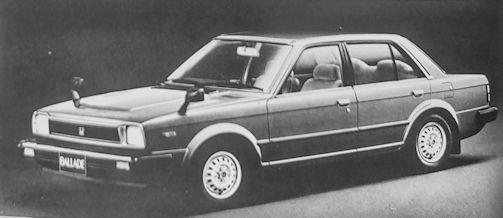
Honda Ballade First generation Type SS/ST
 |
|
|
Make |
Honda |
|
Class |
Motor Car |
|
country of manufacture |
Japan |
|
Sales period |
1980 to 1983 |
|
body type |
4 door sedan |
|
Drive system |
FF |
|
engine |
EJ type: 1.3L SOHC CVCC (72PS) |
|
transmission |
4-speed MT /5-speed MT |
|
Wheelbase |
91.34 in, 232 cm |
|
full length |
161.22 in, 409 cm |
|
Width |
62.99 in, 160 cm |
|
Height |
52.95 in, 134 cm |
|
Ground clearance |
6.49 in, 16 cm |
|
vehicle weight |
770 - 840kg |
The Ballade is a sedan- type compact passenger car that was once manufactured and sold by Honda Motor Co. , Ltd.
History
The Honda Ballade was a four-door version of the Civic with higher equipment level. On August 26, 1980 Honda Announced as a sister car of the second generation Civic , released in Japan as a Verno store exclusive car on August 27 developed along with the Honda Vigor model. Unlike the Civic, the body version is only a 4-door sedan. The mechanical parts such as the engine/suspension are almost the same as the Civic With the front suspension as independent, by McPherson, coil springs/telescopic damper struts, lower-wishbones (trailing links) and anti-roll bar ,at the rear independent, by McPherson, coil springs/telescopic dampers struts, lower wishbones (torque arms) and optional anti-roll bar on rear suspension on some higher performance models. The weight distribution as 60% to front, and 40% to rear.
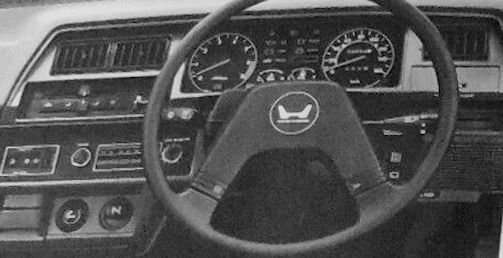
October 1981 - Some changes were made , and the emblem on the front grill was changed to the H mark and attached to the centre of the grill. The standard radio was also changed from a push-button type to an electronic tuner type. British Leyland less than a year after the agreement between Honda and British Leyland produce their own versions of the car as Triumph Acclaim produced under license and also work on future cars In the UK as the combined British Leyland (BL) company. The model being sold in the USA as the Civic Sedan.
Again, by September 1982 more Minor changes were made . The front nose has now been slightly slanted, and the turn signal has been changed to an a typical 2-lamp type headlight that wraps around to the side. At the same time, the position of the rear license plate was also moved to the bottom of the bumper.
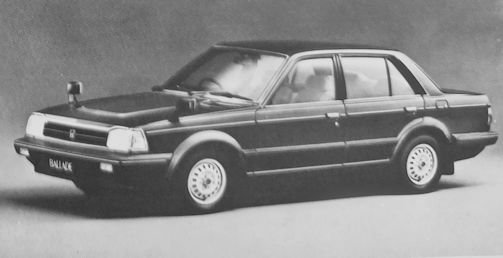
The Honda Ballade was front wheel drive like the Civic with the gearbox as standard a 4-speed MT fully synchronized also a 5-speed MT fully synchronized was available along with the option on some models for the 2-speed AT ( Hondamatic ) and semi-automatic transmission with 3 ratios (I 2.200, II 1.370, III 1.032, rev 1.905)
Options for air-conditioning along with wider light alloy wheels with 5" wide rims.
The engines fitted as the EJ type: 1.3L 1,335 cc SOHC CVCC (72PS) with light alloy block with cast iron liners and light alloy head also the EM type: 1.5L 1,488 cc SOHC CVCC (80/85PS) water-cooled with cast iron block.
Performance:
PERFORMANCE: 1,335 cc
max power (JIS): 72 hp (52 kW) at 5,500 rpm
max torque (JIS): 80 1b ft, 11 kg m (108 Nm) at 3,000 rpm
max engine rpm: 6,000; 53.9 'hp/l (38.9 kW/l)
power-weight ratio: FE 23.6 lb/hp (32.6 lb/kW), 10.7 kg/hp (14.8 kg/kW)
Fuel consumption: 45.6 m/imp gal, 37.9 m/US gal, 6.2 1 x 100 km on Japanese emission test cycle.
max speeds: (l) 30 mph, 48 km/h; (Il) 48 mph, 78 km/h; (Ill) 73 mph, 118 km/h; (IV) 93 mph, 150 km/h
PERFORMANCE :1,488 cc
Engine capacity: 90.8 cu in, 1,488 cc
max power (JIS): 80 hp (57 kW) at 5,500 rpm
max torque (JIS): 89 1b ft, 12.3 kg m (120 Nm) at 3,500 rpm; 53.8 hp;l (38.3 kW/l)
max speed: 95 mph, 153 km/h
power- weight ratio: FL 21.6 lb/hp (30.4 lb/kW), 9.8 kg/hp (13.8 kg/kW)
consumption: 49.6 m/imp gal, 41.3 m/US gal, 5.7 Ix 100 km on Japanese emission test cycle.
Honda Prelude First Generation
 |
|
|
Production period: |
1978 to 2002 |
|
Class: |
sports car |
|
Body versions: |
Coupe |
|
Engines: |
1.6L 1.8L |
|
gearbox: |
5 speed or 2 speed Auto |
|
wheel base: |
91.34 in, 232 cm |
|
length: |
161.02 in, 409 cm |
|
width: |
64.35 in, 163.5 cm |
|
height: |
51.97 in, 132 cm |
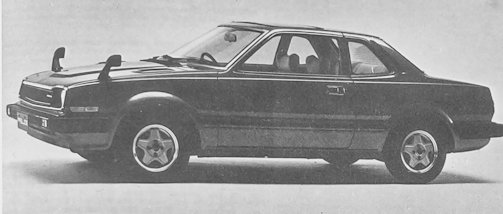
The Honda Prelude first generation is a mid - range sports coupe made by the Japanese automaker Honda from 1978 to 1983. it was further built until 2002. There were five generations.
History
In 1978, the first generation of the Honda Prelude was presented as a sports coupe based on the Accord (type code SN). This was the third Honda series in addition to the Civic and the Accord. From this model, the company Tropic made Crailsheim in 1981 to 1983, built convertibles a total of 47 were made.
The Prelude is 13.41 ft (4.09 metres) long, just a little shorter than the Accord at 13.51 ft (4.12 metres). The Prelude is a 'three-box' car with luggage boot, whereas the Accord is a 'two-box' with hatchback and folding rear seat. Although the two models share a similar mechanical layout, the Prelude is an entirely new car with modified suspension (notably at the rear) and slightly shorter wheelbase (7.61 ft/2.32 metres compared to 7.80 ft/2.38 metres). The suspension layout remains all-independent but with torsion bars and a combination of fore-and-aft and transverse arms.
The European market gets a version of the four-cylinder ohc engine, the 77 mm bore and 86 mm stroke giving a cubic capacity of 1602 cc. Compression ratio is 8.4:1 (instead of there is electronic ignition, and although maximum power output remains at 80 bhp (60.56 kW), torque is improved to 94.17 1b ft (12.9 mkg/126.28 Nm) at 3500 rpm. Transmission is the choice being between the light-to-operate five-speed manual, and the semi-automatic two-speed. Smaller than the Accord, yet a little heavier, the Prelude has rather less interior space, particularly in the rear seats. It is a well-proportioned car, however, and has some notable novelties: a neat facia with concentric rev-counter and speedometer as well as integrated radio. The electric sun-roof too is unusual for the time in that it incorporates filter-glass covered by an opaque sliding panel.
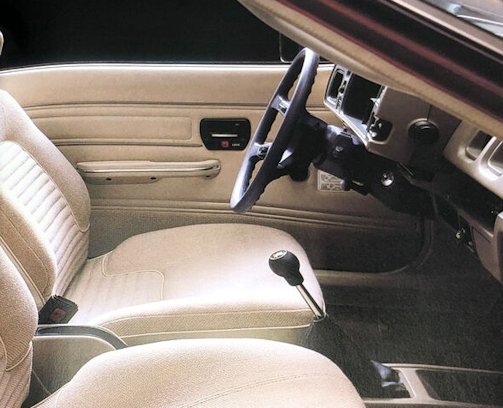
In the Prelude the CVCC engines of the Accord with 1.8-liter displacement for the Japanese and the North American market and 1.6-liter capacity for the other export markets were used. The smaller engine produced 59 kW (80 hp). As the first vehicle in its class, an electrically operated glass sunroof was offered. From the 1980 model year he was available with a Hondamatic called three-speed automatic.
Detail changes to Honda's sohc alloy-head engine include a slight capacity gain from 1599 to 1602cc and the adoption of electronic ignition. To reduce noise and vibration there are two torque' rods and a further special spring mount; the exhaust has a large pre-chamber silencer with flexible exhaust pipe. The compression ratio of 8.4:1 and the twin-choke carburettor remain as before, as does the maximum power of 80 bhp (DIN) at 5300 rpm, but the torque peak is altered from 92 1b ft at 3700 rpm to 93 1b ft at 3500 rpm. Its 0-60 mph time of 12.2 sec the Prelude retains a useful amount of acceleration, to the extent that fifth can be used around town.
Honda has re-designed the locating linkages of the MacPherson strut all-independent coil spring suspension, and an anti-roll bar is now fitted at the rear as well as the front. As a result, there is noticeably less under-steer and even sharper response to the accurate rack and pinion steering. The braking system, including the fitting of automatic adjusters to the rear drums, and new dirt and corrosion-proof front disc brake callipers are light, yet firm
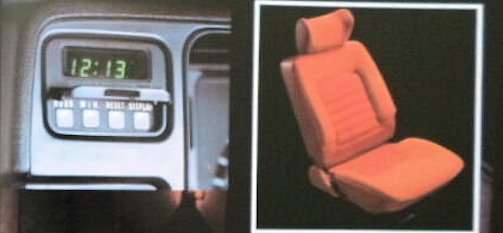
Honda does not claim the Prelude to be more than a 2+2 when it comes to accommodation; thus, the rear seats are for small children only, unless the front seats are set well forward in the front head-room is limited for taller than average drivers, but the front seats' range of adjustment provides plenty of legroom. Interior stowage space is fair, with a deep glove box, a tray in front of the gear-lever, a slot the size of a small cigar box on the facia, and a deep bin either side of the rear seat. A lever by the driver's seat can be used to open the boot lid, giving access to a compartment with 10.9 cu ft luggage capacity layout of controls is good. There are four horn-push buttons set in the spokes of the wheel with column stalks for, on the left, the wash/wipe system, and on the right for indicators and all lighting functions the remaining switches on the right. Two door mirrors are standard, and there is an intermittent as well as two constant wipe speeds.
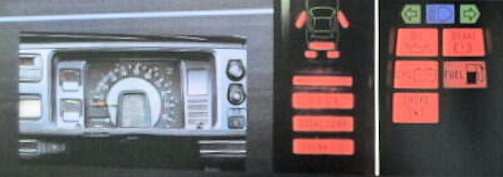
the tachometer inside, the concentric large speedometer, the clear, reflection-free calibrations, green for the tacho and white for the speedometer. Set to the left of these two gauges are the water temperature and fuel gauges, and in the top left corner of the instrument is an L.E.D. digital clock. There is also comprehensive bank of warning lights. For heating it is fitted with two slides for temperature and distribution, a rotary knob for the fan, control the Prelude's heating and ventilation system. Heated air can be directed through the footwell vents, or through two central face-level vents, or to the windscreen and side windows for demisting. Fresh air ventilation is provided through four face-level vents, two in the centre and one at each end of the facia. There are three modes of operation: with the heater in use, fresh air is obtainable on ram flow only through the outer face-level vents, but the flow cannot be regulated as the vents' individual controls are either on or off; with the slide control on "vents" and the temperature control on full cold, a good flow of fresh air can be fan boosted through all four vents. The sunroof made of smoked safety glass, is electrically operated, and incorporates a sliding blind to shut out the light if so desired; and it is standard as are the alloy road wheels, digital clock, rotary-dial radio, head restraints, remote boot opening lever, five-speed gearbox, door-open warning lamps, and indicators that warn the driver when to change the engine oil, oil filter, and to rotate the tyres.
PERFORMANCE:
- 1602 cc
Max power 80 bhp (DIN) at 5300 rpm
Max torque 93 1b ft (DIN) at 3500 rpm
Max Speed 95 Mph 153 kmh
Fuel consumption: 30.3 mpg - 1,750 cc
max power (JIS): 90 hp at 5,300 rpm
max torque (JIS): 98 1b ft, 13.5 kg m at 3,000 rpm
max engine rpm: 5,700; 51.4 hp/l
max speeds: (I) 27 mph, 43 km/h; (II) 45 mph, 73 km/h; (III) 63 mph, 102 km/h; (IV) 93 mph, 150 km/h; (V) 106 mph, 170 km/h
power-weight ratio: 21.8 lb/hp, 9.9 kg/hp
consumption: 29.7 m/imp gal, 24.8 m/US gal
Honda N600
 |
|
|
country of manufacture |
Japan |
|
Sales period |
1967 to 1973 |
|
Class |
Motor Car |
|
body type |
2 -door fastback sedan |
|
Drive system |
FF |
|
engine |
Forced air-cooled 4-stroke 2-cylinder SOHC 598cc |
|
Maximum output |
43PS/6,600rpm |
|
Maximum torque |
5.2kgf m/5,000rpm |
|
Wheelbase |
78.75 in, 2,000 mm |
|
full length |
122.05 in, 3,100 mm |
|
Width |
51 in, 1,295 mm |
|
Height |
52.36 in, 1,330 mm |
|
vehicle weight |
1,213 1b, 550 kg |
The Honda N600 is a small car of the car manufacturer Honda.
History
JAPAN'S equivalent of the Mini has a tiny twin-cylinder engine transversely mounted and driving the front wheels. It is air-cooled, has an overhead camshaft, and runs happily up to
over 8000 r.p.m. if you don't mind the noise. You can make music with the four-speed box or take it easy with little loss of performance using the Hondamatic drive with torque converter and three speed gears.
Announced at the 13th Tokyo Motor Show in 1966. Sales started in March 1967. The N360 sold as the N400 / N600 for overseas and the N600E sold for Japan. It adopted a front-wheel drive (FF) system to secure a spacious cabin space, and was equipped with a high-output engine sparked the "horsepower competition" in the Kei car industry at the time. The combination of high performance and low price made it the best-selling model at the time.
By May, 1970, the Honda 600, after several introductions, finally became a reality on the American market. True to the name of its manufacturer, the 600 is scarcely more than a motorcycle. But for those who cannot or will not ride a bike, the 600 will give nearly as good economy and ease of maintenance.
The engine is a 600cc motorcycle-type, giving 36 bhp at 6000 rpm, and 75 mph is possible if you really want to wind it out. An all-synchro 4-speed transmission is fitted, and engine and transmission oil are common. Obviously,the 600 is a front-wheel drive design. All of these features add up to economy, simplicity and ease in city driving.
The body and interior, though Spartan, are solidly constructed and comply with U.S. safety standards one of the reasons the Honda was so slow in coming. There really isn't any room in the back except for someone used to solitary confinement, but the space is very adequate for a driver and passenger. Rack and pinion steering is quick and responsive and so are the brakes (discs front, drums rear), but you really have to keep the engine well up inrevs to keep up with the bigger cars at stops.
Overall ride is good, but like most short-wheelbase vehicles it becomes thumpy over rough areas. Like many front-wheel drives, large or small, there is understeer and a nose-dive effect if the throttle is released when going into a corner. The word which best describes the 600 is agility, not performance.
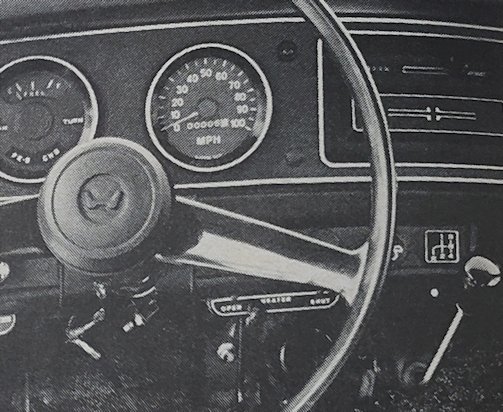
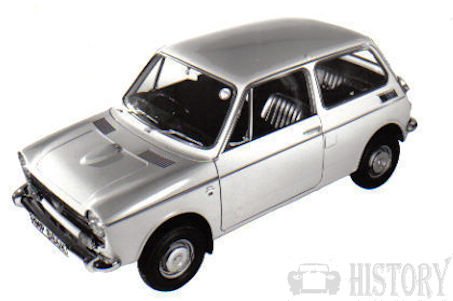
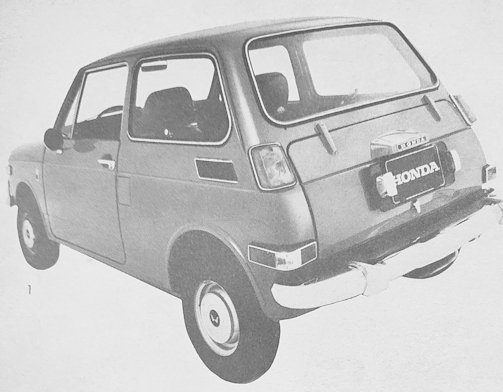
The 2-door, 2-box shape was designed to increase the cabin space by arranging small-diameter tires at the four corners. It had an extremely spacious cabin for a mini passenger car of the time, and its design concept and drive system were strongly influenced by the British made Mini. It also has a trunk lid in common with the mini, but this model adopts a trunk through structure that omits the rear bulkhead and tray but Soichiro Honda didn't like the original rear design, so he ordered the clay model, which had already been made for production, to be scraped. The initial speedometer was a simple design reminiscent of a tester 's indicator, and the shift lever was a kind of " instrument panel shift " that protruded from the bottom of the dashboard. The steering shaft protrudes from the centre of the floor, and was designed to accommodate both left- and right-hand drive versions.
suspension: front, independent, MacPherson strut, coil springs, rear, beam axle, semi-elliptic springs with telescopic dampers; jacking system: scissor jack, rear axle and front sub-frame jacking points. Automatic transmission with torque converter; 3- speed gearbox, manual override, ratios, first 2.421, second 1.357, third 0.838, reverse 3.857, overall 13.07, 7.34, 4.53, reverse 20.84; maximum torque multiplication 2.4. 3.5 in. x 10 in. pressed steel wheel rims, 5.20-10 tyres.
Body: pressed steel monocoque; 2 forward-hinged doors with winding windows and recessed controls; opening rear windows; fresh air type heater; manual windscreen washers;
electric windscreen wipers; interior mirror; underseal; automatic reversing lamps; interior light; padded facia, steering wheel boss and rear of front seats.
de luxe fitted carpet; cigarette lighter; overriders; passenger sun visor; improved door trim; improved sound insulation. Metallic finish available.
It adopted front - wheel drive with a transverse engine mounted at the front. The engine is a 4-stroke forced air- cooled inline 2-cylinder chain drive SOHC, developed based on the air-cooled parallel 2-cylinder DOHC engine installed in the Honda motorbike CB450. For this reason, the timing chain is placed in the middle of the camshaft and crankshaft, similar to a two-cylinder motorcycle, rather than at one end of the cylinder block like in a normal car engine. This engine has a displacement of 354 cc and a maximum output of 31 PS at 8,500 rpm from an inner diameter x stroke of 62.5 x 57.8 (mm). Light cars made by other manufacturers at this time were mainly 2-stroke engines, and their maximum output was generally in the low 20PS range, so it was a remarkably high output. This is the result of applying the method of earning power by allowing high revs, which Honda Motor Co., Ltd. is good at with motorcycles. The nominal maximum speed of 115 km/h was also the highest level among mini passenger cars at the time. Due to the structure of the engine, noise and vibration are somewhat intense, but priority is given to ensuring performance and simplifying the structure, and anti-vibration and soundproofing measures are kept to a simple level.
PERFORMANCE
- Engine capacity: 36.53 cu in, 598.70 cu cm
- Fuel consumption 47 m/imp gal, 39.2 m/US gal, 6 1 x 100 km
- Max speed: 80.8 mph, 130 km/h
- max power (DIN): 42 hp at 6,600 rpm
- max torque (DIN) 40 1b ft
- max engine rpm: 7,500
- specific power: 70.1 hp/l
- power-weight ratio: 28.9 lb/hp, 13.1 kg/hp
- acceleration: standing 1/4 mile 19.7 sec
- max speeds: 27.7 mph, 44.5 km/h in 1st gear; 44.7 mph, 72 km/h in 2nd gear; 69.9 mph, 112.5 km/h in 3rd gear; 80.8 mph, 130 km/h in 4th gear
The 4-speed manual transmission was close to the structure of a motorcycle in the initial model, and was equipped with a constant mesh dog mission that was arranged in series with the engine. The front suspension uses independent coil springs and struts, while the rear uses semi-elliptical leaf spring axle suspensions. The cabin heating uses the waste heat of the air-cooled engine, so the smell of gasoline and engine oil enters the car, which is disadvantageous in terms of temperature control, but simplicity was given priority.
There was only one grade when it was first released, and the price was set at 313,000 yen at Saitama Factory Sayama Factory (now Saitama Factory Sayama Completed Vehicle Factory) and 315,000 yen at Tokyo and Kanagawa stores, which was set by other companies in the same class at 350,000 yen. It was considered to be a significantly cheaper level than the yen ~ 450,000 yen. With its high performance and low price, it became popular with the general public and became a hit. In June of the same year, a light van type "LN360" was added as a sister car. In April 1968, the "N360 AT" equipped with Honda's first automatic transmission was also released. This product was developed in-house and was called " Hondamatic." Unlike the semi-automatic "Hondamatic" that was later installed in the Civic, etc., this "Hondamatic" was a full-fledged 3-speed fully automatic, and the select lever was installed on the handlebar column. It was a 7-position type of "PRND-3-2-1" (each position of 3, 2, 1 is fixed to each gear). The maximum speed reaches 110km/h, which is almost comparable to a 4-speed MT car.
In July 1968, the "N360 sunroof" with a canvas top was added. In September 1968, the T, TS, TM, and TG grades, which were equipped with twin carburettors and generated 36ps/9,000rpm, were added (T stands for Twin). Maximum speed 120km/h.
Honda had already exported the "S series" overseas, but when the "N360" was developed, the "N400”, which expanded the displacement to 400cc based on this, was equipped with a 600cc engine and a maximum speed of 130km/ H "N600" was manufactured and exported to the United States and Europe. In Europe, due to the selection of manufacturers due to intensifying competition and the shift to higher-end production models, the number of inexpensive small-displacement minicars, which is the smallest class, has gradually decreased. Because it is an output vehicle, it has achieved a certain level of sales performance, receiving support from users who have restrictions on income and license system, mainly among young people. Also, in West Germany at the time, cars with a capacity of 250cc or less had preferential taxation and licensing systems similar to those of Japanese Kei cars, so there were some local users who used a bore-down kit to upgrade to 250cc.
The 600cc model was also marketed in Japan from June 1968 as the "N600E", but contrary to its success overseas, it was treated as a regular car under tax law despite having the same level of comfort as a light car. Sales were sluggish from the beginning, and sales ended with about 1,500 units for only half a year. This is the shortest life for a mass-produced passenger car from a major manufacturer. Mechanically, there were some parts that were the same as those for export, but the interior and mechanical details were completely different. For the company, it is the first vehicle to be registered as a four-seat passenger car for the Japanese domestic market.
The model was changed in January 1969. In this model, commonly known as the N II, the exterior design was changed only slightly, but the interior was covered with panels for most of the dashboard, creating a car-like mood.
In January 1970, it evolved into the "N III" due to another model change. In this model change, the name was officially changed to "N III 360", and the exterior was also greatly improved. The characteristic 4-speed MT has been changed from a dog mission to a general full sync type. In addition, "N III 360 Town" was added in September of the same year, with a high-speed, high-output engine that was a symbol. Town's engine, which emphasizes low-speed performance, is tuned to 27ps/7,000rpm (torque remains unchanged). The "N360" has sold 250,000 units in less than two years since its release, and the total production volume has reached 650,000 units.
After 1969, influenced by the "defective car problem" that had become a social problem in the United States led by Ralph Nader, a movement to condemn defective cars occurred in Japan as well. One of the groups that showed this kind of movement was the Japan Automobile User Union, which pointed out that the best-selling car of the time, the N360, had serious defects in terms of steering stability. In 1970, the bereaved family of the driver who died while driving the N360 filed a lawsuit against Soichiro Honda with the Tokyo District Public Prosecutors Office for unintentional and intentional murder. On November 20, 1970, the National Police Agency picked up seven cases that could not be determined to be driving errors, and sent materials to the Ministry of Transport to request a technical judgment. In seven cases, when three or four people were boarding, the vehicle rolled over or left the lane due to meandering when accelerating or approaching a downhill (note: the speed at the time of the accident was not specified)., There were also accidents where factors other than defects could be seen, such as cases where the tires were shaved). In response, the Ministry of Transport reiterated the claim that "according to the materials submitted by Honda Motor Co., Ltd., there seems to be no defects."
Honda Vigor 3rd generation CB5/CC2/3 t
 |
|
|
Production |
Japan |
|
Sales period |
1989 to 1995 |
|
Boarding capacity |
5 people |
|
body type |
4 door hardtop |
|
Drive system |
front wheel drive |
|
engine |
G25A type: 2.5L inline 5 SOHC |
|
transmission |
4-speed AT/5-speed MT |
|
suspension |
Double wishbone |
|
Wheelbase |
2,805mm |
|
full length |
Early: 4,690 mm |
|
Width |
Early: 1,695 mm |
|
Height |
Early: 1,355 mm |
|
vehicle weight |
Early : 1,270-1,350 kg |
|
Built |
87,000 units aprox |
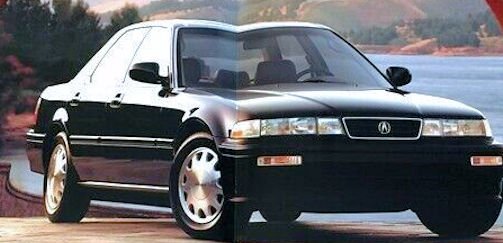
The Honda Honda Vigor 3rd generation was built from 1989 to 1995.
History
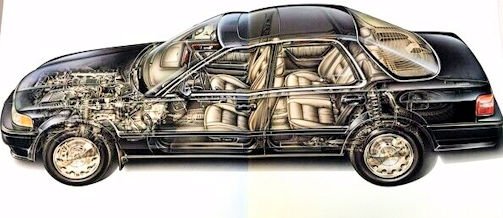
On October 12, 1989 , it was released as a sister car of Accord Inspire , which was newly born as a high-end model of Accord . In North America, it was sold as the Honda's luxury car brand, Acura .
The G20A is mounted in a vertical front midship layout on a long wheelbase 4-door pillared hardtop body . The grades are "Type N" / "Type E" / "Type W" / "Type X" from the bottom. By moving away from the conventional Accord, the personal and sporty character was further strengthened, and the early AT specification was equipped with a gun grip type shift lever.
Partially changed in May 1991 . The shift lever of the car will change from the grip type to the normal one. In addition, the cheapest grade "Type N" was abolished, and "Type S-Limited" was added instead. At the rear, the tail lamps were changed and the garnish was abolished. At the same time, the "VIGOR" mark was moved from the upper right corner of the trunk lid to the center, and the "H" mark was moved to the center of the trunk lid. On January 29, 1992 , a model equipped with a 2.5L G25A and an improved 5PS G20A was added to the 3 number body. G25A-equipped model (model: CC2) is premium gasoline specification, AT specification only. The grade is "25XS" / "25X" / "25S" / "25W". The G20A-equipped vehicle model CC3 was a regular gasoline specification, and unlike the Inspire, an MT specification was also available. The grade is "20G" only.
In January 1995 , production was discontinued due to less orders, and sales were limited to inventory. In February 1995 , Saber appeared as a successor car in Japan . Acura TL also appeared in North America and was discontinued.
Honda Life First Generation
 |
|
|
Production period: |
1971 to 1974 |
|
Class |
Motor Car |
|
Body versions: |
Combined sedan, station wagon, pickup |
|
Engines: |
Gasoline: 0.36 Liter |
|
Length: |
2995 mm |
|
Width: |
50.98 in. 1.295 mm |
|
Height: |
1340-1370 mm |
|
Wheelbase: |
81.89 in, 2.080 mm |
|
Curb weight: |
480-540 kg |
|
Dry weight: |
1,069 1b, 485 kg |
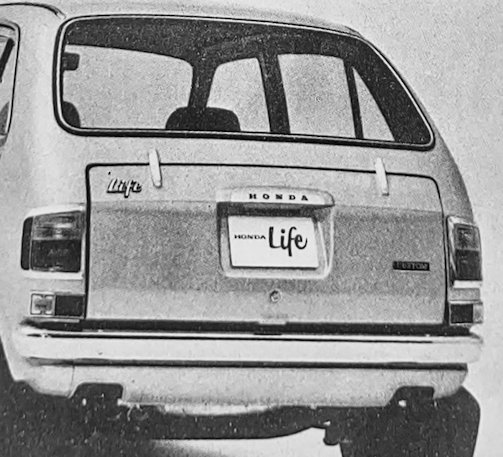
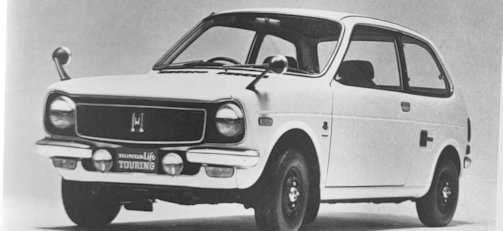
The Honda Life First Generation is a small Japanese car manufacturer Honda from 1971 to 1974.
History
The Honda Life, and generally follows the established two-cylinder transverse engine, driving the front wheels layout of the 'N' series.But there some important departures from normal Honda practice.The Life is the first water cooled Honda since the demise of the S800 sports car. Once staunch believers in air cooling Honda have reverted to water cooling because of its noise suppressing ability. This was current among Japanese 360 cc car manufacturers, and all but one factory offers cars with water cooled engines in this class.
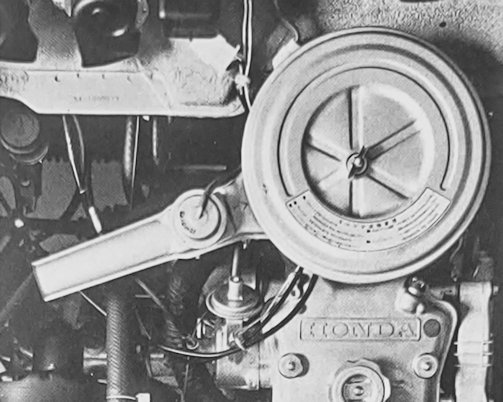
The Life engine is an in-line 354 cc two cylinder ohc unit. The camshaft is driven by a cogged belt (British Uniroyal) and is the first Japanese engine with such a belt. The engine also sports such new Honda innovations as a twin-choke compound downdraught carburetter, forward facing radiator with thermostatically controlled electric fan and a one-piece forged crankshaft with three main bearings (plain). Low and mid-speed torque is the prime design criterion for the engine, and it produces 30 bhp at a 'modest' 8000 rpm. There is also a Town version of the same engine with a lower compression ratio, 21 bhp at 6500 rpm and a milder camshaft. The Life engine incorporates an extremely elaborate dynamic balancing system which consists of twin balancer shafts carrying half moon-shaped balancers which turn counter crankshaftwise to offset the inherent unbalancing force of the in-line two cylinder engine with 3600 crank. The balancer shafts are driven by sprockets and chains.
Transmission is placed in line with the engine, or 'behind' the engine, to compress the power unit forward, so that optimum utilization of the overall length can be made. By law the overall length and width of 360 cc cars are limited to under 3000 mm. and 1300 mm. respectively. By changing to the in-line power unit layout, Honda have succeeded in reserving 82 percent of the total length for passenger and luggage accommodation. In fact the cabin length of the Life matches those of some of our 1-1.2 litre small cars, and Honda are offering four-door versions of the Life as well as the two-door saloon. The gearbox is an all-synchromesh four-speed unit with four indirect ratios. The 21 bhp Town model has a three-speed box. Honda's own automatic, much along the same design as the 'N' automatic, will be offered later. Front suspension is by MacPherson struts, and a rear dead axle on a pair of two leaf semi-elliptic springs is used at the rear. Steering is by rack and pinion, and stopping power is provided by an all drum brake system. The Life is slightly more expensive than the comparable N360.
The first generation was as three- and five-door hatchback, as a three-door station wagon, five-door Van called Step Van, and two-door pickup offered. He was powered by a 27 kW (36 hp) two-cylinder engine with 356 cc displacement with Water not air cooling for new Honda.
Honda added another model to their extensive 360 cc car range. The Honda Life, and generally follows the established two-cylinder transverse engine driving the front wheels layout of the 'N' series. But there some important departures from normal Honda practice.
The Life is the first water cooled Honda since the demise of the S800 sports car. Once staunch believers in air cooling Honda have reverted to water cooling because of its noise suppressing ability. The Life engine is an in-line 354 cc two-cylinder ohc unit. The camshaft is driven by a cogged belt The engine
also sports such new Honda innovations as a twin-choke compound downdraught carburettor, forward facing radiator with thermostatically controlled electric fan and a one-piece forged crankshaft with three main bearings (plain). Low and mid-speed torque is the prime design criterion for the engine, and it produces 30 bhp at a 'modest' 8000 rpm. There is also a Town version of the same engine with a lower compression ratio, 21 bhp at 6500 rpm and a milder camshaft. The Life engine incorporates an extremely elaborate dynamic balancing system which consists of twin balancer shafts carrying half-moon-shaped balancers which turn counter-crankshaft wise to offset the inherent unbalancing force of the in-line two-cylinder engine with 360° crank. The balancer shafts are driven by sprockets and chains.
PERFORMANCE
- Power-weight ratio: 35.6 lb/hp, 16.1 kg/hp
- Max power (DIN): 30 hp at 8,000 rpm
- Max torque (DIN): 21 1b ft, 2.9 kg m at 6,000 rpm
- Max engine rpm: 8,500; 84.3 hp/l
- Max speeds: (1st) 19 mph, 30 km/h; (2nd) 30 mph, 48 km/h: (3rd) 47 mph, 76 km/h; (4th) 71 mph, 115 km/h
Transmission is placed in line with the engine, or 'behind' the engine, much like the Fiat 128 / 127, to compress the power unit forward, so that optimum utilization of the overall length can be made.
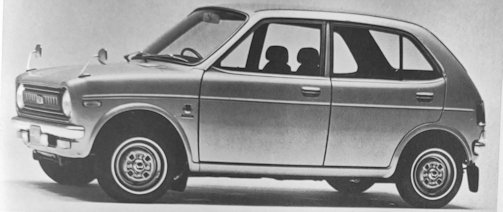
By law the overall length and width of 360 cc cars are limited to under 3000 mm. and 1300 mm. respectively. By changing to the in-line power layout, Honda have unit succeeded in reserving 82 per cent of the total length for passenger and luggage accommodation. In fact, the cabin length of the Life matches those of some of our 1-1.2 litre small cars, and Honda offering four-door versions of the Life as well as the two-door saloon.
The gearbox is an all-synchromesh four-speed unit with four indirect ratios. The 21bhp Town model has a three-speed box. Honda's own automatic, much along the same design as the 'N' automatic.
Front suspension is by MacPherson struts, and a rear dead axle on a pair of two leaf semi-elliptic springs is used at the rear. Steering is by rack and pinion, and stopping power is provided by an all-drum brake system.
The Life is slightly more expensive than the comparable N360 also as a van and wagon models up to 1974.
PERFORMANCE: Life Touring SS 2-door Sedan
- compression ratio: 9:1
- max power (DIN): 36 hp at 9,000 rpm
- max torque (DIN): 23 1b ft. 3.2 kg m at 7,000 rpm
- max engine rpm: 10,000; 101.1 hp/l
- 2 Keihin CV horizontal carburettors,
- max speeds: (I) 21 m h, 33 km/h; (II) 33mph. 53 km/h; (III) 51 mph. 82 km/h(IV) 75 mph, 120 km/h
- power-weight ratio: 29.7 lb/hp, 13.7 kg/hp.