Hyundai
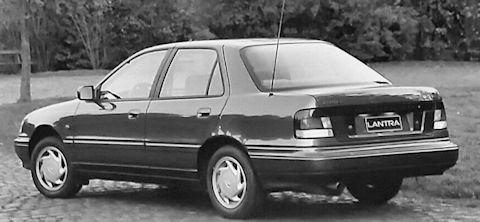
Hyundai Elantra Lantra Second generation (J2 / RD)
|
|
|
|
Model code |
|
|
Also called |
Hyundai Avante (South Korea) |
|
Production |
1995–2000 |
|
Assembly |
South Korea: |
|
Body style |
4-door sedan |
|
Engine |
|
|
Transmission |
5-speed manual |
|
Wheelbase |
2,550 mm (100.4 in) |
|
Length |
4,420 mm (174.0 in) (1995–1998 sedan) |
|
Width |
1,700 mm (66.9 in) (1995–1998) |
|
Height |
1,395 mm (54.9 in) |
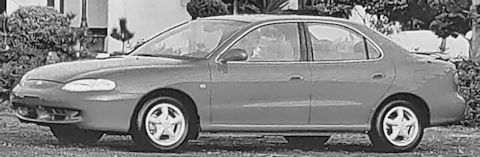
In autumn 1995, the second generation of the Hyundai Lantra came on the European market. This differed clearly from the predecessor and received now exclusively engines from own development.
From spring 1996 Hyundai also offered a wagon version of the Lantra. This platform divides the Lantra now for the first time, because as of summer 1996 was based on the basis of the Hyundai Coupe , with which has the internal abbreviation J2, but not the suspension tuning by Porsche has in common. The chassis was the first time developed computerized and consists of MacPherson struts up front and a multilink rear suspension behind, this gives well-filtered ride over rough bumps. However, driving comfort is reduced by the short leg rests of the front seats. Positively the controllability of the vehicle and the (not standard) strong air conditioner are good.
End of 1998 was a facelift, in which especially the front end and the interior underwent a revision. The rear was hardly changed except for details. This variant bears the internal abbreviation RD , often referred to by drivers as J3 in reference to the previous count.
Reliability
As with its predecessor, the overheating that is more common in the Lantra J2 / RD is usually due to leaking hose connections and marten damage to the cooling water circuit. For the joints, Hyundai has developed improved clamps. Start problems and poor engine operation, however, corroding plug connections are likely also mention defective exhaust manifolds as a more common problem. Chassis side, the rear axle is more affected by rust, Hyundai, however, made changes to it .The frequency of significant deficiencies in the TÜV report is on the average of the same age cars.
For vehicle safety, the passenger now also received an airbag.
frontal tests
- US-NCAP 1995-1998 Driver side: Passenger side:
- US-NCAP 1998-2000 Driver side: Passenger side:
- IIHS 1995-2000: Acceptable
At the US NCAP, driving is tested at 46 km / h on a concrete wall. The IIHS test, on the other hand, simulates a vehicle driven by 40% at 64 km / h. The upper torso protection for driver and front passenger is rated well, all other areas receive the second best, acceptable rating level. Thus, the vehicle moves at the level of the then Japanese competition and surpasses the VW Jetta / Golf by one stage.
page tests
- US-NCAP 1995-1998 Driver side: Passenger side:
- US-NCAP 1998-2000 Driver side: Passenger side:
The upper body load is tested on a deformable barrier that drags sideways at 63 km / h and is modeled on a saloon. In the head and leg area is not measured. Page tests of other organizations were not conducted.
Bumper test
The damage to a parking bumps at 8 km / h very cost unfavorably before the facelift, but was down significantly improved.
Engines
The engine included the so-called beta engine of Hyundai in three displacement variants. Also, the transmission is now an in-house development, which is described as goodd, but In some markets the Lantra was also equipped with a 1.5 liter petrol engine and since 1997 also a 1.9 liter Peugeot diesel. The engines meet the emission standard Euro 2 , from the facelift Euro 3, D3 .
In the summer of 2000, the production of the Lantra was completed. Successor was the Elantra .
Hyundai Motor Company History
Seoul, South Korea

The Hyundai Motor Company (현대 자동차), a South Korean automaker was founded in 1967 by Chung Ju-yung as part of the Hyundai Motor Group.
History
From 1967 Hyundai had at first built the European Ford Cortina under license and began in the early 1970s to develop their own cars.
The first type, as the Hyundai Pony, was presented in 1974 at the 55th Turin Motor Show. In addition, were light trucks manufactured, since the mid-80s and later heavy trucks and buses. While the technology initially built on Mitsubishi models, Hyundai Motors developed since the 1990s, its own cars.
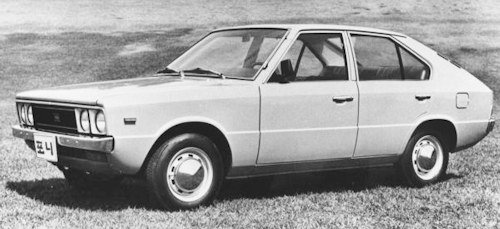
From 1978 the cars were exported to Europe and by 1983, also Central America and Canada joined, followed a year later to the United States. By the 1990s, in order to gain a better foothold in the European market at the beginning of the Hyundai Motor Company pursued an aggressive price policy along with fitted generous standard equipment only available as extras from European makes 20 years earlier, similar to Japanese car manufacturers, in order to sell the models.
In 1998, the South Korean car manufacturer Kia Motors was taken over by Hyundai. A collaboration with Daimler-Chrysler lasted from 2001 to 2004. In October 2005, together with the car manufacturers DaimlerChrysler and Mitsubishi, the joint venture Global Engine Manufacturing Alliance (GEMA) was founded, which produces engines for the companies involved. Meanwhile, the product range ranging from small cars to luxury sedans is no longer limited to passenger cars, but also includes trucks and buses. HMC is also the largest Korean commercial vehicle manufacturer.
The first Hyundai vehicle plant in Europe has started production in 2009 with the construction of Hyundai Motor Manufacturing Czech in Nošovice, Czech Republic. Followed in 2010, with the Hyundai Motor Manufacturing Rus (HMMR) car plant was built in the Kamenka industrial area near St. Petersburg In November 2012, a production site was opened in Piracicaba, Brazil.
Changing times
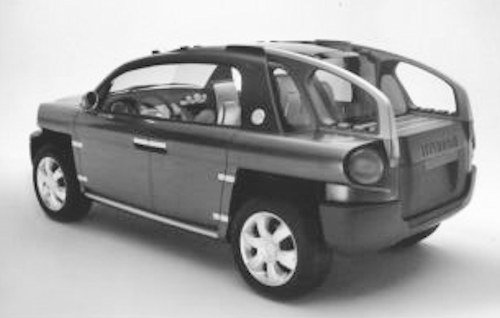
With the introduction of a new model generation from the year 2001, the all-new models which now popular SUV types for a pioneering Hyundai model range. In late 2004, the sale of the Hyundai Tucson, which together with the new generation of the Hyundai Sonata In the course of this model and technology offensive, the Hyundai Motor Company also invested several billion euros in the development of its own and very modern common rail diesel engines with variable turbocharger blade geometry and modernized the petrol engines to help with changing laws with emission standards along with the hybrid models, in which an electric drive supports a natural gas-powered gasoline engine. In early 2016, Hyundai presented the Hyundai Ioniq, which is offered as a pure electric car and in two hybrid versions (plug-in from mid-2017). The electric version is considered one of the most efficient electric cars suitable for everyday use. Hyundai plans to also build hydrogen-powered trucks and cars.
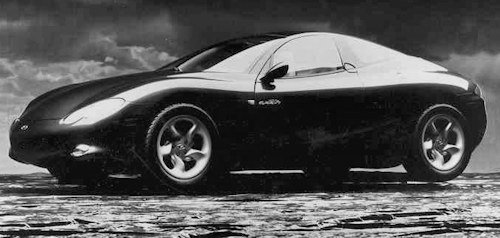
Hyundai Galloper
 |
|
|
Manufacturer |
Hyundai |
|
Production |
1991 to 2004 |
|
Class |
off road |
|
Body style |
SUV |
|
Door |
3/5-door |
|
Layout |
Front-engine, |
|
Drive |
four-wheel-drive |
|
Engine |
3.0 L G6AT V6 (petrol) |
|
Transmission |
4-speed automatic |
|
Wheelbase |
2,350 mm (93 in) SWB |
|
Length |
3,945 mm (155 in) SWB |
|
Width |
1,770 mm (69.7 in) |
|
Height |
1,859 mm (73.2 in) |
The Galloper was introduced in 1991 by HDPIC Hyundai Precision Machine Company Limited and manufactured in Korea after Mitsubishi license of the first Mitsubishi Pajero .By 2004, the production was discontinued.
History
The Hyundai Galloper was a licensed production of the Mitsubishi Pajero.It was produced both as a three-door, as well as a five-door SUV. The three-door is 4.09 meters long, 1.78 meters wide and 1.87 meters high, the five-door comes to 4.69 × 1.78 × 1.90 meters.
The Galloper had power steering and a driver airbag , a passenger airbag was not available. ABS was available only in the Exceed with wide wheels, an automatic transmissiononly with the 3.0 V6. The five-door, long-wheelbase two-fold single seats behind the rear seat belonged to the standard equipment (seven-seater). There was also a version with two benches along the direction of travel in the hold and high roof, this had a total of 10 seats.
The vehicle was offered in two engine variants: The 4-cylinder diesel engine this variant was a turbocharged engine with turbocharging and charge air cooling. This had 2500 cc and 73 kW (99 hp).The same engine was also available without intercooler with 65 kW (88 hp).The 6-cylinder 3.0-l petrol engine is considered relatively robust. It was run on regular gasoline, had 104 kW (141 hp) and hydraulic tappets .
The Hyundai Galloper , which was manufactured in the model variants Exceed , Innovation and Van / Wagon by Hyundai Precision & Industry Company Limited in the years 1991 to 2003, was a licensed production of the Mitsubishi Pajero in the last development stage L040. The Hyundai Precision & Industry Company Limited belongs to the Hyundai Group, has with the automaker Hyundai Motor Companybut nothing to do. For that reason, the Hyundai emblem was never found on the vehicle. In countries where the model had not been distributed through the respective Hyundai general importer, Galloper had been run as a stand-alone brand. The vehicles had therefore been sold there through individual dealers. In Germany and Spain, the model was also marketed as Mitsubishi Galloper , among others . In Iceland, the models with automatic transmission have been sold as Galloper TCI .
The fact that the Galloper was only a Pajero I modified in details, was mainly due to the then at times no longer up to date technology. The all-wheel-drive system largely corresponded to what is also customary in 2013 for off-road vehicles, but was less comfortable to handle than that of a limited-terrain SUV. The life of the manual transmission was difficult to calculate: in some vehicles it was over 250,000 km, in others not even 40,000 km. The turbodiesel engine , whose glow plug system in combination with the immobilizer led to many start failures, also caused problems very often . The rostanfällige body was already a problem with the original, the Galloper as well.
The Hyundai Galloper was produced in two different series.There was a series, which was provided with leaf-sprung rear axle. This type was mainly used in the early days of model production on models equipped with a four-cylinder engine. The second series was equipped with a very robust coil suspension and was mainly used in the models with six-cylinder engines and in the diesel engines with turbocharging and intercooler.

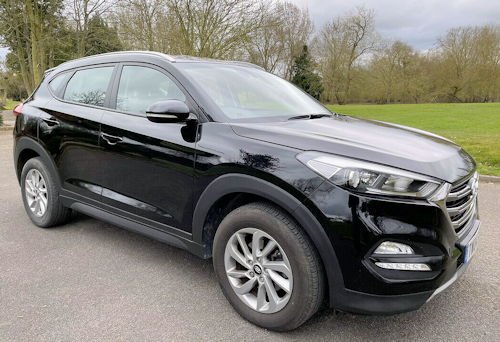
Hyundai Tucson Third generation (TL)
 |
|
|
Production: |
since 2015 |
|
Type: |
SUV |
|
Body versions : |
station wagon |
|
Engines: |
Gasoline: 1.6 liters (97-130 kW) |
|
Length: |
4475 mm |
|
Width: |
1850 mm |
|
Height: |
1645 mm |
|
Wheelbase : |
2670 mm |
|
Curb weight : |
1454-1690 kg |
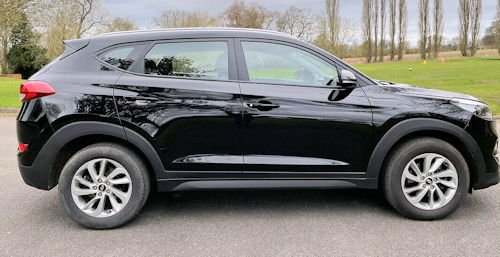
At the Geneva Motor Show 2015, the third generation was presented. The car replaces the Hyundai ix35 worldwide, and has been available since the second half of 2015.
History
The full 5 Stars in the Euro NCAP - crash test in 2015,the new Tucson is 1.65 meters high, 1.85 meters wide and 4.47 meters long.
It’s a mid-size SUV and has spacious, hardwearing interior. It has a load capacity of 513 liters - a maximum of 1,503 liters (when the rear seats are moved forward) the back seats fold down in a 60:40 split. The vehicle is closely related to the Kia Sportage 4th Generation. inside has Apple CarPlay and Android Auto smartphone connectivity
.A six-speed manual or a seven-speed DSG gearbox avalable. The top of the range engine is the 185hp 2.0-litre CRDi.Traction and stability control system, tyre-pressure monitoring.hill-start assist, two Isofix child seat points in the rear as standard.
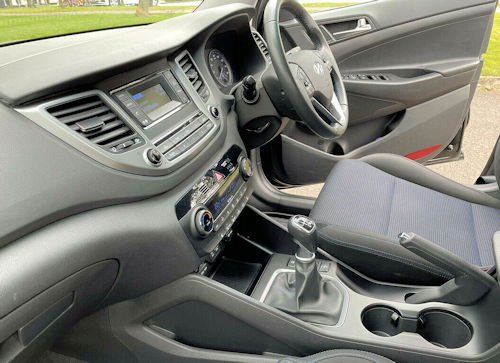
The car is available in four equipment lines. The entry is the ' Classic' variant, which comes as standard with LED daytime running lights, air conditioning and audio system including Bluetooth handsfree. The ' Trend' offers more comfort, which also features automatic climate control, heated steering wheel, front seat heating or rear parking aid. External features include roof rails and underride protection, fog lights and LED taillights. The ' Style' trim level features front and rear parking assistance, reversing camera, rain sensor, automatically dimming rearview mirror or radio navigation system.
In the summer of 2018, the Tuscon was subjected to a facelift.
Hyundai Elantra Lantra 1st generation (J1)
|
|
|
|
Model code |
J1 |
|
Also called |
Hyundai Lantra (Australia, Europe) |
|
Production |
1990–1995 |
|
Assembly |
South Korea: |
|
Body style |
4-door sedan |
|
Engine |
|
|
Transmission |
5-speed manual |
|
Wheelbase |
2,500 mm (98.4 in) |
|
Length |
4,375 mm (172.2 in) (1990–1993) |
|
Width |
1,675 mm (65.9 in) (1990–1993) |
|
Height |
1,395 mm (54.9 in) (1990–1993) |
|
Curb weight |
1,064–1,187 kg (2,346–2,617 lb) |
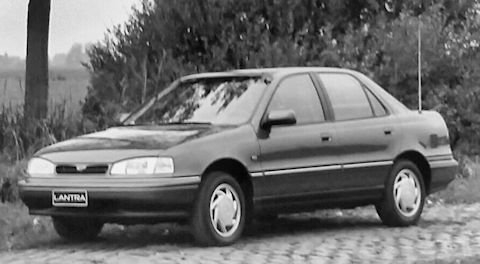
The Elantra also called Lantra in Europe was built from October 1990 Lantra as a notchback with a comparatively rich equipment level but relatively inexpensive. Fog lights, air conditioning and a part leather trim were available as optional extras.
In early 1994, the Lantra J1 was subjected to a comprehensive facelift, in which the rear and front end was modified and the interior was upgraded. For the first time ABS was available and a driver airbag as standard. This improved the crash test result.
Reliability
Frequent repairs on the Lantra type J1 are caused by the small-sized brake system and the cooling systems of the engines, which are not dimensioned for full load. With the facelift therefore a modified cooling water thermostat and a stronger oil pump were used. Due to age, however, the cooling water hoses can now be porous. The result of overheated engines is damage to the cylinder head gasket .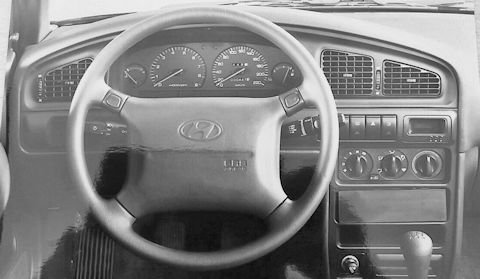
Defective timing belts were another source of engine damage to the model maintenance, which then decreased by reinforced timing belt; Statistics are not available for this. The chassis has an early through leaky sleeves weary drive shaft , which is recognizable by crackling noises during steering and load changes . The joints on the front and rear axles also frequently show considerable deficiencies. The body is partially galvanized, but hardly conserved. Rust is therefore slightly above average, even on the brake lines.
In its inspections, the TÜV finds at three percent more Lantra significant deficiencies than the average of the same age vehicles. Elantra's only real standout feature is generous passenger space for the class trunk space is ample, though some rear leg room is sacrificed to achieve it.
The only crash test performed on the vehicle is the US NCAP front-end test. Driving is tested at 46 km / h on a concrete wall.
- US-NCAP 1990-1994 Driver's side: Passenger side:
- US-NCAP 1994-1995 Driver side: Passenger side:
Engines
The motorization of this generation was still licensed from Mitsubishi engines, but may contain minor changes. They meet the Euro 1 standard .