
Healey
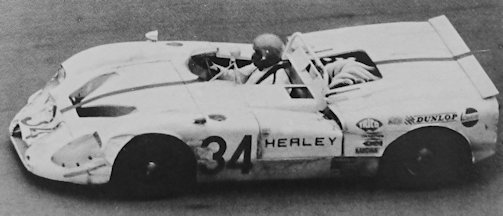
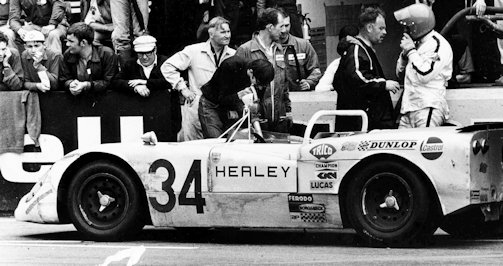
Healey Repco SR XR37 Race Car
 |
|
|
Manufacturer |
Donald Healey Motor Company |
|
Production |
1970 |
|
Class |
Race car |
|
Body |
Roadster |
|
Layout |
Front engine, rear-wheel drive |
|
Engine |
V8 2,994 cu cm |
|
Transmission |
Five-speed manual |
|
Length |
158.00 in, 4,026 mm |
|
Width |
70.98 in 1,803 mm |
|
Wheel base: |
94.02 in, 2,388 mm |
|
Dry weight |
1,775 1b, 805 kg |
The Healey SR XR 37 is a 3-litre Race car that was made by Donald Healey Motor Company from the 1970s and used at Le Mans 24 Heures.
History
The Healey XR 37 was made at a factory in England. The Healey prototype marks the return 'to motor racing of a British make created by the keenness of Donald Healey, the racing driver. After a period of inactivity, the firm, which is now managed by the founder's sons.
The prototype with light alloy integral body, which ran in the Le Mans 24 Heures in 1970 allowed certain technical solutions to be tried out and reminded the public of a familiar name. The Repco Brabham 8-cylinder V8 with cylinder block and head in light alloy is mounted centrally at the rear, the 5-speed gearbox is Howland. and Girling brakes and Dunlop tyros are used on 15" wheels. They have had problems throughout the race and in the last 1/4 of an hour abandoned after 264 laps on failure of ignition system.
PERFORMANCE
max speed: 174 mph, 280 km/h.
max power: 300 hp at 7,500 rpm
specific power: 100 hp/l
Healey Silverstone
 |
|
|
Manufacturer |
Donald Healey Motor Company |
|
Production |
1949 to 1950 |
|
Class |
Sports car |
|
Body |
Roadster |
|
Layout |
Front engine, rear-wheel drive |
|
Engine |
2.5L I-4, 3.0L Six Cylinder |
|
Transmission |
Four-speed manual |
|
Length |
13 ft. 6 ins. |
|
Width |
5 ft. 2 ins |
|
Height |
3 ft. 10 ins |
|
Dry weight |
19 cwt. |
The Healey Silverstone is a sports roadster that was made by Donald Healey Motor Company from the late 1940s.
History
The Silverstone was made at a factory in Warwick, England. They were hand-built and only 105 were produced. intended purely and simply as a two-seater, this had headlights behind the grille to make it more aerodynamic. It was designed to be a dual purpose "race and ride" car. It also had a 104 horsepower 2.5L Riley I-4 engine with accessibility provided via a large and easily removed panel in the top of the bonnet. and fitted to a four-speed manual transmission. The body itself Fabricated by the Abbey Panel and Sheet Metal Co. Ltd, of Coventry consists of a stressed-skin shell of 16 and 18-gauge light alloy on a channel-section framework with tubular bracing it is light, strong and fitted with detachable wings which can easily be removed for maintenance work. the entire body, which is attached to the chassis by approximately 12 bolts and can be lifted clear with a minimum trouble for race prep maintenance.
The Silverstone was designed by Len Hodges the Healey Sports Convertible had same chassis, but following technical differences. Hodges rounded the back of the car and pulled it out slightly from the sides. A slot was cut out of the rear to house a tire. Since the tire was protruding out of the car, it acted like a bumper. The adoption of direct-acting Girling shock-absorbers at the rear and stronger clutch springs for competition usage.
In planning to meet these demands, the constructors also envisaged the possibility of reducing the retail price to under £1,000, thereby eliminating the incidence of double purchase tax. When the British government doubled the purchase tax of cars over £1000($1400) from 33.33% to 66.66% in 1948, Healey realized he was in trouble. He decided to make a high-performance car that was under £1000. The result was the $1365 Healey Silverstone.
There was very little luggage space. It was a two-seater with a very light body. It weighed only 2,100 pounds use of ventilated disc wheels with 5.50 by 15-in. tires. This made it suitable for motor-sports. The 1949 Silverstone(D-Type) was a little bit less wide and the cockpit was a bit uncomfortable.
The 1950 Silverstone (E-Type) was a bit wider and has a more comfortable cockpit the windscreen which also drops into the scuttle instead of folding flat. it slides in channel-
section uprights, which enable it to be dropped into the scuttle. By making this wider, the car was very successful on the track. The Silverstone two-seater the frame of which has been modified to give a tank-mounting suitable to the new body; this has also enabled a bigger tank (17 gallons) to be mounted further forward, and has thus eliminated the rear extension of the frame which normally carries the tank. Suspension is trailing-link i.f.s. suspension A torsion anti-roll bar links the front springs the trailing arms which support made from magnesium casting to which steel side plates are bolted, improves maintenance and has even greater stiffness along with a front torsion anti-roll bar.
Inside the seats have simple adjustments and simple hood which disappears behind the rear squab is provided. tools are carried in an arm-rest and locker mounted on the center propeller-shaft tunnel. The instruments include a large-dial speedometer, together with a thermometer, oil gauge and fuel gauge.
The Silverstone has won many races including the 1949 Alpine Rally where the car was raced by Donald Healey and Ian Appleyard. Another win was in 1951 when Peter Riley and Bill Lamb won the Liege-Rome-Liege Rally and in 1951 Edgar Wadsworth and Cyril Corbishley won the Coupe de Alpes. Other non-wins included Peter Simpson's 6th place overall in the 1951 Isle of Man Manx Cup Races. Later in 1953, Mr. G. Weldon raced a blue Silverstone in the Silverstone circuit in a national race on June 27, finishing fifth. The Silverstone had a top speed of 110 mph and a 0-60 time of 11 seconds, which rivaled other cars.
Production ended in September 1950 when Healey felt his cars were too heavy and expensive. The Silverstone replacement, the Healey 100 rolled out of the Warwick factory in 1953.

Healey Motor Company History 1945
 |
|
| Industry | Manufacture of high performance cars and design consultancy |
|---|---|
| Fate | Sold |
| Founded | 1945 |
| Headquarters | The Cape, Warwick United Kingdom |
| Key people | Donald Healey - founder |
History
Donald Healey Motor Company Limited was a British car manufacturer.
The business was founded in 1945 by Donald Healey, a successful car designer and rally driver. Healey discussed sports car design with Achille Sampietro, a chassis specialist for high performance cars and Ben Bowden, a body engineer, when all three worked at Humber during World War II.
Expensive, high quality, high performance cars
His new enterprise was based in an old aircraft components factory off Miller Road in Warwick. There he was joined by Roger Menadue from Armstrong Whitworth to run the experimental workshop. In later years they also had a now-demolished showroom (formerly a cinema) on Emscote Road, Warwick, commemorated by a new block of flats called Healey Court. The cars mainly used a tuned version of the proven Riley twin cam 2.4 litre four cylinder engine in a light steel box section chassis of their own design using independent front suspension by coil springs and alloy trailing arms with Girling dampers. The rear suspension used a Riley live axle with coil springs again. Advanced design allowed soft springing to be combined with excellent road holding. Lockheed hydraulic brakes were used.
When it was introduced in 1948 the Elliott saloon was claimed to be the fastest production closed car in the world, it was timed at 104.7 mph over a mile. Unusually for the time the body was tested in a wind tunnel to refine its aerodynamics. In 1949 the most sporting of all the Healeys, the Silverstone, was announced. It had a shorter chassis and stiffer springing and was capable of 107 mph. It is now a highly sought after car and many of the other Healeys have been converted into Silverstone replicas. These cars had numerous competition successes including class wins in the 1947 and 1948 Alpine rallies and the 1949 Mille Miglia.
Government planning and controls required any substantial expansion of production to be for the export market alone. So in 1950 Healey built the Nash-Healey using a Nash Ambassador engine with SU carburettors and Nash gearbox. Initially the 3848 cc unit was used but when in 1952 body construction was transferred from Healey to Pininfarina the larger 4138 cc engine was fitted. The final car was the G-Type using an Alvis TB21 engine and gearbox. This was more luxurious and heavier than the Riley engined models and performance suffered.
Affordable sports cars
A cheaper sports car marketable in large numbers was needed to save the business's future. A car that would fit between the MG and Jaguar cars now selling so well in USA. The answer proved to be the use of low-cost Austin components to make the Healey 100 designed by Donald and his eldest son Geoffrey in the attic of the family home. Sir Leonard Lord, chief of Austin and now chief of BMC, was so impressed when he saw it on the Healey stand at the Earls Court Motor Show he offered to make it in his own factories under the name Austin-Healey.
Austin
In 1952, a joint venture with the British Motor Corporation created the Austin-Healey marque and later on the Austin-Healey Sprite. On Donald Healey's death The Times commented: "The big Healey's brutally firm ride, heavy steering and engine so close it would roast a driver's feet never detracted from the superb, timeless styling and classic proportions."
Jensen
Donald Healey became a director of Jensen Motors in the late 1960s and a result of this was the Lotus-engined Jensen-Healey which appeared in 1972.
Sale
Donald Healey Motor Company was finally sold to the Hamblin Group, although Healey Automobile Consultants and the engineering parts of the company remained in the hands of Geoffrey and Donald Haley.

