
Hillman
Talbot Avenger
|
|
|
|
Manufacturer |
PSA group |
|
Production |
1979–1981 |
|
Assembly |
|
|
Class |
Motor car |
|
Body style |
2-4-5 door, saloon, estate |
|
Layout |
Front-engine, rear-wheel drive |
|
Engine |
|
|
Transmission |
4-speed manual |
|
Wheelbase |
98 in (2,489 mm) |
|
Length |
161 in (4,089 mm) |
|
Width |
62 in (1,575 mm) |
|
Height |
53 in (1,346 mm) |
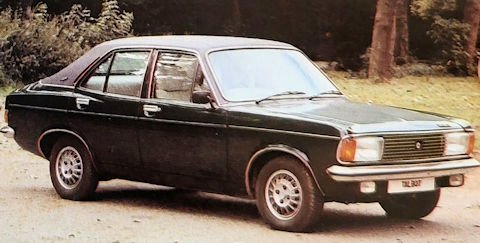
The Talbot Avenger. Built between 1979 and 1981 was manufactured by PSA group Peugeot Citroën, following the collapse of Chrysler Europe and now badged as the Talbot Avenger. This later Avenger was produced at the company's Linwood facility near Glasgow, Scotland UK. The Avenger and Sunbeam still retained the Chrysler badge unlike newer Talbot models.
The Avenger was built in Argentina up to 1990, initially as a four-door sedan and in Brazil until 1981 in two-door facelift form only. New Zealand also until 1980 in four-door sedan and five-door wagon forms only.For the UK markets saloon/estate range Well-equipped and with a reputation for longevity, the Avengers came with choice of 1.3 or 1.6 ohv engines and saloon or estate bodies. The latter with a 160 cm load floor. All 1.6-litre Avengers are available with four-speed automatic transmissions as an option to the manual gearboxes, and there are LS, GL, and GLS trim levels. Top GLS has vinyl roof, halogen head- lights, velour seats, and tinted glass.
4-5 seats,separate front seats, reclining backrests: heated rear window; trip recorder; cloth upholstery; rear fog lamps; vinyl roof (for saloons only); headrests (for GL models only); rear window wiper-washer (for GL Estate only),
Production for main sales continued until the mid 1981.This Avenger was discontinued with no direct replacement ,but Chrysler still retained ownership of the "Avenger" trademark.
OPTIONAL
Borg-Warner 45 automatic transmission, hydraulic torque converter with 4 ratios (I 3, II 1.937, III 1.351, IV 1, rev 4.692
metallic spray; laminated windscreen; rear window wiper-washer (for LS Estate only).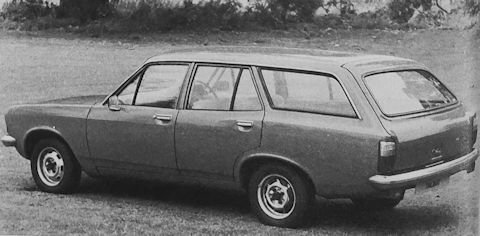
Hillman Imp MK II
 |
|
| Overview | |
|---|---|
| Manufacturer | Rootes Group |
| Class | Motor Car |
| Production | 1965 to 1968 |
| Assembly | Linwood, Scotland Australia Petone, New Zealand |
| Body style | 2-door coupe 2-door saloon 3-door estate |
| Layout | RR layout |
| Engine | 875 cc Straight-4 Overhead camshaft |
| Transmission | 4-speed manual all-synchromesh. |
| Wheelbase | 2,082 mm (82.0 in) |
| Length | 3,581 mm (141.0 in) |
| Width | 1,524 mm (60.0 in) |
| Height | 1,385 mm (54.5 in) Saloon 1,330 mm (52.4 in)Coupe 1,475 mm (58.1 in)Hillman Husky |
| Kerb weight | 725 kg (1,598 lb) |
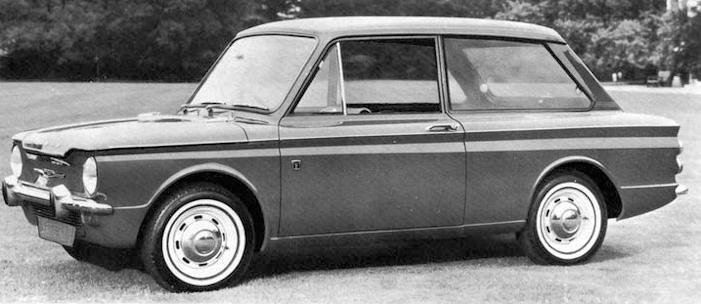
The Hillman Imp Mk II was a compact, rear-engined saloon car, manufactured under the Hillman marque by the Rootes Group in the 1960s.
History
At the end of 1965 a major revision to the Imp was introduced, effectively splitting the marque into Mk I and Mk II cars.The next generation of the Hillman Imp came along with the small van, the Commer Imp, was introduced in November 1965 and an estate version, using most of the same panels but with side windows behind the b-pillar, known as the Hillman Husky was produced from 1967.The Mk I Imps had a pneumatic throttle linkage and an automatic choke, both of which were replaced by more conventional items on the Mk II. The Mk II also had improved front suspension geometry and several trim and detail changes. Although the car was constantly improved over its production life, there was no single change as significant as that in 1965.
The Imp is that it is fun to drive. with integral chassis the front suspension is independent, U-shaped with swinging semi-axles, coil springs, telescopic dampers. It has a semi-trailing arm independent rear suspension system the distribution of weight was 38% to the front axle, and 62% rear axle. accurate rack-and-pinion steering with turns of steering wheel lock to lock of 2.63. coupled with excellent handling mean that the car goes where it is pointed, a superb gearbox allows changes rapidity, and an engine mounted behind the rear wheels, slanted over at 45° to fit. This was done to keep the center of gravity low and to minimise its effects on the roadholding of the car. with output of 39 b.h.p from a single Solex B 30 PlH-5 semi-downdraught single barrel carburettor and from 875 c.c light-alloy engine. With a maximum speed of 75.5 m.p.h. and a 0-50 m.p.h. acceleration time of 16.0 sec. The engine can be revved to 6,000 r.p.m. without any protest. Despite a compression ratio of 10: l, there was no pinking with 98 octane premium grade fuel, with an overall consumption of 31.3 m.p.g.
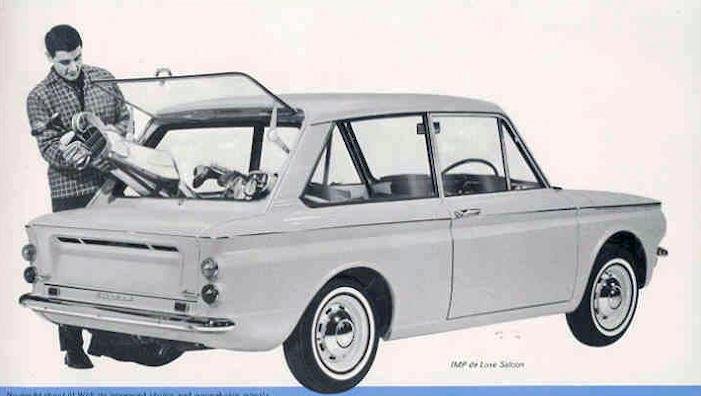
The ride is firm and comfortable and is certainly as good as that o fmost small cars from the time. the layout of the controls: the lights switch, wiper switch, indicator stalk, horn and flasher. Immediately in front of the left-hand side of the steering wheel is the lights switch with the dip/flash stalk just above other side is thc wiper switch and the indicator/horn stalk. The combined temperature gauge, speedo mounted in the binnacle and easy to read. The three additional, optional extra instruments such as clock, oil pressure gauge and ammeter along with three ashtrays.While room in the facia parcel shelf, two rear side pockets and two door pockets, The rear luggage compartment behind the
seats holds more than the front boot, and can be increased in capacity by folding the rear seats forward, so that in conjunction with the opening rear window.The opening rear window was intended to make it easier to load the small luggage area behind the fold-down rear seat. The fold-down nature of the rear seat was itself unusual in small car design at the time, being more often associated with larger upmarket estate cars.
PERFORMANCE
- Engine Capacity 53.39 cu in, 875 cu cm
- Fuel Consumption 43.7 mlimp gal, 36.2 mlUS gal, 6.5 1 x 100 km
- Max Speed 83 mph, 133.6 km/h
- max power (SAE): 42 hp at 5,000 rpm
- max torque (DIN): 52 1b ft, 7.2 kg m at 2,800 rpm
- max number of engine rpm: 6,000
- specific power: 48 hp/l
- power weight ratio: 35.5 lb/hp, 16.1 kg/hp
- acceleration standing 1/4 mile 21.8 sec, 0—50 mph (0—80 km/h) 14.7 sec
Imp Mk II variants
- Hillman Imp de Luxe Mark I & Mark II (1965-1968)
- Hillman Super Imp (1965-1968)
- Hillman Imp (1968-1968)
- Hillman GT (1967-1968) Developed by Chrysler Australia from the Singer Chamois Sport, it was never badged nor officially referred to as the Hillman Imp GT
- Hillman Imp Californian (1967-1968) Coupé / fastback saloon version
- Hillman Husky (1967-1968) Estate version of the Imp
- Commer Imp Van (1965-1968)
Hillman Audax Minx Series III
 |
|
|
Manufacturer |
Rootes Group |
|
Class |
Motor Car |
|
Production |
1956 to 1967 |
|
Assembly |
United Kingdom, Japan, Australia, New Zealand |
|
Body style |
4-door saloon 2-door convertible 4-door estate |
|
Engine |
1,592 cc I4 |
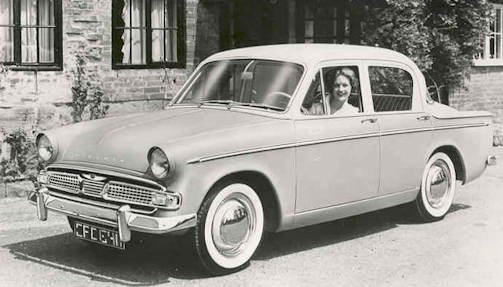
The Hillman Minx Audax Series III was a British car built from 1958 until 1963.
History
The Hillman Minx Audax Series III was built as the Series III first in 1958, the Series IIIA in 1959, the Series IIIB in 1960, and Series IIIC in 1961 until 1963.
The Audax body was designed by the Rootes Group, but helped by the Raymond Loewy design organisation, who were involved in the design of Studebaker coupés in 1953.The Hillman is a four-seater saloon weighing some 21-cwt. powered by an engine of 56 b.h.p. with a maximum speed of about 80 m.p.h. Now with improved larger brakes which increase the lining area from 92 sq. in. to 121 sq. in. with A pedal pressure of 120 lb.,
The car went through a series of annual face lifts each given a Series number, replacing the Mark number used on the previous Minxes; there was no Series IV.A variety of manual transmissions, with column or floor change, and automatic transmissions were offered. For the automatic version the Mark III used a Smiths Easidrive.The automatic gear-changing automatic clutches and manual gear selection. Made by Smiths and developed for a
number of years as the "Easidrive," is quite different from the normal, fluid-drive automatic transmissions by use of electro-magnetic clutches and automatic selection of three forward gear ratios. From the driver's seat the selector lever and its indicator panel on the steering column the lever can be moved to Drive, Second or Neutral and, by lifting it over a safety spring-loaded catch, to Reverse, which should not be engaged before the car has come completely to rest. Changes into second and top gears are governed automatically by a control box matching road speed and throttle response.
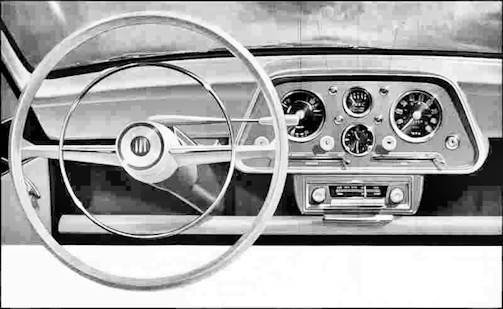
The separate front seats are well-padded and comfortable over a long journey. Visibility, is helped by a new, deeper windscreen. a heating system with the ability to blow warm air on to the floor and cool air on to the windscreen level. Both standard and deluxe come with parcel shelf running the full width of the car has taken the place of a lockable glove box there is ample capacity for luggage at the rear. Instruments: Speedometer with non-decimal,
total distance recorder, fuel gauge, water thermometer, Warning lights; Dynamo charge, oil pressure, indicator, headlamp main beam, Locks: With ignition key Ignition, both front doors. Ashtrays One under facia, one behind front seat Interior lights One with courtesy switches and Interior heater.
Optional, Smiths Optional Extras Heater, radio, oil pressure gauge, ammeter (standard with Easidrive transmission), bumper over-riders. separate
front seats. Upholstery material Floor covering Rubber and carpet
Exterior colours standardized 6 single, Alternative body styles 6 two-tone.
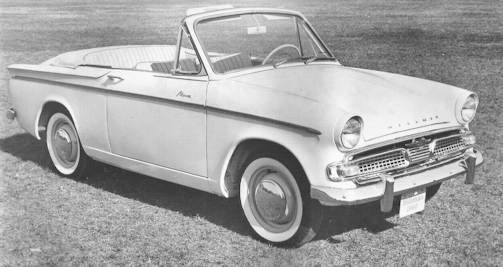
Some models were re-badged in certain markets, with the Sunbeam and Humber marques used for some exports. The New Zealand importer/assembler Todd Motors created the Humber 80 and Humber 90, badge-engineered models based respectively on the Minx and Super Minx, as a way to secure scarce additional import licences for CKD assembly kits. Although the 90 was identical to the Super Minx, the cheaper 80 could be spotted by a horizontal bar grille design. The Audax Minx was also built in Japan by Isuzu Motors as the Isuzu Hillman Minx under licence from Rootes between September 1956 and June 1964 Isuzu produced their own unique estate car version, the Isuzu Hillman Express, from 1958 to 1964.
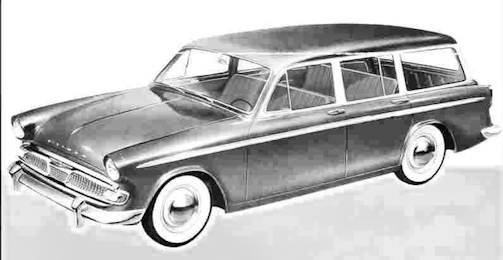
Series III 1494 cc engine
- Top speed of 76.9 mph (123.8 km/h)
- Accelerate from 0–60 mph (97 km/h) in 25.4 seconds.
- Fuel consumption of 31.8 miles per imperial gallon (8.9 L/100 km; 26.5 mpg‑US)
Hillman Audax Minx in Heartbeat tv series

Hillman Imp Californian
 |
|
|
Manufacturer |
Rootes Group |
|
Class |
Sports car |
|
Production |
1967 to 1970 |
|
Assembly |
Linwood, Scotland |
|
Body style |
2-door coupe |
|
Layout |
RR layout |
|
Engine |
875 cc Straight-4 Overhead camshaft |
|
Transmission |
4-speed manual all-synchromesh. |
|
Wheelbase |
82 in, 2,083 mm |
|
Length |
139 in, 3,531 mm |
|
Width |
60.25 in, 1,530 mm |
|
Height |
52.50 in, 1,333 mm |
|
Dry weight |
1,523 1b, 691 kg |
|
Max Speed |
80 mph, 128.8 km/h |
|
Price new |
£713 inc |
The Hillman Imp Californian was a rear-engine coupe car, manufactured under the Hillman marque by the Rootes Group (later Chrysler Europe) from 1967 to 1970.
History
The Imp Californian coupe, was introduced in 1967 at the same time as the van's pressings were used to create an estate car. This coupe had 2 doors with 4 seats the front seats separate units with reclining backrests the divided rear seating the rear seats can be folded down for extra luggage space. Instruments, Speedometer, fuel gauge and warning lights for flashing indicators, oil pressure/water temperature,
headlamp main beam and ignition. Interior light and panel illumination.

The coupe bodyshell was similar to the standard body mk 2 imps but featured a more shallow-raked windscreen and rear window which, unlike that on the standard bodied cars, could not be opened. The attempt at a sportier design did not translate into better acceleration or top speed figures and the aerodynamics of the standard saloon were actually slightly better. The new body style made its first appearance at the Paris Motor Show in October 1967, with the introduction of the sporting Sunbeam Stiletto. The coupe body had also appeared, with less powerful engines, in the Hillman Imp Californian announced in January 1967 and the more luxurious Singer Chamois coupe. By 1967 the company had been acquired by Chrysler, to become part of Chrysler Europe. A year later, ahead of the 1968 London Motor Show, the recommended retail prices of most Imp models were reduced for the domestic market by more than four per cent, despite the general price inflation affecting the UK.
Rear-engine cars generally suffer from oversteer handling characteristics to some extent, and to counteract this as much as possible, the Imp had a semi-trailing arm independent rear suspension system the distribution of weight was 38% to the front axle, and 62% rear axle. This relatively costly and sophisticated solution, typical for small car design at the time, was insisted upon by its designers after testing at length a Chevrolet Corvair with swing axles. To attain balanced handling, the Imp actually used swing axle geometry at the front, but this initially led to too much understeer and the camber was later reduced by lowering the pivot points.
Standard features self-parking screen wipers with heavy duty motor. two sun visors,headlamp flasher switch, zone toughened windscreen. builton heating and ventilation with blower unit. screen-washers,four stowage pockets. front quarter-lights, floor carpeting. ashtrays, padded armrests on rear side pockets, door operated interior light. twin-tone hornsand wheel-trim discs.
Colour schemes
Signal Red with Black upholstery ,Ming Blue with Blue upholstery ,Polar White with Black upholstery ,Polar White with Blue upholstery
Lincoln Green with Black upholstery ,Golden Bronze Metallic with Black upholstery
OPTIONAL EXTRAS. White-wall tyres, Smiths Radiomobile, reversing light, overriders, seat belts, etc.

The Imp's engine was mounted behind the rear wheels, slanted over at 45° to fit. This was done to keep the center of gravity low and to minimize its effects on the roadholding of the car, a 4 stroke water cooled with 4 cylinders slanted at 45°, in line. fitted with 1 Solex 30 PlH-5 semi-downdraught single barrel carburettor .Fitted to a 4 speed mechanical gearbox with synchromesh gears on 1st, 2nd, 3rd and 4th.
Performance
- Engine Capacity 53.39 cu in, 875 cu cm
- Fuel Consumption 43.7 m/imp gal, 36.2 m/US gal, 6.5 1 x 100 km
- Max Speed 80 mph, 128.8 km/h
- Max power (SAE): 42 hp at 5,000 rpm
- Max torque (SAE): 56 1b ft, 7.7 kg m at 2,800 rpm
- Max engine rpm: 5,600
- Specific power: 48 hp/l
- Power- weight ratio: 36.2 lb/hp, 16.4 kg/hp
- Acceleration: standing 1/4 mile 21.8 sec, 0—50 mph (0—80 km/h) 14.6 sec
- Speed in top at 1,000 rpm: 15.1 mph, 24.3 km/h.
- Export engine
- Max power (SAE) 37 hp at 4,900 rpm
- Max torque (SAE) 53 1b ft, 7.3 kg m 2,800 rpm
- 8 compression ratio
- 42.3 hp/l specific power.
Hillman Hunter
 |
|
|
Production period: |
1966 to 1979 |
|
Class : |
Motor car |
|
Body versions : |
Sedan , coupe ,pickup |
|
Engines: |
1.7 liters (54 kW) |
| Wheel base: | 98.50 ln. 2.502 mm |
| Length: | 169.50 ln. 4.305 mm |
| Height: | 56 in, 1,422 mm |
| Ground clearance: | 6.75 in, 1.714 mm |
| Dry weight: | 1,974 1b, 895 kg |
The Hillman Hunter is a vehicle of the British Rootes Group , which was produced from 1966 to 1976 as a sedan and station wagon . The Hunter was the Hillman version of the Roots Arrow and replaced the Hillman Super Minx . The Hunter had initially from 1967 to 1970 as a twin brother, which bore the name Hillman Minx and was slightly simpler equipped and weaker motorized.
The Hillman Hunter Mark I / II took over the engine of its predecessor, a 4-cylinder in-line engine with 1725 cc displacement, which developed in the Hunter but 74 bhp (54 kW ). This allows the vehicle to reach a top speed of 144 km / h. The Hunter also received a completely new, smooth body . In addition to the sedan also a 5-door station wagon was offered. In 1975, this model expired.
PERFORMANCE
- Engine Capacity 105.26 cu in. 1.725 cc
- Fuel Consumption 31 m/imp 25.' m/US 9.' x 100 km
- Max Speed 88 mph. 141.7 km/h
- Max power (SAE): 80 hp at 5,000 rpm
- Torque (SAE): 103 1b ft. 14.2 kg m at 3,000 rpm
- Max engine rpm: 5,600
- Specific power: 46.4 hp/l
- Power— weight ratio: 24.7 lb/hp, 11.2 kg/hp
- Acceleration: standing 1/4 mile 20 sec, O— 50 mph (O —80 km/h) 9.9 sec

From 1969 to 1970, there was the Hillman Hunter GT , whose engine 88 bhp (65 kW) gives and accelerates the vehicle to 149 km / h. It differs by rectangular headlights from the basic model.
From 1971 a version called Hillman Hunter de Luxe appeared. She had a slightly better equipment and replaced the Hillman Minx.
From 1972, the Hillman Hunter GLS is offered, the same size engine 93 bhp (68 kW) makes. This model is 163 km / h fast.
From 1977, the Hunter was sold under the name Chrysler Hunter . The production was continued until 1979; then the company's new owner, the French PSA group, ceased production. In Iran , however, this was (with a different engine) until 2005 as Paykan 1600 of Iran Khodro Co. further developed. The own creation Paykan Pickup is still produced in the city of Tabriz in Iran.
Optional Accessories :Laycock-de Normanville overdrive on 3rd and 4th (0.803 ratio), 3.890 axle ratio; Borg-Warner 35 automatic
gearbox, hydraulic torque convertor and planetary gears with 3 ratios. steering column selector lever.


