
Hino
Hino Contessa 1300 (2nd generation)
 |
|
|
Production |
1964 to 1967 |
|
Class |
Motor Car |
|
designer |
Giovanni Michelotti |
|
Drive system |
RR |
|
Body |
2-door coupé |
|
engine |
GR100 in-line 4-cylinder 1,251cc 65ps/55ps |
|
Wheelbase |
89.76 in, 2,280 mm |
|
full length |
163.39 in, 4,150 mm |
|
Width |
60.24 in, 1,530 mm |
|
Height |
54.72 in, 1,390 mm |
|
Ground clearance |
6.69 in, 170 mm |
|
vehicle weight |
1,940 1b, 880 kg |
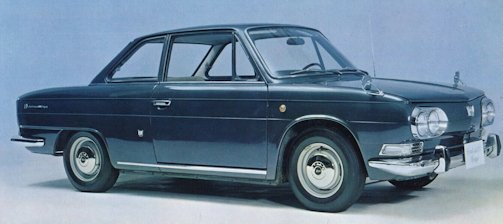
The Hino Contessa 1300 (2nd generation) PD100/300 type is a rear -engine, rear-drive passenger car developed by Hino Motors based on the experience gained in license production of the Renault 4CV and produced from 1964 to 1967.
History
In September 1964, a 4-door sedan was released as the "Contessa 1300”. Like the Contessa 900 Sprint, Giovanni Michelotti created a style based on 4-light headlights, thin pillars, and a long rear deck. From its elegant styling, both sedans and coupes have been selected for several years at the Concours d' Elegance in Italy. It was a success, winning four awards. In the design motif, you can observe the combination of a grilles (or less impressive grille) nose and dual headlights, and a straight press line on the rear side, which are common to the Triumph 2000, which is a Giovanni Michelotti work of the same period. You can see the design taste that Michelotti had.

In the design requirements initially handed to Michelotti from the Hino side, Takashi Suzuki (later Vice President of Hino Motors) and other engineers in charge of the engine said that a cooling air intake of about 1,500 square centimetres should be provided facing the front to cool the radiator. Forced to add conditions. The engineering team was expecting a design similar to the one in front of the rear fender of the Contessa 900 Sprint, but the original design presented by Michelotti had a mouth as a large projection on the rear fender. It was a design that seemed to be defiant. Ultimately, the cooling air was taken in through the vertical grille at the rear end, and the engine room that satisfies the cooling performance was created by devising ways to prevent the air that was drawn under the floor and the engine exhaust from being sucked in again. The sedan model had a nominal top speed of 135 km/h.
The engine was a complete change from Renault's expanded version of the 900 (GP20 type), and Hino developed the "GR100 type" with a total displacement of 1,251cc and an output of 55ps, which was designed in-house by Hino. Although it is a long -stroke OHV, it is an engine with an in -line 4-cylinder, 5 - bearing crankshaft, and a cross-flow valve arrangement with a double rocker arm. As a countermeasure against heat, the engine block was placed at an angle to shorten the length of the exhaust pipe exposed in the engine room, and the area around the carburettor and intake manifold was designed to prevent percolation and facilitate cold starts. It initially issued an instruction to "use the same displacement (1,200cc) as the Nissan Bluebird (at that time)", but the same as the European 1,300cc is the mainstream in the class," but it was difficult to come to terms with it. In the end, development progressed in a way that the field insisted, "If it's a 1,251cc, it's just a little over 1,200."
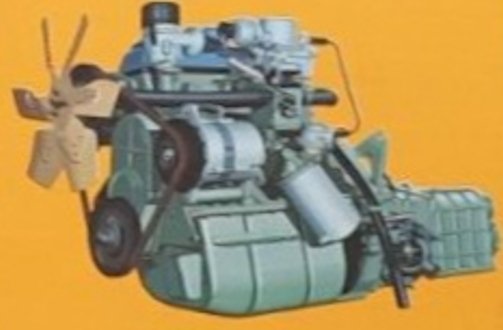
The layout of the radiator was changed from the front of the engine in the 4CV and 900 to the rear end of the engine room, but with this layout change, it was necessary to reconsider the method of introducing cooling air by engine power, which is the fate of rear-engine passenger cars but with distribution of weight: 36% to front axle,and 64% rear axle.
The chassis has also been improved, and compared to the 900, which remained unstable due to the rear engine + swing axle, the rear spring was strengthened to achieve a significant improvement in steering stability. Regarding the shift lever, it followed the column shift with the long-distance linkage of 900, and a floor shift model was also prepared. The front wheels of the sporty coupe use fist-type disc brakes (manufactured by Akebono Brake Industry Co., Ltd.) for the first time in a Japanese domestic car.
COLOR SCHEMES
- Body color
- Marble gray
- Venetian red
- Sage green
- Stone gray metallic
- Moss green metallic
- Holland blue
- Navy blue
- Viking blue metallic
UPHOLSTERY
- Red
- Black
OPTIONAL ACCESSORIES
- Radio
- Heater
- Clock
- Cigarette lighter
- Deluxe wheel cap
- Fog lamp
- 4-speed mechanical gearbox,
Initially, only the 4-door sedan was set, the deluxe model had 4 headlamps, and the standard model used the deluxe light bezel and had 2 lamps on the outer side, but later both the deluxe and standard models had 4 lamps. In 1965, a new 2-door, 4-seater coupe was added. In the coupe, the compression ratio of the engine has been raised from 8.5 to 9.0, the output has been strengthened to 65ps, and the maximum speed is 145km/h. The low, flowing styling that incorporates the motif of the 900 Sprint is said to be one of the most beautiful Japanese passenger cars of the 1960s.
In 1966, a 1,500cc engine was prototyped and was scheduled to be sold as the Contessa 1500 later, but development was cancelled due to a tie-up with Toyota. This prototype engine is currently on display at the Hino Auto Plaza as the "Phantom Contessa 1500 Engine”. At the same time, the prototype 1300 Mark 2, which had simplified the interior and exterior of the sedan for mass production, was based on the production car, and the bumper position was changed, the exterior was simplified, and the interior and dashboard shape were greatly changed. produced. A deluxe 3-speed, deluxe 4-speed (2 units), S (sport), standard, and coupe, a total of 6 prototypes were produced. Sales were undecided, but were planned after the 1967 GR100 engine's 1300cc power-up version (around 10 horsepower).
Among the Japanese-made passenger cars of the time, it was outstanding in terms of performance and style, however, when this model was launched, the mainstream of compact passenger cars in the 1,000cc class had already shifted to front-engine vehicles, and domestic sales were sluggish. In 1967, production ended in line with the withdrawal of the Contessa 1300, which was a precondition of the partnership.
With the Contessa 1300 as the last, Hino withdrew from independent development of passenger cars, and decided to undertake the design and development of the " Hilux " and some of Toyota 's commercial models such as the " Publica Van" and " Carina Van”.
PERFORMANCE
- Engine capacity: 76.34 cu in, 1,251 cu cm
- Fuel consumption: 39.2 ml imp gal.32.7ml US gal,7.2 1 x 100km
- Max speed: 80.8 mph, 130 km/h
- Power-weight ratio: 32.4 lb/hp, 14.7kg/hp
- Max power (SAE): 60 hp at 5,000 rpm
- Max torque (SAE): 72 1b ft, 10 kg m at 3,200 rpm
- Max engine rpm: 5,300
- Specific power: 48 hp/l
- Max speeds: 24.2 mph, 39 km/h in 1st gear; 45.3 mph, 73 km/hin 2nd gear; 80.8 mph, 130 km/h in 3rd gear
From around, the Hino Sprint 1300GT was prototyped separately from the development of mass-produced vehicles. Different from the 1300 coupe, the styling is by Michelotti. The shape has evolved since the Contessa 900 Sprint era, and the styling has clearly progressed to the subsequent Ferrari 330GT Michelotti.
The design and production of the body of the Hino Sprint 1300GT was entrusted to Michelotti in Italy, and the engineering of the chassis and engine was entrusted to Alpine., Equipped with a GR100 type engine that was also converted to DOHC by Alpine (This GR100-based DOHC engine developed by Alpine eventually developed into the YE28, a competition engine dedicated to the Hino prototype). In addition, a steel body has been produced under Michelotti in advance for the purpose of shape confirmation for FRP body production. This is how to take in the cooling air, the upper surface of the rear end of the engine hood of the Renault/Alpine style. An individual with an FRP body was exhibited at the 1966 Paris Salon, and was introduced as "HINO Sprint GT 1300" in some yearbooks. Hino-Michelotti-Alpine carried out a test run of tens of thousands of kilometres in Europe in accordance with a contract with Hino, and delivered it to Hino after the Paris Salon. However, the Hino Sprint 1300GT never reached the market, and the project ended with just this FRP body prototype.
The Contessa 1300 was mainly used in touring car races by Pete Brock and others in the United States. Takashi Suzuki was temporarily sent from Japan as an engineer in charge, and was competing in local grass races. In 1967, the Hino Samurai was developed as a prototype car based on the Contessa 1300, and Toshiro Mifune was appointed as director to participate in Japanese races, and in April of the same year, the vehicle was actually brought to Fuji Speedway. The story progressed, but he could not pass the race inspection and did not participate in the race.

Hino Contessa 900 first generation (PC10)
 |
|
|
Sales period |
1961 to 1965 |
|
Class |
Motor Car |
|
Drive system |
RR |
|
engine |
GP20 in-line 4-cylinder 893cc 35ps |
|
Wheelbase |
84.64 in, 2150 mm |
|
full length |
150.79 in, 3830 mm |
|
Width |
57.87 in, 1470 mm |
|
Height |
47.24 in, 1200 mm |
|
vehicle weight |
1543 1b, 700 kg |
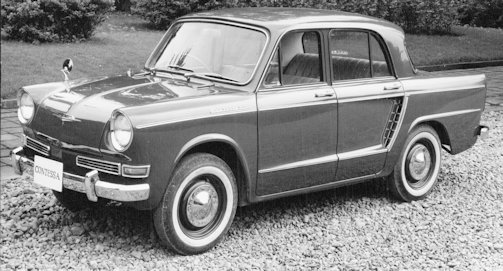
The Hino Contessa 1st Generation 900 was a small Japanese car from the 1960s.
History
The Contessa 900 first appeared in 1961 equipped with an 893cc gasoline engine with an output of 35ps. It was at first only available as a 4-door sedan, and its 1960s styling features include no front grille, two round headlamps, side air intakes, and tail fins. In 1962, based on the Contessa 900, the two-door coupe Contessa 900 Sprint was announced with styling and coachwork by Giovanni Michelotti. Enrico Nardi was in charge of tuning the engine and suspension, and the maximum speed of 150km / h was planned from the engine that was raised to an estimated 45ps. Beginning with the Torino Motor Show in October of the same year, it was exhibited at overseas motor shows from the 1963 Geneva Auto Show to the New York International Auto Show, attracting much attention and admiration. Production in Italy was also planned. Although the announcement by Hino Motors that pressure from various European automakers, it was not commercially available in any numbers. While the 4-door saloon was well-received and led to many deliveries to the taxi industry.

The basic layout, such as the drive system and front suspension was independent, wishbones, anti-roll bar, with telescopic dampers at the rear independent, swinging semi-axles, longitudinal drive shaft, coil springs and telescopic dampers, distribution of weight was 35 % at front axle, and 65 % to the rear axle this followed the conventional Hino/Renault, and the displacement was an enlarged version of the Renault engine. As for its technical characteristics, it was equipped with an optional Shinko-Hinomatic electromagnetic automatic clutch, which realized a column shift even though it was a rear-engine car, thanks to the devising of the shift linkage.
The 900 sedan was produced until 1965,
PERFORMANCE:
- Engine capacity: 54.62 cu in, 893 cu cm
- Fuel consumption: 51.3 m/imp gal, 42.8 m/US gal
- Max speed: 87.0 mph, 140 km/h
- Max power (DIN): 45 hp at 5500 rpm
- Max torque (DIN): 47 1b ft, 6.5 kg. at 3200 rpm
- Max number of engine rpm: 5500
- Specific power: 50.4 hp/l
- Power-weight ratio: 34.2 hp/lb, 15.5 kg/hp
- Acceleration: standing 1/4 mile 24.2 sec, 0-60 mph (0—80 km/h) 19.6 sec
- Max speed in 1st gear: 27.9 mph, 45 km/h; max speed in 2nd gear: 55.9 mph, 90 km/h; max speed in 3rd gear: 87 mph, 140 km/h


