
Ginetta
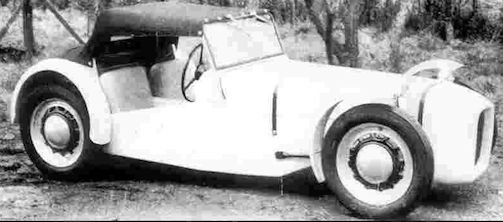
Ginetta G2
 |
|
|
Manufacturer |
Ginetta Cars |
|
Production |
1958 to 1960 |
|
Class |
Sports car |
|
Body style |
2-door roadster |
|
Engines |
Ford |
|
Wheelbase |
7 feet 6 inches |
|
Track |
front, rear 3 feet 9 inches |
|
Length |
10 feet 6 inches |
|
Height |
2 feet 5 inches |
|
Weight |
8 cwt. |
The Ginetta G2 was the first kit type sports car built by Ginetta from the years 1958 to 1960.
History
At the beginning of 1958 Ginetta Cars was formed. It was decided by 1958 after the G1 that they would build a car for sale to the motoring Public made by the usual tools found at home.The final cost of putting the car on the road depended entirely on if the enthusiast used new or secondhand components to build a 2-seater sports car at low cost less than £250. To achieve this goal the car had to be designed primarily for the home constructor as a kit-car the complete kit included the space frame chassis and aluminium and fiberglass body panels, windscreen, hood, pedals, four wings, the nose cowl and bonnet with the look of the lotus 7. Telescopic dampers and remote gear linkage along with Ford parts, the finished car was called the Ginetta G2.
Ivor Walklett carried out the initial work and designed a simple multi-tubular space-frame chassis comprising 1-inch O.D. 16 and 18 SWG steel tubing. A 20-gauge aluminium body was then made to clothe the chassis. The bulkhead, floor, body panels and prop shaft tunnel were all fixed permanently to the chassis frame, making for an extremely rigid unit. Cycle-type wings shielded all four wheels.
To Build the G2 it would accept either the Ford 8 h.p or 10 h.p. vehicle components (1938-1953) and the more modern Ford Popular E93A engine and running gear. Four modifications were necessary, these being the lengthening of the steering column, the shortening of the prop shaft and the alteration of the radius arms, and the gear lever. Ginetta would also undertake these modifications at extra cost if required, although preferable to use a new steering column and box, already lengthened, which they could supply at an additional of £9 10s.
The factory also offered other modifications such as IFS on swing-axle principle. The approximate weight of the body-frame was 1501b. This included adjustable clutch and brake pedals with linkage, accelerator pedal, mounting brackets for the engine, steering, radiator, petrol tank, axles and so on all of which were built in.
Only around 100 were ever built of this first G2 type car.
Ginetta G32
 |
|
|
Manufacturer |
Ginetta Cars |
|
Production |
1986 to 1993 |
|
Class |
Sports car |
|
Body style |
2-door coupé, roadster |
|
Engine |
Ford ,Triumph |
|
Wheelbase |
2,2 m |
|
Length |
3,7 m |
|
Width |
1,6 m |
|
Height |
1,2 m |
|
Kerb weight |
764 kg. |
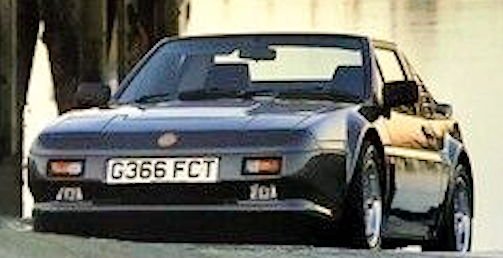
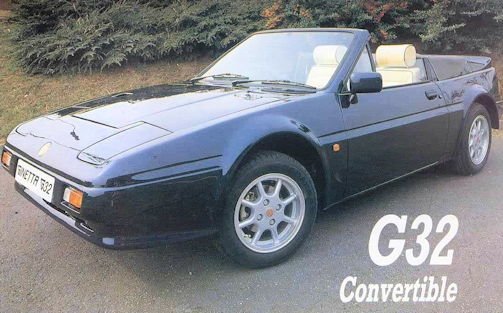
The Ginetta G32 was the British-made mid-engined sports car that was also as a Kit Build in some markets.
History
Introduction at the 1988 Birmingham show the four brothers who founded the company sold out to a businessman in 1989 who immediately launched the long-awaited G32. It had been under development for several years. It's a small 2-seater coupe, with a Ford CVH engine mid-mounted, available with a fixed head or soft-top. Ford Fiesta parts are used such as the dash, steering, controls and doors. The main bodyshell is glass-reinforced plastic and forms a small tidy shape with a small boot with a load space 8.8cu ft. the G32 has undergone many changes for the better in its history to the point where it is was so heavily redeveloped that it carried a fresh name when it was first shown in 1986. At first the G32 would be available only in kit form. Later as full turn key cars. It came with 6" x steel road wheels ( alloy and competition options).Fitted with Front suspension independent , transverse arms, coil spring at the Rear independent , MacPherson strut with transverse arm, coil spring front and rear anti- roll bar and Hydraulic shocks. Four-wheel disc brakes, disc diameter, front (ventilated) 24.lcm, rear 24.7cm, mechanical handbrakes to rear wheels. With three engine options all with 5 speed gearboxes as standard.
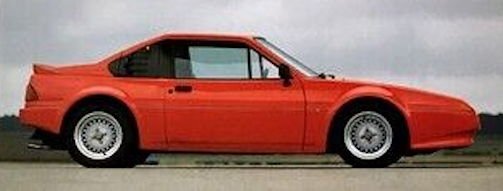
There were three variations on the G32 theme available at launch CVH Engines based on the Ford Escort with a XR3-powered model at £7814, a fuel-injected XR3i-based edition at £8389, or the range-topping 132bhp RS Turbo-based G32 at £9884.
Performance: 1.6 CVH Injection
- Max speed approx. 124mph/200kmh
- Acceleration 0-62mph/100kmh approx. 9sccs;
- Power to weight ratio 10.4kg/kW (7.6kg/PS)
- Fuel consumption approx. 6-11L/ 100k (47.1-25.7mpg) [29.2-21.4US mpg).
- Max power 75 kW/102 hp at 6000 rpm
- Max torque 138 Nm/14 1 kg. at 4800 rpm
With a variety of Ford engines, the later built cars had option for a large 1.9 powerplant from Peugeot. A coupé body was made from glass fibre and introduced alongside the open car. The doors were from the European MK2 Ford Fiesta as was the dashboard. Colours: Ginetta Red, Diamond White, Maritime Blue.
Options available
- Sunshine roof
- Electric windows
- Galvanised Chassis
- Metallic Paint: Anthracite, Silver, Mercury Grey, Paris Blue. Special Colours by arrangement.
- 15" Alloy wheels
- 195-50-15 VR Avon Tyres
- Radio-Cassette
- Cone Door Speakers Co-axial Door Speakers
- Cone Rear Speakers, Co-axial Rear Speakers
- Central Locking,
- Anti-theft Alarm
- Leather Seats.
Ginetta G23
 |
|
|
Manufacturer: |
Ginetta |
|
Production period: |
1991 |
|
Class: |
Concept |
|
Body |
Convertible |
|
Engines: |
Ford V6 2,994 cc |
|
wheel base: |
91 in, 2,311 mm |
|
overall length: |
156.50 in, 3,975 mm |
|
overall width: |
62.99 in, 1,600 mm |
|
ground clearance: |
4.75 in, 121 mm |
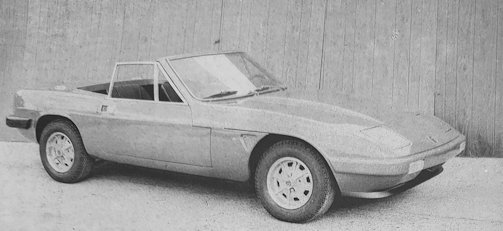
The G23 was a prototype convertible sports car manufactured by Ginetta in 1981
History
The Ginetta G23 was a prototype concept convertible, in plastic material; with 2 doors and 2 separate front seats. This 2-seater sports car built only in 1981 and did not make planned full production. A follow-on from the G21 as a 2-door convertible prototype developed from the previous Ginetta G21 but with more modern look and pop up headlights. The cars were fitted with the same a 2.8 litre Ford V6 OHV petrol engine and a planned cost of around £7,000 with option for a hardtop.
The engine was the heavy Ford unit but with good weight distribution of 49% to the front, and 51% at the rear with a turning circle: 35 ft. 10.7 capable of producing around 130 bhp with a single Weber twin barrel carburettor and a top speed of over 200 km/h. The engine was mated to a manual 4-speed gearbox and power was sent to the rear wheels with option for overdrive.
- PERFORMANCE
max power (DIN): 128 hp (94 kW) at 4,750 rpm
max torque (DIN): 174 1b ft. 24 kg m (235 Nm) at 3,000 rpm
max engine rpm: 5,500; 42.8 hp/l (31.5 kW/l)
max speeds: (I) 45 mph, 72 km/h; (II) 66 mph, 106 km/h; (III) 98 mph, 157 km/h; (IV) 128 mph, 206 km/h
Power-weight ratio: 15 lb/hp, (20,5 lb/kW), 6.8 kg/hp (9.3 kg/ kW)
acceleration: standing 1/4 mile 14.9 sec, 0-50 mph (0-80 km/h) 5.5 sec
speed in direct drive at 1,000 rpm: 23.4 mph, 37.6 km/h
Fuel consumption: 26 m/imp gal, 21.6 m US gal, 10.9 1x 100 km.
A Total of only 3 prototype cars were made.
Ginetta G10/G11
 |
|
|
Manufacturer |
Ginetta Cars |
|
Production |
1965 to 1968 |
|
Class |
Sports car |
|
Body style |
2-door roadster and Coupe |
|
Engines |
Ford, MG |
|
Wheel base |
90 in, 2,286 mm |
|
overall length |
162 in, 4,115 mm |
|
overall width |
60 in, 1,524 mm |
|
overall height |
48 in, 1,219 mm |
|
ground clearance |
5.50 in, 140 mm |
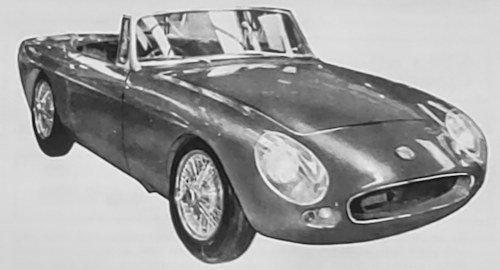
The Ginetta G10 and G11 were British sports and race cars from the 1960s.
History
First Launched at the 1965, the Ginetta G10 was a larger and more performance type front engine sports car. As engine came either with the 1.8-litre version from the MGB (G11) the American 4.7-liter Ford eight-cylinder used in the G10, this was a more powerful car than its predecessors with a Ford V8 engine.
The car was Light weight with a tubular frame chassis,weighing around 900 kg (1,984 lb) and fitted with a 4.7 L (289 cu in) V8 engine from the Ford Mustang, with a 4-speed fully synchronlzed mechanical gearbox and limited slip rear final drive.The G10 was first used for racing with the distribution of weight 51% to front axle, and 49% at rear axle.
Performance V8 289 cu (G10)
- Max power (SAE) 271 hp
- Acceleration standing 1/4 mile 13.5 sec. 0—50 mph (0—80 kmh) 3.2 sec
- Speed in direct drive at 1,000 rpm 23 mph, 37 km/h.
Ginetta produced the G11, a street legal version of the G10 with the same body but with the Ford V8 replaced by the MGB 1800 engine.It was built at the same time as the G12 and MGB, the model G 10 / G11 was developed,however, slow build times and deliveries of the engine meant only a few were produced.
The low production was mainly due to the delayed supply of parts by British Leyland, who saw in the G11 a competitor to the MG. Only six copies of the G10 were produced. In contrast to the MG and other competition, the product had little success which made the now-grown company in financial difficulties.
Ginetta G15
 |
|
|
Manufacturer: |
Ginetta |
|
Production period: |
1968 to 1974 |
|
Type: |
Sports car |
|
Body |
Coupe |
|
Engines: |
875cc to 998cc |
| wheel base: | 82 in, 2,083 mm |
| overall length: | 144.50 in, 3,670 mm |
| overall width: | 57 in, 1,448 mm |
| ground clearance: | 6 in, 152 mm |
| dry weight: | 1,120 1b, 508 kg |
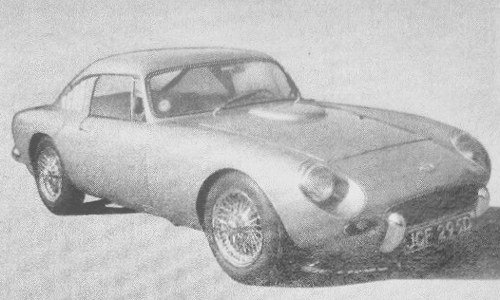
The Ginetta G15 was a British sports car built from 1968 to 1964.
History
The Ginetta G15 was the most successful model of the brand was the 1968 presented G15, a small two-seat rear-engined coupe, which was equipped with the 875 cc engine of the Hillman Imp with a body in plastic glass fibre material with 2 doors. Built with three small updates over the years.
With an tubular chassis, the independent suspension came from the Triumph Herald with independent front suspension that has wishbones, coil springs, telescopic dampers with the rear was also independent, semi-trailing arms, coil springs, telescopic dampers.The imp also included the complete drive technology used as well as the four speed transmission,the distribution of weight was 45% to the front axle,and 55% at the rear axle.
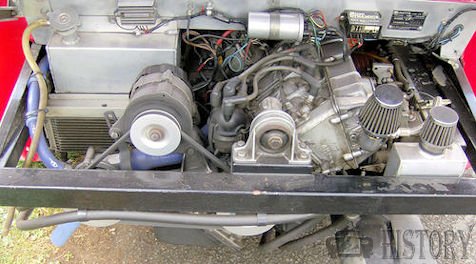
By 1974, just over 800 copies were sold as kitcar and finished vehicles. A special feature of the G15 is a fully fold-up tail, which completely exposes the subframe together with the engine-transmission rear axle unit and allows a removal with minimal effort carburation was 2 Stromberg 125 CDS horizontal carburettors. Of the production sold a "S" version was avaliable with the IMP 998cc engine . Optional Accessories included light alloy wheels.
PERFORMANCE 875cc
- max power (DIN): 55 hp at 6,100 rpm
- max torque (DIN): 52 1b ft, 7.2 kg m at 4,300 rpm
- max engine rpm: 7,000
- specific power: 62.9 hp/l
- power-weight ratio: 20.4 lb/hp, 9.3 kg/hp
- acceleration: standing 1/4 mile 18.4 sec, 0-50 mph (0-80 km/h) 8.5 sec
- speed in top at 1,000 rpm: 14.9 mph, 23.9 km/h
- fuel consumption: 40 m/ imp gal, 33.1 m/US gal, 7.1 1 x 100 km.
- max speeds: 21 mph, 33 km/h in 1st gear: 56 mph, 90 km/h in 2nd gear; 88 mph, 141 km/h in 3rd gear; 101 mph, 162 km/h in 4th gear

Similar in design was the 1973 presented Ginetta G21, which looked like a hatchback version of the G15, but had a front engine. It was produced until 1978 in about 180 copies.


