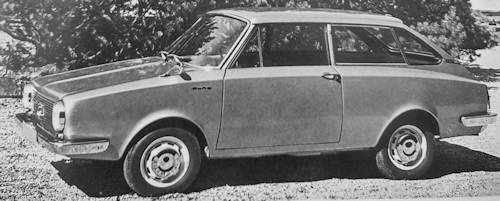
Glas
Glas 1204
 |
|
|
Manufacturer |
Hans Glas GmbH |
|
Production |
coupé Jan 1963 – October 1965 |
|
Produced |
16,902 |
|
Assembly |
Dingolfing |
|
Class |
Motor Car |
|
Body style |
coupé, saloon, cabriolet, kombi limousine (estate) |
|
Layout |
FR layout |
|
Engine |
4-cylinder in-line 1204: 1189 cc |
|
Transmission |
4-speed manual all-synchromesh |
|
Wheelbase |
2,100 mm (83 in) |
|
Length |
3,835 mm (151.0 in) |
|
Width |
1,500 mm (59 in) |
|
Height |
saloon & estate: 1,370 mm (54 in) |
The Glas 1204 is a small two-door, four-seater automobile produced by Hans Glas GmbH at Dingolfing Germany.
History
In January 1963, Glas presented the new sedan with 39 kW (53 hp) and immediately followed up with the coupé and convertible with the larger engine. The full four-seater arrived in January with the 1204 which had its cylinder stroke extended from 61 mm to 73 mm, to give an engine capacity of 1,189 cc and claimed maximum power of 39 kW (53 PS) at 5,100 rpm with the original 1 Solex 32 P ICB downdraft carburettor. The larger engine car was also offered as a coupé and as a cabriolet.
The vehicles occupied a special position in automobile construction at the time due to the first use of a series-produced engine with a toothed belt to drive the camshaft as well as their shape. It soon became clear that middle-class customers expected a car with four full-size seats. So, the coupe was expanded into a two-door sedan. In order to maintain performance despite the higher weight, the water-cooled engine with cast iron cylinder block and light alloy cylinder head was enlarged to 1189 cm³ using a crankshaft with a modified stroke (73 mm) Front 4-stroke engine 4 cylinders in line the bore and stroke 2.83 x 2.87 in, 72 x 73 mm with compression ratio of 8.3:1
Performance:
max power (DIN) 53 hp at 5100 rpm
max torque (DIN) 66 1b ft, 9.1 kgm at 2000 rpm
max number of engine rpm 5500
specific power 47 hp/l
1204 TS
From November 1963 more powerful version was offered. The 1.2 litre engine 51 kW (70 hp) at 5750 rpm; maximum torque: 9.5 mkp (93 Nm) at 4200 rpm. This meant that the vehicles reached a top speed of 160 km/h, a value that put them close to Porsche and Alfa-Romeo-Sports car brought. The Engine capacity 72.72 cu in, 1,189 cu cm with 9.2
compression ratio and 2 Solex carburettors. Front disc brakes. Transverse linkage bar on front suspension. Max speed 99.4 mph, 160 km/h.The 1204 TS accelerated from a standstill to 100 km/h in 11.9 seconds. The consumption determined in the test was 10.9 litres/100 km. The front disc brakes were now standard and were said to have “good deceleration values with low pedal force”. With the 1204 TS, Glas offered a sporty and well-equipped car for 6,980 DM (May 1964) that was otherwise only available in the price range around 10,000 DM and higher.
In 1964 the Glas 1204 TS achieved motorsport success. Among other things, with Gerhard Bodmer at the wheel, he came eighth in the overall ranking of the 86 cars that started in the 500 km race at the Nürburgring and won the touring car class up to 1300 cm³ with an average speed of 112.2 km/h. Bodmer/Schmidt were equally successful at the 24-hour race at Spa-Francorchamps; Here too, they achieved eighth place in the overall ranking (average of 143.791 km/h) and finished the competition as class winners ahead of Lambrechts/Mombaerts (also Glas 1204 TS), who came twelfth in the overall ranking.While the other variants were discontinued in December 1967 at the latest, the CL models were manufactured until April 1968, most recently under BMW management.
Dimensions
- Sedan and CL: length 3835 mm, width 1500 mm, height 1370 mm, wheelbase 2100 mm
- Coupé and convertible: length 3835 mm, width 1500 mm, height 1355 mm, wheelbase 2100 mm
Production figures
- 1204 Sedan + 1204 TS Sedan: 14,392 built
- S 1204 Coupé + S 1204 TS Coupé: 2,463 built
- S 1204 Cabriolet + S 1204 TS Cabriolet: 47 built
Glass Goggomobil Isar Series 1 T 700
 |
|
|
Production period: |
1958 to 1960 |
|
Class: |
Motor Car |
|
Body versions: |
Sedan, station wagon |
|
Engines: |
688 c.c. |
|
Length: |
3430-3455 mm |
|
Width: |
1470 mm |
|
Height: |
1380-1390 mm |
|
wheelbase: |
2000 mm |
|
curb weight: |
650-720 kg |
The Glas Isar series one is a small car from the late 1950s to the early 1960s made by the former Hans Glas GmbH in Dingolfing.
History
Since until its appearance only the Goggomobil was known as a passenger car from Dingolfing, it was initially marketed as the "Big Goggomobil". in the past, the Goggomobil factory has specialized in very small vehicles with rear-mounted two-stroke engines and independent suspension all round. The series production of the new four-seat, two-door sedan began. Panoramic windscreen, small tail fins and the two-tone paintwork corresponded to the fashion of the time, which came to Europe from the USA. The keyhole-shaped rear lights were reminiscent of the Opel Kapitän of that time. Remarkable for the time was the self-supporting all-steel body with (from 1959) the floor section reinforced by box-shaped side members. The T.700's made in saloon and estate car versions, with increasing size, to revert to a more orthodox specification for a car of more conventional size. The 700-c.c. engine has kept the overall weight of a compact four-seater down to the very low figure of 12 cwt. with a combined body and chassis construction which feels extremely rigid and sturdy.
The front wheels were individually on lower wishbones and upper trailing arms with coil springs suspended; At the rear, the car had a rigid axle with leaf springs, which was still widespread at the time.
The engine air-cooled, flat-twin engine which is mounted at the front of the car a distributor is needed for the fan-cooled flat-twin engine which has a coil to each cylinder with contact breakers driven from the front of the crankshaft. in unit with a four-speed gear-box, Unusual in that all four forward gears are fitted with Porsche-type synchromesh and which drives the conventional back axle through an open propeller shaft giving good and acceleration is complemented by a fuel tank holding nearly 9 gallons which avoids the irritation of frequent stops. The boxer engine with a displacement of 584 cm³ developed 20 hp (15 kW) at 5000 rpm. This enabled a top speed of 98 km/h to be reached. The standard consumption was 5.3 l/100 km regular petrol.
From August 1958, the first version was accompanied by a more powerful variant. Your engine had 688 cc displacement and made 30 hp (22 kW). The maximum speed was 110 km/h, acceleration 40 s (0-100 km/h). Consumption rose to 5.8 l/100 km. The first variants of the "Big Goggomobil" had significant initial defects: The die-cast aluminium housing of the motors deformed at high operating temperatures. Due to this defect, the fuel consumption could increase to 12 l/100 km. The bodies twisted so badly on bad roads that cracks appeared and, in the worst case, the panoramic windscreen fell out of its frame. The complaints cost Hans Glas GmbH a lot of money and damaged the company's reputation. The steering is light and positive, with a light load the Goggomobil corners well with a mild understeer characteristic. The suspension provides a ride which is comfortable and well damped. The live back axle is mounted on semi-elliptic springs with almost vertical telescopic dampers, with an unladen weight of only 12 cwt., of which less than 40% is on the back wheels. The brakes are also good and are of unusually large diameter and have generous lining area relative to the weight and performance.
inside the seats are of generous size and comfortable for long distances The bench front seat is provided with separate back rests which hinge forward to
provide access to the back seat; they are independently adjustable for rake by means of threaded abutments. The back seats are then only just sufficient for two small adults. The spare wheel is mounted on the underside of the bonnet lid, and the air cleaner is easily detachable for access to the carburettor.
A built-in heater is part of the standard equipment; it is of unusual design in that the exhaust is the source of heat. Fresh air is tapped from the high-pressure side of the engine cooling fan and heated by passage through the surrounding exhaust pipes. A separate cold-air intake from the front of the car is led to the heater unit which has controls for mixing hot and cold fresh air and diverting through the wind- screen de-mister.
Instruments: Speedometer with total mileage recorder, Warning lights: Oil pressure, headlamp main beam, ignition, direction indicators, petrol Locks, with ignition key: Offside door and boot Glove locker Map pockets Parcel shelve Ashtray One in facia.
Interior lights: One, with manual switch and courtesy switch on driver's door.
Interior heater: Built-in, exhaust heated, with demisters and controllable fresh air inlet.
Extras available: Chrome body strips. radio, windscreen washers, roof rack. Upholstery material Floor covering
Exterior colours standardized: 7 singles, colours at extra cost.
Alternative body styles: Sunroof Esquire Estate Car.
The very wide doors extend forward to make front seat access particularly easy. Both front and rear compartments have moulded rubber floor coverings. The front seat backs are adjustable for rake, and the armrests in the rear, which cover the wheel arches, are detachable. The clean appearance of the body, with its wrap-round windscreen, is helped by the absence of quarter lights. The parking lamps are a standard fitting. The absence of the spare wheel at the rea leaves a boot which is larger than would appear from out-side, and of a practical shape.
To break away from the Goggomobil microcar, the technically unchanged cars were given the name Isar T 700 in November 1959. At the same time, three-door estate variants called Isar K 700 also appeared.
Performance:
- Max. power (gross) 33.9 b.h.p. @ 4,900 r.p.m.
- Capacity: 688 c.c.
- Unladen kerb weight: 12 cwt.
- Acceleration: 0-50 m.p.h. 28.5 sec.
- Maximum speed: 66.0 m.p.h.
- Fuel consumption 43.8 m.p.g.
Production numbers
- Goggomobil T 600 and Isar T 600/K 600 up to July 1960: 16,940 units
- Goggomobil T 700 and Isar T 700/K 700 up to July 1960: 25,092 pieces
Glas 1300 GT
 |
|
| Overview | |
|---|---|
| Manufacturer | Hans Glas GmbH |
| Production | 1964 to 1965 |
| Assembly | Dingolfing, Germany |
| Designer | Frua |
| Body and chassis | |
| Body style | Coupé, Cabriolet |
| Layout | FR layout |
| Powertrain | |
| Engine | 1,290 cc |
| Transmission | 4-speed or 5-speed manual |
| Dimensions | |
| Wheelbase | 2,320 mm (91.3 in) |
| Length | 4,050 mm (159.4 in) |
| Width | 1,550 mm (61.0 in) |
| Height | 1,280 mm (50.4 in) (coupé) 1,280 mm (50.4 in) (cabriolet) |
The Glas GT 1300 is a small sports coupé produced by Hans Glas GmbH at Dingolfing in the 1960s.
History
The car was first presented as the Glas 1300 GT in September 1963 at the Frankfurt Motor Show, with volume production starting in March 1964.
Deliveries of the Glas 1300GT began in March 1964. The body was designed by the Piedmontese firm Frua of Moncalieri. The body shells were built in Moncalierei by coach builders Maggiora, then shipped to the Glas factory at Dingolfing for final assembly. The 1,290 cc engine was a bored-out version of the modern unit that had powered the manufacturer’s 1004 model since 1962, with an overhead camshaft . Claimed power output at this point was 55 kW (75 PS) which provided a top speed of 170 km/h (106 mph).
PERFORMANCE
- Engine capacity: 78.65 cu in, 1,289 cu cm
- Fuel consumption: 33.2 m/imp gal, 27.7 mlUS gal, 8.5 Ix 100 km
- Max speed: 105.6 mph, 170 km/h
- Max power (DIN): 75 hp at 5,800 rpm
- Max torque (DIN): 77 1b ft, 10.6 kg m at 3,500 rpm
- Max number of engine rpm: 6,300
- Specific power: 58.2 hp/l
- Power-weight ratio: 23.6 lb/hp, 10.7 kg/hp
In September 1965 maximum power was increased to 62.5 kW (85 PS). The car was fitted with larger wheels and the top speed rose to 175 km/h (109 mph).
Between 1964 and 1967 Glas produced 5,376 GTs including 363 cabriolets. Between June 1967 and August 1968 a further 1,259 BMW badged cars were produced.
Production figures
- Glass 1300 GT Coupé until 08/1965: 2076 pieces
- Glass 1300 GT Cabriolet until 08/1965: 8 pieces
- Glass 1300 GT Coupé from 09/1965: 1450 pieces
- Glass 1300 GT Cabriolet from 09/1965: 234 pieces
Glas 1300 GT engine view

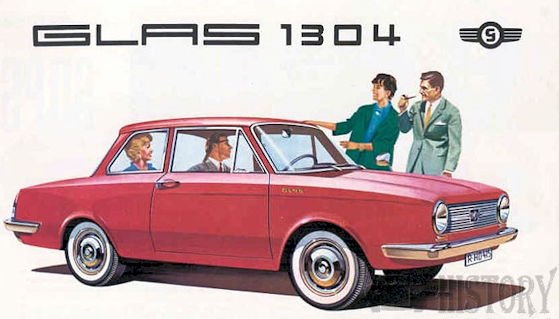
Glas 1304
 |
|
| Manufacturer | Hans Glas GmbH |
|---|---|
| Production | 1965 to 1968 |
| Class | Motor car |
| Produced | 40,703 units total |
| Assembly | Dingolfing |
| Body style | coupé, saloon, cabriolet,estate |
| Layout | FR layout |
| Engine | 4-cylinder in-line 1304: 1290 cc |
| Transmission | 4-speed manual all-synchromesh |
| Wheelbase | 2,100 mm (83 in) |
| Length | 3,835 mm (151.0 in) |
| Width | 1,500 mm (59 in) |
| Height | saloon & estate: 1,370 mm (54 in) |
History
But the medium-sized European car cannot be something designed solely for the town nor solely for long journeys. And so the Glas is also a car with, an adequate performance out on the road. It has an engine that allows speeds of 93 mph (150 km/h) to kept up with no trouble on motorways and will face the most tortuous roads eagerly with a quick and lively gearbox and the possibility of doing over 72 mph (116 km/h) in third. Lively acceleration is guaranteed by an engine with a high compression ratio. A ' favourable power-weight ratio makes this performance particularly brilliant. But at this point, another of the essential requirements of the family car must be considered fuel consumption. The Glas will do about 35 miles to imperial gallon (29 US) and uses 8 litres per hundred kilometres, and is thus is a more than respectable performer in this sense.
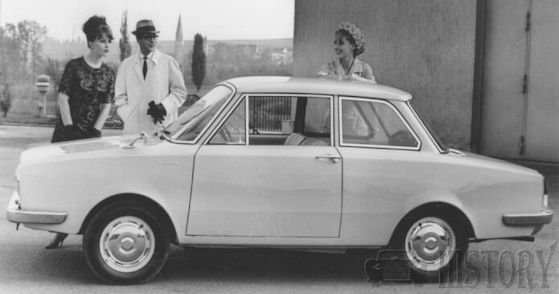
Given the simplicity of the mechanical elements, servicing and maintenance too ,are extremely economical. In cars destined for a wide market, the problem the designer must
find a solution for is always how to find the right compromise between many demands. It must be roomy enough for four, reliable because it will be used on the job, speedy because there will be long motorway journeys to do, economical because it must suit every pocket. The result seems to be particularly praiseworthy in the Glas because the compromise has been achieved without sacrificing any of the elements.
1304 TS
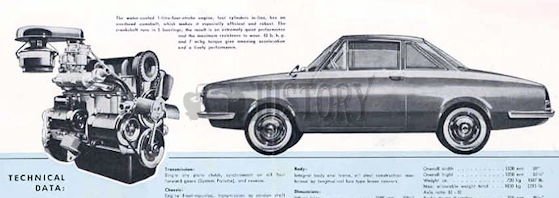
In September 1965 the 1,290 cc engine from the Glas GT was installed, giving rise to a new top of the range model which now offered maximum power of 62.5 kW (85 PS) and a top speed of 168 km/h (104 mph).
PERFORMANCE
Engine capacity: 78.72 cu in, 1,290 cu cm
Fuel consumption: 35.3 m/imp gal, 29.4 m/US gal, 8 1 x 100 km
Max speed: 105.6 mph, 170 km/h
max power(DIN): 85 hp at 5,800 rpm
max torque (DIN): 80 1b ft, 11 kg m at 3,000 rpm
max engine rpm: 6,300
specific power: 65.9 hp/l
power-weight ratio: 19.2 lb/hp, 8.7 kg/hp
1304/S 1304
A single carburetter version of the 1304 engine also became available in 1965, which still offered 44 kW (60 PS) of power and commensurate performance.
1304 CL
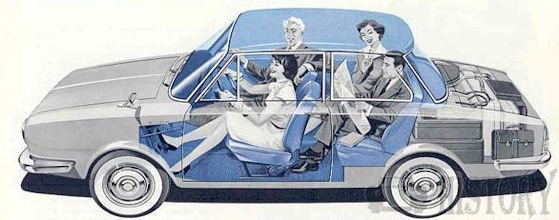
Two fastback bodied kombi-limousines (estate cars) arrived in August 1966. Estate cars of this size – at least in Germany – were still relatively uncommon. The kombi-limousines could be purchased as either 1004 CL or 1304 CL, with the "CL" standing for Combi Limousine. The Glas estate cars met with little success in the market place. Despite the rear tailgate, luggage space and rear leg room was severely limited thanks to the car’s short wheelbase. With a single carburetter the 1304 has 60 PS (44 kW) at 5000 rpm; this was enough for a claimed 148 km/h (92 mph) top speed. The CL continued to be available for a little while after the BMW takeover (until April 1968). It also inspired BMW's then Sales Director Hahnemann to develop the '02-series Touring.
Glas 1004
 |
|
| Manufacturer | Hans Glas GmbH |
|---|---|
| Production | coupé May 1962 – October 1965 saloon January 1963 – December 1967 cabriolet January 1963 – July 1967 estate September 1966 – 1967/1968 40,703 units |
| Assembly | Dingolfing |
| Body style | coupé, saloon, cabriolet,estate |
| Layout | FR layout |
| Engine | 4-cylinder in-line 992 cc |
| Transmission | 4-speed manual all-synchromesh |
| Wheelbase | 82.68 in, 2,100 mm |
| Length | 150.98 in, 3,835 mm |
| Width | 59.05 in, 1,500 mm |
| Height | saloon & estate: 1,370 mm (54 in) coupe & cabriolet: 1,355 mm (53.3 in) |
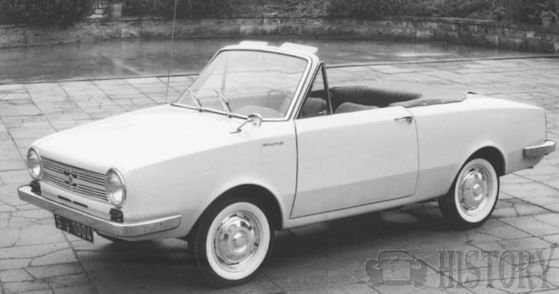
The Glas 1004 is a small two-door, four-seater automobile produced by Hans Glas GmbH at Dingolfing. It was first exhibited in public, in coupé form, at the Frankfurt Motor Show in September 1961. Volume production of the 1004 coupé started in May 1962, and in January 1963 saloon/sedan and cabriolet versions joined the range along with the more powerful Glas 1204. September 1965 saw a yet more powerful variant, the Glas 1304. In September 1966, a fastback estate was added.
In 1960 the company’s research workshop came up with an engine that used an unconventional camshaft drive. Product developer Leonhard Ischinger, who had joined Glas from BMW, had produced a four-cylinder OHC engine with valve gear driven using a toothed rubber cam-belt, which at that time was a novel idea. The 992 cc engine provided a maximum output of 31 kW (42 PS) at 5,000 rpm. During 1961 the company added a modern coupé body using the chassis of the Glas Isar which for this application had been lengthened by 10 cm. The result was the 1004 prototype which appeared at the Motor Show in September of that year.
An updated entry level 1004 was introduced, horsepower on the 992 cc engine now reduced to 40 PS (29 kW). The car featured a slightly higher compression ratio than the original 1004 in 1963 and a different carburetor.
S 1004
Volume production began in May 1962 and the first cars were delivered in August. The car retained the water cooled 992 cc engine of the prototype which at this stage still delivered a claimed 31 kW (42 PS) of maximum power at 5,000 rpm. Drive was to the rear wheels via a four-speed manual transmission incorporating – still slightly unusually for this size of car synchromesh on all four forward speeds.
The S 1004 came with a steel monocoque steel body strengthened, from the start on this model, by reinforcing box sections under the floor. Commentators noted the contrast between the car’s relatively short 2,100 mm wheelbase and the overall 3,835 mm length of the car, which may, by later standards, have compromised the handling but did permit the use of a relatively short drive-shaft.
Front suspension used trailing arms and independent springs in combination, while at the back a rigid “swing” axle was supported by leaf springs. Both at the front and at the back the suspension was enhanced with “rubber air-filled hollow springs”.The hydraulically controlled drum brakes operated on all four wheels while the hand brake operated via a cable linkage to the rear wheels. Steering was of the then common worm and roller type.
The 2+2 coupé, commended in the manufacturer’s publicity for its “convincingly simple lines” in November 1963. From January 1963 the cabriolet was also offered. The Glas 1004 had the smallest engine in the range, and this was offered in combination with the full four seater sedan/saloon only from September 1965. A still unusual optional extra from August 1963 was disc brakes on the front wheels.
Press comment in a country where technical innovation generates enthusiasm was very positive in respect of the car’s status as the world’s first production car to be fitted with a belt driven camshaft, but criticised the unresponsiveness of the standard drum brakes and the heavy clutch. The car’s tendency to pitch under acceleration or sharp braking which was attributed to its short wheel base also drew criticism as did the “back to front” gear box which, as on the existing Isar, had originally been intended for a (never produced except as a prototype) front-wheel-drive small car and accordingly positioned first and third gears nearest to the driver, with second and fourth gears nearest the front of the car.
- PERFORMANCE: S 1004
- Engine capacity: 60.53 cu in, 992 cu cm
- Fuel consumption: 41.5 m/imp gal. 34.6 mlUS gal, 6.81 x 100 km
- Max speed: 80.8 mph, 130 km/h
- Max power (DIN): 42 hp at 5,000 rpm
- Max torque (DIN): 51 '1b ft, 7 kg m at 2,500 rpm
- Max number of engine rpm: 5,500
- Specific power: 42.3 hp/l
1004 TS
In November 1963 Glas added twin carburettor version were branded as the Glas 1004 TS. Claimed maximum horsepower output on these twin carburettor powered cars were 46 kW (63 PS) at 6,000 rpm. The TS powered versions of the car came with front disc brakes included in the price which provided, according to a contemporary report, “good stopping power with little effort”.
1004 CL
A fastback bodied kombi-limousines (estate cars) arrived in August 1966. Estate cars of this size were still relatively uncommon. The kombi-limousines could be purchased as 1004 CL with the "CL" standing for Combi Limousine. The Glas estate cars met with little success in the market place. Despite the rear tailgate, luggage space and rear leg room was severely limited thanks to the car’s short wheelbase.