
GAZ
GAZ-42 Truck
 |
|
|
Manufacturer: |
Gorkowski Awtomobilny Sawod |
|
Class: |
Commercial,military |
|
Production period: |
1939 to 1946 |
|
Type: |
Truck |
|
Engines: |
Petrol engine, converted to gas propulsion |
|
Power: |
22 kW |
|
Payload: |
1.2 t |
|
Perm. Total weight: |
3.25 t |
The GAZ-42 was a light truck produced by GAZ from 1939 to 1946.
History
The GAZ-42 ( Russian ГАЗ-42 ) was a light truck produced by the Gorkowski Awtomobilny Sawod(GAZ) In the 1930s, there were still areas in the northern part of the RSFSR that could not be adequately supplied with conventional fuels such as gasoline and diesel. It was designed on the basis of the GAZ-AA , the series-produced vehicles corresponded to the drive but already the successor, the GAZ-MM . The truck was not powered by gasoline but by wood gas .Correspondingly, domestic trucks in particular produced vehicles that were powered by wood gas instead.
To produce wood gas, a so-called wood gasifier was mounted on the loading area. This is a steel boiler, in which the wood is heated under exclusion of air. Flammable gases are released with which a gasoline engine can be operated. Wood was readily available in the northern areas. Not only from the GAZ-AA, there were such vehicle versions, also based on the ZIS-5 , a wood gas truck was mass-produced, the ZIS-21 .
The first tests with this type of drive were made in the vehicle construction institute NATI . From 1935 to 1936, a small-series steelworks built 76 W-5 gas generators intended for the GAZ-AA lorry. The mass production with these actuators began in 1939, the truck was designated GAZ-42 and built up on the opposite the GAZ-AA slightly revised chassis of GAZ-MM. With the GAZ-43, there was also a model that was operated with coal instead of wood.
In 1942, war-related changes were made to the truck. Mudguards were simplified, body parts made of wood, saved a headlight and roofs realized with tarpaulins. 1946, the production was discontinued.Until that time, 33,840 copies of the GAZ-42 had been built.
However, apart from the enormous advantage that a lorry with wood gasifier can be operated independently of liquid fuels, the vehicles had great disadvantages. The engine could produce significantly less power with wood gas than with gasoline. In addition, it takes until the wood gasifier is heated and gives enough gas to drive. Accordingly, the vehicles were driven with secure fuel supplies in the far north of the Soviet Union. Today, no received vehicle with wood gas drive more known.
GAZ-46 (MAW) amphibious
 |
|
|
Class |
off road |
|
Type |
amphibious |
|
crew |
6 |
|
length |
5070 mm |
|
width |
1750 mm |
|
height |
2000 mm |
|
Dimensions |
1.85 tons |
|
drive |
GAZ-69 four-cylinder gasoline 55 hp (40 kW) |
|
top speed |
90 km / h |
|
Power / weight |
29.7 PS / t |
|
reach |
500 km |
The GAZ-46 is an amphibious vehicle with four-wheel drive from Soviet production built from 1953 to 1958.
History
The GAZ-46 is based on the GAZ-69 off-road vehicle. The Gorkowski Awtomobilny Zavod produced it, and it was given the name Armed Forces MAW. It's beneath the BAW, or "large buoyant vehicle." During WWII, the Soviet Union got US-style amphibious vehicles of the type Ford GPA, which were constructed between 1941 and 1943 and were based on the Willys MB, with up to 3500 made for the Red Army as part of the Lend-Lease Act. After the war, the NAMI vehicle building institute began development on the NAMI-011 project in 1949, with a successor based on the GAZ-67. Later, the project continued as GAZ-011 In 1953, a small series of 68 was produced, which still built on the chassis of the GAZ -67.
1953, the chassis was replaced and instead of the GAZ-69. Also engine and transmission were taken over, whereby the engine is identical with that of the GAZ-M20. By 1958, 654 copies were built, before production stopped. Although it was planned that production as the SUV into the UAZ to , but this venture failed. So it remained with the vehicles, which had been built from 1953 to 1958. The GAZ-46 was used in particular in pioneer and reconnaissance units of the Soviet Army . This was also exported to other states of the Warsaw Pact .
GAZ-M415 Pick up
 |
|
|
Production period: |
1939 to 1941 |
|
Class : |
Commercial vehicle |
|
Body versions : |
Pick up |
|
Engines: |
Gasoline : 3.3 liters (37 kW) |
|
Length: |
4655 mm |
|
Width: |
1770 mm |
|
Height: |
1775 mm |
|
Wheelbase : |
2845 mm |
|
Curb weight : |
1455 kg |
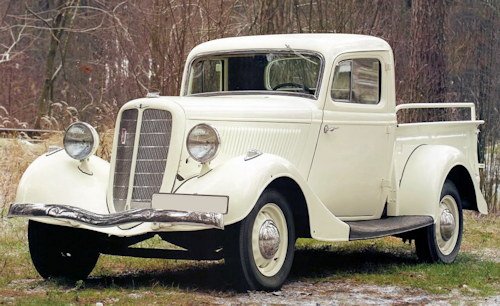
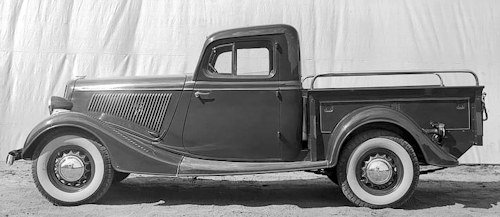
The GAZ-M415 was a Soviet pick-up , which was mass-produced by the Gorkowski Awtomobilny Zavod (GAZ) from 1939 to 1941.
History
The GAZ-M415 ( Russian ГАЗ-M415 ) It is heavily based on the 1936 GAZ-M1. The GAZ-415 and GAZ-M-415 are occasionally used variant names, and the GAZ-4 was a light truck or pick-up. Its manufacture was first halted in 1936 without a replacement. It wasn't until 1939 that a pick-up based on the now-built GAZ-M1 was produced again. This vehicle was given the designation GAZ-M415, where M stands for Molotov, the Soviet Union's then-president, whose nickname was the GAZ plant. Although the first prototypes from the late 1930s had a continuous body, a separate, angular loading area was built in series production. The passenger car entirely took over the frame and drivetrain.
During the short production period, the body of the GAZ-M415 was also used on various other vehicles:GAZ-11-415 - With the GAZ-11-73 there was from 1939 a six-cylinder version of the GAZ-M1 passenger car. This engine, actually intended for a truck, was built on a trial basis in the GAZ-M415. Serial production was omitted for unknown reasons. GAZ-61-415 - A vehicle that combined the four-wheel drive chassis of the GAZ-61 with the body of the GAZ-M415. Only very few specimens were made for the Red Army . A prototype with extended wheelbase was built.
How many copies were ultimately built exactly is not clear. The estimates vary between around 5000 Because of the war ended production in 1941, it was not resumed.
GAZ-12 ZIM
 |
|
|
Make: |
GAZ |
|
Production period: |
1950 to 1960 |
|
Class : |
Luxury car |
|
Body versions : |
sedan,taxi,ambulance,limousine |
|
Engines: |
Gasoline: 3.5 liters (70 kW) |
|
Length: |
5530 mm |
|
Width: |
1900 mm |
|
Height: |
1660 mm |
|
Wheelbase : |
3200 mm |
|
Curb weight : |
1800 kg |
The GAZ-12 ZIM is a luxurious car of the Soviet GAZ built from 1950 to 1960.
History
The GAZ-12 ZIM was initially manufactured in 1950, and it was enormous and opulent because the party's and state's top leaders wanted a new large and prestigious car. The GAZ-12's self-supporting body was mostly based on the GAZ-M20 Pobeda, with a proportionally longer, wider, and strengthened floor pan. The GAZ truck program's long-stroke six-cylinder in-line engine had an aluminium cylinder head with (at the time outmoded) standing valves. He used a hydraulic and dry clutch, a mechanical three-speed synchromesh gearbox with steering wheel shifting, and a propeller shaft to connect the back axle to his performance. The front wheels hung individually on double wishbones . On all wheels there were hydraulically operated drum brakes.
The ZIM is stylistically and technically similar in concept to contemporary US automobiles and had a similar to the models similar no less comfortable as well as rich equipment. A novelty was the electrically heatable rear seat and the self-resetting turn signal lever on the steering column. The wood grain painted dashboardwith a number of control instruments and a car radio was also part of the standard equipment. There were leather seats and precious woodCoverings. The sedans had three side windows and six seats, a little later came in a very small number (probably only five copies) produced four-door convertible , which was designated by the factory as Phaeton . In addition, there was also a version as an ambulance , but with the limousine body, the interior of which was redesigned to suit the purpose - where the stretcher had to be loaded and unloaded via the boot lid open at the top. There was no wagon version .
During the 1946 published ZIS-110 , a replica of the US-American Packard 180 of the pre-war period, which was manufactured on the Soviet Union acquired original Packard manufacturing facilities, the highest representative of the state was reserved (including in heavily armored version also Joseph Stalin himself ), the GAZ-12 ZIM was more of a car for the middle and upper management of the nomenklatura . The ZIM was exported because of the high price only limited, including some copies to Poland , Czechoslovakia and the GDR In Czechoslovakia he was to replace the Tatras of the prewar period, but was due to the poorer performance and the initially not fully satisfactory quality workmanship no greater appeal. In 1955, instead, the newly developed Tatra T 603 was introduced. In the Soviet Union, however, the car was widely used and saw many years of use even after the end of production. It was also used by the militia , these vehicles were painted dark blue with red side stripes and provided with a red flashing light on the roof. In 1960, the production of all three versions of the GAZ-12 ZIM ended after a total of 21,527 pieces.
The existing power is still acceptable for a quiet and comfortable locomotion today, because the engine is elastic and therefore does not need to be changed so often the aisles. The Suspension comfort can certainly convince despite the rear rigid axle on leaf springs .Because of the hydraulic clutch, which produces a sliding frictional connection with increasing engine speed, the clutch must be operated only for engaging a gear and for upshifting and downshifting; However, it can, for example, in 3rd gear, the vehicle braked from any speed to a stop and, without being coupled, be restarted. In conjunction with the smooth-running engine, this constructive solution achieves an impressively low interior noise level and outstanding elasticity. One disadvantage is that this does not allow the drive train to be blocked mechanically. That means, even on the steepest slope you have to rely on the action of the handbrake.
The GAZ-12 was built a a sedan, taxi, ambulance and four-door convertible Phaeton versions. 21,527 copies were produced in three versions. Successor was from 1959 the much more modern GAZ-13 Chaika.
GAZ-A car history
 |
|
|
Production period: |
1932 to 1936 |
|
Class : |
motor car |
|
Body versions : |
Cabriolet , Limousine,tuck |
|
Engines: |
Gasoline : 3.29 liters (29 kW) R4 |
|
Length: |
3875 mm |
|
Width: |
1710 mm |
|
Height: |
1780 mm |
|
Wheelbase: |
2630 mm |
|
Curb weight: |
1080 kg |
|
previous model |
none |
The GAZ-A was a Soviet passenger car, which was produced by the Gorkowski Awtomobilny Zavod (GAZ) from 1932.
History
The GAZ-A (ГАЗ-А) was the first passenger car to be produced mass-produced in the Soviet Union and is a near-exact copy of the Ford Model A of 1930. In the population, the car was nicknamed "Gazik".
The Ford Motor Company and Russia have been working together since 1909. Ford was a significant manufacturer of automobiles and commercial vehicles such as tractors and trucks, particularly in the 1910s and 1920s. Because the Soviet Union's automobile manufacturing was undeveloped, tens of thousands were imported. The first five-year plan, which contributed substantially to the growth of the Soviet Union's industry in general, also included a strategy to construct a domestic vehicle industry. In 1929, the USSR signed an official deal with Ford, requiring the USSR to purchase significant quantities of Ford model kits for assembly at the newly created Nizhnegorodski Awtomobilny Sawod, or NAZ (from 1933, GAZ). In the KIM factory in Moscow vehicles were assembled.
By the end of 1932, the Nizhny Novgorod plant had been brought up to a level where it was able to produce automobiles. The first cars left on December 8, 1932. At about the same time began the production of the GAZ-AA. This was a truck that was based on the same chassis and took over many other vehicle parts from the car. By 1935, 100,000 vehicles were built in the new plant, mostly trucks. In the same year, the contract between Ford and the Soviet Union was dissolved by mutual consent. 1936 ended the manufacturing of GAZ-A in favor of the successor to 41,917 built copies GAZ-M1 .
Since the GAZ-A was the only mass-produced automobile of the time in the Soviet Union, a whole range of other vehicles based on this model. In addition to the truck GAZ-AA these were also pick-ups, racing cars and an armored car for the army..
- GAZ-A - basic variant, was built from 1932 to 1936.
- GAZ-AA -Truck builtfrom 1932 to 1938 (and GAZ-MM until 1950), using the same frame and engine as the GAZ-A. The number of units built far exceeded that of the automobile.
- GAZ-AAAA - Prototype of a three-axle transport vehicle based on the GAZ-A. It did not come to a serial production, only two pieces were manufactured 1936.
- GAZ-A-Aero - racing car whose technical origin lies in the GAZ-A. However, the vehicle got a completely redesigned, streamlined body. In 1934, a single car was built.
- GAZ-A Kegress (Russian ГАЗ-А Кегресс) - A half-track vehicle named after Adolphe Kégresse . The rear axle of the GAZ-A was replaced by a crawler track. The construction could not prevail, in November 1933, only a prototype was built.
- GAZ-3 - variant with closed limousine body. Only a prototype was built in 1934.
- GAZ-4 - GAZ-A based mass-produced pickup, parts of the GAZ-AA truck were used.
- GAZ-6 - model version with closed four-door body. From 1934 produced in small series and used as an ambulance or taxi. Different sources speak of 60 to 100 built copies.
- GAZ-Aremkuz - Also the automobile factory Aremkuz from Moscow built a few copies of the GAZ-6. The design of the body varied.
- D-8 - An armored car built on the chassis of the GAZ-A. Builtin 1932 in small numbers for the Red Army .
In addition, the engine of the GAZ-A, with technical revisions, was still used in the following decades. He finds himself z. In the GAZ-M1 as well as in the GAZ-64 and GAZ-67 . Also the truck GAZ-MM, the successor of the GAZ-AA, uses a revised version of this engine.

