
Fiat
Fiat Palio
|
|
|
|
Manufacturer |
FIAT |
|
Class |
Motor Car |
|
Main type |
Sedan |
|
Other versions |
Weekend; Locker |
|
Production |
from 1996 to 2017 |
|
Style |
Giorgetto Giugiaro |
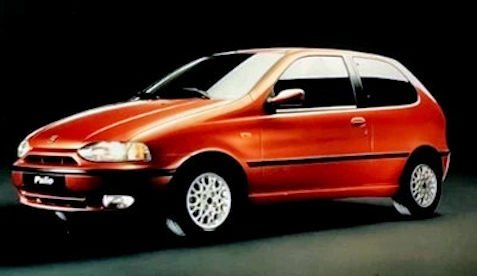
The Fiat Palio is a car produced by the FIAT Turin car manufacturer. Presented in 1996, it is, together with the three-volume sedans Siena and Albea (and in China in 2007 by Fiat Perla), the " world car " of FIAT, marketed in developing countries as: Latin America, Asia and Africa.
Production of this model began in 1996 and is still produced in many countries, such as Brazil, India, China, Turkey, South Africa, Morocco and Russia. It is sold in various versions, including a family version (the Weekend), and in a 3- door or 5- door sedan version. Great success in Brazil where it is also marketed with the 1.8 Flex engine, which allows a separate or combined use of petrol and alcohol.
The launch took place in 1996 in Brazil as a 178 project in four versions including a pick-up (Fiat Strada). The chassis was studied on the basis of that of the European Fiat Uno, with various improvements such as structural stiffening and suspension modifications (in the Weekend version, instead of the twisted deck layout adopted as by the One from the Saloon version of the Palio, the one with drawn arms was adopted used by the Point). For the Weekend model, the engines available in Italy were two multipoint electronic fuel injectors, a turbodiesel and an aspirated diesel:
Shortly after launch, production also began in the Argentinean factories, followed in 1997 by those in Venezuela, Poland and Morocco. Later the Turkish, South African, Egyptian and Chinese establishments were joined in the construction of this model, the latter in 2002. It was also imported and sold in Italy.
In 2001 the first restyling of the car took place, the new design of which was due to Giorgetto Giugiaro: with the latter, numerous new versions were launched with different engines based on the country of marketing. Prominent, for example, a sports version dedicated to the Turkish market with a 120 hp engine. Furthermore, the Turbodiesel version abandoned the old and robust 1.7 pre-chamber to make room for the newer and more efficient 80 hp JTD produced on the solid and well-tested 1.910 cm³ base. The petrol engine department was further updated with the introduction of the 1.2 Fire 16-valve 80 HP which was placed between the 8-valve version of the same Fire and the more powerful and complete 1.6 16-valve with 103 HP. Special attention was also paid to the automotive safety sector with the introduction of airbags and ABS. Another innovation is the inclusion in the range of models with automatic transmission.
From this version the export to various markets was interrupted, including Italy where only the Weekend version remained in the price list until 2004 (and where the car had had some success, especially in the family version). A second update, again due to Giugiaro, has taken up some stylistic themes already present in the sisters Punto and Stilo without, however, distorting their initial form. News also in the engines, especially in the Brazilian market where the Flex version has undergone a good increase in power. With this version, Fiat celebrated in 2006 the achievement of 2 million Palio produced. In 2008 the car's production amounted to over 100,000 units.
In 2005, Fiat launched the Palio 1.8R on the Brazilian market. This version had a sportier and more aerodynamic design that implemented a new body-kit, a new spoiler rear and wheels alloy covered with tires 185/60. On the body were applied the airbrush sports and implantation lights has been changed. The propeller installed is a 1.8 Flex Fuel capable of being used with petrol, alcohol or a mixture of both. It delivers a power of 115 hp, which allows the car to accelerate from 0 to 100 km / h in 9.2 seconds. The interiors are sporty with a digital control panel.
This last model has taken over the style of the Grande Punto grille, but it does not completely replace the previous model which is still marketed under the name "Palio Fire Flex”. The 2007 Model has been marketed, since 2008, together with the three-volume sister Fiat Siena with the initials "2009", and just in 2008 the Palio range is completed with the Station Wagon version (called Week End) and the Crossover SUV version (called Locker). The two new versions of the Palio share the front with the Siena. Basically, the Fiat World car range is complete with a two-volume sedan (Palio), three-volume (Siena) and Station Wagon (Palio Week End, from which the Palio Loker derives).
At the end of 2011, the second completely new generation was presented, developed on the new long-wheelbase Economy platform already adopted by the new Uno presented in 2010. The project for the new Palio (code 326) has been developed since the end of the 2000s: designed by the Turin style centre and engineered by the research and development centre in Brazil. A great novelty is the new base platform, the adoption of a simple and tested mechanical layout and the latest-generation engines of the Fire EVO and Ector family. The bodywork is proposed only in the 5-door variant, the 3-door version is not foreseen while the station wagon version will be introduced later according to the design plans of the house. Structural rigidity increases by 35% and new materials are adopted for the construction of the bodywork in addition to improving sound insulation and new production processes.
Stylistically, the new Palio takes up the design introduced with the Punto Evo as the integrated brand with a Fiat 500- style chrome Mustache, browned calendar and rounded bumpers, while the tail lights are introduced in the tail. Even the passenger compartment is more spacious than the previous series: 5 seats, a more modern and rounded dashboard made of higher quality plastics than the old series, although they still remain aligned with the target of the economic segment car. New more fashionable finishes and coloured inserts.
The length of the car is 3.79 m with 1.67 m of width, 1.49 m in height and with a wheelbase of 2.42 meters. The total mass of the car decreases by 15% compared to the previous series thanks to the adoption of new light alloys for the construction of the bodywork. Among the safety devices they are adopted 4 airbags, ABS with EBD and brake system consists of disc brakes ventilated at ' front axle and drum brakes at the rear axle. The suspensions they are composed of a front MacPherson architecture and interconnected rear bridge. The engine range consists of the revamped 1.0 Fire Evo Flex four-cylinder eight-valve engine delivers 75 hp in petrol operation and 77 hp in ethanol operation. Next to the 1.0 is the 1.4 Fire Evo Flex with 87 or 90 HP and the more powerful 1.6 E. Torq Flex 16 valves of the Palio Sporting at the top of the range with its 119 hp. The gearbox is a 5-speed manual with the option of the Dualogic 6-speed robot.
Production of the Palio ended in Brazil in 2017.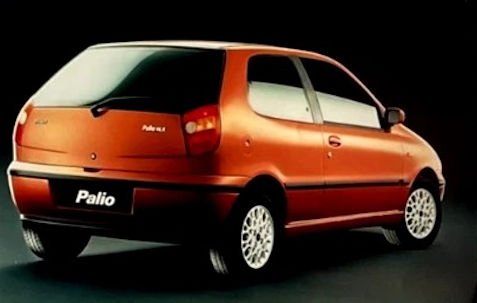
Fiat Uno Turbo
 |
|
|
Manufacturer |
FIAT |
|
Class |
Sports Car |
|
Engines |
1.3-1.4L |
|
Length |
3644mm (First series) |
|
Width |
1560 mm |
|
Height |
1370mm (First series) |
|
Step |
2360 mm |
|
Mass |
845 (First series) kg |
|
Style |
Giorgetto Giugiaro |
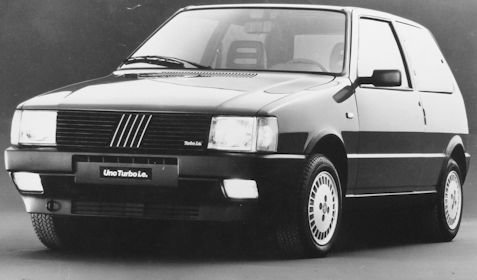
The Fiat Uno Turbo ie was the sports version of the Fiat Uno, produced from the mid 198s to the mid-1990s so classed as an original Hot Hatch.
The Uno Turbo IE was launched to enter the small sports car market, where the Renault 5 GT Turbo, Peugeot 205 GTi, and Golf GTI were notorious at the time.
In a short time, improvements were made to the engine of the basic version. In fact, the engine was equipped with two different control units: one for Bosch LE-Jetronic Multipoint electronic injection and one for the Magneti Marelli Micro plex MED electronic ignition. The turbocharger was a Japanese IHI VL2, water cooled with a maximum pressure of 0.55 bar, equipped with Intercooler to lower the temperature of the air entering the cylinders; in addition, an oil radiator was installed next to the turbocharger behind the front bumper.
The 1301 cc turbocharged engine (engine abbreviation 146A2.000), which in the naturally aspirated version from the Uno 70 SX had 48 kW / 65 HP, in this supercharged variant was now revised in the head and in the water passages. It should be noted that the monobloc had actually been specially developed for the Uno Turbo and was derived from the original engine of the Fiat 128 and the 1116 cc Ritmo but with a stroke of 1598 cc mounted on Ritmo 105TC. The engine was capable of delivering 77 kW (105 hp) at 5750 rpm and a maximum torque of 147 Nm at 3200 rpm with remarkable performances with an acceleration 0-100 km / h in less than 9 seconds. Even the alloy wheels were dedicated to the IE Turbo: with a 13-inch full diamond-coated with 5.5-inch channel, they accommodated 175/60 tires and hubcap cups with the Abarth scorpion logo on a red background.
The First series (from April 1985 to 1989)
On the road, the new Fiat sports car has high roadholding, performance and fuel consumption with the adoption of the turbo, thanks to the electronic injection. The 5-speed gearbox, derived from the Fiat Ritmo 105 TC, and the brake system is equipped with disc brakes front ventilated 240 mm in diameter and rear disc 227 mm.
Outside, the car now shows a redesigned front bumper with standard fog lights and two additional slots for cooling the engine oil and charge air (intercooler). The car is fitted with wheel arches and side skirts identical to those of the SX version. On the back hatchback an integrated spoiler, all made of fiberglass. The exhaust tip is chrome-plated. Inside, the black velvet seats with the Fiat emblem (the 5 red bars) stand out longitudinally on three rows per seat. The backrest of the seat and the rounded part of the dashboard in front of the passenger and of a soft plastic material with small squares printed on the surface. The floor carpet is red without footrest and long pile type, the black safety belts, the interior mirror with red liquid crystal clock. A rare accessory available only on this version is the panel screen at the centre of the instrument panel with the lights set to indicate any anomalies to the cooling system, lubrication, open door warning light, extinguished bulbs. The 1985 model is recognizable by the absence of the adhesive strips on the side and on the tailgate and the details such as the trim and mirrors not matching the exterior.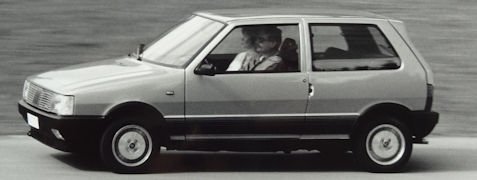
In 1986 with the upgrade of the range comes the model year 86 practically identical to the initial version, but with the addition of external details in matching plastic and adhesive strips in the side and rear hatch with the words Turbo IE on the first two. The red-light digital clock disappears to make way for another green liquid-crystal watch, just as the control panel option is eliminated, but the new and spectacular digital picture produced by the Japanese Nippon-Seiki begins. This option replaces the classic analogue instruments and displays the various information on amber-coloured light bar displays. A footrest is added to the carpet which maintains the same features as the previous one.
For the model year 1988 the most important restyling of the first series. The most innovative option was the Antiskid: it was a braking system with anti-lock, similar to ABS but simpler (and less efficient), produced by the English AP Lockheed; this system only acted on the front wheels. For this version, special dark gray alloy wheels were provided, with only the outer diamond part, and new interior linings. The fabric was changing, now no longer the delicate black velvet with the five red bars of the Fiat logo, but a much more resistant classic fabric, style with Turbo IE written in the centre of the back of the front seats. Also new are the red belts with black piping (the same as those of the Lancia Delta HF Integrale). The steering wheel is now covered in leather and the carpet remains red, but with shorter fur and a more elegant appearance. The model adopts the new gearbox with decidedly improved robustness. The new model also stands out for the different adhesive strips on the newly designed and thinner sides. The decal disappears from the back door, while the door covers and the contours of the windshield and rear window in opaque black. Standard equipped with: fog lights, H4 halogen headlights, additional wheel arches, under door skirts, front wheel arch linings (this only for versions equipped with antiskid module). The main options were: metallic paint, sunroof, central locking, electric windows. As for the next second series, the petrol tank is composed of two tanks connected to each other: one under the car bed, 42 litres, with an additional one inside the right rear wheel compartment of 6 Liters capacity, for a total of 48 litres of fuel.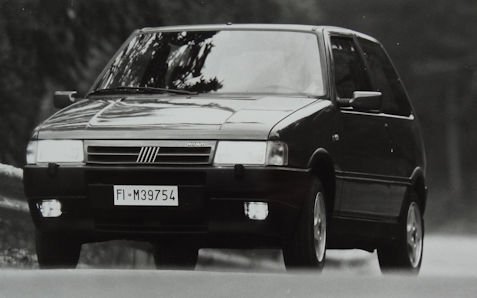
Second series (Built September 1989 until December 1993)
In September 1989 FIAT updates the Uno with an important restyling, to keep its success alive and the new Uno Turbo now has a new engine of 1372 cc (146A8.000) inherited as a Fiat Type 1.4 structure and derived from the previous 1301 simply increasing the stroke by a few mm, the head is also modified with a different compression ratio, a significant increase in power now has 85 kW (116 hp). The maximum speed of this version reaches 205 km / h. The turbocharger is also new, this time an improved Garrett T2 is used with a maximum pressure of 0.8 bar that starts operating very early, already around 2500 rpm.
For the German and Swiss market, as the anti-pollution regulations were already in force, it was marketed as already happened for some specimens of the first series, a catalysed version of the 1301 cc (mot.146A2.246) this model took the name of Uno Turbo, was equipped with a catalytic converter and had 101 HP / 74 kW (191 km / h and 9.1 seconds in the 0-100); this is the less powerful version built.
The interior of the second series was equipped with a more modern and practical as for the rest of the range, as well as a better quality and solidity perceived as well as outside (better finishes and assemblies) the more evident details of this new Turbo ie were the black and Gray checkered seats, and the Momo three-spoke leather steering wheel.
The instrument panel as well as that of the first series, both analogical and digital, included 7 instruments enclosed in the dashboard: speedometer with full scale at 240 km / h with total and partial odometer, petrol level, electronic rev counter with full scale 8000 rpm range cooling water temperature thermometer, thermometer and engine oil pressure gauge, boost pressure with full scale at 1 bar.
Outside the customization was always sporty but more graceful and less striking than the first series: the resin hatch with spoiler disappears, there are new bumper shields (front with additional air intake and fog lights, the rear with integrated spoiler and stone finisher sides) both adorned with a red line along their width, the under door skirts are personalized with a red thread that ideally joins the sides of the bumpers, and the word "Turbo ie" in the area of the rear wheel adopts a new graphic of the characters that compose it. The rear lights are exclusive to this version and have the transparent area of the direction indicator and the reversing lights crossed horizontally by red lines that give it a more modern and sporty mark. It is not uncommon to come across some of these lighthouses which instead of having red lines present them white, in practice for some problem in the first period of production within a few years the red fades almost autonomously becoming white and giving rise to this particular look.
Also new are the sports design wheels, now however with 4 spokes (some called them "ventolini" instead of their design) with measures that are always the same, 5.5J13 - ET42.5, as well as the 175/60 tires. Until the advent of the Racing version, the rims were supplied in a completely diamond-cut version, subsequently to reduce costs they were offered in a silver-painted version.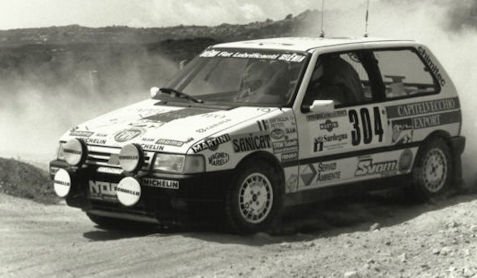
Fiat Ritmo Strada 2nd Generation
 |
|
|
Manufacturer |
FIAT |
|
Main type |
Sedan Cabriolet |
|
Class |
Motor Car |
|
Production |
from 1982 to 1988 |
|
Replaced by |
Fiat Tipo |
|
Length |
4015 mm |
|
Width |
1650 mm |
|
Height |
1405 mm |
|
Step |
2445 mm |
|
Mass |
from 850 to 955 k g |
The car has been produced since 1978 in two different series, the second of which was made in 1982, to be replaced in the C segment, the market segment that covered the FIAT price list, by the Tipo.
History
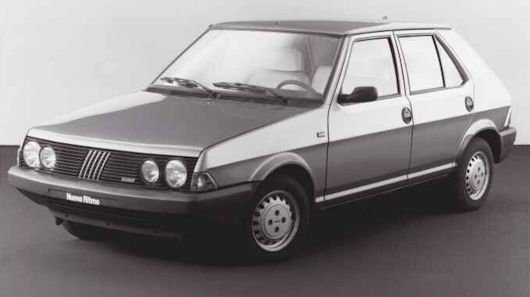
At the end of 1982 a profound restyling led to the presentation of the second series Ritmo. Although at the level of sheet metal only the bonnet seemed to have changed, in reality the body of the car underwent a total redesign that completely differentiated it from the old platform of derivation 128, leading to a weight saving of around 70 kg and at the same time to the resolution of the problems of cracks in the front area of the frame that had plagued numerous specimens of the first series (in particular diesel) and that had forced the designers to introduce plates of reinforcement on the front crossbar especially on the sports versions. The most obvious changes concerned the displacement of the tank in a protected position under the rear seat (it was previously under the boot), the refuelling nozzle passed from the left to the right fender and concealed by a door, the definitive migration of the spare wheel under the luggage compartment (strangely accessible from the outside as in some French cars), and different front suspension domes with three-bolt attacks instead of two. The car's personality appeared significantly modified. Less new, but more elegant, is the new front with 4 circular lights (two on the 60 3p base), black and new mask FIAT logo with 5 slanted vertical bars, while the tail lights changed to larger ones and were no longer incorporated into the bumper. The bumper shields are also newly designed. Completely redesigned, on the other hand, the interiors of the normal versions (seats, door panels and dashboard were completely new), while the Super versions took up the dashboard of the previous ones with few changes in detail. Much appreciated by the press and customers was the new ventilation system, increased thanks to the space recovered with the movement of the spare wheel.
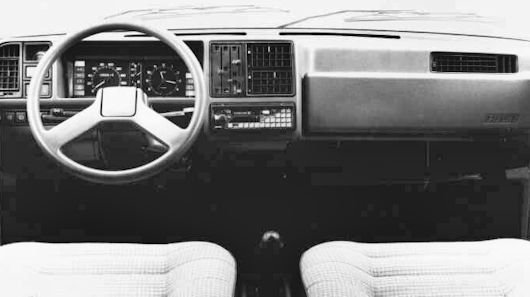
The numerous aesthetic modifications were combined with mechanical ones. The front suspensions adopted new offset conical springs that made the operation of the shock absorbers more precise and limited the reactions to the steering on uneven asphalt, the 5-speed gearbox became standard on the whole "manual" range, and the 1116 and 1301 cm³ engines were revised to make them more elastic and reduce consumption, gaining electronic ignition without "breaker" and a different set-up: these changes reduced power from 60 to 55 hp on the 1100, but improved torque, while the 1300 from 65 and 75 HP were unified in a single 68 HP version equipped with a double body carburettor. The 1500 CV is unchanged. The 1700 diesel was revised in the calibrations and gained 3 hp (now 58). S) plus, the 105 TC, while the sporty 125 TC Abarth remains unchanged for the moment in the first series. The range of convertibles (updated as the sedans) was extended with the introduction of the 1300 engine alongside the 1500.
The Ritmo 2 range was completed in 1983 with the introduction of the Energy Saving and Abarth 130 TC versions. The first, moved from 1116 cm³ to 55 hp with "cut-off" device, thanks also to a 4-point lowering (from 0.42 to 0.38) of the aerodynamic penetration coefficient obtained through the adoption of a small rear spoiler at the end of roof, from the anti-turbulence frames to the windows and to the smooth wheel covers, allowed significant fuel savings. The changes made to the Abarth were decidedly profound: the engine gained Marelli digital electronic ignition DigiPlex and the power supply through two horizontal double-body carburettors of 40. The result was 130 HP at 5800 rpm (200 less than the previous 125 TC), which combined with the lower weight and the slightly elongated final made it capable of one spectacular (for the time) time of 8 seconds net from 0 to 100 km / h. The Ritmo 130 had a resounding success among the fans thanks to the performances (and to the "nastiness" with which they were expressed), further fed by the sporting successes that the car caught in the races on the track and on the road, dominating for years the main European championship Gr. N. In general, the "Abarth care" included many details aimed at an easy preparation of the car: for example, the same adoption, apparently anachronistic, Golf GTI had always been injected), it actually served to have already approved a four-butterfly intake manifold to be coupled with the Kugel Fischer mechanical injection (a must in the competitions of that era).
Restyling 1984
In 1984 the range was renewed: the "basic" version was divided into two versions, "L" (with a mask with only two headlights, 4-speed gearbox and very poor equipment) and "CL" (identical to the previous base, but with standard headrest and rear wiper in addition, the S set-up was also extended to 60. With the end of the second series, in 1985 the special version "IN" was presented, based on the 60 S and characterized by full wheel covers, by a Gray / red adhesive strip, from the specific internal linings and from the standard radio.
In 1985 a slight restyling (front grille, lower front bumper fitted for fog lights, rear plate shift on the shield, black plastic fasciae on the sides, rectangular door handles instead of round ones) accompanied an update of the range. The 60 engines adopted the double-body carburettor gaining 3 HP (now 58). The 105 TC, now displaced by the Abarth, was replaced by the 5-door 100 Equipped with a new version of the double-shaft with a 180-degree rotated head (engine then mounted also on the Lancia Prisma second series) and power reduced to 100 hp to improve elasticity and consumption; this version had little response in Italy, but was more appreciated abroad. The 130 TC Abarth received new alloy wheels with a design similar to those of the Uno Turbo. The diesel versions had important innovations: the old 1714 cm³ engine gave way to a new 1697 cm³ unit, part of the new family of engines derived from the "dieselization" of the single-shaft of the last 131 of 1981. The new engine now supplied 60 hp, making it also more park and more elastic as well as more silent. The new Turbo DS version is completely new, powered by a 4-cylinder turbo diesel engine with an intercooler of 1929 cm³ of 80 hp belonging to the same family of 1697 cm³. From the Energy Saving range were removed, the 85S and versions 3-door "non-sports", while the Convertible 85S gave way to Super cabrio 100 S.
In 1986, to give breath back to sales in view of the last year of production, two new special limited-edition versions were introduced: in May the Team (versions 60 and D) arrived on the basis of the 5p CL and personalized with specific writing and upholstery, while in July it was the turn of the Super Team, recognizable by the matching mask and equipped with electric windows, central locking and adjustable steering wheel. The Super Team was available with 60, 70 and 100 engines.
In 1988 the Ritmo was replaced by the Tipo.
Derived models
Until 1982, according to the collaboration agreement signed between the car manufacturers, Ritmo was produced in Spain by SEAT. At the end of the agreement, the Spanish company recycled its assembly lines as much as possible, replaced a sufficient number of pieces to avoid copyright problems and went out on the market with a model very similar to the progenitor, the SEAT Ronda, redoing what was already the case. happened with the Fiat Panda, recycled in SEAT Marbella, and with the 127 (which became SEAT Fura). In 1984, with few modifications on the same platform as the Ronda, SEAT built the first series of the Ibiza and also the Malaga, also maintaining its suspension.
The Fiat Regata sedan was derived from the second series, a car that had so many elements in common with the Ritmo that it was approved as one of its versions (both had the designation "138", and as such were indicated on the registration certificate).
The brand revived in 2007, when the new Fiat Bravo, presented in Italy in February of that year, was sold on the Australian market under the name of Fiat Ritmo; also, the name Strada has been reused since 1999 for a pick-up model.
Fiat 500 D
 |
|
|
Make |
FIAT |
|
Class |
Motor Car |
|
Production |
From 1960 to 1965 |
|
Produced |
5,231,518 |
|
Wheel base |
76.38 in, 1940 mm |
|
Length |
125.34 in, 3185 mm |
|
Height |
53.15 in, 1354 mm |
|
Width |
51.97 in, 1323 mm |
|
Dry weight |
1190 1b, 540 kg |
|
Assembly |
Turin and Termini Imerese, Italy |
The FIAT 500 D is a small car from the Turin company, produced from 1960 to 1965.
History
In October 1960, shortly after the Giardiniera, a renewed version of the sedan, the 500 D, was presented. This replaces all previous models of the 500, including the Sport. From now on there are no more variants of the sunroof and convertible roof as the new the measurements of the sunroof go up to the middle of the roof. Although the other half is a piece of removable sheet metal, it is not possible to mount the long soft top as on the 500 N Economica as the crossbar that divides the roof from the soft top is part of the structure and if it is removed, it is no longer possible to drive on Street; everything is unified in the new D version which, with the Giardiniera, makes up the 1960 range of the Fiat Nuova 500.

This version derives directly from the 500 which it welcomes the latest innovations from 1959 but adopts the 499.5 cm³ engine of the 500 Sport, refined in terms of delivery and maximum power to deliver 17.5 HP at 4400 rpm instead of the original 21 HP, also through the adoption of a different carburettor (Weber 24IMB) to reduce emissions. It is approved for four people. The standard equipment is enriched with a few details: better padded rear bench seat with folding backrest to create a useful loading surface; padded under-plank edge to cushion any knocks with the knees; flashers and main beam lights to the left of the dashboard (with adjustable brightness); switching on of the internal courtesy light when the driver's side door is opened; onion tank (21 litre capacity), positioned only on the driver's side to Favor the dimensions of the front trunk; headrest pads on both rear inner columns for bench seat passengers. The air filter box is no longer closed with three bolts, but with two more practical pressure wing nuts. The white sidewall tires and the radio are still available as options. The front suspension independent, wishbones, transverse leaf-spring lower arm, telescopic dampers at the rear also independent, swinging semi-trailing arms, coil springs and telescopic dampers.

PERFORMANCE:
- Engine capacity: 30.55 cu in, 499.5 cu cm;
- Fuel consumption: 54.3 m/imp gal, 45.2 rn/US gal, 5.2 1 x 100 km;
- Max speed: 62-1 mph, 100 km/h;
- Max power (SAE): 21.5 hp at 4600 rpm
- Max torque (SAE):26 1b ft, 3.6 'kgm at 2800 rpm
- Max number of engine rpm: 4600
- Specific power:43 hp/l
- Power-weight ratio: 55.1 lb/hp, 25.1 kg/hp
- Acceleration 0—80 km/h) 40 sec
- Standing 1/4-mile 30.8 sec
During 1961 the padded sun visors, the ashtray in the centre of the dashboard, the manual windscreen washer with pump, the courtesy light with automatic switching on controlled by the driver's side door were offered as standard. In 1964 the windscreen wipers became self-returning, the mouldings on the sides at the height of the handles became a little shorter at the rear .
Accessories of the time, widespread and also produced outside FIAT, were: the servo horn or horn ring, produced by the Vitaloni Brothers of Turin (to allow easier use of the horn without taking your hands off the steering wheel rim); the vinyl leather steering wheel cover, a typical accessory found in many cars, to facilitate gripping the crown while driving; the sun visor with built-in mirror on the passenger side; the Giardiniera-style passenger handles; the frieze for the dashboard surface with the writing "FIAT NUOVA 500" in gold on a cream background, or with the writing "Cinquecento" and plastic handle for the front passenger; the rubber mats of various colours (red, black, ochre, havana, grey, green, blue) and in different pieces (from 2 to 6); the front grille entirely in aluminium or plastic but with an aluminium mustache; locking the bonnet with a key; the closure of the front bonnet with an enamelled red FIAT emblem, triangular, in polished aluminium and fitted with a key; the key-operated anti-theft BLOSTER to lock the steering knuckle (applied along the light switch with a spring clamp that acts from below); the petrol tank cap equipped with a key; bumper overriders with rubber reinforcement to cushion the daily shocks due to the harmful actions of inattentive or inattentive parking attendants; the chromed tailpipe to be applied to the final pipe of the muffler, used both for aesthetic reasons and to direct the exhaust smoke further down; the "shelf" in black plastic, FIAT 600 style, to be applied under the dashboard, along its entire extension; the coat hook (which could also be incorporated in the passenger handles); seat covers in fabric or wicker; the hook to keep the soft top partially open while the car is moving, in order to ensure greater ventilation of the passenger compartment (at the time it was applied between the centre of the front rod of the frame and the upper part of the windscreen).
- Chassis code: Fiat 110 D Berlina 500
- Engine code: 110 D 000

Fiat 850 Spider 2nd generation
 |
|
|
Manufacturer |
FIAT |
|
Class |
Sports car |
|
Type |
open Spider |
|
Production |
1968 to 1974 |
|
Assembling |
Bertone |
|
Style |
Giorgetto Giugiaro |
| Length: | 150.55 in. 3.824 mm |
| Width: | 58.98 in, 1,498 mm |
| Height: | 48.03 in. 1.220 mm |
| Ground clearance: | 5.12 in, 130 mm |
| Dry weight: | 1.621 lb. 735 kg |
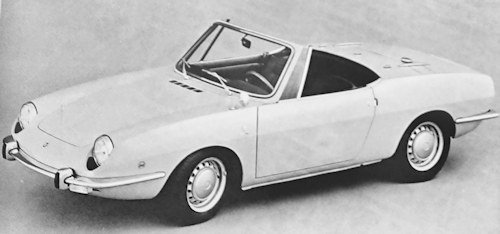
The Fiat 850 Spider second generation is an open sports car marketed by the Turin-based company Fiat from 1968 to 1974.
History
From 1968 the second series was put on sale. The Sport Spider body stayed essentially the same a 2 seat open car, but with a restyled front. The headlamps were moved forward slightly, vertically inserted to adapt to the current legislation and the original flush front turn indicators were replaced with units below the bumper not above it as in the model of the first series.
distribution of the cars weight was rearward bias at 40% front axle, 60% rear axle. with the engine increased to 903 cm³ and 3 hp more power now with a max speed of 95 mph. 153 km/h. For acceleration the standing 1/4 mile in 19.8 sec. 0-50 (0-80 kmh) in 11.8 sec.
- PERFORMANCE
Engine capacity: 55.10 cu in, 903 cu cm
Fuel consumption: 38.7 mlimp gal, 32.2 mlUS gal, 7.3 1 X 100 km
Max speed: 95 mph, 153 km/h
Max power (DIN): 52 hp at 6,500 rpm
Max torque (DIN): 48 1b ft, 6.6 kg m at 4,000 rpm
Max engine rpm: 6,600
Specific power: 57.6 hp/l
Power-weight ratio: 30.9 lb/hp, 14 kg/hp
Acceleration: standing 1/4 mile 19.8 sec, 0—50 mph (0 —80 km/h) 11.8 sec
The second series carryinq capacity was 441 1b, (200 kg), as well as several limited special edition versions of the Spider were offered, including the optional hardtop. detachable body-coloured metal hard top and the Berlinetta featuring a black vinyl hard top.

