
Ferrari
Ferrari 375 Indy
 |
|
|
Builder |
Ferrari |
|
Class |
Race Car |
|
Category |
Indianapolis 500 |
|
Team |
NART - Ferrari |
|
Designed by |
Aurelio Lampredi |
|
Chassis |
spars and crosspieces |
|
Motor |
Ferrari V12 at 60°, 4,493 cm³ |
|
Transmission |
4-speed manual + non-synchronized reverse in lock with the differential, rear-wheel drive |
|
Length |
3937 mm |
|
Length |
1428 mm |
|
Height |
960 mm |
|
Step |
2540 mm |
|
Weight |
786kg |
|
Fuel |
Shell |
|
Tyres |
Firestone |
|
Opponents |
Formula 1 cars 1952 |
|
Debut |
Indianapolis 500 1952 |
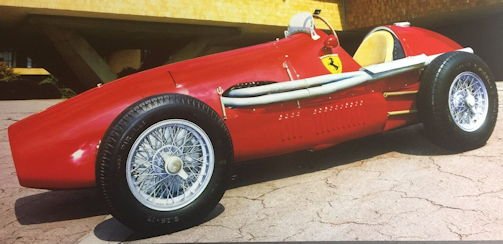
The Ferrari 375 Indy is the car from the 1950s with which Scuderia Ferrari took part in the Indianapolis 500 for the first time in its history. It is directly derived from the 375 F1 .
History
The Ferrari 375 Indianapolis was a developed from the Formula 1 car Ferrari 375F1 monoposto Scuderia Ferrari for the 500 miles of Indianapolis , which were scored in the period from 1950 to 1960 for the drivers' championship. From the 375F1, the vehicles differed by the slightly longer wheelbase (2420 mm) and a stiffer frame. Five copies were made in 1952, a sixth end in 1953 with a shorter wheelbase and tubular frame.
In the 1950s , despite being deserted en masse by non-American teams, the Indianapolis 500 was still a valid race for the Formula 1 world championship . So, in 1952 Ferrari decided to take part with the 375 F1 hoping to replicate Maserati 's successes of 1939 and 1940.
Naturally the 375 F1 needed appropriate modifications that would allow it to withstand the stresses of the Indianapolis basin which would have made a normal Formula 1 undrivable and unreliable. The chassis was therefore modified in wheelbase and strengthened as well as the suspension which was hardened and larger tires were adopted. The engine was increased to 400 HP at 7,500 rpm thanks to the modification of the compression ratio and the adoption of new four-barrel Weber carburettors. The dynamic air intake on the hood was also modified to improve the air flow to the carburettors. In this configuration it therefore became the 375 Indy.
PERFORMANCE
- Top speed 325 km/h
- Power to weight ratio 2.05 kg/hp
- Maximum power 400 hp at 7500 rpm
- Specific power 91.2 hp/litre
The first appearance of the 375 Indy took place at the 1952 Turin Grand Prix with Luigi Villoresi driving and winning the race. Around mid-May the 375 Indy was transferred to the United States where Ascari began to become familiar with the circuit and was thus forced to miss the Swiss Grand Prix , the first event of the Formula 1 season.
Ferrari entered the race with four cars: one managed by Chinetti's NART and driven by Ascari and the other three entrusted to American teams. A curiosity derives from the fact that Ascari's car, not knowing whether the team would participate in an official capacity, showed up at qualifying with the Prancing Horse shield hidden under some adhesive tape, which was then removed during the race.
Right from qualifying, the 375 Indy revealed its inadequacy for the American race and only Ascari managed to qualify, taking 19th place on the grid. In fact, although the American cars were cruder, they were perfectly adapted to that particular type of race. However, in the race Ascari proved to be up to the task, managing to gain a few positions in the first laps, but was forced to retire on lap 40 due to a broken wheel hub.
In the following years the machine was developed by Luigi Chinetti ; the most obvious modification was the installation of two side tanks (the one on the left contained the fuel while the one on the right housed an additional radiator) which made it similar to the Ferrari 555 F1 . Tested by Fred Agabashian and Bobby Ball , the car did not compete in the 1954 Indianapolis 500 . In the 1956 edition it was used by Johnny Baldwin , entered in the race with the Bardahl Ferrari , who however did not qualify. On the occasion of the 500 Miglia di Monza it was entered by NART for Harry Schell .
Ferrari 500 F2
 |
|
|
Builder |
Ferrari |
|
Class |
Race Car |
|
Designed by |
Aurelio Lampredi |
|
Chassis |
tubular spars and crosspieces |
|
Motor |
4 cylinders in line of 1984 cm³ |
|
Transmission |
4-speed manual gearbox + non-synchronized RM mounted in block with the ZF self-locking differential; rear-wheel Drive |
|
Length |
3800 mm |
|
Length |
1400 mm |
|
Height |
1050 mm |
|
Step |
2160 mm |
|
Weight |
560kg |
|
Fuel |
Shell |
|
Tyres |
Pirelli , Englebert , Dunlop , Avon |
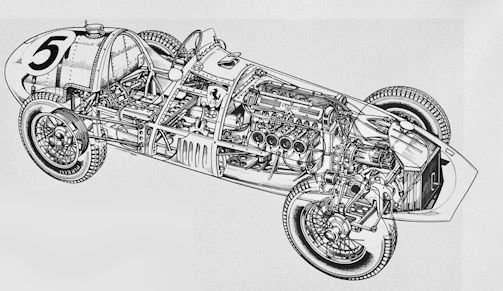
The Ferrari 500 was a Formula racing car , built and used by the Scuderia Ferrari in the 1950s .
History
1952 changed the conditions, after which the World Championship races of the largest Monoposto race series were held. Ferrari responded quickly and had Aurelio Lampredi develop new 4-cylinder engines. The 2-liter version was used in the new Ferrari 500, a race car that dominated the Formula 2 race for two years. In the debut, the Gran Premio di Siracusa 1952, four 500s took the first four places. In 1953, Mike Hawthorn celebrated his first victory in France in a Grand Prix race also on a Ferrari 500.i raced in the 1952 , 1953 , 1954 and 1955 Formula 1 world championship . It was also the first Ferrari to be conceived with an engine other than 12 cylinders. With this car Alberto Ascari won the world drivers' title in 1952 and 1953. The name of the car "500" represents the displacement of 500 cc per cylinder of the engine (500 cc x 4 cylinders = 2,000 cc)
The factory engines, with double overhead camshaft, made up to 180 hp. To achieve a better weight distribution, the engine in the tubular frame was moved further to the rear. The suspension was taken over by the Ferrari 375F1 . With a wheelbase of 2160 mm, a length of almost four meters and a height of 1050 mm, the 500 was an extremely agile monoposto with a curb weight of 560 kg. Alberto Ascari won with the Ferrari 500 twice, 1952 and 1953, the drivers' world championship. Only the private drivers were opponents. However, their 500s were delivered with a speed limit and the engines had significantly less power than the factory cars. First Juan Manuel Fangio finished the end of the season 1953 with his victory on a Maserati A6GCM at the Italian Grand Prix the winning streak of the Ferrari 500.
The debut of the 500 F2 took place at the 1951 Modena Grand Prix (a race not valid for the world championship) with Ascari and Villoresi at the wheel . The former took victory ahead of José Froilán González , who was driving a 166 F2 , while the latter was forced to retire.
At the end of 1951, with Alfa Romeo 's withdrawal from racing, the F1 starting grid featured few good cars. For this reason, before the start of the 1952 season, the FIA announced that for that year and the following it would be allowed to race with Formula 2 cars , a category which saw the participation of teams such as Gordini , Cooper , Maserati and Ferrari itself. So, one of the few F1 teams prepared for the new needs was Ferrari, which was already working on the new 500 F2 at the beginning of 1951.
Instead of modifying the 12-cylinder used on the 166 F2 or on the previous Formula 1s, Aurelio Lampredi decided to design an unprecedented four-cylinder from scratch, a split considered more suitable for the displacement of 2,000 cm³ and that of 2,500 cm³, which would come into force in 1954, both by Ferrari and Lampredi himself. Already in the spring of 1951 the 2,000 cm³ engine was ready and carried out its first bench tests. The first tests revealed its greater efficiency compared to a 12-cylinder of the same displacement: it had more torque, weighed 45 kg less, had a 15% improved weight-power ratio and could count on 65% fewer moving parts. Power was 165 HP at 7,000 rpm, but would reach 200 with modifications made over time. The smaller size of the engine compared to a 12-cylinder also allowed for better weight distribution thanks also to the gearbox housed under the driver's seat and the magnets placed immediately behind the front axle.
PERFORMANCE
- Top speed 240 km
- Power to weight ratio 3.4 kg/hp (3.0) in 1953)
- Maximum power 165 hp at 7000rpm
- Specific power 83.1 hp/litre 93.2 in 1953
In the two years that saw it as a protagonist in the world championship, the 500 F2 underwent very few changes. Apart from the engine which reached 200 HP, the most important modification consisted of a lengthened nose for use on fast circuits to obtain better aerodynamic penetration. But apart from these minimal modifications, the car never underwent changes as it was in fact a balanced object in both form and substance.
While the number '500' in a Formula 3 Cooper's title indicates that it had an engine of only 500 cc, the figures in this Ferrari's title form part of the Modenese company's unusual car classification system, used for many years. Ferrari classified their cars by the number of cubic centimetres of one engine cylinder.
Thus, the Ferrari 500 of 1952—53 was a two-litre four-cylinder Formula 2 car, with each cylinder displacing 500 cc: 500 cc x 2000 cc. Similarly, the earlier 1.5-litre supercharged V 12 Tipo 125 car had had a unit cylinder displacement of 125 cc: 125 cc x 1500 cc. Aurelio Lampredi had developed the simple four-cylinder twin-overhead-camshaft two-litre engine for Formula 2 racing in 1950 and it was installed in a conventional twin-tube chassis frame with transverse leaf-spring independent front suspension and a De Dior axle layout at the rear. When 1.5-litre super charged Grand Prix competition died at the end of 1951, organizers were allowed freedom
by the International governing body—the Commission Sportive Internationale to throw their World Championship Grand Prix races open to unblown two-litre Formula 2 cars. Ferrari, wily as ever, had a well-proven design ready to go. With the 90mm 78 mm, 1980 cc, 170bhp Ferrari 500, Alberto Ascari proved virtually unbeatable in these two seasons, taking two successive Drivers' World Championship titles.
In 1952 he won every Grand Prix he started, six of them, and in 1953 he won five times in eight starts. The only major Grand Prix he did not contest in 1952 fell to team-mate Piero Taruffl in a sister Ferrari 500 and in 1953 newcomer Mike Hawthorn won the French Grand Prix and Dr Farina the German event for the Prancing Horse team.
It took Fangio to break Ferrari's stranglehold by winning the last two-litre Grand Prix, at Monza at the end of the 1953 season.
Add to this magnificent success story non-Championship race wins at Syracuse, Marseilles, Saint-Gaudens, La Baule, Pau and Bordeaux, and you can appreciate how the news of another 'Ascari, Ferrari' victory became repetitious in those two remarkable years.
Ferrari 375 F1
 |
|
|
Builder |
Ferrari |
|
Class |
Race Car |
|
Category |
Formula 1 |
|
Designed by |
Aurelio Lampredi |
|
Chassis |
tubular spars and crosspieces |
|
Motor |
12-cylinder V -engine4 493 cm³ |
|
Transmission |
4-speed manual gearbox + non-synchronized RM mounted in block with the differential; rear-wheel Drive |
|
Length |
3 937 mm |
|
Length |
1 428 mm |
|
Height |
960 mm |
|
Step |
2 320 mm |
|
Weight |
850kg |
|
Fuel |
Shell |
|
Tyres |
Pirelli |
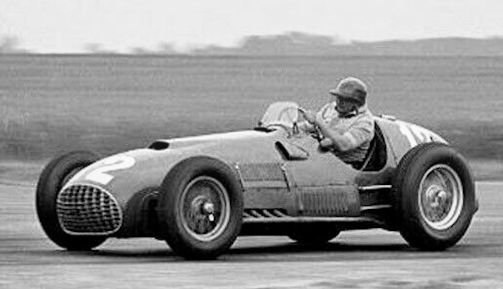
The Ferrari 375F1 was a Formula 1 - racing cars , built and used by the Scuderia Ferrari in the early 1950s.
History
The Ferrari 375 F1 which Scuderia Ferrari took part in the 1951 Formula 1 world championship . It represented the final stage in the development of the 4,500 cm³ naturally aspirated V12 after the 275 F1 and the 340 F1 .This was responsible for the first victory for Scuderia Ferrari in a race valid for the Formula 1 World Championship by José Froilán González in the 1951 British Grand Prix .
The engines he built for the Ferrari 275F1 , 340F1 and Ferrari 375F1 mirrored this view. The most powerful engine was used in the 375F1. This engine had a maximum of 280 kW (380 hp) at 4.4 Liters. Lampredi was convinced that with this technology, the cars were lighter and easier to drive, the engines would be less strained and by the lower gasoline consumption would be more economical. The chassis and suspension were taken from the Ferrari 340F1. It had double wishbone and transverse leaf spring front and a De Dion suspension with a transverse leaf spring rear.
Proceeding in forced stages, the Ferrari engineers managed to create the new V12 by the end of the 1950 season .4,500 cm³ , maximum displacement allowed by the regulation, based on the experiences gained in the same year with V12s of smaller displacements. Mounted on the 375 F1, it would have allowed the Maranello team to finally compete on an equal footing with the Alfa Romeos. Capable of releasing 330 HP at 7,000 rpm, it would reach 380 HP at 7,500 rpm the following year compared to the 425 of the new Alfetta 159 which had a volumetric compressor but suffered from more than triple the fuel consumption compared to the 375 F1 (2.5 km / l for Ferrari, 0.58 km/l for Alfa Romeo).
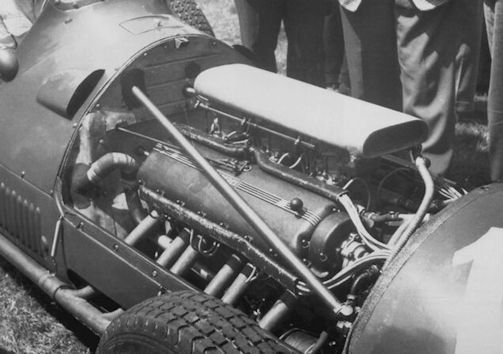
In its early outings, the 375 F1 shared everything apart from the engine with the 340 F1 , but just before the start of the 1951 season it underwent major upgrades. As mentioned, by modifying the compression ratio the new engine was brought to 380 HP and was also equipped with a new double ignition with a single magneto now placed at the front (previously it was single with two magnetos). The dimensions of the chassis in both wheelbase and track were revised and new Weber carburettors were adopted . However, the suspension layout and the gearbox remained unchanged with the differential.
In 1952, with the regulatory changes that promoted Formula 2 cars to the rank of Formula 1 , the 375 F1 was prematurely retired but continued to appear in free formula races especially by private drivers. In the same year it was used in the Indianapolis 500 by Alberto Ascari in the Indy version .
The debut of the 375 F1 took place at the 1950 Italian Grand Prix with two cars entrusted to Alberto Ascari and Dorino Serafini . At the first crossing of the finish line Ascari passes second behind Farina's Alfa, lap after lap the leading two make a gap behind him and on the 15th lap Ascari takes the lead but one lap later the Milanese driver is forced to retire due to a bearing broke, thus leaving the way free for Farina to win the race and the world championship. However, a few laps later Ascari took the wheel again aboard Serafini's car, which had stopped for a tire change, and after a frenetic comeback he took second place overall.
The last event of the 1950 season was the Penya Rhin Grand Prix , a race not valid for the world championship. Here Ferrari always showed up with Ascari and Serafini who finished first and second respectively at the wheel of the 375 F1 without the Alfa Romeos to oppose them. In fact, the Milanese company, having acquired the title with Farina, had decided to abandon the last event of the season. Ferrari had therefore not yet managed to directly prevail over Alfa Romeo, but this possibility was no longer remote and would materialize the following year.
In smaller races, the 1951 season got off to a favourable start for the 375 F1 which won in Siracusa and Pau , with Villoresi , and in San Remo with Ascari. In this last race the evolution of the car equipped with 380 HP made its debut. A 375 F1 exhibited in Maranello
The start of the 1951 championship was once again favourable to the Alfa Romeo of Fangio and Farina who won in Switzerland , Belgium and France while Ascari collected a sixth and two second places. But the first victory was now close and came at the British Grand Prix thanks to José Froilán González . The Argentine driver still had the car from the previous year but this didn't seem to affect him and he took pole ahead of Fangio. The race was a monologue between the two Argentine drivers: Felice Bonetto made the best start and remained in the lead for a lap but then had to give way to the faster González and Fangio. On the 10th Lap Fangio takes the lead, but the Argentine's Ferrari remains close to the Alfa Romeo. After 39 laps Gonzalez returns to the lead but Fangio reattacks him and overtakes him. Ascari, who had retired, decided to let González continue given the Argentine's situation. Gonzalez manages to overtake the Argentinian from Alfa, winning the race by 50 seconds, it is Scuderia Ferrari's first victory in Formula 1, and it is the first time that Alfa Romeo does not win. Villoresi finished third, more than two laps behind first two.
The victory in Great Britain was no coincidence, however, and confirmed Ferrari as Alfa Romeo's biggest rival in winning the title. In the following two grand prix Ascari won as many victories ahead of González (3rd and 2nd) and was able to present himself at the Spanish Grand Prix , the last valid event for the world championship, fighting for the title with Fangio. In fact, both need a victory to win the championship. Ascari is in pole position ahead of Fangio, González and Farina. The Milanese driver leads the pack ahead of Gonzalez at the start but at the end of the first lap González is already fifth overtaken by Farina, Fangio and Bonetto. On the fourth lap Fangio passes Farina and Ascari who is suffering from tire problems. The gap from the Argentine increases lap by lap, Ascari pays for the choice of using fewer wide tires compared to previous GPs. Fangio wins the race and the world championship with González second, Farina third and Ascari only fourth.
The end for the 375 as a service vehicle in the World Cup came by a change in the regulations. From 1952, the Grand Prix races were extended with vehicles of Formula 2 and the Scuderia put the Ferrari 500 a. Next ran the 375F1 but in the formula Libre; Ferrari also used there 1952 still factory cars. Three 375F1 were sold to private drivers. The Ferrari 375 Indianapolis was also based on the 375F1 as the thin wall Special .
Ferrari 166 SC
 |
|
|
Make |
Ferrari |
|
Class |
Race Car |
|
Category |
Sports Prototype |
|
Production |
1947 to 1948 |
|
Squad |
Scuderia Ferrari |
|
Built |
8 copies |
|
Chassis |
Steel tubular with spars and crosspieces. |
|
Motor |
Ferrari V12 front and longitudinal. |
|
Transmission |
Five-speed gearbox mounted together with the engine. Rear-wheel drive . |
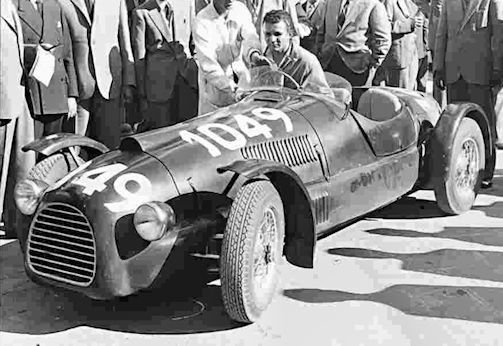
The 166 SC is a racing car produced by Ferrari from 1947 to 1948 .
History
The competitive life of the 166 SC was fairly long as it raced throughout 1948 and 1949 in long and short wheelbase versions The Corsa version of the 166 equipped with the classic two-litre (1995.02 cc) engine had motorcycle-type mudguards, also called the Inter after the Besana brothers
The first example of this model built was actually the 159 S victorious at the 1947 Turin Grand Prix whose engine was replaced in December of the same year. The engine of the "166 SC" derived, indirectly, from the one installed on the first car to bear the Ferrari name , the 125 S. The aforementioned engine was a 1.5 L V12 , and was subsequently modified by increasing the displacement to just under 2 L by working on the stroke and bore . This evolution of the engine was then mounted on the “159 S” . However, the development of the engine did not stop here: the stroke and bore were slightly modified to obtain the "Type 166" engine, which had this name because 166 cm³ was its unit displacement , i.e. that relating to a single cylinder . The “Type 166” was then installed, this them gave its name, to the 166 SC Ferrari models, both single-seaters and two-seater sports prototypes . They shared the acronym “166” in the name and were the 166 F2 , the 166 FL , the 166 Inter , the 166 Inter Corsa , the 166 Inter Sport , the 166 MM and the 166 S. The model's abbreviation "SC" instead stood for "Spyder Corsa". After the example that derived directly from the 159 S, seven other 166 SCs were built in 1948 . These cars had the characteristic of having removable fenders and headlights , and this made them suitable for racing both in sports car races and in Formula 2 .
The model participated in both the Formula 2 championship and sports car competitions . Among the latter, the most important in which he took part were the 12 Hours of Paris , the Targa Florio and the Mille Miglia . In the 1948 edition of the latter, Tazio Nuvolari retired in Ospizio (Reggio Emilia) due to mechanical problems when he was leading the race: the driver first had the bonnet removed to remedy an imperfect closure, then a mudguard came off , subsequently the support of the mechanic's seat broke and finally, after too much of a slide, the support of a crossbow cracked . At this point Enzo Ferrari , given that Nuvolari had no intention of having a repair carried out so as not to lose the lead in the standings, ordered him to stop and retire.
Technical characteristics
The engine was a front and longitudinal non- supercharged V12 , the design of which was the work of Gioachino Colombo . The bore and stroke were 60 mm and 58.8 mm respectively , which brought the total displacement to 1995.02 cm³ . The block and the cylinder head were made of light alloy . The cooling system was water circulating . The compression ratio was 11:1, while the maximum power delivered by the engine was 130 HP at 6500 rpm .The distribution consisted of a single overhead camshaft which controlled two valves per cylinder . Power was provided by three Weber brand carburettors and model 32 DCF . The ignition was single and the relative system included two magnetos . The lubrication was wet sump , while the clutch was a dry single disc .
The front suspension was independent, with deformable wishbones and a transverse leaf spring , while the rear ones consisted of a rigid axle , longitudinal leaf springs and an anti-roll bar . Both had hydraulic shock absorbers . The brakes were drum brakes on the four wheels, while the steering was by worm screw and toothed sector. The traction was rear , and the transmission was made up of a five-speed manual gearbox plus reverse mounted in block with the engine .The chassis was tubular steel with side members and crosspieces, while the bodywork was a two-seater spider .The maximum speed reached by the 166 SC was 170 km/h .
In total eight examples were built.
PERFORMANCE
- Top speed 170 km/h
- Power to weight ratio 5.2 kg/hp
- Maximum power 130 hp at 6500rpm
- Specific power 65 hp / litre
Ferrari 340 F1
 |
|
|
Builder |
Ferrari |
|
Class |
Race Car |
|
Category |
Formula 1 |
|
Production |
1950 |
|
Designed by |
Aurelio Lampredi |
|
Chassis |
tubular spars and crosspieces |
|
Motor |
12 V-cylinder of 4101 cm³ |
|
Transmission |
4-speed manual gearbox + non-synchronized RM mounted in block with the ZF differential; rear-wheel Drive |
|
Length |
3937 mm |
|
Length |
1428 mm |
|
Height |
960 mm |
|
Weight |
850kg |
|
Fuel |
Shell |
|
Tyres |
Pirelli |
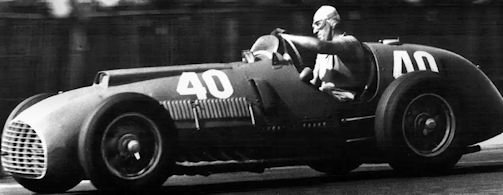
The Ferrari 340F1 was a Formula 1 racing car, built and used by the Scuderia Ferrari in 1950.
History
The Ferrari 275F1 ,fitted with the new V-12 engine from Aurelio Lampredi was used in the 340F1 . Lampredi, who was an advocate of no-turbocharging engines, had developed this early 1950s. The variant in the 340F1 had 4.1 Liters of displacement 320 hp (235 kW). Unlike the 275 F1, which had an old- style chassis, a new chassis was designed for the 340F1 and 375F1 . The racing car had front double wishbones and transverse leaf springs and a rigid De Dion rear axle with a single transverse leaf spring.
Having completed the first phase of the development of the naturally aspirated V12 with a displacement of 3,300 cm³ mounted on the 275 F1 , Eng. Aurelio Lampredi moved on to the next stage which involved the creation of a 4,100 cm³ V12 by increasing the bore and stroke of the engine from 3,300 cm³. This engine was mounted on the 340 F1 single-seater, the logical evolution of the 275 F1.
The new engine now expressed a maximum power of 335 HP at 7,000 rpm and was mounted on a new chassis with side members and crossbars but with a wheelbase lengthened to 2,420 mm. The rear suspension was also new and adopted a De Dion scheme , already tested on the 125 F1 and on Formula 2 single-seaters , replacing the torsion bars. The gearbox was now in lock with the differential, a solution also tested on the 125 F1.
The performance offered by this car was further confirmation of the quality of the project so much so that, proceeding in forced stages, at the end of the year the definitive 4,500 cm³ V12 was already ready which would give life to the new 375 F1
The Ferrari 340 F1 is a car that took part in two races of the 1950 motor season not valid for the Formula 1 world championship . It represented the intermediate stage between the 275 F1 and the 375 F1 in the development of the new naturally aspirated V12 engine.
The 340F1 first made its debut in Geneva on June 30, 1950 at the Grand Prix of Nations . Its first ever World Cup run was the 340F1 at the 1950 Italian Grand Prix with Dorino Serafini at the wheel, finishing second in the race. At the same race, the 375F1, the sister model with the 4.4-liter version of the Lampredi engine, made its race debut. This car piloted Alberto Ascari, the 375F1 became in the season 1951 the common employment vehicle of the Scuderia in the world championship. The 340F1 was often preferred to the 375F1 in many non-championship races. Especially at road races and on city courses, it was better to rely on the 4.1-liter engine, since the unit in the 375F1 already had 380 hp. With the 340F1, some success could be achieved in 1951 at these races. Despite the withdrawal, the 340 F1 proved to be fast and able to keep up with the most famous rivals, thus making it clear that the future 375 F1 would certainly be able to compete for the world championship. The second and last appearance of the 340 F1 occurred at the Penya Rhin Grand Prix when the 375 F1 had already made its debut at the Italian Grand Prix a month and a half earlier. Driven by Piero Taruffi, it ranked third behind the 375 F1s of Ascari and Serafini.
Performance
- Speed : 300 km/h
- Power : 335 HP at 7,000 rpm

