
Elva
Elva Courier T Type Mk. IV
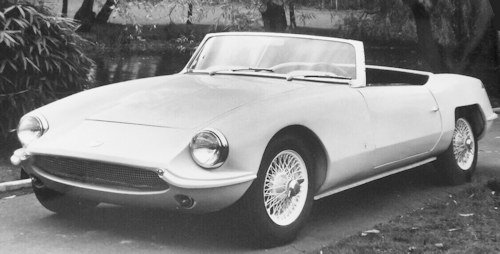 |
|
| Manufacturer | Elva |
|---|---|
| Production | 1963 to 1969 |
| Class | sports car |
| Body | convertible,coupe |
| Engine | 1500cc,1800cc |
| Wheelbase | 90 in 2,286 mm |
| Length | 149.50 in, 3,797 mm |
| Width | 61 in, 1,549 mm |
| Height | 44.50 in, 1,130 mm |
| Dry weight | 1,513 1b, 686 kg |
The T-Type Elva Courier Mk. IV is a British open 2-Seater convertible and coupe from the 1960s.
History
The Manufacturers Trojan Limited, from Croydon, Surrey, England. Built the T-Type Elva in plastic materials of reinforced metal and one-piece glass fibre body bolted and bonded to chassis. with 2 doors. As the Elva Mk IV, or T-Type, came along when Elva was under the control of Trojan, and featured a number of revisions to previous models.with fully independent suspension all around and a switch from MGA to MGB 1800cc powerplant. Prices in UK started from £955 GBP including VAT.
At the time it was the only sub £1000 100mph open 2-seater in Europe with fully independent suspension. Featuring their own Ladder-type chassis carries 'Tru-Trak' independent rear suspension units and strengthened front suspension that was also independent with wishbones, coil springs, anti-roll bar and telescopic dampers. The distribution of weight was 55% to the front axle, and 45% at rear axle.
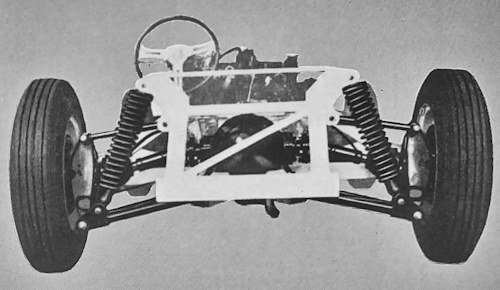
Inside was 2 bucket seats with small rear dunlopillo seats as an option with a fold away all-weather hood. Full carpets ash tray and sun visors as standard with horn button located on steering wheel. Fitted with speedometer and rev counter oil and water gauges, combined ignition and starter. Laminated wind screen and self-parking wipers with two speeds as an option.Other options Wire wheels, heater system a tonneau cover or hard top, overdrive oil cooler and twin tanks.
The T-Type Elva Courier Mk. IV came with a choice of 1500cc Ford with 9.0:1 compression ratio and 1800cc MG engines with a range of power outputs the carburation for the 1800cc was 2 SU type HS 4 semi-downdraught carburettors with power-weight ratio: 15.4 lb/hp, 7 kg/hp MG cast iron cylinder block and head, the 1800cc top speed 98 hp at 5,400 rpm. later cars had much improved fiberglass bodies before production stopped in 1969.
PERFORMANCE:1800cc
- Engine Capacity 109.71 cu in, 1,798 cu cm
- Fuel Consumption 28 m/imp gal, 23.3 m/US gal, 10.1 1 x 100 km
- Max Speed 107 mph, 172.3 km/h
- Max power (SAE): 98 hp at 5,400 rpm
- Max torque (SAE): 110 1b ft, 15.2 kg m at 3,000 rpm
- Max engine rpm: 6,200
- Specific power: 54.5 hp/l
- Acceleration: O—50 mph (0—80 km/h) 6 sec
- Speed in direct drive at 1,000 rpm: 17.9 mph, 28.8 km/h.
- Max speeds: 30 mph, 48.3 km/h in 1st gear; 49 mph, 78.9 km/h in 2nd gear; 81 mph, 130.4 km/h in 3rd gear; 107 mph, 172.3 km/h in 4th gear
Ford engine (1500cc)
- Max power (SAE) 83.5 hp at 5,200 rpm
- Max torque (SAE) 97 1b ft. 13.4 kg m at 3,600 rpm
- Specific power 55.7 hp/l
- power-weight ratio 16.8 lb/hp, 7.6 kg/hP'
- Max speed 102 mph, 164.2 km/h
Elva GT 160 BMW
 |
|
|
Production period: |
1964 |
|
Class : |
sports car |
|
Body versions : |
Coupe |
|
Engines: |
Gasoline BMW 1991 cc |
|
power: |
182 hp |
|
Wheelbase : |
78 in, 1,981 mm |
|
Overall length: : |
150 in, 3,810 mm |
|
Overall height: |
42 in, 1,067 mm |
The Elva GT 160 was a prototype sports car from the 1960s
History
In 1964 there was the Coupe GT 160 , of which only three vehicles were manufactured. It had a four-cylinder water cooled engine from BMW with 1991 cc a dry sump unit with oil cooler and 2 Weber 45 DCOE horizontal twin barrel carburettors, which made 185 hp at 7200 / min and was installed as a mid-engine ,the max Speed was 160 mph, 257.6 km/h .The un-synchronized five-speed gearbox should be available with different ratios with a single dry plate clutch, as well as optionally a self-locking differential .
PERFORMANCE
- Engine Capacity 121.49 cu in, 1,991 cu cm
- Fuel Consumption 16 m/imp gal, 13.4 mlUS gal, 17.6 1 x 100 km
- Max Speed 160 mph, 257.6 km/h
- Max power (SAE): 185 hp at 7,200 rpm
- Max torque (SAE): 140 1b ft, 19.3 kg m at 6,800 rpm
- Max number of engine rpm: 8,000
- Specific power: 92.9 hp l
- Max speeds: 160 mph, 257.6 km/h In 5th gear
- Power-weight ratio; 6.4 lb/hp, 2.9 kg l hp
The car had a tubular trellis frame chassis with aluminium bodywork, distribution of the cars weight was 40% to front axle, and 60% at rear axle and low ground clearance of 4.50 in, (114 mm). The wheels were hung independent front double wishbones, rear independent, wishbones, twin trailing radius arms and disc brakes with andiameter of 10 in, (254 mm). The empty weight (ready to drive) was given as 428 kg.
Because of the engine, the model was also called Elva-BMW .Only three prototypes were produced.
Elva-Porsche race car
 |
|
|
Production period: |
1963 to 1965 |
|
Class : |
race car |
|
Engines: |
Gasoline 4 & 8-cylinder |
|
Length: |
3500 mm |
|
Wheelbase : |
2286 mm |
The Elva-Porsche was a light racing sports car with Porsche engine from the 1960s
History
Around 1960 the request from the US, the for a light racing sports car with Porsche engine. Porsche then developed for the so-called Elva (type 547) with four overhead camshafts , among other things, a horizontally above the crankcase received lying cooling impeller from plastic. With 1.7 liter and a compression of 11: 1 made this unit 183 hp at 7800 / min.
Porsche supplied 15 of these engines for installation in the appropriately adapted Elva chassis Mk VII. This adjustment included changes in the placement of gasoline and oil tank, the cockpit and the rear of the tubular frame. The Porsche five-speed gearbox was tuned to the 13-inch wheels (front 6, rear 7 inches wide).
The first vehicles were finished at the end of 1963. They were light cars that accelerated from standstill to 100 km / h in about 5 seconds and reached a top speed of about 260 km / h. A car cost over $ 10,000.
In 1964, Porsche used an Elva Mark VII chassis with the Type 771 8-cylinder racing engine in the European Mountain Championships . This car weighed only approximately 520 kg and was therefore much lighter than the Porsche RS 61 (type 718) or the Porsche 904 based Spyder. Edgar Barth won the Rossfeld hill climb with the Elva Porsche. Because of the poorer handling characteristics of the Elva, whose frame was possibly too heavily loaded by the 8-cylinder engine, Barth started in the following race but again with the old RS 61 and won as the previous year's championship of the class for sports cars. With only around 19 Elva-Porsches built.
ELVA Formula Junior
 |
|
|
Production period: |
1960 |
|
Class: |
Race car |
|
Team: |
Elva |
|
Body versions : |
Formula Junior |
|
wheelbase: |
226cm (89in) |
|
STEERING: |
Rack and Pinion |
|
BRAKES: |
Lockheed hydraulic |
The ELVA Formula Junior was a Formula Junior racing car from ELVA in Great Britain in the 1960s.
History
Frank Nicols' popular Elva was one of the first British cars to take part in Formula Junior racing when it was introduced in 1960. The DKW-engined Elva had some success at first, but was quickly overtaken by the rear-engined Lotus and Lola machines. This was partly because the Elva's engine was unreliable when highlystressed .The body was a 3-section shell in lightweight fibreglass the car was updated throughout th early 1960s .
Nicols tried to remedy this by putting the DKW engine behind the driver with a four-speed gearbox the DKW, was a three-cylinder; two-stroke with a capacity of 986cc and Bore & Stroke: 74 X 76mm and a maximum Speed of 177km/h (110mph), and later inserted BMC and Ford engines in the search for greater reliability with a Borg & Beck, single dry plate clutch the final drive a hypoid bevel gearing in Elva light-alloy casing. Optional axle ratios 4.22, 4.55 .
Chassis:Elva multitube spaceframe. Independent front suspension by wishbones and coil springs. Independent rear suspension by wishbones, radius arms and coil springs
Elva Sports car history
 |
|
| Type | British Sports and racing car manufacturer |
|---|---|
| Founded | 1955 |
| Founder | Frank G. Nichols |
| Headquarters | Bexhill, Sussex, England, UK |
Elva was a sports and racing car manufacturing company based in Bexhill, then Hastings and Rye, East Sussex, United Kingdom. The company was founded in 1955 by Frank G. Nichols. The name comes from the French phrase elle va ("she goes").
Racing cars
Frank Nichols's intention was to build a low-cost sports/racing car, and a series of models were produced between 1954 and 1959. The original model, based on the CSM car built nearby in Hastings by Mike Chapman, used Standard Ten front suspension rather than Ford swing axles, and a Ford Anglia rear axle with an overhead-valve-conversion of a Ford 10 engine. About 25 were made. While awaiting delivery of the CSM, Nichols finished second in a handicap race at Goodwood on March 27, 1954, driving a Lotus. "From racing a Ford-based CSM sports car in 1954, just for fun but nevertheless with great success, Frank Nichols has become a component manufacturer. The intermediate stage was concerned with the design of a special head, tried in the CSM and the introduction of the Elva car which was raced with success in 1955."The cylinder head for the 1,172 c.c. Ford engine, devised by Malcolm Witts and Harry Weslake, featured overhead inlet valves
On May 22, 1955 Robbie Mackenzie-Low climbed Prescott in the sports Elva to set the class record at 51.14 sec. Mackenzie-Low also won the Bodiam Hill Climb outright at the end of the season.
The 1956 Elva MK II works prototype, registered KDY 68, was fitted with a Falcon all-enveloping fibreglass bodyshell. Nichols developed the Elva Mk II from lessons learnt in racing the prototype: "That car was driven in 1956 races by Archie Scott Brown, Stuart Lewis-Evans and others." The Elva Mk II appeared in 1957: "Main differences from the Mark I are in the use of a De Dion rear axle as on the prototype, but with new location, inboard rear brakes, lengthened wheelbase, and lighter chassis frame." The car was offered as standard with 1,100 c.c. Coventry-Climax engine. This went through various changes up to the Mark IV of 1958.
Carl Haas, from Chicago, was Elva agent in the midwest of the United States from the mid-fifties through the nineteen sixties. In 1958 he was invited to England to drive an Elva in the Tourist Trophy at Goodwood, where he finished twelfth overall. With the Mark IV: "The major change is an all-new independent rear suspension utilizing low-pivot swing axles. The body is entirely new with close attention to aerodynamics and a reduced frontal area." At the Sebring 12 Hours sports car race in 1959 the #48 Elva Mark IV driven by Frank Baptista, Art Tweedale and Charley Wallace finished first in Class G, and 19th overall.
On June 21, 1959, Arthur Tweedale and Bob Davis won the Marlboro Six Hour Endurance Race in Maryland driving the #37 Elva Mk IV. Arthur Tweedale repeated the win in the Marlboro Six Hours in 1960. Teamed with Ed Costley he covered 337.75 miles in an Elva Mk V sports car. This was the final iteration of the Elva front-engined sports racing car. The last Mk V chassis won a number of important races in the midwest driven by Dick Buedingen, including the 1961 Elkhart Lake 500 teamed with Carl Haas. At this time Elva Cars Limited was operating from premises at Sedlescombe Road North, Hastings, Sussex, England.
Elva produced a single-seater car for Formula Junior events, the FJ 100, initially supplied with a front-mounted B.M.C. 'A' series engine in a tubular steel chassis. "ELVA CARS, Ltd., new Formula Junior powered by an untuned BMC 'A' Series 948cc engine. Price of this 970 lb. car is $2,725 in England. Wheelbase: 84", tread: 48", brake lining area: 163" sq. The 15" wheels are cast magnesium. Independent suspension front and rear with transverse wishbones, coil springs, and telescopic shock absorbers. The car is 12 feet, four inches long."Bill de Selincourt won a race at Cadours, France, in an Elva-B.M.C. FJ on September 6, 1959. Nichols switched to a two-stroke DKW engine supplied by Gerhard Mitter. In 1959 Peter Arundell won the John Davy Trophy at the Boxing Day Brands Hatch meeting driving an Elva-D.K.W. "Orders poured in for the Elva but when the 1960 season commenced Lotus and Cooper had things under control and disillusioned Elva owners watched the rear-engined car disappearing round corners, knowing they had backed the wrong horse." Sporadic success continued for Elva in the early part of that year, with Jim Hall winning at Sebring and Loyer at Montlhéry.

1961 Elva Formula Junior car
Elva produced a rear-engined FJ car, with B.M.C. engine, at the end of the 1960 season. Chuck Dietrich finished third at Silverstone in the BRDC British Empire Trophy race on October 1. In 1961 "an entirely new and rather experimental Elva-Ford" FJ-car debuted at Goodwood, making fastest lap, driven by Chris Meek.
After financial problems caused by the failure of the US distributor, Frank Nichols started a new company in Rye, Sussex in 1961 to continue building racing cars. The Elva Mk VI rear-engined sports car, with 1,100 c.c. Coventry Climax power, made its competition debut at Brands Hatch on Boxing Day, 1961, driven by Chris Ashmore, finishing second to the 3-litre Ferrari of Graham Hill. The car was designed by Keith Marsden.
On September 8, 1963, Bill Wuesthoff and Augie Pabst won the Road America 500, round 7 of the United States Road Racing Championship, at Elkhart Lake, Wisconsin driving an Elva Mk.7-Porsche. "The Elva-Porsche is based on the Mark VII Elva, but redesigned aft of the front section to take the 1,700 c.c. Porsche air-cooled flat-four unit and its horizontal cooling fan."
Edgar Barth won the opening round of the European Hill Climb Championship on June 7, 1964, at Rossfeld in southern Germany in an Elva-Porsche flat-8 sports car. The cars were placed throughout the seven-round series with Herbert Muller winning at the final round at Sierre Montana Crans in Switzerland on August 30, 1964.
Around 1964-1966 Elva made a very successful series of Mk 8 sports racers mostly with 1.8 litre BMW engines (modified from the 1.6 litre by Nerus) and some with 1.15 litre Holbay-Ford engines. The Mk8 had a longer wheelbase and wider track compared to the Mk7, which was known for difficult handling due to a 70-30 weight bias to the rear. Following the success of the McLaren in sportscar racing, Elva became involved in producing cars for sale to customers:

1965 Elva BMW 2000 Fiore Fissore
"Later a tie-up with Elva and the Trojan Group was arranged and they took over the manufacture of the McLaren sports/racer, under the name McLaren-Elva-Oldsmobile."
At the 1966 Racing Car Show, held in London in January, Elva exhibited two sports racing cars - the McLaren-Elva Mk.II V8 and the Elva-BMW Mk. VIIIS. The McLaren-Elva was offered with the option of Oldsmobile, Chevrolet or Ford V8 engines. The Elva-BMW Mk. VIIIS was fitted with a rear-mounted BMW 2-litre four-cylinder O.H.C. engine.
Luki Botha campaigned an Elva-Porsche in southern Africa from 1966.
1964 Elva Courier Mark 4


