El Nasr
El Nasr 128
 |
|
|
Production: |
1972-1983 |
|
Class: |
Motor Car |
|
Body versions: |
Sedan |
|
Engines: |
1.1–1.3 liters |
|
Length: |
151.18 in, 384 cm |
|
Width: |
62.60 in, 159 cm |
|
Height: |
55.91 in, 142 cm |
|
wheelbase: |
96.38 in, 245 cm |
|
curb weight: |
1,775 1b, 805 kg |
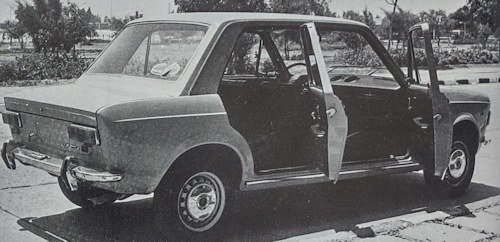
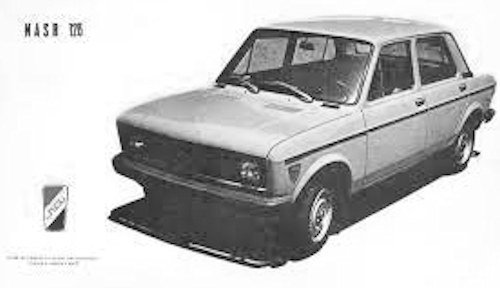
The Nasr 128 is a passenger car A notchback version of the Fiat 128 as the Nasr 128 available from El Nasr Automotive Manufacturing Company in Egypt until 2009.
History
Nasr's best-selling model, the 128 GLS, a front-wheel drive four-door notchback sedan with 4 doors and 5 seats. Completely redesigned along with a new engine, with a transversely mounted front engine with an overhead camshaft and individually suspended wheels, it was the most modern vehicle in its class on the market at the time.
The engine had a displacement of 1116 cc and delivered 55 hp (40 kW) at 6000 rpm, the overhead camshaft was driven by a toothed belt and actuated the parallel hanging valves with bucket tappets. With a piston stroke of just 55 millimetres, the engine with cast iron block, light alloy head was designed with an extremely short stroke and was correspondingly lively with the 1 Weber 32 ICEV 17 downdraught carburettor. The intake and exhaust ports were on the same side of the cylinder head, and the engine was installed in the vehicle at a slight forward tilt. An electric fan with a thermostat on the radiator completed the cooling system. The fuel tank size of 8.4 imp gal, 10 US gal.
PERFORMANCE
- power-weight ratio: 34.8 lb/hp, 15.8 kg/hp
- max power (DIN): 51 hp at 6,000 rpm
- max torque (DIN): 55 1b ft, 7.6 kg m at 3,500 rpm
- max engine rpm: 6.500; 45.7 hp/l
- acceleration: standing 1/4 mile 21 sec, 0-50 mph (0-80 km/h) 15.8 sec
- consumption: 35.3 m/imp gal, 29.4 m/US gal, 8 1 x 100 km.
With a weight distribution of 61.5% to the front, and 38.5% at rear the wheels were suspended at the front on MacPherson struts and wishbones and guided by an anti-roll bar. At the back was a self-stabilizing system of struts and trapezoidal wishbones, with a transverse leaf spring mounted at two points, which had no control functions.
The steering was designed as a rack and pinion steering system the turning circle (between walls) of 35.8 ft, 10.9 m. Disc brakes were installed at the front and drum brakes at the rear. The chassis of the 128 was the template for many other vehicles (Autobianchi A112, Fiat 127, Ritmo, Regata, Elba; Seat Ibiza, Yugo Koral and others).
In April 1978 the successor model Fiat Ritmo was presented. However, due to continued demand, the Fiat 128 continued to be produced in parallel with the Ritmo until the end of 1983 along with a 1300GLS model.