
Daihatsu
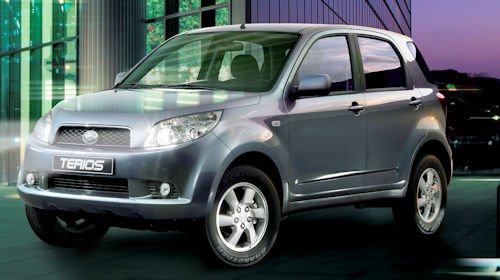
Daihatsu Terios 2nd Generation
 |
|
|
Production period: |
2006 to 2017 |
|
Body versions: |
station wagon |
|
Engines: |
Gasoline :1.5 litres |
|
Length: |
4095 mm |
|
Width: |
1695 mm |
|
Height: |
1740 mm |
|
Wheelbase: |
2580 mm |
|
Curb weight: |
1170-1235 kg |
In 2006, a successor model was presented, which was developed in cooperation with Toyota. The new Terios is also sold as Toyota Rush and Daihatsu Be‣go. In early 2009, the second generation of the Terios received a facelift, in which the front, especially the grille, and the tail lights were changed.
The all-new Terios is a fully updated compact SUV. The 2nd gen Terios delivers seemingly contradicting goals of genuine sport utility performance and ease of use in town and provides a stylish presence in whichever situation it is used. Combining the SUV's power, nimble drivability on any road surface, and excellent manoeuvrability in town, the new Terios proposes a new concept compact SUV that can be used stylishly in any situation. Featuring a long wheelbase and super short overhangs two of the most important elements of this car's styling. Specifically, a rounded front bumper and rearward extended headlamps are employed to make the front overhang look shorter and lighter.
The D pillar in the rear is concealed by the quarter window, giving a lighter finish to the rear overhang. These meticulous design works from the front to the rear further emphasise the large wheels and tyres that firmly support the vehicle at the four corners of the body and give the car a big-boned presence without resorting to gimmicky techniques.
The second objective is to express the powerful image of the SUV. The eye-catching wheel flares at the four corners of the body, the sturdy looking door sections and the prominent front styling all contribute to the new Terios's powerful SUV image. The third objective is to give the car a sense of urban sophistication that matches the product concept. The powerfully curved bonnet and headlamps and the flowing, animated cabin styling.
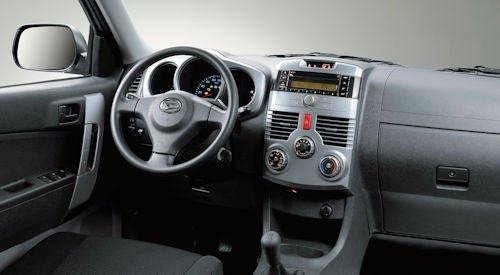
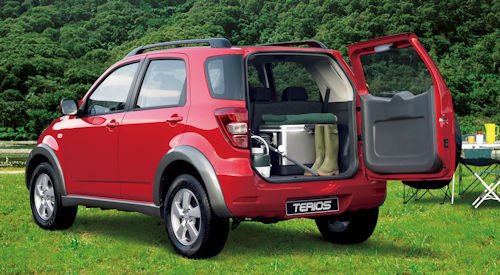
The interior is designed to create the "feel excited" atmosphere that users expect from the SUV. Instead of the "rugged" feel frequently seen in the interiors of traditional SUV. The combination of the long wheelbase and super short overhangs contribute not only to the futuristic proportions of the body but also to the comfortable interior and sophisticated ease of use. In order to seat five adults in comfort and realise packaging that allows generous luggage capacity, Daihatsu's designers studied a variety of situations in which the previous model was used. The conclusion they reached was that the new Terios's couple distance and tandem distance had to be significantly improved and its luggage-compartment length extended by 13 cm compared with its predecessor. To realise an SUV that's also a convenient everyday tool, the new Terios also features a versatile seating arrangement, flat and wide luggage compartment, and ample storage space that effectively takes advantage of the entire cabin space. A combination of tilt steering, seat-height adjuster, shoulder-anchor adjuster and long front-seat slide allows the driver to assume the best driving position tailored to his physique. Excellent forward visibility thanks to the high eye point and a small turning circle of 9.8 metres (kerb to kerb) also make driving easy.
The Terios's power unit is a newly developed 1.5-litre engine Its rich torque in the low to medium rev range promises quick acceleration from standstill and easy overtaking at high speeds. The Terios comes standard with full time 4WD with a centre differential, allowing the driver to drive on the highway, rough terrain or slippery road surfaces with confidence.
In order to improve occupant safety, the Terios employs a safety body structure with increased cabin strength and a variety of safety features including SRS curtain shield airbags, soft upper interior and an airbag-cutoff switch. The Terios also employs VSC (Vehicle Stability Control), which controls the vehicle's
movements in all directions, improving safety in quick cornering and on slippery roads.
AT (automatic transmission) models with VSC come standard with DAC (Down Assist Control) and HAC (Hill-start Assist Control).
By the end of 2014, the model has since not been offered in Europe.
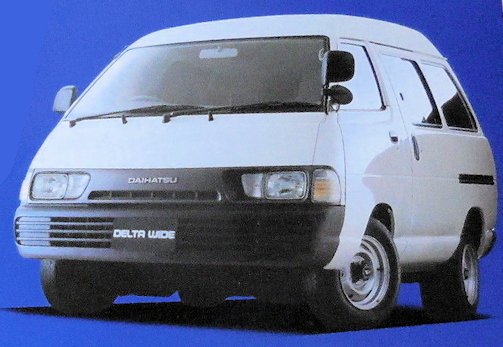
Daihatsu Delta Wide second generation
 |
|
|
Manufacturer |
Daihatsu |
|
Production |
1982 to 1996 |
|
Class |
Motor Car, Commercial vehicle |
|
Body style |
Wagon Van |
|
Layout |
|
|
Transmission |
4-speed manual |
|
Wheel base |
86.42 in, 219 cm |
|
Length |
157.09 in, 399 cm |
|
Height |
68.70 in, 174 cm |
|
Weight |
2,370 1b, 1,075 kg |
The Daihatsu Delta Wide Wagon second generation was built from 1982 to 1996
History
The Daihatsu Delta Wide Wagon name that has been used on a variety of Hino Motors and Toyota-based Japanese Daihatsu vans and trucks between 1970 and 2010. fitted with Daihatsu or Toyota engines with 1 Asian 12T or 13T downdraught twin barrel carburettor TGP high turbulence cylinder head. secondary air induction. exhaust gas recirculation and catalytic converter to meet emissions.
The Delta Wagon with Standard, de Luxe or Custom versions trim levels with low or high roof as the basic SE and high equipped SQ versions with manual or auto gearbox depending on marketability as a badge engineering Toyota version of the Toyota TownAce often as multi seat or camper versions with integral chassis the front suspension as independent with double wishbones, coil springs, telescopic dampers at the rear rigid axle, semi-elliptic leaf springs, telescopic dampers. The Delta Wagon with Standard, de Luxe or Custom versions.
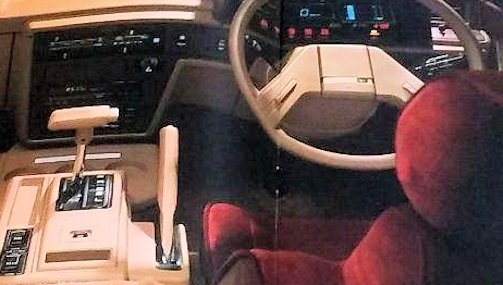
Second generation Daihatsu Delta Wide updates
1982 Full model change. It has undergone a full model change to a more edgy style, with the angle of the A- pillar and steering column made even smaller, and the appearance and equipment have all changed to a high-end route. the new generation commercial engine 1Y and 2Y-U type (1600cc and 1800cc, both carburettors), and the AT will also be a 4-speed (wagon only). The Corolla 1C type (1800cc) was selected as the first diesel engine. The 2200cc 4Y-EU type was also installed for the outside of Japan.

- PERFORMANCE: 1,588 cc
max speeds:(IV) 93 mph, 150 km/h
max power (JIS): 85 hp at 5.400 rpm
max torque (JIS): 91 1b ft. 12.5 kg m at 3,400 rpm
max engine rpm: 6.000: 53.5 hp/l
power-weight ratio: 27.9 lb/hp, 12.6 kg/hp
consumption: 39.8 m/imp gal, 33.1 m/US gal, 7.1 1 x 100 km at 37 mph, 60 km/h. - PERFORMANCE: 1.770 cc
max power (JIS): 92 hp at 5,000 rpm:
max torque (JIS): 109 1b ft. 15 kg m at 3.400 rpm:
max engine rpm: 5.400; 52 hp/l
power-weight ratio: standard 26 lb/hp. 11.8 kg/hp
Fuel consumption: 29.7 m/imp gal. 24.8 m/US gal, 9.5 1 x 100 km.
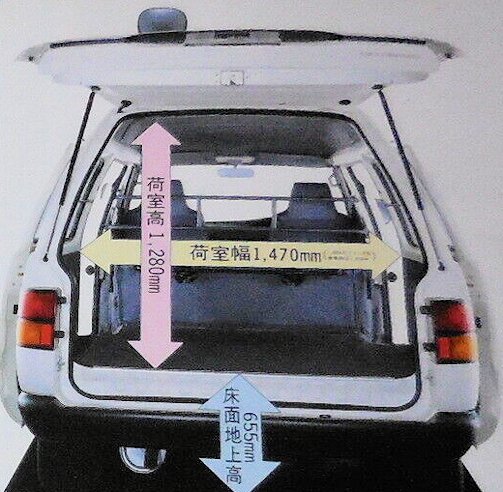
Minor change in 1988. The front and rear views and the instrument panel have been changed to a more rounded design.Significantly changed interior and exterior. At the same time, a flat floor car with flat tires on the rear wheels is set. Column shift vans were abolished and all were floor shift. As for the gasoline engine, 2Y-U was abolished with this minor change, leaving only 3Y-EU. A clutch disc with a torsional damper will be adopted for diesel turbo MT vehicles.
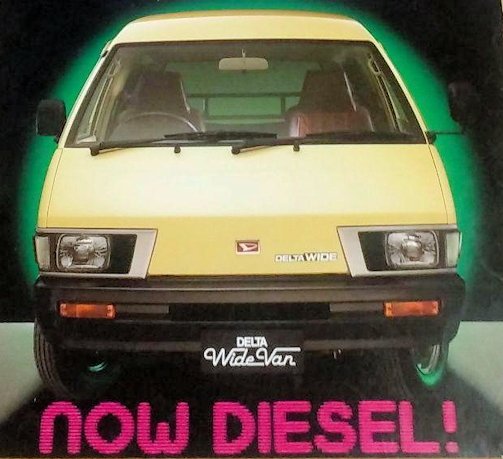
In 1993, the diesel engine was changed from the 2,000cc 2C-T type to the 2,200cc 3C-T type. As a result, the maximum output also improved from 85ps to 88ps. Only the 4WD model was released nine years later than the Town Ace.
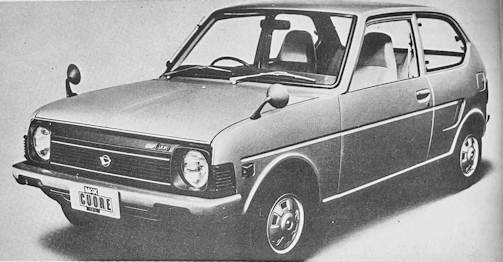
Daihatsu MAX Cuore First generation L40S series
 |
|
|
Manufacturing company |
Daihatsu Motor |
|
country of manufacture |
Japan |
|
Sales period |
1977 to 1980 |
|
Class |
Motor car |
|
Body type |
2-door/4-door fastback sedan |
|
Drive system |
FF |
|
Engine |
AB type 0.55L 4 cycle direct 2 |
|
Maximum output |
31PS/6,000rpm |
|
Maximum torque |
4.2kgf m/3,500rpm |
|
Transmission |
4-speed MT |
|
Suspension |
Front: MacPherson strut coil springs |
|
Wheelbase |
82.28 in, 209 cm |
|
full length |
124.40 in. 316 cm |
|
Width |
54.72 in, 139 cm |
|
Height |
51.97 in, 132 cm |
|
vehicle weight |
2-dr. 1,191 1b, 540 kg 4-dr. 1,235 1b, 560 kg |
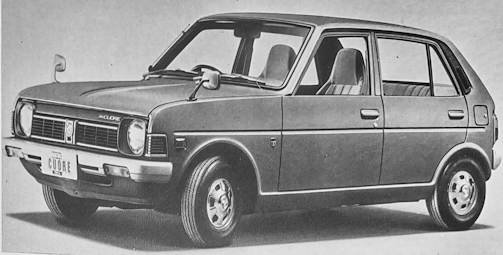
The Max Cuore was first released in 1977 in Japan.
History
The Max Cuore was a minor change version of the previous Fellow MAX launched in 1970 with an enlarged body to meet the new mini vehicle standards (enforced in January 1976).
In May 1976, the engine was changed and expanded from a 2-stroke 360cc to a 4-stroke 550cc, but the body remained the same as the 360cc standard (only the bumper was enlarged and strengthened). The body width of the MAX Cuore has been expanded by 100mm, which has enabled both the body and the engine to comply with the new standards. On the chassis side, the wheelbase and suspension type have not changed, except for the wider tread due to the wider width. The engine has also taken over the one that appeared in the previous year.
The line-up includes three types: a 2-door sedan (STD/EX/custom), a 4-door sedan (EX/custom/high custom/Hi EX custom), and a 3-door van (STD/DX/Super DX). The engine is an AB type 2-cylinder 4 cycle.with cast iron block, alloy head 547cc, 28 horsepower with Aisan downdraught twin barrel carburettor. The sedan version as the C-L40 and the van is H-L40V.
By March 1979 some Minor changes. The sedan will be the E-L40, which complies with the 1953 emissions regulations, and the van will be the J-L40V, which complies with the 1954 emissions regulations control by Daihatsu lean-burn system with turbulence generating pot in each combustion chamber and catalytic converter. The maximum output is improved to 31 horsepower.
PERFORMANCE
- Max speeds:(IV) 68 mph, 110 km/h
- Max power (JIS): 28 hp at 6,000 rpm
- Max torque (JIS): 28 1b ft, 3.9 kg m at 3,500 rpm
- Max engine rpm: 7,800
- Power 51.2 hp/l
- Power-weight ratio: 2-dr. sedans 42.6 lb/hp, 19.3 kg/hp - 4-dr. sedans 44.1 lb/hp, 20 kg/hp
- Acceleration: standing 1/4 mile 21.8 sec
- Fuel consumption: 52.3 m/imp gal, 43.6 m/US gal at 37 mph, 60 km/h.
This first range was discontinued in July 1980. In total there was 144,241 MAX Cuore produced in all versions. The successor model as the " Cuore (2nd generation)" (Cuore) sedan and the " Miracuore " van the car name became " Cuore ", it was set only for passenger car models, and Mira (originally Mira Cuore) was set as a sister car of the commercial model. After that, the Mira, which was advantageous in terms of taxation at that time, sold more, and in Japan, it was integrated into the Mira in 1989, at the end of the third-generation model continued as an export vehicle for Europe. It was sold until the end of January 2013, when Daihatsu withdrew from sales in Europe with an 850cc or 1000cc engine mounted on a body almost identical to the Mira sedan for the Japanese market.
Daihatsu YRV
 |
|
|
Production period: |
2000 to 2005 |
|
Class: |
Motorcar |
|
Body versions: |
Small 4 door |
|
Engines: |
1.0–1.3 litres |
|
Length: |
3765mm |
|
Width: |
1620mm |
|
Height: |
1550mm |
|
wheelbase: |
2355mm |
|
curb weight: |
890-1002kg |
|
Turning Circle: |
8m |
|
Fuel Capacity |
40 litres |
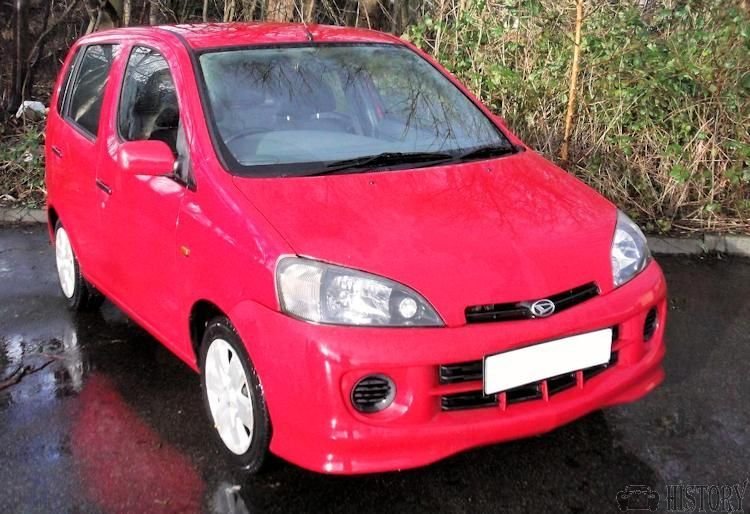
The Daihatsu YRV minivan was produced for 5 years from August 2000 to July 2005 on the basis of the Sirion Storia subcompact.
History
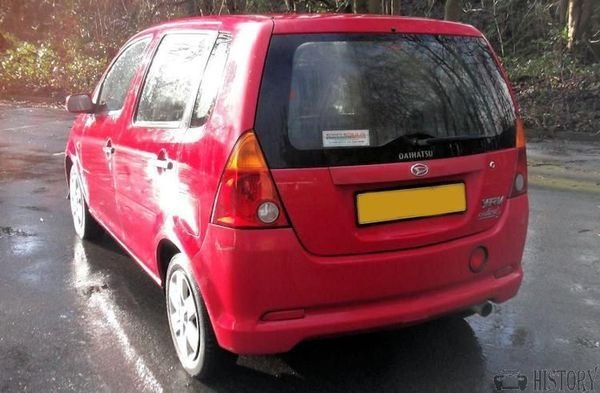
The Daihatsu YRV was 3.77-meter-long car, which was only available as a five-door model The name is short for "Young Recreational Vehicle", had a rear seat bench that could be moved lengthways by 15 centimetres in the higher-quality CXL and CXS versions. The YRV was powered either by at first by a one-litre three-cylinder or a 1.3-liter four-cylinder in naturally K3-VE engine aspirated or turbo versions of the K3-VET engine internationally.; the power transmission to the front wheels took over a five-speed manual transmission or a four-speed automatic electronically controlled. All-wheel drive 4Trak was available on request.
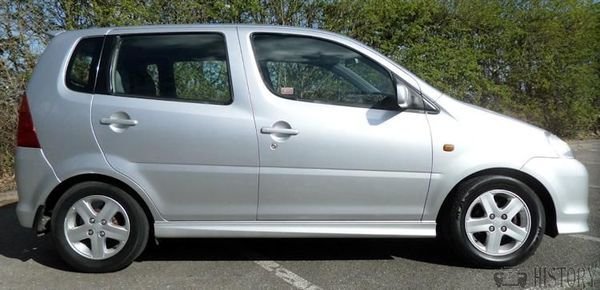
The interior features a geometric dashboard layout with the instrument panel and the unique side window shape. The standard JDM car, "S pack", "Aero S pack", "Turbo", and "Turbo Panorama Pack (2WD car only)". ("CG" and 1.3 L / NA car with 5 Manual in addition to 4 Auto turbo car only has 4 Auto. The AT select lever NA is column shift and turbo is floor shift. Car with Manual mode in this case, only the steering switch can be operated in MT mode.
Engines
- EJ-VE
- K3-VE2
- K3-VE
- K3-VET
- K3-VET-R
In, 2001 For the JDM market the special model "Limited" series "S Edition". "Aero S Pack" and "Turbo Panorama Pack", and is equipped with multi-reflector halogen fog lamps, a seat lifter for driver's seat, and a 2DIN CD/MD/AM/FM stereo. In addition, the "Limited " is equipped with smoked glass, sliding and split folding rear seats, and rear door speakers, while the "Aero S Pack Limited" is equipped with crystal rear combination lamps (clear) and sliding and split folding rear seats. The latter is based on the CG, with coloured electric retractable door mirrors, full wheel caps, UV cut glass, rear wiper, driver's seat lifter, separate rear headrest, power windows, power door locks, keyless entry, impact sensing safety system, it is a complete specification equipped with a 2DIN CD/AM/FM stereo. The 1.3 L turbo cars becoming "Turbo G", "Parco Turbo", " 6th grade of Turbo R. "Parco Turbo" adopts a column shift in a turbo car. In addition, the 2WD vehicles of "Parco L" and "Parco S" have improved environmental performance.
- All-wheel drive system named "4Trak", available only with K3-VE; all other versions are equipped with 2WD.
- The YRV has an option for an electronically controlled 4-speed automatic transmission, with built-in "steer shift" function. YRV turbo comes only with that option.
- Foldable rear seats allow for the YRV to allocate more space for luggage.
By 2004 The vehicle model has been changed, and the "L" and "X" 2WD vehicles have been certified as "2005 standard exhaust gas 50% reduction level. By August 2005 is the end of production with last stock sold over the next few months.
1.3 Turbo Performance
| Power | 127 bhp |
|---|---|
| Top Speed | 112 mph |
| 0-60 mph | 8.1 secs |
| Torque | 170 Nm, 125 ft-lb |
| CO2 Emissions | 165 g/km |
| Euro Emissions Standard | 3 |
| Miles Per Tank | 352 miles |
| Engine Size | 1298cc |
|---|---|
| Cylinders | 4 |
| Valves | 16 |
| Fuel Type | Petrol |
| Transmission | Automatic |
| Gearbox | 4 Speed Auto |
| Drivetrain | Front wheel drive |
The 1.3-liter turbo sometimes called the called "GTti" feature an air scoop on the bonnet, below which the intercooler was placed. In Europe was only available in yellow and silver, with some special models in black. Otherwise, the YRV was also available in Mars red, white, Caribbean blue metallic and silver rose metallic finishes.
Daihatsu Fellow
 |
|
|
Manufacturer |
Daihatsu |
|
Production |
1966 to 1970 |
|
Assembly |
Ikeda, Osaka, Japan |
|
Body style |
2-door sedan |
|
Layout |
Front engine, rear-wheel-drive |
|
Engine |
356 cc ZM I2 2-stroke water-cooled |
|
Transmission |
4-speed manual |
|
Wheelbase |
1,990 mm (78.3 in) |
|
Length |
2,990 mm (117.7 in) |
|
Width |
1,285 mm (50.6 in) |
|
Height |
1,350 mm (53.1 in) |
|
Ground clearance |
155 mm (6.10 in) |
|
Curb weight |
495 kg (1,091 lb) |
The Daihatsu Fellow is a small passenger car model from the manufacturer Daihatsu built from 1966 up to 1970
History
The Daihatsu Fellow is a passenger car model from the manufacturer Daihatsu with the internal designation L37. The kei-car was equipped with a 360-cc engine and rear -wheel drive with a box-type ladder frame chassis and could seat four people. Daihatsu introduced the Fellow, also known as Daihatsu 360 in export markets. it came in Standard, Deluxe and Super Deluxe equipment levels with a carrying capacity of 794 1b, 360 kg. Also available as small commercial vehicles with a Fellow Van and pickup truck.
The predecessor the HI jet L35 was available as a truck and car variant. Daihatsu decided to market the car models as Fellows and the trucks as HI jet for the next generation of vehicles. In April 1970, Daihatsu introduced the successor, the Fellow Max, which was internally called the L38.

the L37 was conventionally built with a front-mounted engine and rear wheel drive, the distribution of weight was 54.4% to the front axle and 45.6% to rear axle. It used the 356 cc, water-cooled two-cylinder two-stroke "ZM" engine already seen in the HI jet and a four-speed manual transmission. The self-lubricating Oil-Matic engine weighed only 58 kg (128 lb) with a cylinder head in light alloy fitted with a single Mikuni-Solex down-draught single barrel carburettor.
Performance
- Engine Capacity 21.72 cu in, 356 cu cm
- Fuel Consumption 61.4 ml imp gal, 51.1 ml US gal, 4.6 1 X 100 km
- Max Speed 62 mph, 99.8 mph
- max power (SAE): 23 hp at 5,000 rpm
- max torque (SAE): 25 1b ft, 3.5 kg m at 4,000 rpm
- max engine rpm: 6,000
- specific power: 64.6 hp/l
- power-weight ratio: 49.4 lb/hp, 22.4 kg/hp
- speed in direct drive at 1,000 rpm: Its mph, 17.7 km/h.
A sportier version of the Fellow SS, the P-5 with the SS engine, was unveiled in 1967 as a sportscar prototype a la Le Mans. In October 1967, The Fellow saw a minor facelift as well, with the dashboard and steering wheel being the most obvious changes. Due to new safety standards, a fixed driver's side headrest and seatbelts were added in January 1969, which was a small alteration. The lesser engine's output was raised to 26 PS in July along with what could be considered a makeover (the front bumper was now mounted higher), and a relatively opulent "Custom" version was added at the top of the list. The taillights' size also slightly increased. In September 1969, the Daihatsu Fellow Van EV, an electric variant, went on sale.


