
Daimler
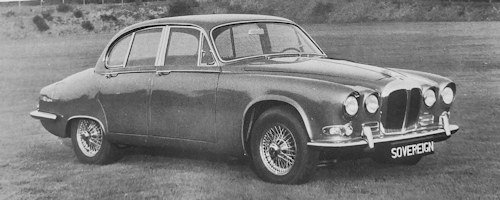
Daimler Sovereign 420
 |
|
|
Manufacturer |
Jaguar Cars |
|
Production |
1966 to 1969 |
|
Produced |
5831 |
|
Class |
Luxury car |
|
Body style |
4-door saloon |
|
Layout |
FR layout |
|
Engine |
4.2L 6 cylinders vertical, in line |
|
Wheelbase |
107.37 in, 2,727 mm |
|
Length |
1187.75 in, 4,769 mm |
|
Width |
66.75 in, 1,695 mm |
|
Height |
54.50 in, 1,384 mm |
| Ground clearance |
7 in, 178 mm |
|
Related |
Jaguar 420 |
The first Daimler Sovereign was a luxury car built from 1966 to 1969 in Great Britain as the Daimler 420 Sovereign.
History
The first Sovereign was a badge-engineered version of the Jaguar 420 saloon, which was itself based on the Jaguar S-Type. The Daimler Sovereign was a name applied by British manufacturer Jaguar Cars for luxury automobiles built carrying the Daimler badge between 1966 and 1983.The Daimler Sovereigns were based on contemporary Jaguar bodyshells, chassis and engines in an example of badge engineering. Jaguar Cars took over The Daimler Company in 1960 and the 1966 Sovereign was the second Daimler to be based on a Jaguar model. Unlike the Daimler 2½ litre, the Sovereign had a Jaguar engine, marking the end for the Turner designed engines. This first Daimler sovereign sold for only four years with only 5476 in right hand drive markets with also only 355 left hand drive being sold making this a rare car
The engine of the Sovereign is a classic 'six cylinders line, maximum 'torque of 282 1b ft, (38.9 kg m) at 3,750 rpm. With roadholding that is in the 'highest class, with limited slip finaldrive (optional), with disc brakes, front and rear, 'the Daimler, Sovereign is a perfect vehicle for brilliant, competitive driving.However, the Daimler wishes to remain first, and foremost- a cars of elegant comfort.studied to increase passenger comfort. Attention has been given even to the smallest details of the finishings, and the materials used, from the wood of the facia to the hide of the upholstery are of the highest quality.For example, driving is made easy and restful by the adoption of a servobrakes and servo steering. The suspension is soft and gradual, But above all the engine gives a very real sensation of a comfortable luxury drive.

PERFORMANCE
- Engine Capacity 258.42 cu in, 4,235 cu cm
- Fuel Consumption 18 ml imp gal, 15 ml US gal, 15.7 1 x 100 km
- Max Speed 122 mph, 196.4 km/h
- max power (SAE): 245 hp at 5,500 rpm
- max torque (SAE): 28.2 1b ft, 38.9 kg m at 3,750 rpm
- max engine rpm: 6,000
- specific power: 57.9 hp/l
- power-weight ratio: 14.6 lb/hp, 6.6 kg/hp
- acceleration: standing 1/4 mile 16.9 sec, 0—50 mph (0—80 km/h) 7 sec
- max speeds: 33 mph, 53.1 km/h in 1st gear; 51 mph, 82.1 km/h in 2nd gear; 76 mph, 122.4 km/h in 3rd gear; 101 mph, 162.6 km/h in 4th
- gear; 122 mph, 196.4 km/h in overdrive/top.
The first Daimler Sovereign was based on the 1966 Jaguar 420 and is sometimes referred to as the "Sovereign 420". Subsequent Sovereigns arose from the Series I, II and III Jaguar XJ6. The 420 and Sovereign differed from the S-Type in having a revised four-headlight nose reminiscent of the Jaguar Mark X and a 4.2 litre version of the straight-six XK engine. .The main external difference between the 420 and Sovereign was the traditional Daimler fluted radiator grille. With full rust and soundproofing, Ventilated leather upholstery recline and height adjustable front seats electrically heated rear screen .Air conditioning system was also an option.Along with fog lamps. Radio system with electric aerial, rear seat belts , wire wheels and anti-theft steering lock

In 1967 the final drive ratio was quietly changed from 3.31:1 to 3.54:1 which led to press complaints about high-speed cruising but which improved acceleration times from stand-still within the range of the speeds legal in Britain following the introduction, in December 1965, of a 70 mph (113 km/h) speed limit across the nation's highways which had previously been unrestricted om motorways.
The front-end styling of the Daimler DS420 limousine introduced in 1968 shared a family resemblance with a Daimler grille mated to a four-headlight nose. The 420/Sovereign range began to be replaced by the Jaguar XJ6 in September 1968. The Jaguar ceased production in December 1968, the Daimler remaining in production until July 1969 and was thus sold alongside the new Jaguar XJ 6 for a short time.
Jaguar XJ X300
Daimler Vanden Plas
 |
|
| Manufacturer | Jaguar Cars |
|---|---|
| Production | September 1994-June 1997 |
| Assembly | Coventry, England |
| Predecessor | Jaguar XJ (XJ40) |
| Successor | Jaguar XJ (X308) |
| Class | Luxury vehicle |
| Body style | 4-door sedan |
| Layout | FR layout |
| Engine | 3.2 L AJ16 I6 4.0 L AJ16 I6 4.0 L supercharged AJ16 I6 6.0 L Jaguar V12 |
| Transmission | 4-speed automatic ZF 4HP-22 4-speed automatic ZF 4HP-24 4-speed automatic GM 4L80-E 5-speed manual Getrag 290 |
| Wheelbase | SWB: 2,870 mm (113 in) LWB: 2,995 mm (117.9 in) |
| Length | SWB: 5,024 mm (197.8 in) LWB: 5,149 mm (202.7 in) |
| Width | 1,799 mm (70.8 in) exc. mirrors 2,074 mm (81.7 in) inc. mirrors |
| Height | Comfort SWB: 1,314 mm (51.7 in) Sport SWB: 1,307 mm (51.5 in) XJR: 1,303 mm (51.3 in) Comfort LWB: 1,333 mm (52.5 in) Sport LWB: 1,326 mm (52.2 in) |
| Curb weight | XJ6: 1,800 kg (4,000 lb) Daimler Six: 1,825 kg (4,020 lb) XJ12/Daimler Double Six: 1,975 kg (4,350 lb) XJR: 1,875 kg (4,130 lb) |
| Designer(s) | Geoff Lawson (1991) |
The Jaguar XJ (X300) is a luxury saloon manufactured by Jaguar Cars between 1994 and 1997. It was the first XJ produced entirely under Ford ownership, and can be considered an evolution of the outgoing XJ40 generation. Like all previous XJ generations, it features the Jaguar independent rear suspension arrangement. The design of the X300 placed emphasis on improved build quality, improved reliability, and a return to traditional Jaguar styling elements.
At the car's launch in 1994, Jaguar marketing material made use of the phrase "New Series XJ" when describing the X300 models.
Exterior
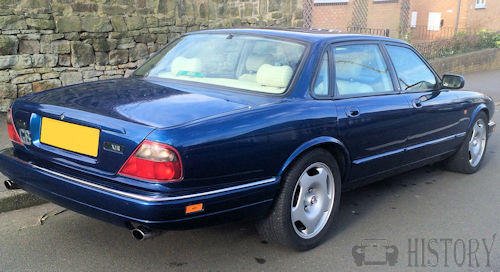
Aesthetically, the X300 received several updates in the design refresh led by Geoff Lawson in 1991(penned). The mostly flat bonnet of the XJ40 was replaced with a fluted, curvaceous design that accentuated the four separate round headlamps. Rear wings were reshaped to accommodate the new wrap-around rear light clusters. Also, the separate black-rubber bumper bar of the XJ40 is gone and replaced with a fully integrated body-coloured bumper.
The Jaguar "leaper" hood mascot was installed only on cars for non-European markets.
Interior
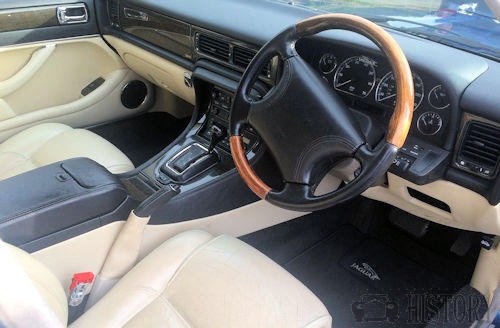
The interior of the X300 was similar to that found in the XJ40, with some revisions. The seats were updated to have a more rounded profile, wood trim was updated with beveled edges, and the steering wheel was redesigned.
Early X300 cars were built without a front passenger glove-box, due to space constraints caused by the introduction of a front-passenger airbag.
Mechanicals
Jaguar's V12 engine and AJ6 inline-six engine were both available in various X300 models, although they received significant updates. Both engines were fitted with distributorless electronic engine management systems.
The V12's new management system was designed by Nippon Denso. The top aluminium cover in the engine's valley was redesigned to house two packs of three coils each, with each coil having two high-tension terminals for a total of twelve. These coilpacks were driven by two Denso ignition modules, which are very similar to Ford EDIS-6 units. The crankshaft in the V12 was switched from a forging to a chill casting. A visibly significant chromed pipe connecting the left and the right banks of the V12 in the XJ40 platform (intended to vent and route the crankcase blow-by gas to the intake plenum) was changed with the introduction of the X300 to an almost invisible design at the top center of the engine underneath a plastic cover that also hides fuel rails and coilpacks.
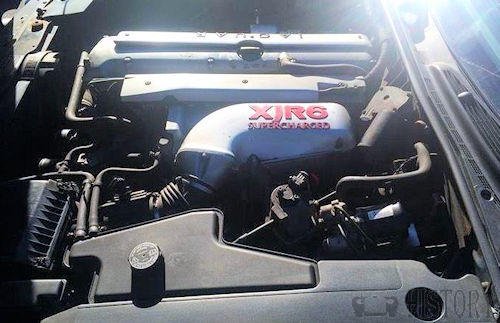
The AJ6 changed to use magnesium-alloy valve covers and revised pistons, and was given the new designation "AJ16". It was found in 4.0 L supercharged form in the XJR.
The normally aspirated six-cylinder X300 cars used either a ZF four-speed automatic gearbox (4HP-22 on the 3.2 L and 4HP-24 on the 4.0 L), or a Getrag 290 five-speed manual. The 4HP-22 automatic is mechanically controlled while the 4HP-24 is electronically controlled, allowing 4.0-litre models to offer 'normal' and 'sport' modes on a switch by the gear lever. This switch is replaced with a blanking plate on the 3.2 L. The supercharged six-cylinder in the XJR was normally built with the optional GM 4L80-E four-speed automatic and very few XJRs were ordered with the standard specification Getrag 290. All V12-equipped cars were built with the GM 4L80-E automatic. In certain markets, such as North America, no manual gearbox was offered.
Models
The X300 was latterly available in both short- and long-wheelbase body styles and in various trim levels. Some markets had a limited selection of X300 models or features. For example, the North American XJ6 was only available with the 4.0 L engine, and all cars sold there were equipped with alloy wheels, a leather interior, and air conditioning. North America did not receive the Sovereign, Sport, Executive, or Century models, nor was a manual transmission offered.
Power folding mirrors were standard in Japan and optional in all other markets except the USA.
XJ6
The base model in the range was the XJ6, which featured the 3.2 L version of the AJ16. On these base cars, aluminum alloy wheels, leather upholstery, and air conditioning were all extra-cost options. Later, the 4.0 L version of the AJ16 was offered in the XJ6.
Sovereign
The Sovereign model also used the AJ16 engine (in either 3.2 L or 4.0 L form), and came equipped with luxury features as standard such as ten-way electric leather seats with three-way memory on the driver's side, cruise control, automatic climate control and a tool kit located under the bonnet. The exterior of the Sovereign was adorned with chromed trim in various locations: on the radiator grille, rear light cluster surrounds, windscreen and rear window surrounds, rain gutters, window frames, and boot-lid plinth.
Sport
To attract younger buyers, Jaguar offered a "Sport" model with wider 8-inch wheels, revised seats, and stiffer suspension. The Sport kept the matte-black window surrounds from the base model, and is identified by "Sport" badges on the B-pillars and "XJ Sport" badging on the rear. The sports suspension (along with the wider wheels) were also available as an option on both SWB and LWB XJ6 and Sovereign models.
Executive
Aimed at a younger market segment, the Executive model was introduced for the 1997 model year and featured leather trim, a wood/leather steering wheel, wide wheels (similar to the "Sport" model), and air conditioning. It was treated as a run-out specification for the XJ6 and so separate production numbers are not available.
Long Wheel Base (X330)
Part way through the 1995 model year, a long wheel base version of the body shell was introduced, adding an extra 6 inches (150 mm) for rear seat occupants and an extra inch of headroom. This body style was available for all of the "classic" models (XJ, Sovereign, XJ12) but not the "sport" models (XJ Sport, XJR). There were two X330 variants, one with five seats and one with four, which featured a raised centre console between the two adjustable rear seats. Internally, Jaguar referred to the long wheel base version as the X330 Majestic, although unlike the XJ40 they were never badged as such. The X330 bodies were built on the standard production line, whereas the XJ40 Majestic started as a SWB body which was then taken away and stretched by Project Aerospace in Coventry, before being returned and fitted out by Jaguar Special Vehicle Operations. This meant the X330 carried a much smaller price premium over the standard models, as compared to its predecessor.
This mid-1995 model change also includes a revision in the rear suspension that allowed adjustment of toe-in.
XJR (X306)
The XJR was introduced as a high-performance sport model, and it was Jaguar's first-ever supercharged road car (and only the second Jaguar road car to use forced induction, after the turbocharged Jaguar XJ220.) The output of the six-cylinder AJ16 engine was increased to 326 bhp (243 kW; 331 PS) and 378 lb·ft (512 N·m) with the use of an Eaton M90 supercharger and an air-water intercooler. The 0 to 60 mph (0 to 97 km/h) time was generally around the 5.7 to 6.4 second mark. The XJR was fitted with wider wheels than the Sport model, and firmer suspension. Although the manual gearbox was standard, almost all XJRs were built with the optional automatic gearbox.
Cosmetically, the XJR differed from the standard cars with a body-coloured grille surround, mesh grille insert, body-coloured boot-lid plinth, larger exhaust outlets, special five-spoke "Sport" alloy wheels, and "XJR" badging. Rain gutters and window surrounds were matte black, except on North American models where they were polished stainless steel.
This generation of the XJR model carries the code name "X306". It is also sometimes referred to as the "XJR6" to differentiate it from the later V8-engined X308 XJR.
XJ12 (X305)
The XJ12 model (which carries the code name "X305") featured the same trim level of the Sovereign, but was powered by the 6.0 L version of the Jaguar V12 engine. It is visually differentiated by the rear boot-lid "XJ12" badge, a "V12" badge on the passenger-side dashboard wood trim, a "V12" badge on each B-pillar, and a gold-colored Jaguar crest at the top of the radiator grille surround.
In the US market, this generation of the XJ12 was available only as model years 1995 (which were all short-wheelbase) and 1996 (which were all long.)
The X305 was equipped with an on-board diagnostics system; however, the system failed to fully meet the OBD-II specifications, which became mandatory for the 1996 model year in the U.S.With a special dispensation for that model year expired, no 1997 model year X305 models were sold in North America.
While the similar Daimler Double Six came with 225/60-16 tyres on 7-inch wheels and comfort suspension as standard, the XJ12 came with 225/55-16 tyres on 8-inch wide wheels and sports suspension, which explains the height difference between the two models.
The last Jaguar to be powered by a V12 engine was a black XJ12 which left the production line on April 17, 1997. It used to reside in the Jaguar Daimler Heritage Trust museum in Coventry,before its closure and move to the Heritage Motor Centre in Warwickshire.
Daimler / Vanden Plas
The "Daimler" name was applied to the highest trim level of the X300 cars, and featured all the chrome brightwork found on the Sovereign cars, plus chromed doors mirrors, chromed door handles, and a fluted radiator grille surround. The Daimler Six model was equipped with the AJ16 engine, and the Daimler Double Six with the V12.
In some markets (such as North America), the "Vanden Plas" model name was used instead of "Daimler". Vanden Plas X300 cars in the United States are all built on the long-wheelbase body shell, although they were only available with the six-cylinder engine (leaving the V12 available solely in the XJ12 model for that market.)
Century
In 1996, the Century model was introduced to commemorate the centennial of the Daimler name. The Century was equipped with all features and upgrades available on the X300 cars, plus chromed wheels, special exterior paint, and electrically adjustable rear seats.
Daimler Corsica concept
A single two-door XJ convertible was built in 1996 to commemorate Daimler's centenary. The concept car, called the Daimler Corsica, was based on the Daimler Double-Six saloon and can seat four. The prototype, which lacked an engine, had all the luxury features of an XJ saloon, but a shorter wheelbase. It is painted in a colour called "Seafrost", which was later discontinued. The Daimler Corsica was named after the 1931 Daimler Double-Six Corsica. The concept was a one-off, and may have been intended for limited production beginning in 1997. The car has made a limited number of appearances at car shows and events since 1996. It has most recently appeared at the Belfast Sports Car Show in January 2004. The Daimler Corsica prototype is owned by the Jaguar Daimler Heritage Trust, who have commissioned it to operate as a fully functional road-legal car. It has been on display at their museum at Browns Lane in Coventry. The car has also been displayed at Harewood House as part of the Jaguar Enthusiasts' Club show.
Daimler DR450 Limousine
 |
|
| Manufacturer | The Daimler Company Limited |
|---|---|
| Production | 1961 to 1968 |
| Produced | 864 produced |
| Assembly | Coventry England |
| Class | luxury car |
| Body style | 4-door 8-passenger limousine |
| Layout | Front-engine, Rear-wheel-drive |
| Engine | 4.561 litres (278 cu in) V8 |
| Transmission | Borg Warner DG12 automatic |
| Wheelbase | 3,505 mm (138.0 in) |
| Length | 5,740 mm (226.0 in) |
| Width | 1,868 mm (73.5 in) |
| Height | 1,615 mm (63.6 in) |
| Kerb weight | 2,122 kg (4,678 lb) |
The Daimler DR450 is a limousine variant of the Majestic Major DQ450 saloon. Produced from 1961 to 1968, it was the last complete car designed by The Daimler Company Limited.
Intended for the carriage trade, as an executive express or as a hire car for those needing something larger than a five-seater saloon, the DR450 was produced in numbers close to those of the Majestic Major saloon on which it was based.
Design and specifications
The chassis was 24.0 in (609.6 mm) longer than for the Majestic Major and the necessarily flat glass of the three side-windows no longer could be let flow with the body-shape. The equally flat-windowed but bulbous Jaguar Mark X was released to the market the same year. The 4,561 cc (278 cubic inch) hemi-head engine pushed the 2¼ tonnes of car and driver to 100 km/h in under 11 seconds, to 100 mph in 37 seconds and provided a top speed of 183 km/h (114 miles per hour), rather better than the much shorter lighter 5-passenger Jaguar Mark X.The distribution of weight: 51% front axle, 49% rear axle.
chassis: massive box-section and cross-braced frame, separate from the all-steel body suspensionfront: Girling type with semi-trailing wishbones and forward facing arms, coil springs, Girling telescopic dampersrear: live axle, half-elliptic leaf springs, Girling telescopic dampers
Brakes:Dunlop disc brakes vacuum-servo assisted front: 12.5 in (317.5 mm)rear: 12 in (304.8 mm)wheels: 16 in (406.4 mm) pressed steel, 5 studs, rims—5.5 in (139.7 mm) tyres: Dunlop RS5, 700-16 with tubes steering: Hydrosteer power assisted ,steering wheel diameter 18 in (457.2 mm)Steering column: adjustable for reach,headlamps two 50/40 watts and fog lamps
seating, 8-seater Limousine three on the front bench seat, three on the back seat and two on the folding occasional seatsfolding occasional seats have received particular care in shaping for comfort and support. They fold away into their own footwells below the division when not required

Performance
- Engine Capacity 278.31 cu in, 4,561 cu cm
- Fuel Consumption 17.1 m/imp gal, 14.2 m/US gal, 16.5 1 x 100 km
- Max Speed 113 mph, 181.9 km/h
- max power (SAE): 223 hp at 5,500 rpm
- max torque (SAE): 283 1b ft, 39.1 kg m at 3,200 rpm
- max number of engine rpm: 6,000
- specific power: 48.9 hp/l
- power-weight ratio: 20.9 lb/hp, 9.5 kg/hp
- acceleration: standing 1/4 mile 18 sec, 0—50 mph (0—80 km/h) 8.2 sec
A 1966 Daimler DR450 Limousine in The Italian Job Movie from 1969

Daimler Dart SP250
 |
|
| Manufacturer | The Daimler Company Limited |
|---|---|
| Also called | Daimler Dart |
| Production | 1959–1964 |
| Class | Sports car |
| Body style | 2-seat open car |
| Layout | FR layout |
| Engine | 2.5 litre iron-block V-8 140 HP |
| Transmission | 4-speed manual 3-speed automatic |
| Wheelbase | 92 in (2,337 mm) |
| Length | 165 in (4,191 mm) |
| Width | 60 in (1,524 mm) |
| Height | 50.25 in (1,276 mm) |
| Kerb weight | 2,070 lb (940 kg) |
The Daimler SP250 is a sports car which was built by British manufacturer Daimler in Coventry from 1959 to 1964.
The SP250 was originally known as the Daimler Dart, however Daimler were soon forced to drop the Dart name when threatened with legal action by Chrysler’s Dodge division, and the car was then renamed the Daimler SP250.
It was launched at the 1959 New York Motor Show, and its greatest success was in the North American market. It had a fibreglass body, four-wheel Girling disc brakes, and a 2.5-litre Hemi-head V8 engine designed by Edward Turner. The car was described as a 2+2, but the bench-like rear seat offered very limited leg room unless the front seats were pushed fully forward. Thirty black Daimler Darts with the Borg-Warner Model 8 3-speed automatic were used by the British Metropolitan Police.
Versions
- A-spec:The original A-spec version could do 120 mph (193 km/h), but the chassis, a “14-gauge ladder frame with cruciform bracing” based on the Triumph TR3, flexed so much that doors came open, marring its reputation. Bumpers were originally an optional extra.
- B-spec :Jaguar bought Daimler in 1960, and were immediately concerned about the chassis flex. They brought out the B-spec version with extra outriggers on the chassis and a strengthening hoop between the A posts. There were also other detail improvements, including an adjustable steering column.
- C-spec: The C-spec version, introduced in 1963, had some additional luxuries as standard equipment.
2,645 were produced in total (all specs).
Jaguar built a prototype replacement (known as the SP252) with a neater body style but decided not to proceed with production. Ogle Design produced a coupé version called the SX250, but this was not taken up by Daimler and the body design was later used for the Reliant Scimitar.

Specification
- Engine: V 8 iron block, water cooled, OHV, bore 76mm x stroke 70mm, capacity 2547 cc. Single central camshaft operated valves through short pushrods with double heavy-duty valve springs. Aluminium alloy hemispherical cylinder heads. Stiff 5 main bearing crankshaft, dynamically balanced. Compression ratio 8.2:1. Twin SU carburettors. bhp 140 @ 5800 rpm. Max Torque 155 lb·ft (210 N·m) at 3600 rpm. SU electric fuel pump.
- Ignition: Coil and distributor with conventional automatic advance & retard.
- Lubrication: Submerged gear oil pump with full flow filter. Sump capacity 1.75 US gallons.
- Cooling: Pressurised radiator with fan, pump and thermostat control.
- Transmission: 4 speeds with synchromesh on top three ratios. Provision for overdrive. Automatic optional.
- Rear Axle: Hypoid bevel 3.58:1
- Steering: Cam & follower.
- Suspension: Front independent with coil springs. Rear live axle with half elliptic leaf springs. Oversize dampers.
- Brakes: Girling Discs on all four wheels,hydraulic operation.

Performance
PERFORMANCE: max speed in 1st gear: 42.0 mph, 67.6 km/h; max speed in
2nd gear: 71.0 mph, 114.3 km/h; max speed in 3rd gear.: 100.0 mph, 161 km/h; max speed in 4th gear: 124.2 mph, 200 km/h; power-weight ratio: 15.0 lb/hP, 6.8 kg/hp; acceleration: standing 1/4 mile 17 sec, 0—80 km)0—50 mph, 6.8 sec; speed in direct drive at 1000 rpm: 20.6 mph, 33.2 km/h.
Media Appearances
- Modesty Blaise had an ivory-coloured Dart in the early book versions of her adventures, and it also appeared occasionally in the comic strip.
- A Dart features briefly in the film The Fast Lady.
- A green Dart was used in the ITV Series Heartbeat in 2005.
A green Dart used in the ITV Series Heartbeat in 2005.

Daimler Eighteen DB18 Consort
 |
|
| Manufacturer | The Daimler Company Limited |
|---|---|
| Also called | Daimler Eighteen (1939–1950) Daimler 2½-litre (1939–1950) Daimler Consort (1949–1953) |
| Production | 1939–1953 |
| Predecessor | Daimler New Fifteen |
| Successor | Daimler Conquest whole new smaller vehicle Daimler Regency same chassis, bigger engine |
| Body style | four-door saloon numerous coachbuilt versions, standard catalogued models by Daimler subsidiaries Hooper (formal) and Barker (drophead coupés), others as arranged with coachbuilder by customer |
| Layout | FR layout |
| Engine | 2,522 cc 6-cylinder in-line ohv |
| Transmission | 4-speed preselective self-changing gearbox and Fluid Flywheel an open propellor shaft and underhung worm-driven axle, hypoid bevel from June 1950 Overdrive on Special Sports |
| Wheelbase | 114 in (2,900 mm) |
| Length | 180 in (4,600 mm) (2½-litre) 180 in (4,600 mm) (Consort) |
| Width | 65 in (1,700 mm) |
| Height | 63 in (1,600 mm) |
The Daimler Eighteen or Daimler DB18, a 2½-litre version of the preceding 2.2-litre New Fifteen introduced in 1937.
Using the engine developed for the Daimler Scout Car,it was offered to customers from 1939 as a six-cylinder chassis on which Daimler and various British coach builders offered a range of bodies including drop-head coupes.
Development
The model was introduced immediately before the start of the World War II, during which the company was compelled to concentrated on the manufacture of military vehicles. Therefore most DB18s were produced after 1945.
To contemporaries the model was generally known as the Daimler 2½-litre until Daimler adopted the North American habit of giving their cars names (although not on any badgework), and a slightly updated version of the car was introduced in October 1948 at the London Motor Show, "principally for export" and branded as the Daimler Consort. The updates included the integration of the firewall into the body rather than it being part of the chassis, a move from rod operated mechanical brakes to a Girling-Bendix hydraulic front and rod operated rear system, incorporating the head lights into the front guards, and providing a badge plate behind the front bumper with a more curved radiator grille.

Specification
The car used a 2,522 cc in-line six-cylinder, pushrod ohv engine fed by a single SU carburetter. Throughout its life, 70 brake horsepower (52 kW) was claimed, though a change in the gearing in 1950 was marked by an increase in maximum speed from 76 miles per hour (122 km/h) to 82 miles per hour (132 km/h) for the saloon, while the acceleration time from 0 – 50 miles per hour (80 km/h) improved from 17.9 to 16.9 seconds. By the standards of the time the car was brisker than it looked.
The car was supplied with the Daimler Fluid Flywheel coupled to a 4-speed Wilson Pre-selector gearbox. The independent front suspension used coil springs, while the back axle was suspended using a traditional semi-elliptical set-up. The chassis was "underslung" at the rear with the main chassis members passing below the rear axle. In mid-1950 the restricted ground clearance was improved by the adoption of a conventional hypoid bevel drive to the rear axle replacing the traditional Daimler underslung worm drive which had hampered sales outside Britain.

Coachwork
Although offered originally as a chassis only model, post-war the most common version was a four-door saloon which Daimler themselves produced. The interior was fitted out with traditional “good taste” using mat leather and polished wood fillets. By the early 1950s, this coachwork was beginning to look unfashionably upright and “severe yet dignified”.
In 1939, Winston Churchill commissioned Carlton Carriage Co to build a drophead coupe on a DB18 chassis, chassis No.49531. Never used until post-World War II, he used it to campaign both the 1944 and 1948 general elections.
Production
Sales levels were respectable: 3,355 Daimler 2½-litres were produced and 4,250 Consorts The Consort became a popular car among the wealthy in India. All together over 100 cars were ordered mainly by the Maharaja's in India and a further dozen were ordered by Royalty in Ceylon and Burma.


