
DeSoto
DeSoto Firesweep
 |
|
|
Manufacturer |
DeSoto (Chrysler) |
|
Production |
1957 to 1959 |
|
Assembly |
United States |
|
Class |
Motor Car |
|
Body style |
4-door sedan,hardtop |
|
Layout |
FR layout |
|
Engine |
325 cu in (5.3 L) V8 |
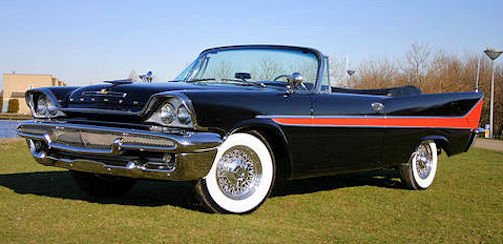
The DeSoto Firesweep was a car manufactured by Chrysler and continued to use the Dodge chassis,T he car, which was offered under the car brand DeSoto from 1957 to 1959.
The Firesweep was similar to the other DeSoto models from 1957. Its main distinguishing feature was the substantial similarity with competing, small Dodge models that had the same substructure as the Firesweep. The Firesweep had DeSoto lettering on the tail fins, but the stem (in front of the bulkhead) was based on the Dodge Coronet.
Styling was characterized by a minor face lift in 1957 with a honeycomb grill with a dip to center of the middle bar and round parking lights at the outboard ends of the
lower grille opening. Bodyside trim was redesigned to the upper corner of the tailfin. There were also Firesweep nameplates on rear fender Sportsman models had the dome-like windshield while sedans continued with a visored windshield.
The easiest way to recognize the kinship with the headlights, the heavily chrome-plated "eyebrows" were typical of Dodge. The grille of the Firesweep was similar to other contemporary DeSoto models.
The vehicle could accommodate 6 people. It was available as a 4-door sedan, 5-door station wagon, 2-door coupe and 2-door convertible. Depending on the type of body the Firesweep weighed between 1660 kg and 1674 kg. Chrysler's 360-liter V8 engine (5791 cc) with overhead valves fueled the firesweep and produced 295 bhp (217 kW) at 4600 rpm. The basic equipment included a manual three-speed transmission, but there was also a Torqueflite automatic. Most 1959 Firesweep were equipped with automatic gearbox.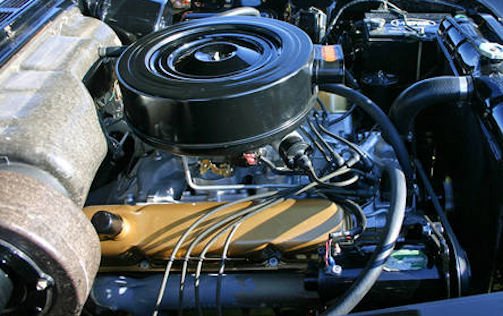
The base price of the Firesweep in 1957 was $ 3169 and two-color paint was standard. The equipment also included power steering , brake booster , a clock on the dashboard, a radio with push buttons and whitewall tires .
In the first year of production in 1957, most Firesweep were sold. Declining production quality at DeSoto and higher market pressure led to the discontinuation of the Firesweep in late 1959. The 1959 Firesweep bore the inscription "DeSoto".
DeSoto Powermaster
 |
|
|
Production period: |
1953 to 1954 |
|
Class : |
Motor car |
|
Body versions : |
Saloon , station wagon , coupe |
|
Engines: |
Gasoline : 4.05-4.3 liters(85-87.5 kW) |
|
Wheelbase : |
3188-3543 mm |
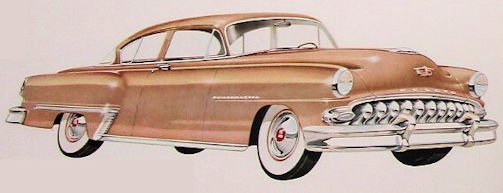
The DeSoto Powermaster was a car that Chrysler offered under the car brand DeSoto in the model years 1953 and 1954. The car was introduced to DeSoto's 25th birthday and replaced both the entry-level Deluxe and the better-equipped Custom .The Custom and Deluxe series were now combined in 1953 to form the PowerMaster Six series, which comprised a sedan, club coupe, hard- top, wagon and long sedan. Both the PowerMaster Six and the Fire-Dome V8 series included the very
pooular Sportsman hardtops.
The Powermaster was a big car, which existed as a 2- and 4-door sedan and a 5-door station wagon. The vehicles were powered by Chrysler's inline six-cylinder 4038 cc engine. In both production years, an 8-seater sedan with folding seats was also offered.4-wheel hydraulic internal. expanding type, twin cylinder type in front; big 12.inch diameter drums Toe Shift transmission. operated independently of external contracting type drum brake mounted behind manual shift operated independently of service brakes. Positive action hand brake lever mounted alongside.
The Powermaster was also on a longer chassis with 3543 mm wheelbase, with improved designed to resist twisting; widened and flattened With deeper kickup in front of rear axles more shorter rigid body brackets. In contrast to the normal 6-seater sedan with 3188 mm wheelbase. A long-wheelbase version was also used as the basis for the DeSoto taxi , which can be seen in many Hollywood movies from the late 1930s to the mid-1950s.
ELECTRIC WINDOW equipment, individual controls, independent motor for each door. control beside driver seat. Window. worm and sector driven.
The cars also had a curved windshield that replaced the two-piece disc of earlier models. Interior heating, electric clock, brake booster , power steering and whitewall tires were available on request for an extra charge.
SOLEX SAFETY glass—Special equipment. tinted for Window reduces effect of outside keeps interior cooler.
Because of the Korean War , the Powermasters, which originated at the beginning of the model year 1953, had minimal chrome trim; as the restrictions on material procurement were lifted, there was also better equipment.
The Canadian Chrysler plants built the Powermaster as a 4-door sedan and 2-door hardtop coupe, which was not offered in the US. In Canada also came Chrysler's straight-six with 4263 cc and standing valves used, which first appeared in 1952 in the Chrysler Windsor .
The Powermaster was discontinued at the end of the model year 1954, when DeSoto converted all models to V8 engines.
Production:
1953
Powermaster club coupe 8063
Sportsman htp coupe 1470
4d sedan 33,644
4d wagon 500, 4d sedan 8P 225
1954
Powermaster club coupe 3499
Sportsman htp coupe 250
4d sedan 14,967
4d wagon 225
4d sedan 8P 263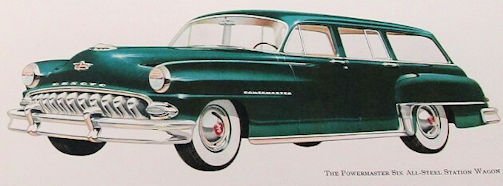
DeSoto Custom
 |
|
|
Production period: |
1942 to 1952 |
|
Class: |
Luxury Car |
|
Body versions: |
Saloon, station wagon, coupé, convertible |
|
Engines: |
Gasoline :3.8 Liters (80 kW) |
|
Wheelbase: |
122.5 -139.5-inch |
|
successor |
DeSoto Power master |
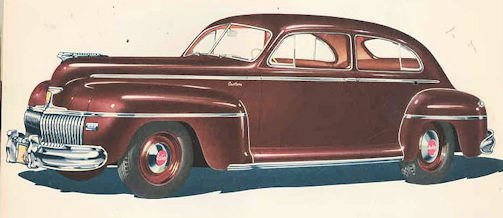
The DeSoto Custom was a car that Chrysler manufactured under the car brand DeSoto in the model years 1940 and post war from 1946 to 1952. At that time, the Custom was the best-equipped line in a range of body styles, including a long-wheelbase Suburban sedan chassis.
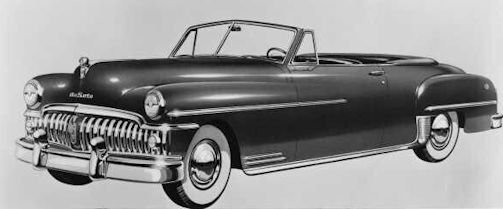
DeSotos came in two lines, DeLuxe and Custom. The latter were higher-priced models ranging from $885 to $1209. There were two wheelbases: 122.5 inches standard; and 139.5 for large sedans and the limousine. Both lines offered coupes; sedans with two and four doors; and seven-passenger, long-wheelbase sedans. A Custom convertible and a
limousine were also available. The Custom, as well as the simpler equipped Deluxe, powered by a Chrysler six-cylinder with 3808 cc displacement and side valves, the 109 bhp (80 kW) at 3600rpm.
For 1940, De Soto had an entirely new car from the previous year. The engine increased its horsepower to 100 at 3600 RPM. The fuel tank was a 1 7-gallon supply for all models. The tire size was 6:00 x 16 inches for all models but the 7-passenger Sedans required 6:50 x 16-inch tires.The wheelbase was 122.5 inches for all models except the
limousines which used the 139.5-inch wheelbase. The model designations for 1940 were DeLuxe, and Custom for the cars with more trim. All models used sealed beam headlamps for the first tilne. Red warning signals were used to tell the driver if the fuel supply, water temperature, oil pressure or electrical system required attention. The Safety Signal device on the speedometer which changed color from green to red was continued.
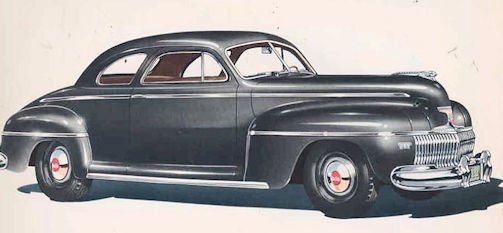
A total of 12 models were available for 1940. The Convertible, absent in 1939, was reintroduced in the Custom line. It was equipped with a power operated top with a push-pull control on the dashboard. The Custom Limousine for seven passengers sold for $1 , 290. The company sold 83,805 cars for the calendar year.
For 1942 the production totals as 4d sedan 7974, club coupe 2236 ,town sedan 1084,2d sedan 913 ,convertible coupe 489,business coupe 120, 7-pass. sedan 79, 7-pass. limousine 20 .
The model 1946, 1947, 1948 and 1949 custom models (1st half) had the pre-war bodies of DeSoto. In the second half of the model year 1949, a completely redesigned car appeared.
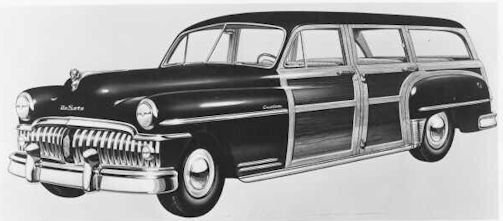
In 1950 they brought out the first station wagon. Also got the series DeSoto's first hardtop coupe, which looked almost like a convertible without the B-pillars.
The Custom lost its status as DeSoto's flagship model with the introduction of the Firedome with V8 engine in 1952. In 1953, DeSoto had the Custom and Deluxe depart; the Powermaster was then DeSoto's six-cylinder series.
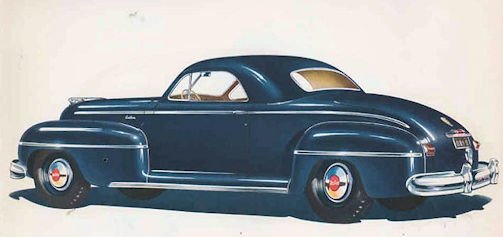
DeSoto Airflow
 |
|
|
Manufacturer |
DeSoto (Chrysler) |
|
Model years |
1934 to 1936 |
|
Assembly |
U.S.A |
|
Class |
Motor Car |
|
Body style |
2-door coupe |
|
Layout |
FR layout |
|
Engine |
241.5 cu in (4.0 L) Chrysler I6 |
|
Transmission |
3-speed manual |
|
Wheelbase |
115.5 in (2,934 mm) |
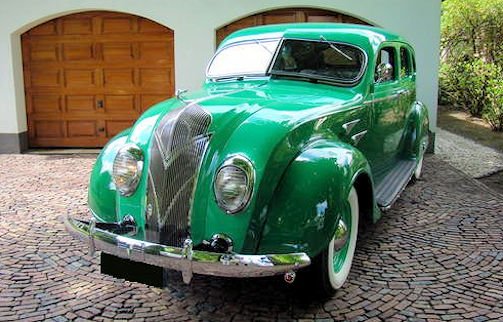
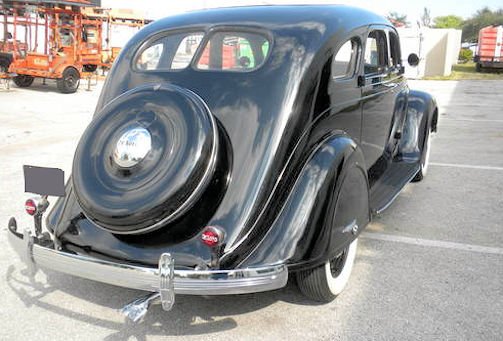
The DeSoto Airflow automobile was built by Chrysler under the car brand DeSoto in the model years 1934-1936 car. DeSoto received the then-revolutionary Airflow model for its price ratio to the larger and more expensive Chrysler cars.
History
The streamlined and newly formed car was presented along with the slightly larger Chrysler Airflow. The Airflow design was an early attempt to level the objects and lines on the then cars, which faced the wind. The headlights moved from their place (next to the radiator grille) forward and were in the continuous front plate on both sides of the waterfall same radiator grille housed, who had no traditional filler neck with radiator figure more. Instead of the one-piece, almost vertical windshield of the then cars (the force of the incoming wind when the car moved through the air) had the Airflow a split windshield, both halves side were employed to better dissipate the wind to the outside, The front and rear fenders got softer, the body shape more adapted forms. The rear wheels were covered. All Airflows had the hand brake handle mounted under the instrument panel and the gear shift lever was placed far forward on the floor board so not to be in the way of front seat passengers. This allowed for three to sit in front in comfort.
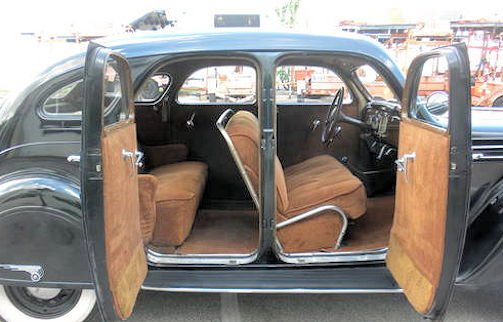
In addition to the benefits of the softer outer shapes, which resulted in less wind noise inside the cars than previous DeSoto models, the cars were wider inside and the seats moved forward. The passengers sat between the axles and because of the monocoque construction within the frame and not on the frame as with cars of other American manufacturers. The vehicle was stiffer and the weight distribution was better, since the engine with its centre of gravity above the front axle and not, as was customary at the time, was mounted behind it. In the trade press, the car was praised for its good handling and its high acceleration.
Although DeSoto (and Chrysler) portrayed their Airflow bodies as futuristic in the age of the streamline, customers found the cars too unfamiliar at a time of great economic uncertainty. Chrysler's Airflow looked better on the long chassis than the dumpy DeSoto with the short wheelbase of just 2,921 mm. Walter P. Chrysler, a big proponent of the Airflow project, was disappointed at the lack of interest in the car, which he considered ground breaking for future US automobile production. The Airflows came in three models all selling at $1,195. Tire size on the Airflows used 6:50 x 16s. came with hydraulic brakes. and Airflows held 16-gallon fuel supply .
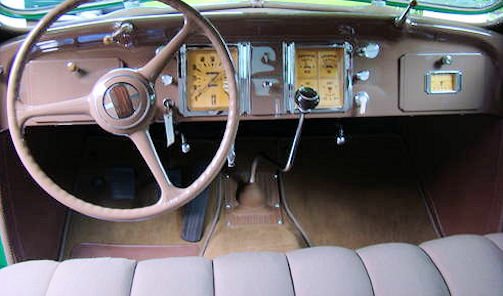
All Airflows came with a X-frame chassis, with the body being bolted straight to the frame. The 1935 models changed the anti-roll stabilizer to the front. All had a hypoid rear axle and optional overdrive transmission which automatically cut the engine speed by 30% when above 40 MPH. There were also rumours that the bodies are uncertain. Tests showed that the all-steel monocoque construction was safer than other cars of the time (many manufacturers still had wooden support frames with sheets pulled over them). In a widespread commercial that was screened in cinemas, you saw an empty airflow falling from a cliff in Pennsylvania and being rebuilt and driven away after a fall of more than 30 meters, crumpled but still recognizable as airflow. Nevertheless, rumours persisted that airflows were uncertain.
While Chrysler also built a standard-looking car in 1934, DeSoto offered only the airflow. Although DeSoto sold more Airflow models than Chrysler, Chrysler sold a total of more cars, with the majority being reworked models of the "standard" 1933 Chrysler.
1934
coupe 5 Person produced 1 ,584
brougham 6 Person produced 522
sedan 4d produced 11,713
Town sedan 6 Person produced 119
chassis only produced 2
In 1935 and 1936, DeSoto also offered the more traditional Airstream, a model they shared with Chrysler, and DeSoto regained part of its lost market share. The Airflow was still on offer, but most of the cars sold were Airstream, so the Airflow was passed to the end of the DeSoto catalogue.
The buyers who opted for an airflow found that their car had a conspicuous tapered grille. Otherwise, there were only cosmetic changes (air intakes etc.).
While Chrysler had the Airflow body up to 1937, DeSoto hired the model in late 1936 to focus on more traditional models that would sell better.
DeSoto Fireflite
 |
|
|
Manufacturer |
DeSoto (Chrysler) |
|
Model years |
1955 to 1960 |
|
Class |
Motor Car |
|
Assembly |
USA |
|
Body style |
2-door coupe |
|
Layout |
FR layout |
|
Engine |
325 cu in (5.3 L) V8 |
|
Wheelbase |
126 in (3,200 mm) |
|
Length |
217.9 in (5,535 mm) (1955) |
|
Width |
77 in (1,956 mm) (1955) |
The DeSoto Fireflite was offered in several model generations vehicle belonging to the Chrysler Group automotive brand DeSoto . In 1955 and 1956, the Fireflite was the top model of the brand, before he gave this rank from 1957 to the Adventurer .
History
The first, introduced in 1955 Fireflite generation was positioned above the Firedome . Both vehicles, like the Chrysler models Windsor and New Yorker had a 3200 mm long wheelbase. Thus, they were located in the hierarchy of the Chrysler Group below the (newly founded) brand Imperial (3,302 mm), but ranked above the vehicles of Dodge (3,040 mm) and Plymouth (2,924 mm).
The new top-of-the-line series was the more decorated Fireflite, distinguished by the large chrome moldings from the headlamp rims along the tops of its fenders.
There were only three Fireflite models: Sportsman hardtop, four-door sedan, and convertible. Fireflites Color schemes were bright Paper Mate pen combinations could be bought in monotone with bright metal side molding also in two-tone color-sweep, which carried the contrasting roof color along the body sides and down around the rear wheel wells.DeSoto introduced a "Spring special" Fireflite four door, the "Coronado". This model first pioneered the three-tone paint job. Coronados all had a black roof, turquoise body, and white sweepspear, with a matching interior.
The Fireflite was available as a convertible, two-door coupe and a four-door sedan. All versions used the same wheelbase. The body design of Fireflite was a modification of the of Virgil Exner designed Hundred one million US dollars look and oriented in the profile largely to the size identical Chrysler models. However, this wore Fireflite a striking side decoration with contrasting color inserts and wide chrome bezels. The in the trim level Coronado, the Fireflite even had a three-color paint (turquoise, black, white). Overall, the Fireflite of the year 1955 is described as the "most glittering" model of the Chrysler Group.
Fireflite horsepower was up 30 from 1954, with larger displacement, valves, cam modifications, and a four-barrel carburetor. The Fireflite was made in 1955 by a 4.9-liter eight-cylinder V8 engine with an output of 200 bhp. As a power transmission served PowerFlite - automatic . Nineteen fifty-five was also the year when Powerflite's gear selector moved to the dashboard. The automatic had a "flite control" lever on the dashboard Chrysler made it of SAE 1010 steel, which bends easily. It was also angled slightly, so it would bend properly. Nobody was much convinced by these measures, but Chrysler had something much more intriguing in the works for 1956 the pushbutton. Depending on the body shape, the car weighed between 1,850 kg and 2,100 kg.
1956
Two new Fireflites this year were a four-door hardtop Sportsman, sold in small quantities, and the Pacesetter replica of the 1956 Indy 500 pace car, of which
only 100 were built.
For the model year 1956, the body of the previous year's model was basically maintained, however, found at the end of the rear fenders small tail fins, the three mutually mounted round lights roofed. In addition, the radiator grille changed for 1956. The 1956 Fireflite facelift involving a mesh grille which replaced the long dentures. The first of tailfins also appeared,grafted onto the rear fenders at the rear for a trio of taillight lenses. The new rear bumper ends also contained dummy exhaust ports, with the exhaust still underneath in normal fashion. The instrument panel now sported gold-on-white lettering .
Technically, the Fireflite received in 1956 as the models of the Chrysler brand a new engine. As standard, he was now with a 255 bhp strong, 5.6-liter eight-cylinder engine. The exclusive equipment variant, the Fireflite Adventurer , had a contrast 5.8 liters large engine, which made bhp 320th With it, the Fireflite accelerated in 11 s from 0 to 100 km / h and reached a top speed of 175 km / h.
In 1956, a gold and white Fireflite cabriolet was the official pace car of the Indianapolis 500 race . De Soto produced about 100 replicas of the pace car.
1957 to 1960:

Straight flanks, tapered tail fins and two-tone paint: baseline of the Forward Look, which remained unchanged until 1959 (here a coupe from 1957)
For the model year 1957, the design of all Chrysler models changed fundamentally. Virgil Exner had developed a smooth-surfaced, large-tail-finned design called Forward Look , which used all the Chrysler brands with different detail variations. Groupwide there were again four different wheelbases. As in the previous year, the Chrysler models and the De Soto Fireflite used the second largest (3,200 mm), while Dodge (3,098 mm) and Plymouth (2,990 mm) each used shorter versions.
DeSoto's version of the Forward Look was, as in previous years, characterized by a striking two-tone paint and chrome bordered applications on the sides of the car, whose shape changed over the years. The rectilinear rising and pointed tail fins flowed into a lighting unit in which three vertically arranged round lights were combined. The exhaust system ended in two openings, which was integrated into the rear bumpers. The advertisement suggested that the shape of the tail fins give the car aerodynamic stability at high speeds; they did not affect the driving behavior of the car . The front end design changed within the production span of Forward look multiple times.
The Fireflite was available from 1957 to 1959 in four body styles: coupe, convertible, sedan and station wagon. The four-door sedan was by far the most successful body shape; the rarest version is the convertible of the model year 1959, which was produced in only 186 copies. The combination models are rare.
1957

The '57 DeSoto Body styles continued as before with Sportsman hardtop coupes and sedans, a convertible, and a four-door sedan, but for the first time Fireflite wagons were added: the six-passenger Shopper, and the three-seat, nine-passenger Explorer. three-model line of fully restyled, rakishly tailfinned on the traditional 126-inch wheelbase, with the new Firesweep had been designed to bring DeSoto prices back down under $3000, and the four-door sedan started at only $2777.
Firesweeps were lighter than other DeSotos, and also had a smaller engine a 341-cubic-inch engine developing 290 horsepower, shifting through new improved TorqueFlite automatic. Body styles continued as before with Sportsman hardtop coupes and sedans, a convertible, and a four-door sedan, but for the first time Fireflite wagons were added: the six-passenger Shopper, and the three-seat, nine-passenger Explorer.
From 1957 the Fireflite was only the second most expensive model of the brand. The Adventurer, so far an equipment variant of the Fireflite, took over the role of the top model. The Fireflite was equipped with a 5.8-liter eight-cylinder engine, which made 290 hp.
The front of the Fireflite was horizontally designed. The grille was integrated into the front bumper and extended over the entire width of the wagon. Above the bumper was the rounded bonnet. As lighting units, the designers had always provided dual headlights; however, they were not yet approved in all American states , so that alternatively, round individual headlights could be installed.
In 1957, the most successful year for Fireflite was the Forward Look era. A total of 28,430 vehicles were created, more than twice as much as in any other model year.
1958
For the model year 1958, the body of the Fireflite was only slightly revised; only the design of the radiator grille changed in detail. However, the vehicle received a new engine: The model now used a 5.9-liter eight-cylinder wedge head row, which gave 305 bhp. The Fireflite model year 1958 was not successful. Compared to the previous year models with almost identical design, the production figures of Fireflite fell by more than 50 percent. One reason for this was the decreasing production quality.
1959
For the 1959 model year, the Chrysler designers redesigned the front end of the DeSoto models. It was designed more rugged and now resembled the Imperial models of the same vintage with the protruding twin headlights and heavy chrome bumpers. Again there was a bigger engine. The eight-cylinder engine now had a displacement of 6.3 liters; however, the maximum power remained at 305 hp. The sales of the Fireflite fell again. In 1959, only 9,127 Fireflites were sold in all four body versions.
1960
For the model year 1960, the positioning of the Fireflite changed. DeSoto reduced its model range from four to two rows: the models Firesweep and Firedome , which had recently taken a market position below the Fireflite, were discontinued; Thus, the Fireflite became the base model of the brand DeSoto, while the Adventurer remained the top model.
In 1960, DeSoto presented a new design. Although the roof structure remained essentially unchanged, but the cars received a highly rugged profile with opposing vaults. The tail fins now already started in the driver's door area and followed a continuously rising line until the end of the car. The front end carried a tall, barred grille, and the front bumper dropped in the middle of the car.
The wheelbase of the Fireflite has been reduced to 3,098 mm. The Fireflite thus corresponded in terms of its dimensions to the previous Firesweep.
The engine has been changed again. The previous eight-cylinder engine with 6.3 liters of displacement was now reserved for the adventurer; the Fireflite received instead the 5.9 liter large version, which had already been offered in 1958. In 1960, the engine made 295 bhp.The Fireflite was offered in 1960 only as a coupe and a sedan. The cabriolet and wagon versions have been discontinued.In 1960, the sales of the Fireflite could be increased again. Of both body versions, 14,484 vehicles were sold.
1960 was the last year of the Fireflite. For the model year 1961 DeSoto omitted all model designations; the cars were called only DeSoto. They were largely identical to the Chrysler Windsor.

