
DAF
DAF 44 and 46
 |
|
|
Manufacturer |
DAF |
|
Production |
1966 to 1976 |
|
Class |
Motor car |
|
Layout |
2 door saloon, estate |
|
Engine |
0.85 litre |
|
Transmission |
Variomatic |
| Wheel base | 88.58 in, 2,250 mm |
| Overall length | 151.57 in, 3,850 mm |
| Overall width | 60.63 in, 1,540 mm |
| Dry weight | 1,599 1b, 725 kg |
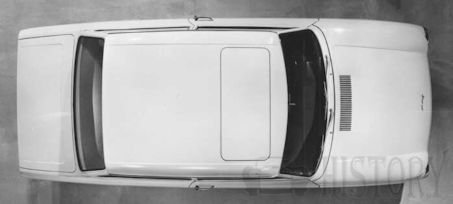
The DAF 44 was a Dutch car which the DAF in Limburg produced in the model years from 1966 to 1974.
History
The DAF 44 has the same general layout as the earlier Daffodil model. The bodywork was designed by Giovanni Michelet. The air-cooled two-cylinder boxer engine with 844 cc and 34 hp (25 kW), the drive with infinitely variable Variomatic and the suspension with shock absorber axle front and swing axle rear were designed essentially as the DAF 33.The 44 is roomier than the earlier Daffodil and the passenger in the front and rear seats is good. The front seats have adevice prevents them from tilting forward in an emergency.
The car's most characteristic feature is the Variomatic automatic transmission with infinite progressive range of ratios. It is transmitted by toothed belts which run on large-diameter pulleys. One of these pulleys, the one connected to the engine, can expand or contract, thus producing the variation in the diameter of the driving pulley is controlled automatically in accordance with the load. the position of the accelerator pedal and the speed of the car, thus obtaining the most suitable reduction in any and every kind of conditions the distribution of weight is 54% to front axle, and 46% to the rear axle. Ensures smoothness and keeps the power transmitted to each of the rear drive wheels at the right level for the adhesion of that one wheels this transmission giving the two drive wheels complete independence from the other, achieving a final drive effect that is not inferior to what is obtained with a limited slip final drive.
The maximum power only 40 hp at 4.500 rpm from its air-cooled engine. The steering of the Daf is light and precise and its normally neutral
behaviour becomes slight oversteer only when it is pushed to the limit. This combined with the final drive effect of the drive wheels of the infinitely
variable transmission allows good performance to be achieved in all conditions the braking is adequate for normal usage.
PERFORMANCE
- Engine Capacity 51.50 cu in, 844 cu cm
- Fuel Consumption 37.6 m/imp gal, 31.4 m/US gal, 7.51 x 100 km
- Max Speed 76.4 mph, 123 km/h
- max power (SAE): 40 hp at 4,500 rpm
- max torque (SAE): 51 1b ft, 7.1 kg m at 2,400 rpm
- max engine rpm: 4,500
- specific power: 47.4 hp/l
- power-weight ratio: 39.9 lb/hp, 18.1 kg/hp
- carrying capacity: 882 1b, 400 kg
For the truck manufacturer DAF, which had previously built only the smaller, weaker Daffodil series (DAF 30 to 33) for the passenger car market, the DAF 44 was a cautious step upwards. In 1974, the model with slight technical changes, such as the De-Dion rear axle of the DAF 66, renamed DAF 46 and built under Volvo for two years. The DAF 44 was also the basis of the Kalmar DAF post vehicle. 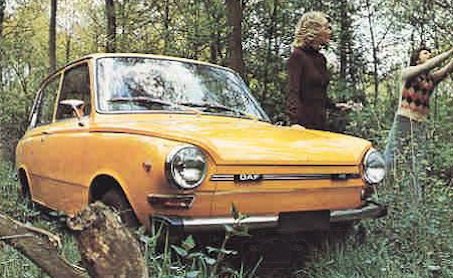
DAF Daffodil 30/750
 |
|
|
Manufacturer |
DAF |
|
Production |
1961 to 1963 |
|
Class |
Motor Car |
|
Doors |
2 doors |
|
Engine |
0.75 litre petrol |
|
Transmission |
Variomatic |
|
Wheel base: |
80.71 in, 2050 mm |
|
Length: |
142.13 in, 3610 mm |
|
Width: |
56.74 in, 1440 mm |
|
Dry weight: |
1455 1b, 660 kg |
The DAF Daffodil also as the "30" and "750" was a small car from the Dutch of the manufacturer DAF with unusual automatic transmission " Variomatic "built from 1961 to 1963.
History
The DAF 30 with the sales name Daffodil was a Dutch small car of the manufacturer DAF with standard automatic transmission " Variomatic ". The vehicle appeared in 1961 along with the slightly less luxurious DAF 750. Both were the same except for the grille and equipment. They were improved versions of the first DAF of 1959, the DAF 600, which had a smaller engine with 590 cc, which DAF continued to offer as the cheapest model. The two-door body had the then modern tail fins. Production number 23045.

The DAF 30 had an air-cooled two-cylinder boxer engine with 26 hp (19 kW) with one 28 BCI downdraft carburettor, the rear wheels driven by a centrifugal clutch, a gearbox, a drive shaft and the V-belt automatic transmission. The heavy Variomatic was installed in front of the rear axle under the back seat. Because of the reversing gear you could drive backwards with the Daffodil as fast as forward. With front suspension as independent, transverse lower leaf spring, vertical sliding pillars and co-axial telescopic dampers, to the rear was independent, swinging semi-axles, semi trailing links, coil springs and telescopic dampers. New compared to the previous DAF 600 was a modified vacuum system with an additional vacuum reservoir. In the driving experience, this had a stable transmission ratio with constant driving resistance, but accelerated accelerator off. In addition, the engine now turned up in the range of maximum power when the accelerator pedal was fully depressed. The acceleration from 0 to 80 km / h improved compared to the DAF 600 not only because of the larger engine quite considerably from 35 to 20 seconds. The Daffodil had no differential. When cornering, the slippage of the V-belts compensated for the different speeds.

Performance:
- Engine Capacity: 45.62 cu in, 746 cu cm
- Fuel Consumption: 42.1 m imp gal, 35.1
- Max Speed: 65.2 mph, 105 km h;
- max power (SAE): 30 hp at 4000 rpm
- max torque (SAE)42 1b ft, 5.8 kg. at 2800 rpm
- specific power: 40.2 hp / l
- power-weight ratio: 48.5 1b Ahp, 22 kg/ hp
- acceleration: 0 80 km h) 20 sec
In 1963, the Italian designer Giovanni Michelotti revised the 600-750-30 series and designed the DAF 31, which was now available in the equipment variants "Standard", "Luxe" and "Luxe Extra". In 1965 came the last Daffodil, the DAF 32 - again as "Standard", "Luxe" and "Luxe Extra". The Daffodil series was replaced in 1966/1967 by the small car DAF 33, in addition came DAF 44 and DAF 55 with new body, the 55 had to a modified chassis and a water-cooled engine from Renault.
DAF YA-314/324 Military Truck
 |
|
|
Manufacturer |
DAF |
|
Production |
1955 to 1965 |
|
Class |
military |
|
Layout |
truck |
|
Engine |
Cylinder |
|
Transmission |
Four-speed manual |
The DAF YA-314 / YA 324 was a military truck, that DAF produced for the Dutch army from 1955 to 1965
History
In the 1950s, the Royal Dutch Army consisted mainly of vehicles of the Allies from the Second World War. The maintenance and supply of spare parts for the off-production original British and American vehicles has become increasingly a problem. In, 1951 DAF received a first order from the government for the amount of 175 million guilders. Total orders between 1951 and 1956 totalled 393,583,005 guilders for the delivery of three different types of military trucks, in addition to the YA-314 also the DAF YA-328 and the DAF YA-126.
The truck was basic the YA-314 had no power steering and no heating. In order to warm the cab, the bonnet placed between the seats had to be opened, so that the engine heat, but also noise and oil vapor could spread. The value of a vehicle was 25,000 guilders.
The Series 1 DAF YA-314 was built from 1955 to 1960 and the second series YA-324 from 1961 to 1965. The YA-324, the chassis was slightly expanded, stronger leaf springs installed on the rear axle with modified shock absorbers front and rear. In addition, the YA-324 next to the speedometer and the level indicators next to the speedometer was illuminated and in addition to the tarpaulin structure, it was now also available with a closed metal structure.
Unlike the DAF YA-328 and the DAF YA-126, the DAF YA-314 and YA-324 barely got into private hands when it was retired from the Dutch army, which began in the 1980s. Probably due to the higher usability, the majority of the specimens landed in foreign armies. Many YAS 314 were scrapped and their front and rear axles used in the construction of containers. In the Dutch army, the DAF YA 4440/4442 was the successor model.
In total 4406 copies built. Later In the 1980s, the model series was replaced by the DAF YA 4440/4442.
Type designation
The type designations YA, YK, YF-314/324 were composed in the following manner:
- Y = military vehicle
- A = General,
- F = (fuel) tank vehicle,
- K = dump truck,
- 3 = payload in tons,
- 1 or 2 = series 1 or 2.
- 4 = number of wheels
Model Variants
- General service, tarpaulin construction for transportation of soldiers or goods
- Toolset, box body with office equipment
- Radio service or reconnaissance vehicle with box body
- Workshop trolley with box body and winch
- Field kitchen vehicle with box body
- Tanker YF-324
- dump truck YK-314 tipper. With the advent of the YA-616 dump truck, the YA-314 dump trucks became obsolete. As a result, they were converted and instead of the tipper body, they received a tarpaulin structure of the YA-324 standard model with the advantage of higher payload now 4.5 tons.
- DAF YA-414 4-tonne version of the 314 which was only developed as a prototype of DAF, but was built under license from Pegaso.
DAF YA-414 truck
 |
|
|
Manufacturer: |
DAF |
|
Type: |
military |
|
Production period: |
1968 |
|
Body: |
Truck |
|
Engines: |
DAF 475BB, 6-cylinder petrol engine |
|
Power: |
114 kW |
|
Payload: |
4 t |
The DAF YA-414 was a military truck prototype of DAF which the DAF YA-314/324 was derived for the Dutch produced army.
History
The YA-414 had in contrast to the YA-314 a payload of four tons and four-wheel drive . The YA-414 was ultimately built under license from Pegaso as Pegaso 3020-3050 .The DAF works also presented their army vehicles several times in NATO partner countries. They aroused the interest of the Spanish army, which was confirmed by working visits by Spanish officers . The interest was in the DAF YA-314, but with a payload of four tonnes. In 1968 it was decided to build a prototype, which was finally presented by DAF as YA-414 and was largely equipped with components of the YA-314.
After extensive testing, the production of the DAF YA-414 under license in Spain was decided by Pegaso . The type designations of the production models at Pegaso were:
- Pegaso 3020 Todo Terrano, corresponded to the prototype DAF YA-414 and was produced until 1970.
- Pegaso 3045 D, equipped with a Pegaso under license from Leyland Motors built 6-cylinder diesel engine with 125 hp and 6-speed manual transmission . Also models with rear dual tires were produced.
For the Spanish Navy , a special version of the 3045 D with a wading capacity of 2 meters was produced. The intake and exhaust valves of the engine were raised.
- Pegaso 3046 D, version of the Leyland diesel engine with 170 hp
- Pegaso 3050, proprietary development of Pegaso with 6 × 6 drive formula variant (2 instead of a driven rear axle) and 6-cylinder gasoline engine with 220 hp
Pegaso delivered these models in addition to the Spanish army to the armies of Burkina Faso , Chile and Nicaragua .
DAF Pony
 |
|
|
Manufacturer |
DAF |
|
Production |
1968 to 1969 |
|
Class |
commercial vehicle |
|
Layout |
flat bed pick up |
|
Transmission |
Variomatic |
The DAF Pony was a small pickup truck of the Dutch manufacturer DAF , from which 700 were built between 1968 and 1969.
The pony was the result of a development for the America in 1964 army some prototypes built of an all-terrain 4x4 vehicle with an automatic drive.an unsuccessful tender of the US Army.
The project was eventually awarded to an American company,the plans were for a more commercial vehicle,the DAF Pony. It was equipped with a modified 2-cylinder boxer engine and the Variomatic of the DAF 44 . Were built flatbed and as a larger tractor unit .
The DAF-PONY was a very versatile vehicle and yet very simple in construction. In this uniquevehicle are the DAF-44 engine and its versatilepartner applied the Variomatic.The engine is located directly behind the cab in the chassis the window hung right at front, resulting in a spacious cabin,good weight distribution and a compact.The maximum speed and cruising speed is 70 km/h.Gearbox the Variomatic. This stepless automatic transmission consists of two pairs of disks, each connected byan endless V-belt, which drives themotor independently of each other, to the two rear transfer wheels. Thanks to the Variomatic switches fast and precise with the accelerator.
The pony could not meet the high expectations and was stopped because of the disappointing sales figures.


