
Delage
Delage D8
| 1929-1940 | |
|---|---|
 |
|
| Overview | |
| Manufacturer | Delage |
| Production | 1929 to 1940 |
| Body and chassis | |
| Body style | Bespoke coach built body, coupé, cabriolet, sedan/saloon , roadster |
| Powertrain | |
| Transmission | Four speed manual four-speed Cotal pre-selector (initially optional, subsequently standard equipment) |
Manufactured by Automobiles Delage, Courbevoie, France
The Delage car factory was involved in racing from its foundation in Even the first single-cylinder car of Louis Delage was entered for races.
After the First World War the company tried to make its mark in the luxury range. A big six-cylinder model with a 1 litre capacity for each cylinder was built. The camshaft, located in the cylinder head, was driven by a vertical bevel drive shaft. However, the car was a commercial failure.
Bigger successes came with races. Delages came 2nd and 3rd in the 1924 French Grand Prix in Lyon, and a year later the outstanding racing driver Robert Benoit won this event in a Delage. In 1927 Benoit won the Grand Prix of Montlhéry, the Monza, and the San Sebastian, making Delate the most successful racing cars of the year. At the same time, the company kept an eye on the so-called Concours d'É/égance, which were popular at that time. At the 1929
Paris Motor Show a new model, D8, was introduced. It had an in-line eight-cylinder 4060 cc engine, with bore and stroke of 77x109mm.
The touring version developed 59.2kW (80hp), the sports 66.2kW (90hp). The four-speed gearbox and the engine were one solid block. The rigid front axle was suspended on semi-elliptic leaf springs. The car weighed 1440kg (31751b). In 1934 a 12-cylinder Delage won the perfection contest in Cannes, where it was exhibited in a coupé-de-ville version. In 1939, the jury in Monte Carlo was so impressed by the Delage D8/120 that this car, fitted with Villars cabriolet body, almost 5.5m (18ft) long, was awarded the first prize. In spite of all this success the company suffered from financial difficulties, and in 1935 Louis Delage had to sell out to the Delahaye car factory. Émile Delahaye had been producing up-market cars since 1894 and his company was known for fast motor boats and the taxi cabs it supplied to New York City.
Delage cars were produced under that name even after amalgamation, but both Delage and Delahaye disappeared from the market in 1954.
Chassis
At launch there were two versions of the D8 : the “D8 Normale” and the “D8 S”. For the “D8 Normale” there were three different wheelbase lengths: these were 3,167 mm (124.7 in), 3,467 mm (136.5 in) and 4,066 mm (160.1 in), the third of which would accommodate body lengths of more than 5 meters. The “D8 S” was intended for sports car applications, and the shortened wheelbase was intended to optimize manoeuvrability and handling.
Both versions were produced till 1933.
Engine
The "Delage D8" was powered by a straight 8 engine which was a first both for Delage and for the French auto-industry. The 4061cc engine featured an overhead centrally positioned camshaft and a listed maximum output of 102 hp (76 kW) at 3,500 rpm for the “D8 Normale” and 120 hp (89 kW) in the “D8 S” version. Power was delivered to the rear wheels through a four speed manual gear-box featuring synchromesh on the upper two ratios.
Performance will have varied according to the weight of the body specified but the top speed listed for the "D8 Normale" was 120 km/h (75 mph) with 130 km/h (82 mph) listed for the "D8 S".
Brakes and suspension
The drum brakes operated on all four wheels. Suspension was traditional, involving rigid axles front and back with semi-elliptic leaf springs and “friction dampers”.
Further Developments
Delage D8-15 (1933 – 1934)
In 1933 Delage introduced the “D8-15” in which the size of the 8 cylinder engine had been reduced to 2668 cc. The “-15” suffix referred to the 15CV car tax band in which the smaller engine placed the car. The lesser performance of this version of the Delage D8 moved the model downmarket in the direction of volume automakers such as Citroen who were already working on a 16 CV 6 cylinder version of their newly introduced Traction model (although the project seems to have been a low priority for Citroën and the car in question would only appear in the market, initially very cautiously, in June 1938).
The 15CV Delage D8, like the original 23CV version, was produced both in “-Normale” versions and in a shorter wheelbase “-S” version. However, the Delage D8-15 had been withdrawn by the end of 1934.
Delage D8-85 and Delage D8-105 (1934 – 1935)
The same year saw the launch of the “D8-85 » and the « D8 105 ». The D8-85 was the less extreme in terms of ultimate performance, offered with a choice between a 3,378 mm (133.0 in) and a 3,578 mm (140.9 in) chassis. The engine displacement, adding the eight cylinders together, was 3570cc in this version producing, as indicated by the name, a maximum output of 85 hp (63 kW) at 4,000 rpm. On The D8-105 the engine size was the same, but the unit was modified to produce 105 hp (78 kW), while the car sat on a shortened 3,296 mm (129.8 in) chassis.
In April 1935 the manufacturer’s financial difficulties culminated in the closure of Delage plant at Courbevoie, as a result of which the D8-85 and Delage D8-105 were taken out of production.
Delage D8-100 (1936 - 1940)
The arrangements with Delahaye were worked through over a period of several years, with Delage effectively a Delahaye subsidiary by 1938. Walter Watney, the British born entrepreneure who established in 1935 the Delage sales and marketing company “SAFAD” remained in post till 1940. Greater urgency was needed over the question of where to build the cars now that the Delage factory had closed. The solution already in place by 1936 involved continuing production of Delage engines and retaining other mechanical components, but installing them on existing Delahaye chassis.
The first D8 to be produced at the Delahaye Paris plant under the new arrangements was the D8-100. In this period Delahaye were producing cars with fashionably flamboyant bodies from bespoke body builders such as Figoni et Falaschi and Saoutchik, and the Delage cars followed the same trends. The D8 as the top “mainstream” Delage model, turned up, during the second half of the decade, with various fabulously aerodynamic profiles. Coachbuilders who had traditionally worked closely with Delage during the years of independence, chief among them Letourneur & Marchand and their subsidiary, Autobineau, were also responsible for many eye catching D8 bodied cars during this time.
The D8-100’s 8 cylinder engine was now increased to 4302cc, the cylinder bores giving rise to a fiscal horsepower of 25 CV., Power output for the « D8-100 » was listed at 90 hp (67 kW), although by 1937 105 hp (78 kW) at 3500 rpm was the value given. By this time the Cotal pre-selector transmission, previously an option, came included in the price of a Delage D8. Delahayes were still powered by six cylinder engines, and the Delage D8 was the top model produced under either brand.
The D8-100 was launched with a wheelbase choice between 3,630 mm (143 in) and 3,350 mm (132 in), although according to some sources the shorter chassis was delisted in 1937

1937 Delage D8-120 De-Villars rear view
Delage D8-120 (1937 - 1940)
By October 1937 Delage were also listing at the Paris motor show a « D8-120 » model, which was essentially a « D8-100 » with the cylinder bore/diameter increased by 4mm. Listed power was now 120 hp (89 kW) at 4,500 rpm.
In 1939 the larger engine from the D8-120 also found its way into the D8-100. However, with the declaration of war in 1939 and the invasion of northern France, in 1940, passenger car production came to an end, as the Delahaye plant was taken over by the German military occupation. Although the six cylinder Delages would return in 1946, after the war, the eight cylinder D-8 did not.
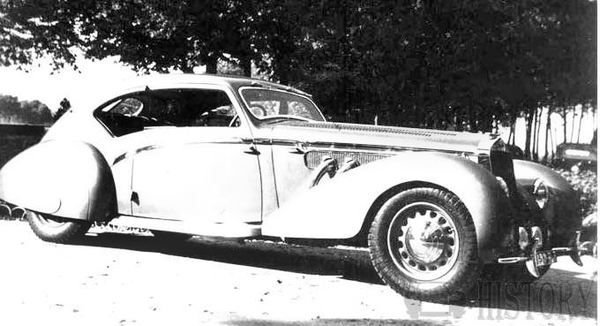
1937 Delage-D8-120 side view
Delage D6
| 1930-1953 | |
|---|---|
|
|
|
| Overview | |
| Manufacturer | Delage |
| Production | 1930 – 1940 1946 – 1953 |
| Body and chassis | |
| Body style | Normally delivered by Delage in bare chassis form, to be fitted with a bespoke coach built body from one of several leading coachbuilders. Most cars were given coupé, cabriolet, sedan/saloon or roadster bodies |
| Powertrain | |
| Engine | six-cylinder (1930-54) |
| Transmission | Four-speed manual four-speed Cotal pre-selector (optional) |
| Dimensions | |
| Wheelbase | various, all above 3,000 mm (120 in) |

The Delage D6 was a six-cylinder luxury car produced by the manufacturer between 1930 and 1940 and again, after the war, between 1946 and 1953. (The final cars were still receiving their bodies from specialist coach builders and being listed for sale during 1954.) For much of this time it was the company’s principal or, from 1946, only model.
The 3045 cc engine of the original D6 placed it in the 17CV car tax band which, for many contemporaries, would also have defined its position in the market hierarchy. During its long production run the car underwent a succession of changes, many of which involved enlargement or modification of the six-cylinder engine. During the 1930s there were, for some of the time, two or three different engines sizes offered. Principal changes and differences in engine sizes were marked by changes and differences as to the suffix at the end of the car’s name, generally reflecting differences in fiscal or actual horsepower. For some purposes it can be helpful to think of the D6 as a succession of closely related individual models, but the basic architecture of the chassis and engine did not differ radically between the different versions.
Bodies
Delage took a traditional view of its role as a car producer, and provided cars in bare chassis form to have their bodies fitted by one of the more prestigious bespoke body builders operating (in most cases) in the Paris area which reflected the way that most of France's auto-industry had, from the earliest days, been concentrated on this one region. The D6 therefore appeared, throughout its life, in a wide variety of (frequently) elegant shapes.
The list of coach builders whose bodies were fitted on the Delage D6 reads like a list of France's leading coachbuilders, many of them descended from carriage builders from the pre-motorcar days. Body builders most frequently mentioned in connection with Delage include Letourneur & Marchand and their subsidiary, Autobineau, Henri Chapron, Henri Labourdette, Marius Franay and, especially after the coming together with Delahaye, Alphonse Guilloré.
Chronology
The D6 was introduced in 1930 as a replacement for the Delage DM, but in view of the range of six-cylinder engines with which it was offered it could also be seen as a replacement for the smaller engine Delage DR.
In 1930 the D6 was one in a range of three Delage models on offer. The other two were the slightly lighter (but still six-cylinder powered) DS and, at the top of the range, the very large D8 launched the previous year. All three faced strong economic headwinds in the wake of the 1929 stockmarket crashes.
Delage D6 (1930 - 1933)
The original Delage D6 came with a choice of two chassis lengths, these being 3,149 mm (124.0 in) or 3,289 mm (129.5 in). The 6-cylinder engine had a displacement of 3045 cc. Listed maximum power was 75 hp (56 kW), produced at 3,600 rpm.
By the time production of the original Delage D6 ended, in 1933, 1160 had been produced.
Delage D6-11 (1932 – 1934)
A complementary model, the D6-11, was presented at the 26th Paris Motor Show in October 1932, although production only got under way the following Spring. The D6-11 was a more economical version of the original DE6. The “-11” suffix referred to the fiscal horsepower which was a function of the cylinder diameters and determined the level of annual car tax to be paid by owners in France. The 2001 cc 6-cylinder engine came with a listed maximum power output of 55 hp (41 kW) at 4,000 rpm. There was also an “S” version of the D6-11 for which 60 hp (45 kW) at 4,500 rpm was claimed.
The manufacturers' price list at the motor show in October 1933 listed ten different "standard" body types offered for the car. What they had in common was that the prices were high for a car in the 11CV car tax band/class.In bare chassis form the 6-11 was priced at 31,600 francs for a "normal" standard length chassis and 32,600 francs for a long version. There was also a price of 33,600 francs for a "normal" length sports chassis. The wheelbase lengths in question were 3,060 mm (120 in) (normal) and 3,260 mm (128 in) (long).
The last D6-11 was produced in 1934. Its direct replacement, the D60-12, entered production only in 1936
Delage D6-65 (1934 – 1935)
In 1934 the new Delage D6-65, appeared, now with a 3,378 mm (133.0 in) chassis. The 6-cylinder engine had a displacement of 2678 cc. Listed maximum power, as identified in the suffix on the name, was 65 hp (48 kW), produced at 4,000 rpm.
Delage D6-60 (1935 – 1937)
As the company succumbed to its financial difficulties, in April 1935 the plant at Courbevoie, which Delage had occupied since 1910, produced its last car, and the process began which would leave Delage as a simple affiliate of Delahaye by 1938.In 1935 Delage retained a separate management, but production was transferred to the Delahaye factory, in the 13th arrondissement of Paris. The Delage range was rearranged in order to facilitate the sharing of production facilities.
As part of this process, the Delage D6-65 was replaced by the Delage D6-60. It was available only with a 3,150 mm (124 in) wheelbase, shared with the four-cylinder Delayahe Models such as the 134N. Delages retained their own engine designs and the D6-60 came with a straight 6 of 2335 cc which was increased to 2528 cc at the Motor Dhow in October 1936 in time for the 1937 model year. Maximum power now rose from 56 hp (42 kW) to 67 hp (50 kW) at 3,500 rpm.At the end of 1937 the D6-60 was taken out of production.
Delage D6-80 (1935 – 1937)
Also introduced in time for 1936 was the Delage D6-80. Initially this was powered by a 3227 cc in line 6-cylinder engine for which maximum power of 72 hp (54 kW) is listed. The D6-80 was a long vehicle. Like other Delages at this time the D6-80 shared its wheelbase - in this case of 3,350 mm (132 in) – with a Delahaye. In the case of cars and the accompanying information presented at the 1936 motor show for 1937 cars, the Delage D6-80 also shared its 3557 cc six-cylinder 90 hp (67 kW) engine with a Delahaye, although the switch to a Delahaye engine engine change was not immediately implemented in respect of the cars provided for sale.
By 1938 the D6-80 had disappeared from the Delage range.

1937 Delage D6-70 Letourneur et Marchand sports
Delage D6-70 (1937 – 1938)
For 1937 Delage presented the D6-70. The car was effectively a rebadged D6-60S, which in turn was a derivation of the D6-60. The D6-70 sat on the same 3,150 mm (124 in) wheelbase as the D6-60 which was withdrawn from sale a few months after its launch. The car’s straight-six engine was of 2729 cc displacement and was not shared with any Delahaye. Maximum output is listed as 78 hp (58 kW) though as before, sources differ. The D6-70 seems to have been the star of the Delage 6-cylinder range at this time, with some particularly elegant bodies provided such as the “Coach Panoramique” 2-door sports saloon from Letourneur & Marchand, a Chapron cabriolet bodied car depicted in the 1937 Delage catalogue and a particularly well balanced “Berline” (saloon/sedan) from Autobineau.
Delage D6-75 (1939 – 1940)
The D6-75 appeared for 1939, effectively replacing the D6-70 which had by now been withdrawn. Its 2798 cc 6-cylinder engine was considered particularly refined. Power output was quoted at 95 hp (71 kW). In 1940 production was ended by the rapid invasion of northern France, following the declaration of war at the end of the previous summer.
Delage D6 3-litre (1946 – 1954)
By the end of the war Delage was firmly in the hands of Delahaye, Delage’s British born chief, Walter Watney, having found himself obliged to leave France in 1942. Louis Delâge himself had not been welcome at the company that bore his name since 1935, and would die at the end of 1947.
1946 found Delage production resuming with a single model, the D6 3-litre, slotting in below the larger and (even) more powerful models for which Delahaye used their own name. Many things had changed in the intervening years, but post-war Delages, like the Delahayes, still had their steering wheels on the right, something which would have been mainstream in France thirty years earlier, but which now very firmly set the high-luxury end cars apart from the Peugeots, Renaults, Citroens, Panhards and Simcas that many French citizens would have seen daily on the roads, and which the more fortunate among them might have aspired to drive or purchase.
The D6 3-litre now came with a 2984 cc straight-6 engine. Quoted power of 90 hp (67 kW) at 3,800 rpm was slightly down on the figure quoted for the pre-war D6-70, possibly reflecting a lower compression ratio enforced by the lower octanes of the fuel available to car buyers at this time. Performance would have varied according to the weight and shape of the body fitted, but a top speed of “approximately” 135 km/h (84 mph) was quoted by the manufacturer.
The bespoke body builders had less work now than in the 1930s, but their craft based methods enabled them to respond more immediately to new styling trends than the volume automakers, and many of the Delages from the late 1940s and early 1950s look strangely modern when compared to the early post war products from Renault, Peugeot and Citroen. The coach builders were willing and able more immediately to copy and build on the developments in car design that during the early 1940s had been more apparent in North America than in Europe. Nevertheless, the Delage D6-3-litre of 1948 – 1954 came with exactly the same 3,150 mm (124 in) that had been standard on successive D6s since 1935. A longer 3,330 mm (131 in) was also available for longer bodies such as those for Limousine style cars.
The Delage D6 3-litre was listed as part of the Delahaye-Delage range till 1954: it is thought that the last of the cars, in bare chassis form, were constructed during the closing months of 1953, but the final batch were still available for purchase during 1954, most of them bodied by Chapron. 1954 marked the exit from auto-production of both brands. The political context and the state of the post-war French economy were hostile to large cars in France. In 1954 even Henry Ford gave up on French auto-production, selling his business to Simca. By 1955 Delahaye had been taken over by Hotchkiss whose own business now survived, at least for the time being, not from producing luxury cars but on the basis of rebuilding and, by now increasingly building from scratch, Jeep based vehicles.
Delage D6 Olympic (1948 – 1949)
The D6 3-litre came in its standard form with only one carburettor, In 1946 a performance version, the Delage D6 Olympic, was presented, using the same engine block, but here supporting it with a triple carburettor fuel feed system. The gave rise to an output of 100 hp (75 kW), now with the engine spinning up to 4,500 rpm, and corresponding with a top speed of “approximately” 140 km/h (87 mph). This may have been in connection with the 3-litre Delage racing cars which were much in evidence during the 1948 racing season. However, in 1949 this performance version of the D6 was withdrawn.
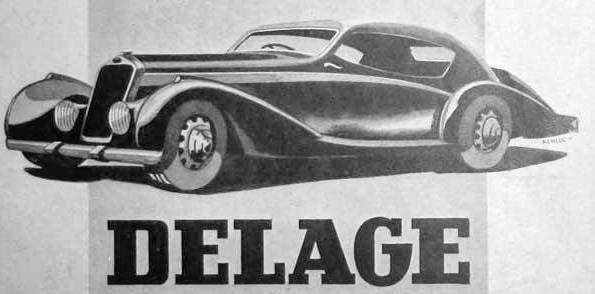
Delage D4
|
1933 to 1934
|
|
|---|---|
| Overview | |
| Manufacturer | Delage |
| Production | 1933 – 1934 |
| Body and chassis | |
| Body style | "Coach standard" 2-doors/4-seats "Berline" (saloon/sedan) 4-doors/4-seats "Coupé" 2/3 seats "Coach luxe" 2-doors/4-seats "Torpédo roadster" (cabriolet) 2-seats "Cabriolet décapotable" 2-doors/4-seats Also offered in bare chassis form |
| Powertrain | |
| Engine | 1480cc 4-cylinder ohv |
| Transmission | Four-speed manual |
| Dimensions | |
| Wheelbase | 2,800 mm (110 in) |

The Delage D4 was a 4-cylinder compact luxury car in the 8CV car tax band produced by the manufacturer between 1933 and 1934.
With the D4 the manufacturer returned to a market sector that it had neglected ever since ending production of the "Type AM" in 1921. A strategy of broadening the range downwards was understandable in the context of a French car market that failed to rebound from the economic depression in the way experienced in Britain and Germany. (French automobile production only returned to its 1928 level in 1938.
Launched in October 1933 at the 27th Paris Motor Show, the D4 was positioned at the lower end of the Delage range, below the 2-litre D6-11 which had been introduced the previous year initially to complement and then effectively to replace the manufacturer's DS. The D4 was therefore part of a broader change in focus by Delage away from the larger cars, reflecting a more general switch towards middle-class cars in the overall French auto-market during the first five or so years of the 1930s.
The D4 sat on a 2,800 mm (110 in) wheelbase, and was designed to incorporate the maximum possible level of component commonality with other Delage models. It was nevertheless fitted with the manufacturer's only four cylinder engine, an overhead valve unit of 1480cc (8CV).The maximum listed output was 40 hp (30 kW), produced at 4,200 rpm. Performance would have varied according to the body type selected and driving conditions, but a value of "approximately 100 km/h (63 mph)" was quoted.
The car could be ordered in bare chassis form, permitting customers to make their own arrangements with bespoke coach builders for clothing the chassis. That reflected normal practice among more traditional auto-makers, especially in respect of larger cars. Nevertheless, the catalogue given out at the Motor Show listed six "standard" body types from which customers could also choose. These included 2-door and 4-door saloon/sedan bodies as well as a coupe, a four seater cabriolet and a two seater "roadster" style cabriolet.

1934 Delage D4 side view
Commercial
The arrival of the D4 coincided with a renewed interest in the 8CV (8HP) class by what were already becoming France's "Big-3" automakers, with the introduction for 1934 of the new "all-steel" bodied versions of the Peugeot 301 and Renault Monaquatre YN3. "All-steel" car bodies were transforming the economics of automobile manufacturing, polarizing the market between automakers with access to the funds necessary to invest in heavy steel presses and dies and the second tier automakers. Once the capital cost of the steel presses had been found, the unit cost of production was much lower with "all-steel" bodied cars than with the traditional labour-intensive timber frame car bodies, but the economics only worked where the volume of cars produced was sufficient to cover the initial capital cost.
Delage did not have the dealer/service network across France necessary for a volume automaker, and it is unlikely that the production processes for the D4 were as cost-effective as those for its competitors in the now hotly contested 8CV class. In price terms the Delage found itself undercut by Peugeot, Citroen and Renault. It's larger cylinder diameter and the overhead valves for which that gave space gives credibility to the higher listed power output figure which implied a performance advantage, but even allowing for the somewhat approximate nature of manufacturers' performance data at this time, the D4 appears to have been only marginally faster than the 8CV models from the volume manufacturers: the Delage D4 was marginally heavier than the volume manufacturer's rival products, presumably reflecting more conservative production processes.
The D4 did, for a time, boost Delage sales, but the effect proved short-lived. In 1934 production came to an end.

1934 Delage D4 rear view

