
DKW Auto Union
- Details
- Parent Category: D
- Category: DKW Auto Union
- Hits: 47
DKW F12
 |
|
|
Production period: |
1963 to 1965 |
|
Class: |
motor car |
|
Body versions: |
Sedan, cabriolet |
|
Engines: |
Gasoline: 3 cylinders: 0.8-0.9 litres |
|
Length: |
156.22 in, 3,968 mm |
|
Width: |
62.01 in, 1,575 mm |
|
Height: |
55.91 in, 1,420 mm |
|
Wheelbase: |
88.58 in, 2,250 mm |
|
Curb weight: |
1,621 1b, 735 kg |
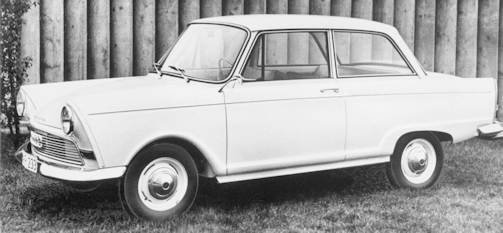
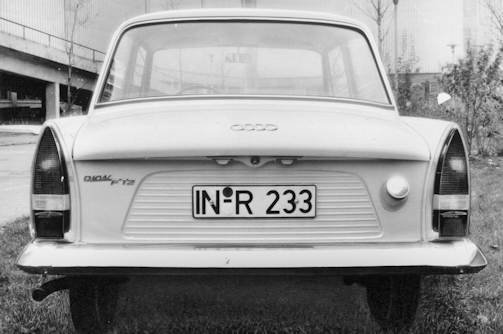
The DKW F12 was a small car of the automobile manufacturer Auto Union made in the 1960s.
History
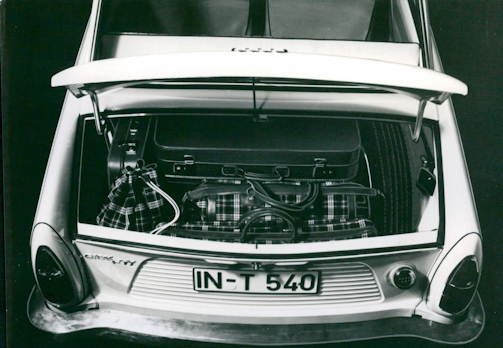
The DKW F12 replaced the DKW Junior in January 1963. This was basically an evolved junior deluxe. The changes included, among other things, an enlarged front and rear window, a larger grille, heater with heat exchanger and blower and large elongated tail lights. On request, the F12, as well as the junior, offered with two-tone paint.
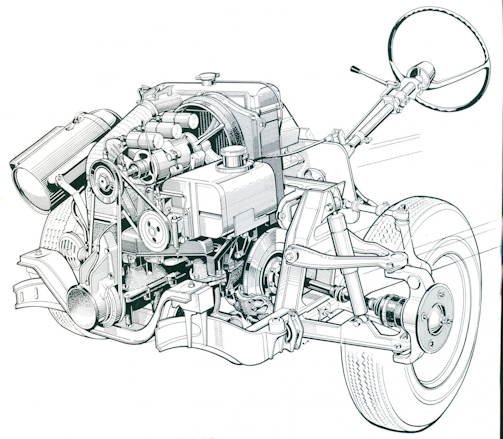
The F12 fitted with a three-cylinder powered two-stroke engine with 889 cc displacement, 40 hp and automatic oil systems, with internal disc brakes quickly made-equipped cars, some 125 km / h. The chassis and frame concept had been adopted by the Junior and extended by a stabilizer bar on the front axle with type box-type ladder frame the front suspension was independent, wishbones,longitudinal torsion bars, anti-roll bar and telescopic dampers at the rear rigid axle, swinging longitudinal trailing arms, transverse torsion bars, transverse linkage bar and telescopic dampers.
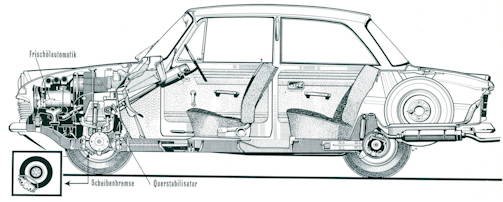
The wheelbase was extended by 75 mm compared to the Junior gave the sedan a distribution of weight of 60% to front axle and 40% to the rear axle. From February 1965, the higher-compression 45-horsepower variant of the 900 engine was installed, which slightly increased the performance. This version had a gearbox with freewheel as standard, which eliminated the unpleasant jerking during coasting.
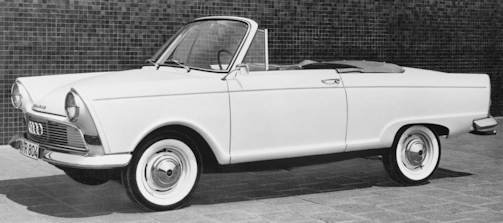
From early 1964 to early 1965 in a small series of Baur body and vehicle construction in Stuttgart. The DKW F12 Roadster, a convertible with the 45-horsepower engine, was introduced and produced.
PERFORMANCE
- Engine capacity: 54.25 cu in, 889 cu cm
- Fuel consumption: 36.2 m/imp gal, 30.1 m/US gal, 7.8 x 100 km
- Max speed:80.8 mph, 130 km/h
- max power (SAE): 51 hp at 4,500 rpm
- max torque (SAE): 59 1b ft, 8.2 kg m at 2,250 rpm
- max engine rpm: 4,700
- specific power: 57.4 hp/l
- power-weight ratio: 31.7 lb/hp, 14.4 kg/hp
- acceleration: O—50 mph (0—80 km/h) 11.1 sec
- max speeds: 24.2 mph, 39 km/h in 1st gear; 40.4 mph, 65 km/h in 2nd gear; 62.1 mph, 100 km/h in 3rd gear; 80.8 mph, 130 km/h in 4th gear
- Details
- Parent Category: D
- Category: DKW Auto Union
- Hits: 33
DKW F11
 |
|
|
Production period: |
1963 to 1965 |
|
Class : |
Motor car |
|
Body versions : |
Sedan |
|
Engines: |
Gasoline : 0.8 liters 2 stroke; 3 cylinders |
|
Length: |
156.22 in, 3,968 mm |
|
Width: |
62.01 in, 1,575 mm |
|
Height: |
57.20 in, 1,453 mm |
|
Wheelbase : |
88.58 in, 2,250 mm |
|
Curb weight : |
1,610 1b, 730 kg |
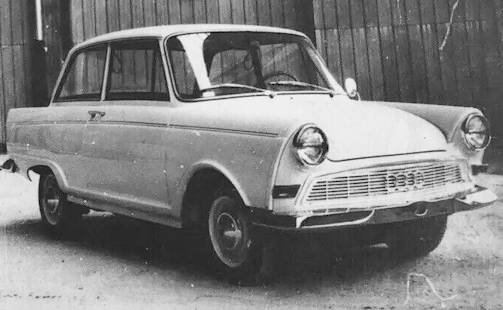
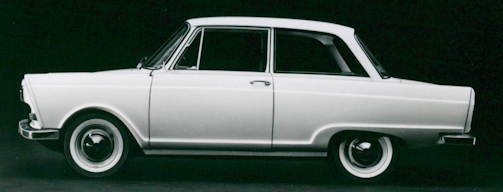
The DKW F11 was small cars of the automobile manufacturer Auto Union in the 1960s .
History
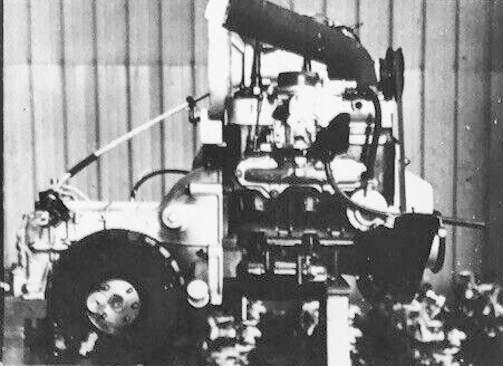
The car introduced at the same time as the DKW F102 in August 1963 was a simplified reduced specification version of the DKW F12 with its body, but technically a simple Junior de Luxe with a 34 hp engine with cast iron block and light alloy cylinder head with a displacement of 796 cc fitted with 1 Solex 40 CIB downdraught carburettor. The F11 was offered until June 1965.
Shapely in the lines, powerful in expression, functional in conception, this five-seater offers with low upkeep and maintenance costs medium great performance. The valveless three-cylinder engine with 796 ccm has 34 hp (39 SAE) with the stepwise AUTO.In conjunction with front-wheel drive, contact steering, a well-balanced suspension and exemplary brakes, it develops optimal driving characteristics. Windshield washer system and ignition steering lock included as standard start-repeat lock On with automatic"Saxomat" clutch and sliding roof available. With box-type ladder frame chassis.The front suspension was independent, wishbones,longitudinal torsion bars with telescopic dampers at the rear rigid axle, swinging longitudinal trailing arms, transverse torsion bars, transverse linkage bar, and telescopic dampers, The distribution of weight: 60% front axle, 40% rear axle.
After the takeover by the Volkswagen factory , the Auto Union stopped in March 1966, the production of two-stroke cars finally. The SUV DKW Munga was built until December 1968 for the German Armed Forces . Due to the insufficient market success of the two-stroke engines, which were considered obsolete, the company was on the brink of insolvency.
PERFORMANCE
- Engine capacity:48.57 cu in, 796 cu cm
Fuel consumption: 38.7 m/imp gal, 32.2 m/US gal, 7.3 1 x 100 km
Max speed: 73.3 mph, 118 km/h
max power (SAE): 39 hp at 4,600 rpm
max torque (DIN): 52 1b ft, 7.2 kg m at 2,500 rpm
max engine rpm: 4,800
specific power: 49 hp/l
max speeds: 23.6 mph, 38 km/h in 1st gear; 38.5 mph, 62 km/h
in 2nd gear; 55.9 mph, 90 km/h in 3rd gear; 73.3 mph, 118 km/h in 4th gear
cooling system capacity: 12.67 imp pt, 15.22 US pt
power-weight ratio: 41.2 lb/hp, 18.7 kg/hp
acceleration: standing 1/4 mile 22.4 sec, 0—50 mph (O—80km/h) 14.8 sec
- Details
- Parent Category: D
- Category: DKW Auto Union
- Hits: 75
Auto Union 1000 car range and history
 |
|
|
Manufacturer: |
Auto Union |
|
Production years: |
1958 to 1963 |
|
Class: |
Motor car |
|
Total production: |
18,085 (Germany) |
|
Assembly plants: |
Düsseldorf, West Germany |
|
Top speed: |
83.9 mph, 135 kmh |
|
Body styles: |
Sedan, station wagon, coupe, cabriolet |
|
Doors: |
2,3 and 4 |
|
Chassis/body: |
box-type ladder frame |
|
Suspension front: |
independent |
|
Suspension rear: |
rigid axle |
|
Drive: |
front |
|
Engine Type: |
Petrol engine :981 cc two-stroke straight-3 |
|
Engine Displacement: |
1.0 litre |
|
Engine location: |
front |
|
Engine power: |
32–40 kW |
|
Transmission: |
mechanical; gears: 4 |
|
Steering: |
rack-and-pinion |
|
Cooling: |
water |
|
Brakes: |
drum |
|
Fuel: |
mixture, 80 oct petrol, 20 SAE oil |
|
Tyres: |
5.60 x 15 |
|
Wheelbase: |
2350-2450 mm |
|
Length: |
4170-4325 mm |
|
Width: |
1640-1695 mm |
|
Height: |
1325-1565 mm |
|
Track front: |
50.79 in, 1,290 mm |
|
Track rear: |
53.15 in, 1,350 mm |
|
Weight: |
2,315 1b, 1,050 kg |
The Auto Union 1000 is a German car with a three-cylinder, two-stroke engine and front-wheel drive built from the late 1950s to the early 1960s.
History
It is the successor of the "Big DKW 3 = 6" (F93 / 94) and the only Auto Union passenger car with the manufacturer's name as a brand instead of DKW. In August 1963, the DKW F 102 followed as the last West German production car with a two-stroke engine. The Auto Union 1000 largely corresponded to the DKW 3 = 6 (F93 / F94). The main differences were the more powerful engine with more cubic capacity (981 cm³) and on the outside the four rings in the radiator grille and the words "Auto Union" instead of the DKW trademark on the bonnet. Later Apart from the enlarged engine, which now provided in the base model 44 bhp (33 kW), the 1000 featured the old four-ring Auto Union badge across the air grill along with the Auto Union name above it, in place of the DKW badge that had adorned the nose of the earlier model.

It was available as a four and two-door sedan with doors hinged at the front and as a four-seater coupe without a B-pillar. For the model year 1960 (from August 1959), the two-door sedan and the four-seater Coupé Auto Union 1000 S were given a panoramic windscreen. In 1961 the radiator grille was redesigned with vertical trim. The station wagon, known as the Universal, was produced from 1959 to 1963.
A three-door estate version was also offered, branded as the Universal, between 1959 and 1962. For the 1960s, the saloon was renamed Auto Union 1000S and received, a wrap-around windscreen.
The vehicles had a box profile frame and an all-steel body. At the front, the wheels were individually suspended from lower wishbones and an overhead leaf spring. The levitation axis known from the predecessors was installed at the rear. On request, the vehicles were also available with the " Saxomat " fully automatic centrifugal clutch.

Between January 1958 and July 1963, Auto Union produced 171,008 sedans and coupés of the Auto Union 1000 and 1000 S types at the Düsseldorf-Derendorf plant. From August 1959, a station wagon version called "Universal" was added. times was sold. The highlight of the series was the Auto Union 1000 S Coupé de Luxe with disc brakes. In 1962, however, only 18,085 Auto Union 1000 were still manufactured.
The Auto Union's 981-cc two-stroke three-cylinder engine was available in various states of tune. In the model year 1961/62, Auto Union introduced two-stroke separate lubrication using the "fresh oil automatic" developed in cooperation with Bosch. The system with a separate oil tank and oil pump should make it possible to fill up with petrol without the addition of oil, because petrol stations with a two-stroke mixture became less common. If the mixing ratio had already been reduced from 1:25 to 1:40 in 1956, the engine could now be operated at full load at 1:60 and at idle speed at 1: 400. According to advertising the new system should ensure especially the engine a longer service life, which was not achieved in practice. In the extremely cold winter of 1962/63 in Europe an unusually large number of crankshaft damage occurred because the oil, which was viscous at low temperatures, was not adequately transported through the thin line into the carburettor Power was delivered via a four-speed manual gearbox, controlled using a column-mounted lever.
PERFORMANCE
- Fuel Consumption 31.7 ml imp gal, 26.4 ml US gal, 8.9 1 x 100 km
- Max Speed 83.9 mph, 135 kmh
- max engine rpm: 5,200 rpm
- specific power: 51 hp/l
- power- weight ratio: 46.3 lb/hp, 21 kg/hp

After production in Germany ceased in mid-1963, the Auto Union 1000 S was manufactured by Veículos e Máquinas Agrícolas in São Paulo (Brazil) with minor retouching and in Argentina under license by Industrias Automotriz de Santa Fe (IASF) The line-up consisted of the two- and four-door sedans, the three-door Universal estate wagon, and built without changes until 1970 with about 30,000 copies manufactured. Only limited numbers of the coupé were built and licensed productions of the coupés and Spyder were also built in Spain.
The Auto Union 1000 Sp (Sp for special and not, as is often assumed, for the word "sport”) was a two-seater sports coupe or a two-seater roadster.
The 1000 SP was presented at the IAA in 1957 and manufactured at Baur in Stuttgart from 1958 to 1965. This reached a number of 5004 coupes. From September 1961 to April 1965, 1640 open roadsters were also manufactured.
Compared to the Auto Union 1000 S, the engine output was increased mainly to 41 kW (55 hp) by higher compression (8: 1), but also by slight differences in the engine block and different carburettor system. This 1000 Sp was lower and brought about the name "narrow-gauge Thunderbird ", as the 1000 Sp was sometimes called in the press, to a top speed that at 140 km / h slightly exceeded the weaker motorized 1000 S coupe.
From the 62 models, both the Coupe and the Roadster a two-seater sports car were given rounded side fins at the rear. Subsequently (from chassis number 4,360 / March 1962) there were also disc brakes on the front axle and the fresh oil automatic. Like the other models, the AU 1000 Sp also has sheet metal reinforcements for attaching seat belts. With the use of the automatic fresh oil system, the 32/36 NDIX dual carburettor was replaced by the Solex 40 CIB falling gas carburettor.
Coupé and Roadster cost DM 11,950 at market launch, later the price was reduced to DM 10,950 and most recently, in early 1965, to DM 9,400. In 1963, the Auto Union 1000 was replaced in Europe by its successor, the DKW F102 the company was then acquired by Volkswagen and the dormant at the time Audi brand was now resurrected.

- Details
- Parent Category: D
- Category: DKW Auto Union
- Hits: 37
DKW F91 3=6 Sonderklasse
 |
|
|
Production period: |
1953 to 1957 |
|
Class : |
Motor car |
|
Body versions : |
Saloon , Coupé ,Cabriolet , Kombi |
|
Engines: |
Petrol : 0.9 liter (25 kW) |
|
Length: |
4170-4225 mm |
|
Width: |
1520-1595 mm |
|
Height: |
1450-1555 mm |
|
Wheelbase : |
2350-2500 mm |
|
Curb weight: |
895 kg |
The DKW F91 Sonderklasse (special class) was a car of Auto Union , which appeared in March 1953 at the International Motor Show (IAA) in Frankfurt.
History
The F91 had This internal name and largely corresponded to the DKW F9 planned for 1940 . While its predecessor, the DKW F89 in contrast to the IFA F9 was still had the two-cylinder engine of the DKW F8 (hence DKW F8-9 ), the F91 had a three-cylinder engine , therefore DKW F9-1 .This Larger 3=6 model built as a two-door saloon with front suicide type opening doors . Also a ‘pillarless’ coupe version and Cabriolet.
From March 1953 to September 1955, 57,407 sedans and coupes were produced in Dusseldorf, in addition Karmann produced 1550 two- and four-seater convertibles. The until June 1957 further produced Kombi Universal brought the total to 15.193.
From the DKW Meisterklasse with transversely mounted two-cylinder two-stroke engine, the special class distinguished first and foremost by a standing front of the front three-cylinder engine with 897 cc displacement and 34 hp (25 kW) and a new transmission along the rear axle. As before, it was a two-stroke engine with reverse purge and a partially synchronized transmission (2nd and 3rd gear). There was also the typical for DKW freewheel. The radiator was like the Meisterklasse behind the engine and not in front behind the radiator grille. Innovations were tilted telescopic shock absorbers on the rear axle axis .The advertising promised of the three-cylinder two-stroke engine smoothness and vibration freedom of a six-cylinder four-stroke, which was also approximately achieved. The standard consumption in accordance with DIN 70030 (at a constant three-quarters of the maximum speed, but no more than 110 km / h, on a level track) was relatively low at 7.8 l / 100.
Externally, the special class differed from its predecessor by a radiator grille with only five instead of nine transverse bars. From 1954 she was also available as a four-seater coupe with rear panoramic window , as seen at the 1953 IAA. The coupe had fully retractable side windows front and rear and no B-pillar (" hardtop coupe "). As special equipment details highlighted the advertising of the manufacturer flasher, gasoline watch and automatic switching on the interior lighting when opening the right door.with over 34 hp can achieve a top speed of more than 120 km/h
a great a special feature. An easily accessible unusual large trunk that holds numerous luggage also for long journeys.Convenient front passenger seat is located right next to the information for the adjustable heating and defroster system are located in the middle on the right Seat (LHD) backrest tilt completely forward.
- Details
- Parent Category: D
- Category: DKW Auto Union
- Hits: 38
DKW Schnellaster van
(1949–1962)

The DKW Schnellaster, also known as the DKW F89 L, was a van produced by DKW from 1949 to 1962. The model name Schnellaster translates from German to English as Rapid Transporter.
Design
The Schnell-Laster is of a one box or monospace configuration featuring front wheels set forward in the passenger cabin, a short sloping aerodynamic hood, front wheel drive, transverse engine, flat load floor throughout with flexible seating and cargo accommodations. These same features make theSchnellaster a precursor of the modern minivan, a body configuration subsequently popularized in notable examples such as the Renault Espace, or the Chrysler Voyager/Dodge Caravan and, mechanically, of the BMC Mini plus most modern cars.
The van included a trailing-arm rear suspension system incorporating springs in the cross bar assembly. The modern layout featured a prewar two-cylinder 700 cc two-stroke engine of the DKW F8 rated at 20 hp (22 hp after 1952). In 1955 the van received the DKW F9's three cylinder unit with 900 cc, producing 32 hp (24 kW).
The van's layout enabled a flat loading floor only 40 cm (16 in) off the ground. It was also fitted with a large single rear door fitted to hinges on the right-hand side.
World markets
The van was also produced in Vitoria, Spain, by Industrias del Motor S.A. (IMOSA) from 1954. In Spain, DKW became a common term for any van, and is still used today. The Spanish subsidiary also produced a modern successor with all new bodywork, introduced in 1963 and called the DKW F1000 L. This van started with the three-cylinder 981 cc two-stroke DKW engine, but later received a Mercedes-Benz Diesel engine and was finally renamed a Mercedes-Benz in 1975.
The Finnish heavy vehicle producer Suomen Autoteollisuus assembled a series of ten Schnellaster's in Karis, Finland at the turn of November 1956. The vehicle was branded Donau-Sisu. The bodies were welded in Finland by use of fixtures delivered from West Germany. Welding of the complete body took just two hours per unit. Plans were in place for a larger scale production but it was not started because the technically archaic vehicle did not meet the needs of the potential Finnish customers. One repairable Donau-Sisu has survived and saved by vintage vehicle enthusiasts at the end of 2011.
From 1960 to 1969 the DKW van was manufactured under licence by Industrias Automotriz de Santa Fe (IASFe) in Argentina as the Auto Union Combi, Pickup, Furgón (van) and Ambulance after producing the Schnellaster for 10 years. The factory had closed its doors, but Industrias Mecánicas del Estado (IAME) continued production of the DKW F1000 L as the Rastrojero Frontalito from 1969 until 1979 in single and double cab pickup and flatbed, minibus and van versions.


