
Dodge
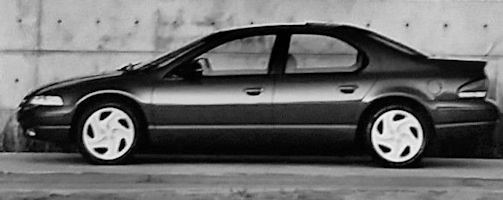
Dodge Stratus 1st generation
 |
|
|
Production |
1994 to 2000 |
|
Assembly |
United States |
|
Body style |
4-Door Sedan |
|
Platform |
Chrysler JA platform |
|
Engine |
|
|
Transmission |
5-speed manual4-speed Ultradrive 41TE automatic |
|
Wheelbase |
108 in (2,743 mm) |
|
Length |
186 in (4,724 mm) |
|
Width |
71.7 in (1,821 mm) |
|
Height |
1995–98 Base: 54.2 in (1,377 mm)1999–2000 Base: 54.2 in (1,377 mm) |
The Dodge Stratus was a from 1995 to 2006 by the US automaker Dodge in two generations offered with front wheel drive.
Except for trademark, radiator grille and taillights Stratus the first generation with the Chrysler Cirrus and 1996 Plymouth Breeze was identical.
The design of the Stratus corresponded to the Dodge Intrepid introduced cab-forward philosophy with a long wheelbase, short overhangs and wide-ranging forward passenger cabin.
Dodge's midsize sedan with the Plymouth Breeze and Chrysler Cirrus. All three share the same design. Stratus offers base and ES models. A 2.0-liter 4-cylinder engine and manual transmission are standard on the base, and a 2.4-liter dual-camshaft 4-cylinder is optional. A Mitsubishi-built 2.5-liter V-6 is standard on the ES with Chrysler's Autostick automatic transmission, Anti-lock brakes are optionalon the base model and standard on the ES
The base model used one of the Neon's four-cylinder engines. Seating is roomy, and the interior is nicely designed, with good displays.
Safety equipment:
Driver and passenger air bags standard. ABS optional.
The Stratus was powered by a 134 hp two-liter in-line four-cylinder with 16 valves, coupled with a five-speed gearbox or a four-speed automatic; alternatively, there was a Mitsubishi-derived 2.5-liter V6 with four-speed automatic or a 2.4-liter double-camshaft four-cylinder. Offered were a basic model and the Stratus ES with upscale amenities.
In 1999, the Stratus received slight external modifications. ES models also get 4-wheel discs. Other changes include a revised suspension designed to increase ride comfort, new wheel covers on the base model, and new alloy wheels on the ES.
Until the end of production in 2000, about 450,000 copies were produced.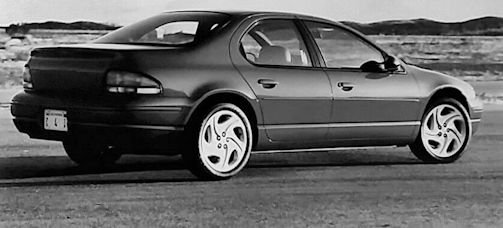
Dodge Magnum Second Generation
|
|
|
|
Model years |
2005–2008 |
|
Assembly |
Canada |
|
Class |
Motor Car |
|
Body style |
5-door station wagon |
|
Layout |
Front engine, rear / four-wheel drive |
|
Platform |
Chrysler LX platform |
|
Engine |
2.7 L (167 cu in) EER V6 |
|
Transmission |
4-speed 42RLE automatic |
|
Wheelbase |
120.0 in (3,048 mm) |
|
Length |
197.7 in (5,022 mm) |
|
Width |
74.1 in (1,882 mm) |
|
Height |
2005-07: 58.4 in (1,483 mm) |
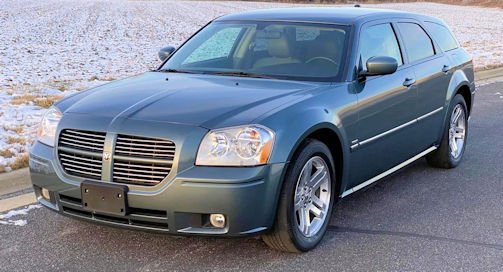
Dodge Magnum is the name of two cars of the US car manufacturer Dodge .In 2004, Dodge began producing a new model, which was again named Magnum . In contrast to the namesake from the 1970s, the current Magnum is a station wagon .
Since its creation in 2005, the Magnum has attracted all kinds of comments. The "smoke show", but others may treat it as an enemy of Greenpeace with its large engines.
One thing is certain; this car has a very strong personality and robustness. The secret of the success of the Magnum is based on this hot-rod key power from the past. The tinted windows, the wheels of 17-, 18- or 20-inches command respect. In addition, the dials on a white background contrast with black coverings. very 1970s, The only downside: the quality of the plastic, rather unpleasant to the touch, could be improved and makes It looks a bit low-end.
In Europe, the Dodge Magnum was marketed by DaimlerChrysler as Chrysler 300C touring . It is offered in the following displacement variants:
- SE : 2.7 Liters with 140 kW / 190 hp
- SXT : 3.5 Liters with 253 hp
- R / T : 5.7 Liter HEMI with 250 kW / 340 hp
- SRT8 : 6.1 litres HEMI with 313 kW / 425 hp
There are the versions SXT and R / T since 2005 also with all-wheel drive (and optionally with four-speed or five-speed gearbox). For the model year 2008, the Magnum received a facelift. The gearbox and many engine parts come from the Mercedes-Benz W210 , from which the vehicle platform was also taken over.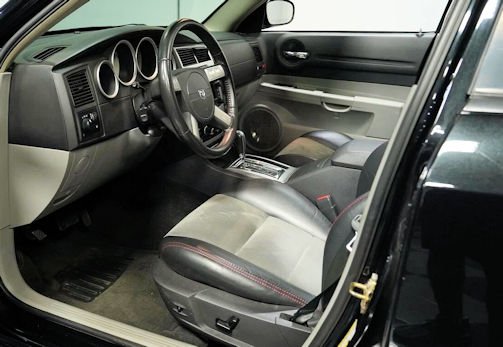
INTERIOR From the outside, its roof line lack of clearance. but it is only an optical illusion, In fact its High. With superior soundproofing and a longer wheelbase than that of a European Mercedes S-Class and a BMW 7 Series. And space loading is huge.
The options range from the navigation automatic climate control including leather upholstery. A good audio system with a six-CD magazine and enough power.
Standard Track Pack (SRT8),
Rear Entertainment with Optional DVD,
transmission oil change reminder
automatic, electrically adjustable pedals (R/T),
Available 18-inch and 20-inch chrome wheels
MECHANICS Here we are at the heart of what is the appeal of this vehicle.
For the SE version with V6 engine from 190 horsepower is indicated, but the SXT version, with the 3.5-liter V6 and 250 horsepower, is the best compromise between power, driving pleasure and an Acceptable consumption. The V6s are equipped with an automatic gearbox 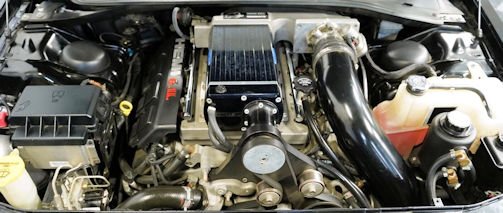
Next the big guns with the HEMI engines. The R/T version offers 340 horsepower, a 100 km/h start stopped in less than 6.5 seconds, and a mechanical symphony that makes you shiver of pleasure every acceleration. Fitted with system for disabling cylinders in the HEMI V8 of 5.7 litres, which allows the Magnum to run on four Cylinders cruising speed on the road, authorizing a better Fuel economy of approximately 10%. Chassis and suspension are well calibrated.
However, a full-on propulsion drive becomes a real problem in winter, all the more so as the stability control is worth nothing in the snow. But there is plus, if you can afford it: the Magnum SRT8 with its HEMI and its 425 horsepower and five gears with HEMI motors.. With power delivered in A loud debauchery makes the hairs stand on end of the arms. A real beast that accelerates as fast aa the Porsche 911 or a Corvette, but unlike these you still have room for all your grocery in the back!
In the US, the Magnum is no longer offered, since the sales figures were below the expectations last.
Dodge Challenger
 |
|
|
Manufacturer |
Dodge |
|
Production |
2008–2023 |
|
Assembly |
Canada |
|
Class |
Sports Car |
|
Body style |
2-door coupe |
|
Layout |
Front engine, rear-wheel drive |
|
Engine |
|
|
Transmission |
|
At the North American International Auto Show 2006 was a style study of the Dodge Challenger in retro design to visit. It was based on the shortened DaimlerChrysler LX platform (as well as the Chrysler 300 and others), had a 6.1-liter Hemi V8 engine with manual transmission and Chrysler quoted the design of the Challengers from 1970. Announced in July 2006 Dodge on, want to build the vehicle in February 2008 in series.
The production model was then presented to the public on February 6, 2008 at the Chicago Auto Show. The production of the Challenger was limited in the first model year to a number of 6,400 pieces, the serial number of each copy is noted on a sticker inside the vehicle. All Challenger of the year 2008 are SRT8 models , which are equipped with the 6.1-liter Hemi V8 engine with 317 kW (431 hp) and a five-speed automatic transmission (W5A580) with autostick.
The model was offered in 2008 exclusively in the colors silver, black and orange (the latter at extra cost). As standard, the SRT8 models have 20 × 9.0 alloy wheels . Since the model year 2009, V6 engines and manual transmission are available. The drag coefficient (C w ) is 0.353, the weight distribution is 55.6 / 44.4 (front / rear), the turning circle is 11.48 m. The Challenger is manufactured at the Canadian plant Brampton (Ontario) .
Since early 2011, the Challenger SRT8 392 with a 6.4-liter Hemi V8 with 346 kW (470 hp) is available.

In spring 2012, the limited special edition Yellow Jacket was released . It has a 6.4-liter Hemi V8 with 350 kW (476 hp) and was painted exclusively in the color Stinger Yellow . Striking are the black side stripes with the yellow jacket logo over the fender and the dark 9 × 20 inch wheels. The interior was upgraded with leather and yellow trim on the rear seats something. Technically, there was only one innovation: an adaptive suspension ADS, which allows the driver to change the damper tuning between sporty and automatic with a push of a button.
By the summer of 2014, the Challenger was subjected to a larger facelift. The new model was in April 2014, on the Show New York Auto presented to the public and is produced since the summer of the same year.Compared to the previous Challenger, which took stylistic borrowings in the 1970s model, the 1971 model was chosen as a retro model for the facelift. Both the bodywork and the interior have been redesigned.
While the base engine for the equipment variant SXT continues to be the 227 kW (309 hp) Pentastar V6 engine with a displacement of 3.6 liters, revised V8 engines were introduced. The engine of the R / T model still has a 5.7-liter displacement, but was increased in power by 8 to 280 kW (381 hp). From the in-house tuning department SRT there are now two instead of one model so far on offer: The most powerful variant still the SRT 392 is offered, the 6.4-liter Hemi V8 engine now provides 362 kW (492 hp) instead of the previous 350 kW , This engine is also available with the same performance in the equipment variant R / T Scat Pack . The new top model since the end of 2014 was the SRT Hellcat in which Dodge for the first time fitted a standard Hemi engine with supercharger. With a maximum power of 527 kW and 881 Nm of torque, it was also the most powerful engine, the Chrysler Group had hitherto depending installed in a train carriage.
In April 2017, at the New York Auto Show with the Dodge Challenger SRT Demon an even more uprated version was presented. The known from the Hellcat compressor-charged 6.2-liter V8 makes in the Demon 603 kW (819 hp) with regular gasoline ( 91 RON ) and 626 kW (852 hp) with gasoline from an octane rating of 100 or higher. With 100 octane gasoline, the engine reaches a torque of 1,044 Nm. The vehicle is specially optimized for drag races , has a special extra-wide tires under widened fenders and completes the quarter-mile race according to official figures within 9.65 seconds, which is faster than any other mass-produced vehicle with internal combustion engine.
The automatic transmissions used since 2015 come from ZF . It is the second generation of the 8-speed 8HP automatic transmission.

Dodge Challenger First generation
 |
|
|
Production period: |
1969 to 1974 |
|
Body versions : |
Coupe , convertible |
|
Engines: |
Gasoline engines : 3.2-7.2 liters |
|
Length: |
4859 mm |
|
Width: |
1983 mm |
|
Height: |
1293 mm |
|
Wheelbase : |
2794 mm |
|
Curb weight : |
1436-1725 kg |
The first Dodge Challenger was introduced in the model year 1970 and belonged to the named after the first Ford Mustang vehicle family of pony cars (long hood, short deck) compact sports coupe or convertible.
The Challenger was largely identical to the third generation Plymouth Barracuda ; The bodywork was slightly modified and the wheelbase extended by 5 cm. The design came from Carl Cameron, who had already designed the Dodge Charger from 1966. Although the Challenger with 83,032 units sold in the first year of production was a good reception in the market, but it appeared at a time when the decline of the Pony Cars was already emerging. After only five years, the Challenger was discontinued with the end of the model year 1974 without replacement. A total of 188,611 first-generation vehicles were sold.
The Challenger was available as Hardtop Coupé without B-pillar and in 1970/71 as Cabriolet. The top model of the series was the Challenger R / T, which was available only in 1970 as a convertible. The base model as well as the R / T coupe could be ordered in an SE version with leather seats, vinyl roofand a smaller rear window. From 1972, the R / T variant was dropped, instead, a rally called version came into the program. At the same time, the most powerful engines and many performance extras were no longer available. Only in 1970 was the Challenger T / A available, a homologation model for the Trans-Am series equipped with a special 5.6 l V8 (340 cui ), three double carburetors and a fiberglass engine hood with a large air scoop . The tubes of the sport exhaust flowed laterally in front of the rear wheels ( sidepipes ). Also standard were anti-roll bars front and rear, different width tires on the front and rear (Polyglas GT, rear G60-15, in some exceptions 275-55x15 or 285-60x15, front E60-15) and rear spoiler. Optionally, a front spoiler and a rear jalousie (J68 - Window Louvers) could be ordered. In model year 1972 accounted for all high-performance engines; strongest engine was since then an eight-cylinder, which was then discontinued in early 1974 then.

The body remained unchanged over the entire life of the Challenger, twice the grille was modified. The models 1970/71 had a retired barbecue, which received a central pier in 1971. From 1972, the grill was at a height with the headlights. The models of the years 1972 to 1974 can be distinguished by the increasing from year to year bumper horns. The tail lights ranged in the model year 1970 over the entire width of the car. In 1971, the reversing lights were arranged on the left and right side of the license plate. As of 1972, the Challenger had four individual taillight lenses.
Quarter Miles
Listing of the best times achieved over the quarter mile at a standstill:
- 340: 14.8 seconds, final speed 155 km / h
- 340 T / A: 13.99 seconds, top speed 157 km / h
- 383: 15.1 seconds, final speed 150 km / h
- 440 Magnum R / T: 13.9 seconds, final speed 163 km / h
- 440 Six-Pack: 13.6 seconds, final speed 167 km / h
- 426 Hemi: 13.2 seconds, final speed 169 km / h

Dodge Coronet Seventh generation
 |
|
|
Production |
1975 to 1976 |
|
Assembly |
United States |
|
Body style |
4-door sedan and wagon (1975–76) |
|
Platform |
B-body |
|
Engines |
225 cu in (3.7 L) Slant-6 I6 |
|
Transmission |
3-speed Chrysler A320 manual |
|
Wheelbase |
Sedan & Wagon: 118.0 in (2,997 mm) |
|
Length |
Sedan: 217.9 in (5,535 mm) |
|
Width |
Sedan: 77.7 in (1,974 mm) |
|
Height |
Sedan: 53.9 in (1,369 mm) |
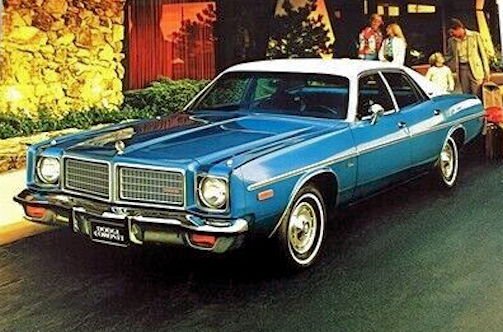
The Dodge Coronet 7th generation was built from in the 1970s from 1975 up to 1976.
History
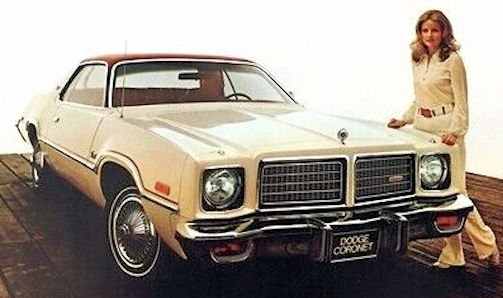
In 1975, the cars were revised again, so their bodies appeared angular. The Coronet coupe returned for a year. The front view got, like the Plymouth Fury , two round headlights. a restyled by horizontal the and divided grille divided in the centre. revived hardtops, which featured vertical taillights and a full-width bumper
The basic Coronet inside features vinyl bench seats and foam rear seat cushion; was the base trim level and incorporated a colour-keyed rubber floor mats; with day and Nite mirrors three-spoke steering wheel; front and rear ash trays and arm rests; cigarette lighter; glove box lock. Coronet Customs added carpeting; roof drip rail, bodyside mouldings; dual note horns and Deluxe steering wheel. The Brougham was the top trim level, incorporating all Custom features, plus padded vinyl top ,special side mouldings hood ornament; special exterior rear mirrors; The Crestwood was high-level station wagon and included rear mounted air deflector map and glove box lights; cargo area carpet; wood bodyside panelling.
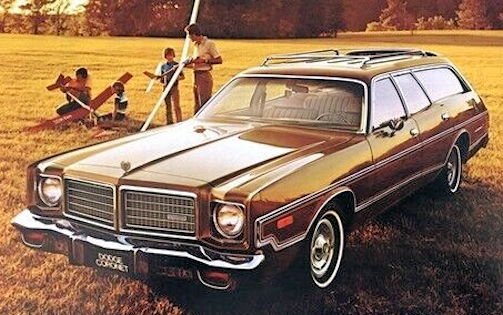
By 1976 was the last year for the Coronet; In 1977, the models in Monaco - until then the larger Dodge model - renamed and got rectangular headlights and other minor changes, which became an instant sales success. The two-door coupe was sold in 1976 under the name Dodge Charger Coupe . It joined with this designation alongside the Dodge Charger S / E, which was a derivative of the Chrysler Cordoba . Only sedan and wagon bodies were offered. Wagons had a standard 360 cu. in. V-8, while the sedan was powered by a 225-cu. in. Slant Six or optional 318 V-8. Single round headlamps sat in square housings. Curved-side amber parking lamps were mounted in the bumper, below the headlamps. Wide horizontal taillamps were set into the back bumper, with backup lenses in the centre of each unit and a recessed license plate housing in the middle.
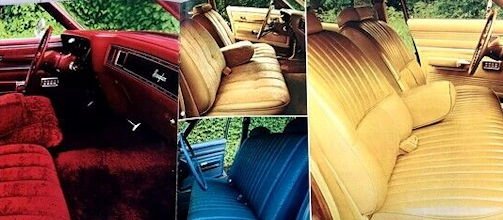
A 'Dodge' nameplate was on the decklid and grille; 'Coronet' script on front fenders. Coronets had a hood ornament in this, their final year. Minor instrument changes included speedometer calibration in miles and kilometres’ Royal Monaco still had the larger Monaco body. Another successor of the Coronet was the diplomat.
- PERFORMANCE: 225 cu in, 3,687 cc
max speed: about 99 mph, 160 km/h
max power (DIN): 95 hp at 3,600 rpm
max torque (DIN): 170 1b ft, 23.4 kg m at 1,600 rpm
max engine rpm: 4,000; 25.8 hp/l
power-weight ratio: Coronet Sedan 37.8 lb/hp, 17.1 kg/hp Coronet Custom Sedan 38.3 lb/hp, 17.3 kg/hp
fuel consumption: 17.1 m/ imp gal, 14.3 m/US gal, 16.5 1 x 100 km. - PERFORMANCE: 318 cu in, 5,211 cc
max power (DIN): 150 hp at 4,000 rpm
max toque (DIN): 255 1b ft. 35.2 kg m at 1,600 rpm
max engine rpm: 4,400; 28.8 hp/l
max speed: about 109 mph, 175 km/h
power- weight ratio: Coronet Sedan 24.7 lb/hp, 11.2 kg/hp - Coronet Custom Sedan 25 lb/hp, 11.3 kg/hp
fuel consumption: 15.7 m/imp gal, 13.1 m/US gal, 18 1 x 100 km. - PERFORMANCE: 360 cu in, 5,900 cc
max speed: about 112 mph, 180 km/h
max power (DIN): 180 hp at 4,000 rpm
max torque (DIN): 290 1b ft. 40 kg m at 2,400 rpm
max engine rpm: 4.400; 30.5 hp/l
power- weight ratio: Coronet Sedan 20.8 lb/hp, 9.4 kg/hp - Coronet Custom Sedan 21 lb/hp, 9.5 kg/hp
fuel consumption: 14.5 m/imp gal, 12.1 m/US gal, 19.5 1 x 100 km. - PERFORMANCE: 360 cu in, 190 hp
max speed: about 115 mph, 185 km/h
max power (DIN): 190 hp at 4,000 rpm;
max torque (DIN): 270 1b ft, 37B kg m at 3,200 rpm;
max engine rpm: 4,400; 32.2 hp/l
power-weight ratio: Coronet Sedan 19.9 lb/hp, 9 kg/hp Coronet Custom Sedan 20.1 lb/hp, 9.1 kg/hp
fuel consumption: 14.1 m/imp gal, 11.2 m/US gal, 20 1 x 100 km. - PERFORMANCE: 400 cu in
max speed: about 110 mph, 177 km/h
max power (DIN): 165 hp at 4,000 rpm
max torque (DIN): 295 1b ft. 40.7 kg m at 3,200 rpm
max engine rpm: 4,400; 25.2 hp/l
power-weight ratio: Coronet Sedan 23.4 lb/hp, 10.6 kg/hp - Coronet Custom Sedan 23.7 lb/hp, 10.7 kg/hp
fuel consumption: 14.9 m/imp gal, 12.4 m/US gal, 19 1 x 100 km.

