
Citroen
Citroën Ami Super
 |
|
|
Manufacturer |
Citroën |
|
Production |
1973 yo 1976 |
|
Designer |
Flaminio Bertoni |
|
Class |
Motor Car |
|
Layout |
FF layout |
|
Engine |
1015 cc flat-4 |
|
Wheelbase |
94.5 in (2,400 mm) |
|
Width |
1,524 mm (60 in) |
|
Height |
57 in (1,448 mm) |
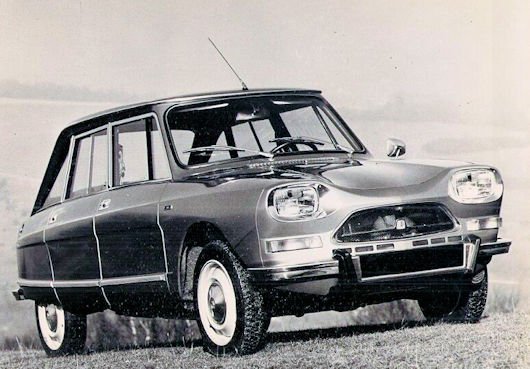
The Citroën Ami Super is a four-door, front-wheel drive car, manufactured and marketed by Citroën from 1973 to 1976.
History
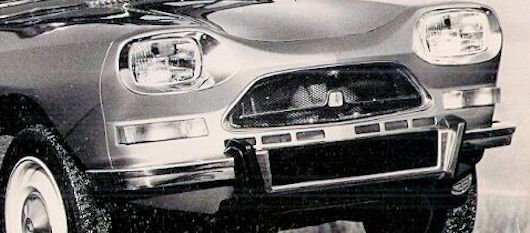
By January 10, 1973, Citroën now expanding its range with the Ami Super. From the outside, it is distinguished by its six additional air intake vents under its grille, which is adorned on the grille with an additional bar highlighting the Citroën logo in a golden yellow plastic trapezium. A small monogram stamped "1015" on the side of the right wing indicates the new engine capacity, it will then be replaced by "Ami Super", as well as on the tailgate. For the rest, apart from a modification at the bottom of the front apron, the bodywork is the same as that of the Ami 8.
Fitted with a 1,015-cc engine specific to the G10/613 type with 53.5 bhp DIN at 6,500 rpm and 6.9 kg m at 3,500 rpm, directly derived from that of 56 bhp and 7, 2 kg m from the GS, an automobile from which it also takes its gearbox, as well as its front brake calliper’s (but without high pressure), it can reach 140 km / h.
PERFORMANCE
- max power (DIN): 53.5 hp at 6,500 rpm
- max torque (DIN): 50 1b ft, 6.9 kg m at 3,500 rpm
- max engine rpm: 6,750; 52.7 hp/l
- max speeds: (I) 29 mph, 47 km/h; (II) 48 mph, 78 km/h; (III) 74 mph, 119 km/h; (IV) 87 mph, 140 km/h
- power-weight ratio: 33.1 lb/hp, 15 kg/hp
- acceleration: standing 1/4 mile 20.4 sec
- speed in top at 1,000 rpm: 14.9 mph, 23.9 km/h
- fuel consumption: 30.4 m/ imp gal, 25.3 m/US gal,9.3 1 x 100 km.
The traditional chassis-platform derived from the 2 CV family is fitted out to accommodate this powertrain (in particular an intermediate front crossmember carrying the engine). It is made of thicker steel sheets in order to improve rigidity which contributes to a significant increase in weight of 85 kg.
Inside, the main visible feature is the floor-mounted gear lever. The dashboard and controls are specific to the new model. With this additional power, it is quieter in everyday use the lowering of the engine speed at equal speed and the distribution by belts of this engine.
The suspension is fitted with two front and rear anti- roll bars and loses the front/rear interaction of the suspension. The geometry of the front axle is modified, the caster angle goes from 15 to 5.20°, the steering, also specific, gains in lightness and smoothness of recall. The tires remain 135 R 15 in size. Iodine projectors are optional. The specific tank has a capacity of 40 litres. Lighter but less aerodynamic, it has a consumption comparable to a GS 1015.
The Ami Super is considered too close to the Ami 8. For the 1974 model year, Citroën will therefore set the Ami Super apart with a strip of high side decoration sides and on the tailgate, as well as with open rims. The Ami Super will be produced in 44,820 copies, in sedan and station wagon, until February 1976 but sold to 1977.
OPTIONAL ACCESSORIES
reclining backrests; electrically- heated rear window; metallic spray; halogen headlamps.
Citroen DS 21 DS 23
 |
|
|
Brand |
Citroen |
|
Years of production |
1965 to 1975 |
|
Production |
1,455,746 |
|
Class |
Luxury Car |
|
Engines |
2,175cc 2,347cc |
|
Gearbox |
Manual, hydraulically operated or automatic |
|
Unloaded weight |
1170kg |
|
Maximum speed |
135 to 188 km/h |
|
Acceleration |
0 to 100 km/h in 10.2 to 17 s |
|
Bodywork |
Sedan |
|
drag coefficient |
0.38 |
|
Length |
Saloon: 4,800 mm |
|
Width |
1790mm |
|
Height |
1470mm |
After the DS 19 which have already been in production for ten years. the model with the new engine which finally brings the DS back on the same level as the most Advanced cars produced in the world. While with the presentation of the ID and the DS the makers’ The 2,175-cc engine capacity and the 109 hp SAE maximum power the new model is as durable and as economical to run as its predecessor. The car's maximum speed is however increased the tachometer in fact shows a scale of braking distances at various stages a warning light for the control of pressure in the servo-assisted braking circuit and also another warning light indicating excess wear of the pads of the disc brakes.
The system is extremely simple: inside calliper pad 'there is a metallic wire which. when it is uncovered by wear on the brake lining. comes into contact with the metallic surface of the disc and consequently closes the signalling system circuit in a manner that is at the same effective. precise and quite simple. Another device adding to the safety of the car is the variable tilt of the headlamps which is controlled automatically according to the trim of the car: the device works by means of systems of levers linked to the front suspension. and these may be easily adjusted during normal controls of the headlands eliminates dazzle to oncoming drivers.
History
Designed by the Italian sculptor and designer Flaminio Bertoni in collaboration with André Lefebvre , an aeronautical engineer, and the hydraulic engineer Paul Magès , the DS could have been partly inspired by the Studebaker Commander Starliner, designed by Raymond Loewy . This car is revolutionary in many ways. Originally, its long bonnet was designed to accommodate a 6-cylinder engine, but both the 6-cylinder in-line of the 15 and the flat one could not be adopted, due to incomplete development and space because this engine 'penetrated' into the passenger compartment. Its code name is "VGD" (Vehicle of great diffusion), the design of the project being launched by the CEO of Citroën Pierre-Jules Boulanger then his successor Pierre Bercot . It was the centrepiece of the 1955 Motor Show. It has an extremely daring line, qualified even as revolutionary, and remarkable interior comfort thanks to its hydropneumatics suspension specific to the brand until May 2017. The DS also includes many technical innovations that set it apart from the world. of the automobile of its time in Europe: power steering, hydraulically controlled power-assisted gearbox, braking assisted by disc brake sat the front, steering pivot in the axis of the wheels and, from September 1967, pivoting headlights, then, from September 1969, introduction of electronics (injection engine). Important safety innovation: the single-spoke steering wheel, copied from the 1903 Humber Humberette and designed to avoid breaking the driver's rib cage in the event of a violent frontal impact. The tachometer of the DS 21 presented in September 1965 will also show the braking distances associated with the main speeds on the road.
After its presentation at the Paris Motor Show on October 7, 1955(at the end of the first day, 12,000 copies were ordered, the brand opting for an effective advertising strategy by having several models cross Paris in parallel in order to attract them to the show), the DS aroused great enthusiasm from the public, so much did its bodywork break with all the aesthetic canons then in force. At the front the muzzle is tapered, and the bumper lined in its centre evokes a thin chrome grille. At the rear, the flashing lights bordering the pavilion look like engine nozzles, and the exhaust outlet is in a "carp's tail" (only the first two years). A full fairing is fixed under the front of the car: this profiled sheet has two air inlets for cooling the brake discs which are attached to the gearbox (cooling with Venturi effect system). The interior equipment is also unusual for a car of this era: single-spoke steering wheel as on the Humber "Humberette" of 1904, futuristic dashboard, pedal-button as a brake pedal, disc brakes standard on the front, etc.).
In 1958, Henri Chapron, a French automobile coachbuilder, created the first DS Convertible. His creations become collector's items. He produced very small series of numerous versions of DS sedans, coaches, convertibles and convertibles. The DS Prestige, presented in 1958, was integrated into the Citroën catalogue in 1965. A rebodied sedan called Majesty was presented in 1964 before being replaced by the Lorraine, only 19 of which were produced between 1969 and 1974.
It was Chapron who is chosen by Citroën to design and manufacture the so-called " factory" convertible, launched at the 1960 show (1961 vintage) and discontinued at the end of the 1971 vintage. 1971), DS 21 electronic injection (1969-1970) and DS 23. An ID variant of the "factory" convertible also exists.
Even the secondary details are astonishing: fixing of the wheels by a simple central nut (until 1966), inclined spare wheel placed at the extreme front of the car, under the bonnet in front of the radiator, rear track narrower by 20 cm that of the front, front and rear tires of different widths, necessary removal of the rear wing (held by two fittings towards the front and a bolt at the rear) to access the wheel during a replacement, gear lever controlling the starter, curved windscreen with very thin uprights… (windscreen which caused problems during its manufacture, because this innovative shape had never been practiced then).
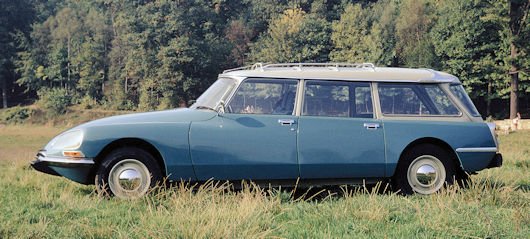
On the tailgate of the DS break, with double opening, there are two license plates: one vertical and set back and the other flat horizontally in order to be visible even when the lower flap of the tailgate is lowered. As on the sedan, the rear trim of the body is kept horizontal even at full load thanks to the suspension trim corrector, which has made it adopted by many traders.
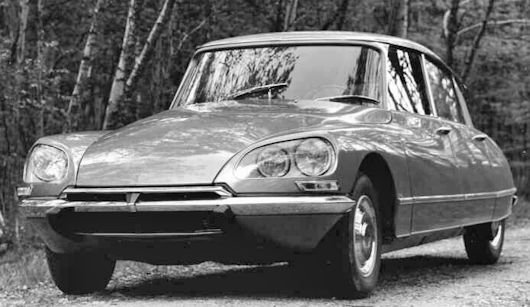
Regarding the bodywork, the first major modification appeared at the 1962 Paris Motor Show, for the 63 vintages: new front bumper with rubber buffers in the shape of vertical boomerangs framing the license plate. The lower apron is no longer separated from the body, while the front fenders are imperceptibly modified, all for an improvement in aerodynamic efficiency (+ 10 km/h), and a modernization of the line. In September 1967 (model year 1968) the front was redesigned again, incorporating four streamlined headlights. Citroën, which bought Panhard & Levassor, in 1965, will "borrow" the idea - for a DS!! - of the double headlights of the 24 CT). The large external headlights including the codes adjust to the plate as on the models after 1965, while the interior long-range headlights with iodine can orient themselves according to the trajectory of the car, at least on the models equipped with power steering. Standard on all DS versions, this device is however optional on the other models in the ID range.
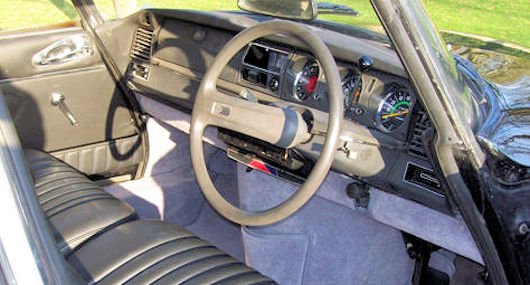
The interior also has several generations of dashboards. The initial panel of the DS 19, in synthetic material in one piece, has aerators at each end replacing deflectors. It is an exercise in style of great purity and very design; it has in particular a splendid watch integrated into the ashtray (until April 1959). It was replaced in September 1961 (model year 1962) by a more ergonomic, more modern version, but above all easier to manufacture and assemble. The last dashboard, common to the entire "D" range, appeared in the 1970 vintage (September 1969) with three round dials: control lights testable by a push button, tachometer and rev counter, the upper part is padded for security reasons. Offering only advantages on paper, the style of this dashboard is for many people not at the level of its predecessors in terms of its style.
Independently of the technical and style modifications, the launch at the 1964 show took place (vintage 1965) of the Pallas finish, available on all DS until production stops. Externally, it can be recognized by its brushed aluminium quarter panels and centre pillars, its stainless steel upper and lower body trim strips, its side protection strips with ribbed rubber insert joining the reflectors, its specific wheels including an ephemeral radially ribbed model for the 1965 model year alone, its front turn signals surrounded by stainless steel as well as its stainless steel-looking plastic rear lights and whose stops are orange in colour until around 1973. On some foreign markets (Belgium, Switzerland etc.) the stops are red while the top of the safe door is lined with an upper strip in stainless steel similar to those of the doors as well as a "Pallas" logo placed on the left symmetrically to the possible "DS21" logo. Additional long-range halogen headlamps simply placed on the front of the front fenders from September 1964 until September 1967 were standard on the Pallas then DS21 but optional on the other models. A medium palladium metallic gray colour is also available and specific to this luxurious Pallas finish. Inside, the doors are fully padded, the interior handles have stainless steel door plates, the floor is covered with a Dunlopillo carpet, the door sills in stainless steel, the backs of the front seats are higher, the fabric-covered roof and, optional,
Mechanical Evolution
It is the first car to generalize the centralized hydraulic systems of assistance, in particular the steering, the braking and the hydropneumatics suspension which makes it possible, with the exception of the first two hundred examples produced; to vary the ground clearance thus facilitating changing wheels, the jack being replaced by an adjustable stand. The hydropneumatics suspension was mass-tested in more than 3,000 units on the rear of the Citroën Traction Avant 15 CV 6 Cylinders "H" from 15 April 1954. But above all, it provided the DS with and exceptional comfort for the time. An engineer's car, its construction required the invention of new precision machines used for the (pneumatic) measurement of parts. Despite its old Traction AV engine, improved with a side camshaft for the first models, its rearing up when accelerating and its dive on the front when braking, its sensitivity to blackcurrants and the fact that the rear passengers may be subject to “seasick “, it was the benchmark for luxury cars throughout the 1960s, giving Citroën a big head start. Since the hydropneumatics suspension system is the only alternative to spring suspension, Rolls Royce and Mercedes adopt a similar technique for their heaviest and also higher-end models. Its comfort and its handling, exceptional for the time, as well as the large space in series for the legs of the passengers in the back.
The four-cylinder in-line engine goes from 1.9 to 2.0 then 2.1 and finally 2.3 Liters hence the designations of the different versions (DS 19, 20, 21, 23). This engine, designed in the 1930s for the Traction, already considered one of the weaknesses of the later Tractions and, a fortiori of the DS, because of its lack of sophistication (lateral camshaft, crankshaft with only three bearings until 1966), evolves all the same and will even still be used on the first CX.
PERFORMANCE: DS 21
- Engine capacity: 132.72 cu in, 2,175cc
- Fuel consumption: 28.8 m/imp gal, 24 m/US gal, 9.8 X 100 km
- Max speed: 108.7 mph, 175 km/h
- max power (SAE): 109 hp at 5,500 rpm
- max torque (SAE): 128 1b ft, 17.7 kg m at 3,000 rpm
- max engine rpm: 6,600
- specific power: 50.1 hp/l
- max speeds: 35.7 mph, 57.5 km/h in 1st gear; 59.6 mph, 96 km/hin 2nd gear; 91.3 mph, 147 km/h in 3rd gear; 108.7 mph, 175 km/h in 4th gear
- power-weight ratio: 25.8 lb/hp, 11.7 kg/hp
- acceleration: standing 1/4 mile 19.5 sec
From the 1969 show, Bosch electronic injection (D-Jetronic type) appeared on the DS 21 electronic injection (139 hp SAE, or 125 hp DIN - 188 km/h). It was in vintage 71 that the mechanical gearboxes received a 5th gear, welcome on the motorways. The following year, all the “21” were offered with a Borg-Warner 3-speed automatic gearbox, as a catalogue option. The “21” gave way to the “23” with 2,347 cc from 1973, providing 115 DIN with carburettor or 130 hp DIN with injection, on the DS 23 electronic injection.
The red liquid, LHS (synthetic hydraulic liquid) used in the hydraulic circuit, caused an epidemic of breakdowns shortly after the launch of the car due to a major oversight by Citroën chemists: this liquid, although identical to that used in aviation, becomes oxidizing above 40 °Cand eats away at all joints in the circuit causing leaks. The slight change in the formula of the LHS2 solved the problem in 1957. From October 66 (model 67) a brand-new green oil of mineral origin, the LHM ("Liquid Hydraulic Mineral"), also used in most machines’ solutions, will solve the problem of leaks and offers the advantage of superior stability with a boiling point of 265 °C. Hydraulic parts for LHS (synthetic hydraulic fluid) and LHM (mineral hydraulic fluid) will be incompatible.
VARIATIONS AND OPTIONAL ACCESSORIES
power-assisted steering; iodine headlamps; separate front seats; boosted heating for temperatures below 200C, 680F Break Luxe 21 separate front seats Familiale Luxe 21 Familiale Confort 21 Break
The DS in the United States
In addition, US law at the time banned certain innovative devices, such as LHM's mineral hydraulic fluid and aerodynamic headlights, two pieces of equipment now common in vehicles sold in the United States. Nevertheless, 38,000 units have been sold in the United States, which is ultimately quite an honourable performance in a market known to be difficult to access for French manufacturers.
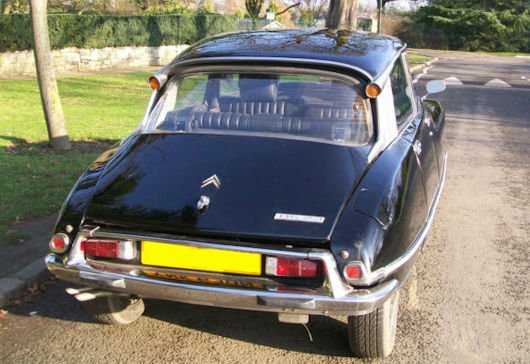
Citroën DS 19 and 20
 |
|
| Manufacturer | Citroën |
|---|---|
| Production | 1955 to 1975 |
| Produced | 1,455,746 (worldwide) |
| Assembly | France, United Kingdom, Australia, South Africa, Yugoslavia |
| Designer | Flaminio Bertoni |
| Class | luxury car |
| Body style | 4-door sedan 5-door Safari station wagon 2-door convertible |
| Layout | MF layout |
| Engine | 1,911 cc (1.911 L; 116.6 cu in) I4 1,985 cc (1.985 L; 121.1 cu in) I4 2,175 cc (2.175 L; 132.7 cu in)109 hp I4 2,347 cc (2.347 L; 143.2 cu in) I4 |
| Transmission | 3-speed automatic 4-speed manual 5-speed manual 4-speed semi-automatic |
| Wheelbase | 3,124 mm (123.0 in) |
| Length | 4,826 mm (190.0 in) (saloon) 4,991 mm (196.5 in) (estate) |
| Width | 1,791 mm (70.5 in) |
| Height | 1,464 mm (57.6 in) (saloon) 1,537 mm (60.5 in) (estate) |
| Curb weight | 1,270 kg (2,800 lb)(saloon) 1,384 kg (3,051 lb)(estate) |
The Citroën DS is an luxury automobile which was manufactured and marketed by the French company Citroën from 1955 to 1975.
History
Styled by Italian sculptor and industrial designer Flaminio Bertoni and the French aeronautical engineer André Lefèbvre, the DS was known for its aerodynamic futuristic body design and innovative technology, including a hydropneumatic self-levelling suspension.The DS was primarily manufactured in Paris, with other manufacturing facilities in the United Kingdom, South Africa, the former Yugoslavia (mostly Break Ambulances), and Australia.
The DS advanced achievable standards in automobile ride quality, handling, and braking. Citroën sold nearly 1.5 million D-series during the model's 20-year production run.After 18 years of secret development as the successor to the Traction Avant, the DS 19 was introduced on 5 October 1955 at the Paris Motor Show. In the first 15 minutes of the show, 743 orders were taken, and orders for the first day totalled 12,000.
The high price tag, however, hurt general sales in a country still recovering from World War II, and a cheaper submodel, the Citroën ID, was introduced in 1957. The ID shared the DS's body but was less powerful. Although it shared the engine capacity of the DS engine (at this stage 1,911 cc), the ID provided a maximum power output of only 69 hp compared to the 75 hp claimed for the DS19. Power outputs were further differentiated in 1961 when the DS19 acquired a Weber-32 twin bodied carburetter, and the increasing availability of higher octane fuel enabled the manufacturer to increase the compression ratio from 7.5:1 to 8.5:1.A new DS19 now came with a promised 83 hp of power.The ID19 was also more traditional mechanically: it had no power steering and had conventional transmission and clutch instead of the DS's hydraulically controlled set-up. Initially the basic ID19 was sold on the French market with a price saving of more than 25% against the DS, although the differential was reduced at the end of 1961 when the manufacturer quietly withdrew the entry level ID19 "Normale" from sale. A station wagon variant, the ID Break, was introduced in 1958.
The DS was the first mass production car with front power disc brakes. It also featured hydropneumatic suspension including an automatic leveling system and variable ground clearance, power steering and a semi-automatic transmission (the transmission required no clutch pedal, but gears still had to be shifted by hand), though the shift lever controlled a powered hydraulic shift mechanism in place of a mechanical linkage, and a fibreglass roof which lowered the centre of gravity and so reduced weight transfer. Inboard front brakes (as well as independent suspension) reduced unsprung weight. Different front and rear track widths and tyre sizes reduced the unequal tyre loading, which is well known to promote understeer, typical of front-engined and front-wheel drive cars.
As with all French cars, the DS design was affected by the tax horsepower system, which effectively mandated very small engines. Unlike the Traction Avant predecessor, there was no top-of-range model with a powerful six-cylinder engine. Citroën had planned an air-cooled flat-6 engine for the car, but did not have the funds to put the prototype engine into production. Despite the rather leisurely acceleration afforded by its small four-cylinder engine, derived from the Traction Avant, the DS was successful in motorsports like rallying, where sustained speeds on poor surfaces are paramount, and won the Monte Carlo Rally in 1959 and controversially in 1966, after the disqualification of the BMC Mini-Cooper team. In the 1000 Lakes Rally, Pauli Toivonen drove a DS19 to victory in 1962.
Australia constructed their own D variant in the 1960s at Heidelberg, Victoria, identified as the ID 19 "Parisienne." Australian market cars were fitted with options as standard equipment such as the "DSpecial DeLuxe" that were not available on domestic European models.
Until 1965 cars were assembled at the manufacturer's Slough premises, to the west of London, using a combination of French made semi CKD kits and locally sourced components, some of them machined on site. A French electrical system superseded the British one on the Slough cars in 1962, giving rise to a switch to "continental style" negative earthing. After 1965 cars for the British market were imported fully assembled from the company's French plant. The British-built cars are distinguished by their leather seats, wooden dashboards, and (on pre-1962 cars) Lucas-made electrics.
The DS was sold in the United States from 1956 to 1972, over which time 38,000 units were sold. While the DS was popular in Europe, it didn't sell well in the United States. Ostensibly a luxurious car, it did not have the basic features that buyers expected to find on such a vehicle: fully automatic transmission, air conditioning, power windows, and a powerful engine. The DS's price in 1970 ranged from US$4,066 to US$4,329.
Also, American luxury-car buyers at the time were conditioned to show off their new cars, the design details of which were changed every model year as a kind of stylistic planned obsolescence, but the DS' appearance did not change substantially in the 16 years it was available in the States.
US regulations at the time banned one of the car's more advanced features, its composite headlamps with aerodynamic cover lenses. At the time, all vehicles sold in the US had to have standard-size sealed beam headlamps; composite replaceable-bulb lamps weren't permitted until late 1983. And cover lenses, even clear ones, are not legal in the US. The first year of aerodynamic glass enclosing the headlamps on the DS was also the first year that feature was outlawed in the US: 1968.
Cars Built By Year
- 1950s 1955: 69 - 1956: 9,868 - 1957: 28,593 - 1958: 52,416 - 1959: 66,931
- 1960s 1960: 83,205 - 1961: 77,597 - 1962: 83,035 - 1963: 93,476 - 1964: 85,379 - 1965: 89,318 - 1966: 99,561 - 1967: 101,904 - 1968: 81,860 - 1969: 82,218
- 1970s 1970: 103,633 - 1971: 84,328 - 1972: 92,483 - 1973: 96,990 - 1974: 40,039 - 1975: 847

The DS was finally phased out in 1976, by which time 1,455,746 cars had been produced, including 1,330,755 built at the manufacturer's original mass-production plant in Paris at the Quai André-Citroën (previously the Quai de Javel). The decision not to continue with the model simplified the company's plans to transfer its principal production lines by 1976 to a new plant being developed further from central Paris, at Aulnay-sous-Bois. The last car came off the production line on 24 April 1975, and the DS was replaced as the large family or executive car in the model range by the smaller CX. By this time the manufacturer had taken the elementary precaution of building up approximately eight month's of inventory of the "break" (estate/station wagon) version of the DS, however, to cover the period till Autumn 1975 when the estate/station wagon version of the CX would be introduced.

Design variations
The DS always maintained its size and shape, with easily removable, unstressed body panels, but certain design changes did occur.
A station wagon version was introduced in 1958. It was known by various names in different markets (Break in France, Safari and Estate in the UK, Wagon in the US, and Citroën Australia used the terms Safari and Station-Wagon). It had a steel roof to support the standard roof rack. Familiales had a rear seat mounted further back in the cabin, with three folding seats between the front and rear squabs. The standard Break had two side-facing seats in the main load area at the back. The Ambulance configuration was similar to that of the Break, but with a 60/30 split in the rear folding seat to accommodate a stretcher. A 'Commerciale' version was also available for a time.
In September 1962, the DS was restyled with a more aerodynamically efficient nose, better ventilation and other improvements. It retained the open two headlamp appearance, but was available with an optional set of driving lights mounted on the front fenders. In 1965 a luxury upgrade kit, the DS Pallas (after Greek goddess Pallas), was introduced. This included comfort features such as better noise insulation, a more luxurious (and optional leather) upholstery and external trim embellishments.
In 1967, the DS and ID was again restyled, by Robert Opron, stylist of the later SM. This version had a more streamlined headlamp design, giving the car a notably shark-like appearance. This design had four headlights under a smooth glass canopy, and the inner set swivelled with the steering wheel. This allowed the driver to see "around" turns, especially valuable on twisting roads driven at high speed at night.
The station wagon edition, the Break (called the ID Safari on the UK market) and "Familiale", was also upgraded. The hydraulic fluid changed to the technically superior LHM (Liquide Hydraulique Minéral) in all markets except the US, where the change did not take place until January 1969.
Rarest and most collectable of all DS variants, a convertible was offered from 1958 until 1973. The Cabriolet d'Usine (factory-built convertible) were built in small series by French carrossier Henri Chapron, for the Citroën dealer network. These DS convertibles used a special frame which was reinforced on the sidemembers and rear suspension swingarm bearing box, similar to, but not identical to the Break (Station Wagon) frame.In addition, Chapron also produced a few coupés, non-works convertibles and special sedans (including the "Prestige", same wheelbase but with a central divider, and the "Lorraine" notchback).

Technical details
It is the first car to generalize the centralized hydraulic systems of assistance, in particular the steering, the braking and the hydropneumatics suspension which makes it possible, with the exception of the first two hundred examples produced, to vary the ground clearance thus facilitating changing wheels, the jack being replaced by an adjustable stand. The hydropneumatics suspension was mass-tested in more than 3,000 units on the rear of the Citroën Traction Avant 15 CV 6 Cylinders "H" from 15 April 1954. But above all, it provided the DS with and exceptional comfort for the time. An engineer's car, its construction required the invention of new precision machines used for the (pneumatic) measurement of parts. Despite its old Traction AV engine, improved with a side camshaft for the first models, its rearing up when accelerating and its dive on the front when braking, its sensitivity to blackcurrants and the fact that the rear passengers may be subject to “seasick “, it was the benchmark for luxury cars throughout the 1960s, giving Citroën a big head start. Since the hydropneumatics suspension system is the only alternative to spring suspension, Rolls Royce and Mercedes adopt a similar technique for their heaviest and also higher-end models. Its comfort and its handling, exceptional for the time, as well as the large space in series for the legs of the passengers in the back, immediately make it the official vehicle of General de Gaulle.
The four-cylinder in-line engine goes from 1.9 to 2.0 then 2.1 and finally 2.3 litres hence the designations of the different versions (DS 19, 20, 21, 23). This engine, designed in the 1930s for the Traction, already considered one of the weaknesses of the later Tractions and, a fortiori of the DS, because of its lack of sophistication (lateral camshaft, crankshaft with only three bearings until 1966), evolves all the same and will even still be used on the first CX.
Performance: 1911 cc
- Max power (SAE): 83 hp at 4500 rpm
- Fuel consumption: 28.2 m imp gal, 23.5 m
- Max speed: 99.4 mph, 160 km h
- Max speed in 1st gear: 24.8 mph, 40 km h
- Max 2nd gear: 49.7 mph, 80 km/h
- Max speed in 3rd gear: 74.5 mph, 120 km/h
- Max speed in 4th gear: 99.4 mph, 160 km/h
- Power-weight ratio: 32.8 14.9 kg/hp
In March 1961, the power of the DS 19 went from 75 to 83 SAE horsepower by increasing the compression ratio (8.5 instead of 7.5), the design of new domed-head pistons and a new double barrel carburettor. In early 1963, Citroën offered a classic 4-speed manual gearbox as an option on its DS 19, hitherto reserved for the most basic ID 19s. The DS 19 becomes DS 19 A by increasing its displacement to 1,985 cm 3 and now provides 90 SAE hp (84 DIN hp), the all-new DS 21 (2,175 cm 3) providing 109 SAE hp (100 DIN hp). At the 1968 show for the 1969 vintage, the DS 19 A became DS 20, a new name justified by the consequent increase in its power, up to 103 hp SAE (91 hp DIN), while the DS 21 saw its power increase to 115 hp SAE (106 hp DIN).
From the 1969 show, Bosch electronic injection (Jetronic type) appeared on the DS 21. It was in that the mechanical gearboxes received a 5-speed gearbox, welcome on the highways. The following year, all the “21” were offered with a Borg-Warner 3- speed automatic gearbox.
The red liquid, LHS (synthetic hydraulic liquid) used in the hydraulic circuit, caused an epidemic of breakdowns shortly after the launch of the car due to a major oversight by Citroën chemists: this liquid, although identical to that used in aviation, becomes oxidizing above 40 °Cand eats away at all joints in the circuit causing leaks. The slight change in the formula of the LHS2 solved the problem in 1957. From October 66 (model 67) a brand-new green oil of mineral origin, the LHM ("Liquid Hydraulic Mineral"), also used in most machines’ solutions, will solve the problem of leaks and offers the advantage of superior stability with a boiling point of 265 °C. Hydraulic parts for LHS (synthetic hydraulic fluid) and LHM (mineral hydraulic fluid) will be incompatible.
Directional headlamps were introduced as an option on the DS in September 1967 (standard on the Pallas model) for the first time on a Citroën. Behind each glass cover lens, the inboard high-beam headlamp swivels by up to 80° as the driver steers, throwing the beam along the driver's intended path rather than uselessly across the curved road. The outboard low-beam headlamps are self-leveling in response to pitching caused by acceleration and braking.

In Film and TV
- In the film Back to the Future Part II, a modified Citroen DS was featured as a taxi cab when the main characters visited the future in 2015.
- The film The Goddess of 1967 was named after the DS. The movie is about a 1967 DS or goddess (déesse in French).
- In the film Tinker Tailor Soldier Spy the character Peter Guillam portrayed by Benedict Cumberbatch drives a brown DS.

Citroën Ami 6
 |
|
| Manufacturer | Citroën |
|---|---|
| Production | 1961 to 1969 |
| Class | Motor Car |
| Body style |
4-door saloon,5-door estate,3 door van |
| Layout | Front engine |
| Engine | 602 cc flat-2 |
| Drive | Front wheel drive |
| Wheelbase | 95 in (2,413 mm) |
| Length | 154 in (3,912 mm) |
| Width | 60 in (1,524 mm) |
| Height | 57 in (1,448 mm) |
| Dry weight | 1411 1b, 640 kg |
The Citroën Ami 6 is an automobile, produced by the French automaker Citroën from 1961 to 1969.
History
The Citroën Ami 6 (also called the "3 CV ") is a sedan and station wagon and van produced by the French automobile manufacturer Citroën from 1961 to 1969. The Ami 8 will take over until 1978. The primary objective was to offer customers a compromise between two models, the top-of-the-range DS, and the low range 2 CV.
The first Citroën Amis built on the 2 CV platform were manufactured in the Panhard factory in Paris, then in the newly created Rennes-la-Janais and in Belgium. However, in a 2 CV, the lowering of the roof is such that the rear window forces passengers to lean their heads forward. Flaminio Bertoni, creator of the Traction Avant, 2 CV and DS, finds a solution: it proposes to reverse the slope of the window to offer passengers more comfort. The inverted rear window, results in a rather controversial "Z" profile. However, it allows easy access to the imposing rear trunk. Presented for the first time on the 1953 Packard Balboa X prototype.
The 425-cc twin-cylinder boxer engine of the 2CV was seen as not being powerful enough for the weight of the bodywork envisaged, its displacement was increased by the bore size while keeping the same engine base. It will be set at a larger 602 cc to stay within the administrative limit size of 610 cc.
The Ami 6 innovates on the sociological level by presenting itself on advertising documents as the ideal second car for lady drivers. As for the name "Ami", it would have been born from the association of the name AM, following the M project, of the number 6 corresponding to its engine capacity.
In April 1961, the Ami 6 is inserted between the popular 2 CV and the revolutionary DS in the range. To do this, the takes best assets of the robustness and rusticity of the 2 CV chassis platform and mechanics as well as the finish inspired by the DS soft seats, single-spoke steering wheel, door handles and controls. The car quickly met with success, despite flaws such as too thin sheet metal bodywork, a rear trunk opening latch located under the rear seat and spartan equipment no automatic windscreen wiper return until August 1961, as well as the evacuation of rainwater accumulated in the roof gutter which required two modifications before the appearance of two holes in line with the uprights in July 1962 first positioned above the windshield wipers, they caused runoff on the windshield in the event of heavy rain; then completely removed, packets of water spilled out during braking). The wiper blades first oriented towards the bottom of the windscreen on the driver's side are quickly replaced by blades aligned in the axis of the brush holders.

In September 1963 the opening of the bonnet was controlled at the bottom of the dashboard and on the left by a ring pull and a cable connected to the striker fixed to the front face now comprising an intermediate central sheet visible at the front of the car above the grille. In addition, a semi-automatic centrifugal clutch is now available as an option as on the 2CV. Between December 1963 and January 1964 the pedals of clutch and brake in the floor as on the 2CV are replaced by suspended pedals. From the start of production, the front windows are sliding for their rear half, those of the rear doors are fixed until August 1961. The window frames are made of aluminium, with a gouge line up to July 1963. Then they have three features until the replacement for the 1969 model year by steel profiles in the colour of the bodywork or covered with a stainless-steel trim on the "Club" station wagon finish.
The third window of the Ami 6 station wagons is just surrounded by a large black rubber seal with a thin stainless-steel strip in the “Club” finish. The top of the dashboard, first in hard gray plastic, is quickly covered with a flexible plastic coating of the same colour. For the 1967 model year, the dashboard became black. The comfortable seats are removable.

From a mechanical point of view, the twin-cylinder boxer engine has an displacement of 602 cc. First with a power of 22 hp SAE in 1961 then 26 hp by the 1964 models, for a top speed of 110 km/h, it ends with 28 hp by 1968 models for a speed of 112 km/h. The last models feature a 35 hp SAE engine (32 hp DIN), at the compression ratio increased to 9/1. It is equipped with a double-barrel carburettor (21/24) fed with forced air and a specific camshaft, which allows the car to reach a speed of 123 km/h.
Performance 22 hp
- Engine Capacity : 36.82 cu in, 602 cu cm
- Fuel Consumption: 47 mils per gal, 39.2 m NS gal, 6 x 100 km
- Max Speed : 65.2 mph, 105 km/h
- max power (DIN): 22 hp at 4500 rpm
- max torque (DIN). 30 1b it, 4.1 kgm at 2800 rpm
- max number of engine rpm: 4500
- specific power: 36.5 hp/l
Because of its chassis base, there are characteristics of the 2 CV on the Ami 6. The brakes are drums on all four wheels. The front brakes have a diameter of 220 mm against 200 mm on the 2 CV with cooling fins, and are attached to the gearbox. This is four gears all synchronized. The transmission to the wheels is done by double cardan joints, therefore constant velocity.
The bodywork is entirely bolted together, but the very light-coloured roof, first in fiberglass, then in synthetic material, is riveted to the body. From October 1967 the saloon received an optional half-sunroof in canvas or a roof painted in red or blue. The rectangular section headlamps developed by Cibié is a new feature. They replace the round parabolic mirror optics fitted to all the brand's other models. Which now allows the return of a denser reflected light beam but requires an increase in diameter. The rectangular headlight being truncated at the top and bottom, the truncation reduces the efficiency which is compensated by a set of three reflectors. Thus, with the same bulbs, the light intensity is twice as high as that of a conventional projector. Rectangular headlights and oval headlight bezels from the Ami 6 were used on the Maserati 5000 GT Allemano also fitted to Lamborghini 350 GTs.
The suspension of the Ami 6 takes up the same principle by the 2 CV. The suspension is by lateral horizontal springs compressed by a system of connections to the wheels by tie rods. They are housed in a cylindrical pot under the sides of the platform. All four wheels work independently. A mass stabilizer is present on each wheel and an elastic interaction system between the front and rear suspension completes the system. In June 1963 are replaced by four telescopic hydraulic shock absorbers which no longer require periodic adjustments. This quadruple effect system (springs, shock absorbers and front/rear elastic interaction achieves a particularly high-performance level of suspension which will be used on the Ami 8 by the addition of a front anti-roll bar limiting the effect of roll in curves.

In January 1964, the range is expanded with a station wagon which will quickly exceed the production and sales figures of the saloon. The explanation comes as much from its more conventional line as from its adaptation to the rural environment. The station wagon has better aerodynamics than the sedan. Thanks to the new bodywork.
In the fall of 1965, the seats with padded trim were replaced by longitudinal ribs and the lights of the sedans adopted those of the smaller station wagons and other utility vehicles in the Citroën range. From June 1966 for the sedan and September 1966 for the break, the electrical equipment goes to 12 volts instead of 6 volts previous, the dynamo is replaced by an alternator. The dashboard changes colour, it becomes partially black and the red charging light disappears. On the outside, the 1967 models are recognizable by the grille with horizontal bars and the ventilation grille streaked with small chrome bars. At the beginning of 1968, the rear lights were redesigned and grouped together on a trapezoidal block which would be fitted to the 2 CV in 1970 until the end of production.
Later by May 1968, the Ami 6 monogram in gilded brass affixed to the edge of the trunk identifies the model. Also in 1968, the range was completed by the Club version first on the estate then on the saloon which is distinguished by its four round headlights, its side mouldings, and elegant interior finish with mixed fabric seats in the centre and sides with reclining backrests.
The Ami 6 was also sold in the United States from 1962 to 1963 with the specific features that this country imposes, reinforced bumpers and a special lighting system. All versions combined; the Ami 6 was built in more with more than a million copies.

The Citroën Ami 6 side view
Citroën Ami 8 and Super
 |
|
|
Make |
Citroen |
|
Years of production |
1969-1978 |
|
Class |
Motor car |
|
Fuel |
petrol |
|
Engine |
Citroën boxer (flat-twin) G series (flat 4) |
|
Engine position |
Longitudinal front |
|
Drive |
Front wheel drive |
|
Displacement |
602 to 1015 cc |
|
Maximum power |
22–55 DIN hp (16–39 kW) |
|
Transmission |
Traction |
|
Gearbox |
4-speed manual |
|
Unloaded weight |
620 to 805 kg |
|
Maximum speed |
105 to 144 km/h |
|
Bodywork |
Saloon notchback, hatchback, Break |
|
Length |
3,958 to 3,960mm |
|
Length |
1520mm |
|
Height |
1480 to 1485mm |
The Citroën Ami 6 is an automobile, produced by the French automaker Citroën from 1969 to 1978.
History
In March 1969, at the Geneva Motor Show, the Ami 6 was replaced by the Ami 8. This incorporates most of the bodywork elements of the Ami 6 identically platform, body, doors, roof, rear wings except for the location of the red lights and brings a more classic line thanks to a front completely redesigned with a so-called “Italian-style” bonnet. The models first in 1969 and 1970 did not feature the Citroën chevrons on the grille. The restyling is done under the direction of stylist Robert Opron, who also worked on the GS, the CX and the SM coupe.

The Ami 8 is available in "comfort" and "club" versions with separate front seats, stainless steel window surrounds and also available as a station wagon, still highly prized by the clientele, especially rural ones. The sedan abandons the inverted rear window, but does not benefit from a tailgate. From the 1971 models, the sliding front windows were abandoned in favour of crank-operated descending windows, the rear windows would remain sliding until the end of production.
On the mechanical side, the twin-cylinder 602 cc M28 engine is still present, with a double-barrel carburettor and a redesigned intake manifold and with a revised 4-speed gearbox. The power gain allows the Ami 8 to be equipped, for 1970, with disc brakes at the front, attached to the gearbox, and a ball joint transmission. The front and rear suspensions gained a front anti-roll bar torsion bar linking the two-wheel arms of the same axle. The maximum speed of the sedan is given for 123 km/h, that of the station wagon 120 km/h.

In early 1973, Citroën presented the Ami Super, powered by a 1,015cc engine of the first GS. Due to reliability and power consumption issues, it was a commercial failure. Copies in good condition are highly sought after today. When Citroën was taken over by Peugeot in 1974, production of the Ami 8 estate and saloon continued. In 1976, sales of the Ami 8 plummeted, dropping from 90,000 copies in 1974 to 54,000 copies. Citroën put an end to the line by presenting two new models, based on Peugeot 104: the LN in 1976 (104 coupé) and the Visa in 1978. The latter, driven by the two-cylinder engine increased to 652 cc with integral electronic ignition on the basic versions, replaces the Ami 8 but will never have an estate version.
The Ami 8 sedan finished in July 1978, followed in September by the station wagon, the last examples of which feature a black dashboard. It was not until the arrival of the ZX station wagon, in 1994, that the Ami 8 station wagon finally had a real successor.

Ami Super (1973-1976)
In January 1973, Citroën is expanding its range with a top-of-the-range model, the Ami Super. Equipped with a powertrain directly derived from the GS with first 1,015cc 55 hp engine, later increased to 61 hp. The platform is reinforced, as well as the cooling of the engine by small additional openings under the grille and uprated front brake callipers, it can now reach 140 km/h.
From the outside, it is distinguished by its six additional air intake vents under its grille, which is adorned on the grille with an additional bar highlighting the Citroën logo in a golden yellow plastic. A small monogram stamped "1015" on the side of the right wing indicates the new engine capacity, it will then be replaced by "Ami Super", as well as on the tailgate. For the rest, apart from a modification at the bottom of the front apron, the bodywork is the same as that of the Ami 8, but the sheet metal is a little thicker. Similarly, the traditional chassis-platform derived from the 2 CV family is also thicker in order to improve rigidity), which together with the new engine contributes to a significant weight increase of 85 Kg. Inside, the main visible feature is the floor-mounted gear lever. The dashboard and controls are specific to the new model. Despite its 67% more power, it is quieter in everyday use thanks to the timing belts.
The suspension is equipped with two front and rear anti-roll bars. The geometry of the front axle is modified, the steering becomes lighter and smoother. The tires are 135 R 15 in size. The tank, specific to these models, has a capacity of 40 litres. Lighter but less aerodynamic, it has a consumption comparable to a GS 1015.
The Ami Super is considered too uninhabitable for a 6 CV, as well as not very rewarding because it is too close to the Ami 8. For the 1974 model year, Citroën will therefore set the Ami Super apart with a strip of high side decoration sides and on the tailgate, as well as with open rims. The Ami Super will be produced in 44,820 copies, in sedan and station wagon, until February 1976. The last of the stock sales will run until 1977.there is a convertible, the Ami Super XC, created in two copies by private individuals.


