
Chevrolet
Chevrolet Chevelle Third generation
|
|
|
|
Production |
1973 to 1977 |
|
Class |
Motor Car |
|
Assembly |
United States, Canada |
|
Body style |
2-door coupe |
|
Engine |
250 cu in (4.1 L) Turbo-Thrift I6 |
|
Transmission |
3-4 speed manual |
|
Wheelbase |
112 in (2845 mm) Coupe |
|
Length |
209.7 in (5,326 mm) (sedan) |
|
Width |
77.3 in (1,963 mm) |
|
Height |
54.1 in (1,374 mm) (sedan) |
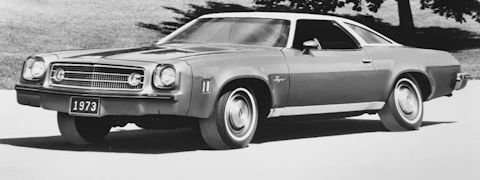
The Chevelle Chevrolet third generation came in 1973 also called the Malibu, Chevrolet Chevelle Laguna.
The Chevelle was revised for the 1973 model year that included frameless side windows in the doors and fixed B pillars. The rear side windows on the coupe could not be opened, but there was a surcharge still for GM air conditioning. Single seats and center consoles for automatic and manual cars were offered in all models, as well as additional instruments. Disc brakes on the front and drum brakes on the back and a brake booster were standard equipment. Packages, air conditioners and stereo radio recorders were ordered more frequently during these years. In the model years 1973-1975 there was an electrically operated glass sunroof on request.
The engines ranged from the 4.1-liter straight-six to the powerful 7.4-liter V8. Hardened valve seats and hydraulic lash adjuster made the engines reliable and enabled the use of increasingly popular unleaded gasoline. Cross-flow coolers and closed cooling systems, which avoided the air entry into the cooling system, prevented the overheating of the engines.
The station wagon was available with six or nine seats and a large tailgate. The Chevrolet El Camino and the GMC Sprint wereb ased on the Chevelle. As before, the shape of the front and rear has changed a little every year. The Chevelle was among the best sellers of GM, as was the Oldsmobile Cutlass which was also built on the GM-A platform.
The 1973 model range began with the top model Laguna with its PU nose, followed by the Malibu and Deluxe models. The Super Sport package was available for the Malibu coupes and this year only for the station wagons. The SS package consisted of a black grille, SS emblems inside and out, stripes on the sides of the vehicle, rally wheels and tires with white lettering, the F41 sports suspension with rear and front stabilizers and a V8 engine with 5.7 or 7, 4 liters capacity (350 or 454 cu.in.). For the so motorized vehicles, there was also a 4-stage Muncie transmission. Performance: 454 cu in. Max speed: about 121 mph, 195 km/h; max power (DIN): 215 hp at 4,000 rpm;max torque (DIN): 350 1b ft, 48.3 kg m at 2,400 rpm; 27.8 hp/l power- weight ratio: Chevelle Malibu Sedan 19.1 lb/hp, 8.7 kg/hp - Chevelle Malibu Classic Sedan 19.4 lb/hp, 8.8 kg/hp; speed in direct drive at 1,000 rpm: 28 mph, 45 km/h; fuel consumption: 12.8 m/ imp gal, 10.7 m/ US gal, 22 1 x 100 km.
In 1974, the Laguna S-3 coupe replaced the SS as an uprated sports version of the Chevelle. Nomenclature S3 referred to the third generation of the Chevelle. The cars had a special PU nose, stripes on the sides of the vehicle, Laguna S-3 emblems, rally wheels, four-spoke steering wheel and the F41 sports suspension with stabilizers rear and front. Radial tires on 15 "rims and a matching chassis provided for traction and the then introduced three-point automatic belts are still used in modern vehicles. A 6.6-liter V8 engine was new this year. The 7.4l -V8 was the top engine and was combined with a TurboHydraMatic 400 automatic or a Muncie four-speed gearbox.
Since the Laguna was now the sports model of the Chevelle, the top models were now in Malibu Classic renamed and offered as a sedan, coupe or station wagon. Unlike the 1973 Laguna, the Malibu Classic had the same grille as the simpler Chevelle models, but a sprung cooler figure. Inside, the Malibu Classic had luxurious furnishings with benches and foldable backrests (or optional strato single seats) covered in fabric or vinyl. In addition, there were door panels made of carpet, wood imitation on the dashboard, vertical "Opera Windows" (small windows in the C-pillars) in the coupe and imitation wood on the sides of the station wagon. This year was also the Chevelle Deluxe series away, making the normal Chevelle Malibu the entry-level series.
OPTIONAL ACCESSORIES
limited slip differential; Turbo. Hydramatic automatic transmission with 3 ratios steering column lever, 2.730 or 3.080 axle ratio; power-assisted steering; tilt of steering wheel; servo brake; electrically controlled windows; vinyl roof; air-condition; electrically-controlled sunshine roof (for coupes only).
The 1975 Laguna S-3 was introduced in the middle of the model year, in February, and had a new, rising Nascar-style front. HEI - High Energy Ignition - provided strong spark with minimal maintenance and increased power. The larger distributor cap resulted in better high-speed performance because it prevented a spark from being sent to the wrong spark plug. The 7.4-liter V8 in conjunction with the TurboHydraMatic 400 was delivered in the first half of the model year, then there was the 6.6 -liter V8 as a top engine.
In 1976 there was the Chevelle with the new 5.0-liter V8, the 5.7-liter V8 or the 6.6-liter V8.In 1977 the Malibu Classic was the top model and the 5.7-liter V8 the top engine. There was a Chevelle SE (Special Edition), which featured spoilers front and rear, rally wheels, a special livery and a sports suspension. But only 50 copies were built.
The 1973-1977 Chevelle was the most successful car in the 1970s NASCAR race. The car was so popular and successful on the racing circuits that in 1975 Chevrolet supplied a new nose that led to today's aerodynamic cars. The cars dominated the races so much that the Nascar organization dictated the use of a cover plate for the carburetors for all Chevelle Laguna. Drivers of these cars were: Darrell Waltrip, Junior Johnson, Benny Parsons, Cale Yarborough, Bobby and Donnie Allison, Bobby Isaac, Lennie Pond, AJ Foyt, Ricky Rudd, Dale Earnhardt and the driver Janet Guthrie.
As GM downsized the mid-size models in 1978, they dropped the name Chevelle and called the model only Chevrolet Malibu .The third generation of the Chevelle created about 1,600,000 copies in five years.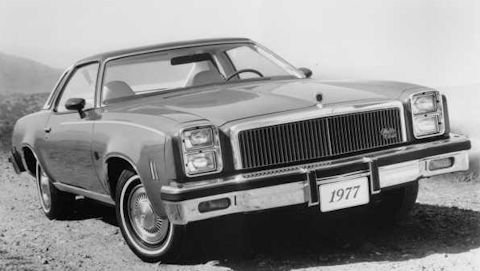
Chevrolet Standard Series EC (1935)
 |
|
|
Production period: |
1935 |
|
Body versions : |
Touring car , roadster ,sedan , coupe |
|
Engines: |
Gasoline : 3.4 Liters (54 kW) |
|
Wheelbase: |
2718 mm |
|
Curb weight: |
1092-1212 kg |
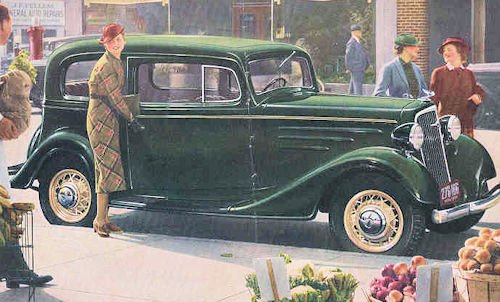
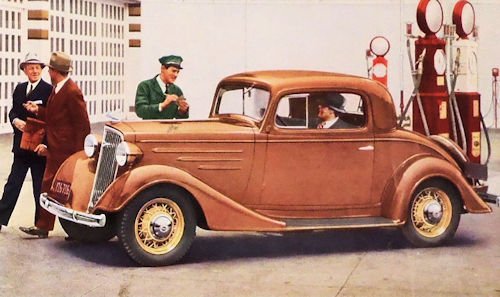
The styling of the standard models changed nothing in 1935, but it came a larger engine, which was taken from the middle-class model Master .The 1935 Chevrolets were the last models with any previous styling relationship to the classic era. A wide model line up was still offered. Standards were priced at $465-$550. While standards kept a 107-inch wheelbase, Masters used a larger 113-inch.
The standards developed only 74 bhp. In the standard the 3,388-cc engine six-cylinder with only 74 hp (54 kW) at 3200 rpm . The oiling system is positive pressure feed to crankshaft main bearings, camshaft bearings and valve rocker arms. Vane type pump in crankcase; oil pressure gauge in instrument panel. Crankcase ventilator.
oil pump capacity 8.5 quarts per minute. Screen on intake side of oil pump. A positive stream of oil is forced along the path of each connecting rod dipper from opposite direction than that of rotation of connecting rod.
Furthermore, five different bodies were offered. All cars equipped with high pressure gun lubrication system; complete tool kit; automatic stoplight: rear vision mirror; full vision one piece windshield: automatic two-beam headlamps: parking bulbs on all passenger models.
Adjustable sun visor on closed models. Fisher No Draft Ventilation on all closed models. Top boot on open models.
The Coach features adjustable driver’s seat and flat floor of the rear compartment. upholstery mohair of heavy. long-wearing texture Fisher No draft Ventilation and cowl ventilator. The Standard Six Coupe is favoured as a personal or a business car for the small family The deep cushioning, upholstered in extra-heavy, long-wearing mohair. The rear luggage compartment provides large capacity. The driver’s seat is adjustable by means of "linger-tip" control. unusually large capacity. Fisher No Draft Ventilation, overlapping doors and insulation against heat and cold assure snug protection in inclement weather and cool driving in summer.
With 201,773 copies, this standard clearly exceeded its predecessor.
Chevrolet Series S10 GMC Sonoma Second Generation
 |
|
|
Also called |
GMC Sonoma |
|
Production |
1993–2004 (North America) |
|
Model years |
1994–2004 (S-10/Sonoma) |
|
Assembly |
United States, Brazil, China |
|
Platform |
GMT325 |
|
Engine |
|
|
Transmission |
4-speed 4L60-E automatic |
|
Wheelbase |
108.3 in (2,751 mm) to (122.9 in (3,122 mm) |
|
Length |
190 in (4,826 mm) to (205 in (5,207 mm) |
|
Width |
67.9 in (1,725 mm) |
|
Height |
63.5 in (1,613 mm) |
The second-generation pickups appeared in 1993 for the 1994 model year. All special models (Syclone, Typhoon, Sonoma GT) had now disappeared, but the changes brought the cars on a plane with the Ford Ranger . The Iron Duke engines and the 2.8-liter V6 engine were no longer available; only the 4.3-liter V6 engine and a new 2.2-liter R4 engine derived from the old Cavalier engine were added. In this generation airbags were introduced as safety equipment for the first time , which came however only in the second model year (1995). The vehicles of other manufacturers, which appeared this year as a new generation, for. As the Dodge Ram Van 1994 had models without airbag.
The S-Series comes in two price levels, base and LS. A driver-side rear door is optional on extended-cab models. The door contains side-impact protection and can be opened only when the front door is open. The short bed is six feet long and the long bed is 7.5 feet. The standard slab-sided cargo bed is called Fleetside, and the optional flared-fender cargo bed is called Sportside and is available with the 6-foot-long bed. A driver-side air bag, 4-wheel anti-lock brakes, and day-time running lights are standard.
Regular-cab S-Series pickups come with a standard 3- place bench seat. Extended-cab models add two rear jump seats, though the left-side jump seat is eliminated on models with the third door. Front bucket seats are optional.
Most suspension components were adopted by the previous generation, as were the steering, the leaf springs and the differential. In this second generation, there was also an optional 8.5 "differential (usually in the S-series four-wheel drive vehicles together with the ZR2 off-road package and 2000-2003 also in rear-wheel drive models with the Xtreme package).
Generally there was the 8.5 "differential only with a manual gearbox and the big 4.3L V6 engine; in the four-wheel models, there was this differential with each gearbox. This year, GM also introduced the ZR2 off-road package.
The 4.3-liter V6 engine was redesigned in 1996 and the extended-cab version got a third door. In 1998, revised the exterior, the interior, the brakes and the 2.2-liter R4 engine. In 1999, there were on request the four-wheel drive Auto-Trac Blazer. Likewise, the SS package was replaced by the Xtreme package. As of 2001, there was a crew cab version , but only with all-wheel drive and automatic transmission.
The Xtreme package was available for all cabs, wheelbases and drives. It was only available from the factory with the 2 "(50 mm) lower ZQ8 sports suspension. The Xtreme package consisted of a lower body, a "Ground Effects" package along the entrances and the bunk, signage plates on the front doors and tailgate, and Goodyear's 23 "aluminum wheels with 235/55 R16 tires . On request, there were also rally stripes and a heat graphic package, individually or in combination, to.
The rear-wheel drive base models had 6.5 "× 15" vents with a given direction of travel, Xtreme and ZQ8 models had 8 "× 16" wheels, and the four-wheel models had ZR2 package 7 "× 15" wheels , The 14 "wheels of the first generation did not exist anymore. The second generation S series was also made in Brazil; There she was still built after production ceased in the US in 2004. Brazilian S-10 have a different grille and are available with a 2.8-liter diesel engine MWM .
S10 SS
The SS (Super Sport) option package, available on 2WD regular-cab, short-bed LS models, includes a sport suspension, body-color grille, and alloy wheels. An off-road package called the ZR2 Wide Stance Sport Performance.
The Chevrolet S10 SS was the high-performance version of the S10 and was introduced in 1993. Less than 3000 were produced on average annually. When it was introduced, the SS was only available in three colors: Onyx Black, Apple Red or Summit White. The SS was made only until 1998, then replaced him from the S10 Xtreme.
The 4.3-liter V6 engine (also available on request for the other S10s) was the usual SS engine. It produced 180 hp (134 kW) or 195 hp (145 kW). The SS design was associated with lower ground clearance, cosmetic changes such as a different grille, body color bumpers, 16 "wheels and other sports modifications. All SS versions had a normal cab.
S10 Electric
In the model years 1997 and 1998, a number of about 60 electric vehicles was built on the S10. The vehicles have a short loading area (short bed). The electric motor used has a power of 85 kW.
In September 1982, Chevrolet launched a smaller blazer than Blazer S-10 . 106,000 blazers were sold in the first year of production.
The Chevrolet Blazer was revised in October 1994 both technically and visually fundamentally. In 1998 there was another facelift.
In parallel, GM launched the GMC S-15 Jimmy . In 1991, the production of the Oldsmobile Bravada was recorded. All three SUVs were based on the same platform, with the GMC Jimmy and the Chevrolet Blazer offered largely identical equipment variants, while the Oldsmobile Bravada was settled in the higher-quality segment.
As of 1999, a higher-quality equipment package was offered under the name TrailBlazer and 2000 was a new model with this name in the sales. While the three-door model was still regularly offered, the five-door model could only be ordered as a fleet vehicle. In December 2005, the production of the Blazer was discontinued.

Chevrolet Suburban Eighth Generation
 |
|
|
Production |
1991–1999 (US) |
|
Assembly |
USA, Mexico |
|
Class |
Off Road SUV |
|
Body style |
4-door |
|
Layout |
Front engine, rear / four-wheel drive |
|
Platform |
GMT410/425 |
|
Engine |
6.5 L (395 cu in) L56 & L65 Turbo Diesel V8 |
|
Transmission |
4-speed automatic 4L60 ,4L80 |
|
Wheelbase |
131.5 in (3,340 mm) |
|
Length |
Chevrolet: 219.5 in (5,575 mm) |
|
Width |
77.0 in (1,956 mm) |
|
Height |
68.8 in (1,748 mm) (1992–94 GMC) – 74.6 in (1,895 mm) (1997–99 2500 4WD) |
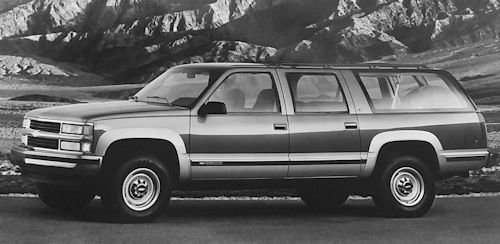
Since their arrival on the market in 1992, these large utility vehicles have sold out. Yet, they offer nothing particularly spectacular compared to the models they replace. The exterior design and the mechanicals were designed as an evolution of the previous version. Whereas in the past, the bodies of these models were very rigid. As desired, the bodies are rock-solid. Furthermore, greatly improved build quality in recent years. The handling offers another surprise. On bumpy roads, both the Blazer/Yukon and the Suburban maintain their composure. The trajectory is always good, and the rear axle handles very respectably. It's worth noting the "isolation of the suspension components from the road, which greatly adds to the comfort. In addition, the interior isn't a problem given the more than generous dimensions of these utility vehicles.
They are not without their faults, however. You shouldn't expect very precise and responsive steering, and the front seats don't offer all the support you need. Furthermore, the dashboard isn't unanimously appreciated, and its ergonomics could easily be improved. Rear-drive Suburbans carry the "C" designation, and 4-wheel-drive models use a "K" designation. The 1500- series Suburbans have a half-ton payload rating and the 2500 series a three-quarter ton rating.
From 1991 to 1999 with a 5.7-liter small-block - V8 engine with 254 horsepower, a 7.4-liter big block -V8 engine with 290 horsepower and a 6.5-liter V8 small block diesel engine with Turbocharging and 195 hp.
A 4-speed automatic transmission comes with all engines. Suburban 4X4s use General Motors' Insta-Trac 4WD system, which allows shifting in and out of 4WD on the fly. A floor-mounted transfer-case lever is standard. An electronic transfer case that uses dashboard buttons is optional.
The 5.7-liter V8 engine is quite fuel-thirsty, especially when the vehicle is heavily loaded. On the other hand, the 6.5-liter V8 is significantly more economical and good acceleration. The Suburban is a "family" version of these utility vehicles. No other vehicle can carry as many people and luggage. Its price is almost as high as its size, but it meets the needs of those with very specific requirements. Like the Blazer/Yukon, the Suburban is derived from the full-size C/K pickup truck, with which it shares its mechanicals, front end, and dashboard. The choice of engines is even wider than with the 4x4 utility vehicles, because in addition to the 5.7-liter V8 gasoline engine and the 6.5-liter turbo diesel, it is also possible to choose from a order a 7.5-liter V8 developing 230 horsepower and 385 lb/ft of torque at 1600 rpm. With such statistics, it is possible to tow the most imposing trailers.
From the end of 1999 to 2005 with a 5.3-liter Vortec low-power V8 engine with 217 kW (295 hp), a 6-liter V8 engine with 246 kW (335 hp) and an 8.1-liter -V8-Bigblock with 235 kW (325 hp).
The Suburban based on the GMT 400 was introduced in model year 1992. The same type pickup truck models were offered on newer platforms from model year 1998th There were again models with rear and four-wheel drive, as "C" and "K" referred, as well as those with 0.5 to. and 0.75 to. Payload ("1500" and "2500").
The base engine was the 5735cc V8 engine (Chevrolet Small Block). The V8 engine with 7440 cc displacement (Chevrolet Big Block) was available on request in the 2500th The 6.5 -Liter turbo diesel engine was available in all versions on request, although he was rarely ordered in the 1500.
For the 1500 there was the automatic transmission GM 4L60 with 4 stages, for the 2500 the more powerful automatic transmission GM 4L80. Manual transmissions were no longer offered.
Independent front suspensions were introduced with the GMT400. The rear-wheel drive models have coil springs and the four-wheel model’s torsion bars on the front axle. All models have a leaf-sprung rigid axle at the rear.
The 1995 Suburban accelerates from 0 to 100 km / h in 11.7 seconds. The turning circle diameter is 14.57 m.
Three trim levels are offered, base, LS, and LT. LT is the top-of-the-line that includes leather seating surfaces. Seating for up to nine on three rows of bench seats is available. The middle bench seat splits and folds, and the rear bench is removable. Front bucket seats are optional with LS and LT trim.
The simplest equipment is the LS version, then follows the LT . There was either a seat or single seats in the first row of seats and on request there was a third row of seats. So, between 2 and 9 seats can be realized.
In the spring of 1995, General Motors introduced its new versions.The chassis has been modified at the rear, while the suspension geometry is exclusive to this version. In addition, the shock absorbers and springs are specially calibrated for the four-wheel drive version.
From 1994 there were innovations every year:
- Revised front end and 3rd brake light (1994)
- New interior with driver's airbag , new rearview mirrors (1995)
- New, uprated, more fuel-efficient 5.7-liter and 7.4-liter engines, electronically shiftable all-wheel drive, daytime running lights, entry-level lights and some interior modifications (1996)
- New transmissions, improved steering and passenger airbag (1997)
- Immobilizer and permanent four-wheel drive on request, new airbags, new steering and new gearboxes (1998)
- In 1999, no changes were made until the introduction of the new 2000s models.
Trailer towing capacity is 6500 pounds with the 1500 series and 10,000 pounds on the 2500 series with the 7.4-liter V-8.
In 1998, Holden introduced a right-hand version of the Suburban for the markets in Australia and New Zealand. The vehicles available with gasoline or diesel engines have the dashboard of the right-hand drive Chevrolet Blazer (1995-2005).
Chevrolet Series FB
 |
|
|
Production period: |
1919 to 1922 |
|
Body versions : |
Touring car , roadster ,sedan , coupe |
|
Engines: |
Gasoline engine : 3.7 liters (27 kW) |
|
Wheelbase: |
2794 mm |
|
Curb weight: |
1196-1336 kg |
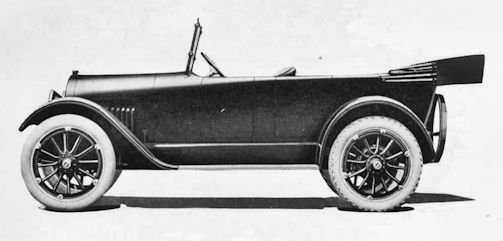
In the model year 1919, the series FA was renamed FB series. Initially, 1514 pieces of the 2-door FA sedans under the name FB -40 were further developed. The other vehicles of the FB series had a chassis with 2794 mm wheelbase. These were a 2-seater roadster with 2 doors ( model FB-20 ), a 3-seater coupe with 2 doors ( model FB-30 ), a 4-seater sedan with 4 doors ( model FB-40 ) and a 5- seated tourer with 4 doors ( model FB-50 ) shown above. Engine, drive and brakes remained the same. The selling prices were between 1110, - and 1685, - US $.
In 1920, the styling was revised. Like the lower-priced models of the 490 series , the FB received sweeping lines around the bulkhead. With these changes, the models were manufactured until 1922. Last year prices fell to 865, - to 1395, - US $.
A total of 74,140 FB series vehicles were built in four years. 1923 accounted for the series without replacement.

