
CG Automobiles
- Details
- Parent Category: C
- Category: CG Automobiles
- Hits: 40
CG 1000 sports car
 |
|
|
Make |
CG Automobiles |
|
Years of production |
1966 to 1969 |
|
Production total |
30 |
|
Class |
Sports car |
|
Assembly plant |
Brie-Comte-Robert |
|
Fuel |
petrol |
|
Engine |
944 cc to 1,118 cc |
|
Engine position |
Rear |
|
Maximum power |
1000: 40 hp 1000 S: 49 hp |
|
Transmission |
Rear-wheel drive, 4 gears |
|
Unloaded weight |
from 600 to 640 kg |
|
Maximum speed |
1000: 160 km/h |
|
Bodywork |
Spider 2+2 (hard top on Sport 1000) |
|
Length |
4024mm |
|
Length |
1540mm |
|
Wheelbase |
2224mm |
The CG 1000 are sports cars from the 1960s, manufactured by the French coachbuilder Chappe Frères et Gessalin (Automobiles CG) from May 1966 until 1969.
History
The CG 1000 is sometimes referred to as the CG Sport 1000, CG Spider 1000 S, and CG Coupé 1000 S. Under the designation Spider 1000, the CG type A1000 made its debut at the Paris Motor Show in 1966. This particular 2+2 spider has an original body and a unique chassis integral, tubular reinforced platform.that incorporates the mechanical elements of the Simca 1000 coupé and is a rare car.
The chassis consists of a central beam connecting the front axle to the rear crossmember supporting the gearbox and the rear axle. This architecture has already been tested by Chappe and Gessalin during the construction of the Alpine A108. The chassis is reinforced by side boxes and a welded steel floor and extended at the rear by longitudinal members where the original Simca engine cross member is fixed.
The body is made entirely of polyester resin reinforced with fiberglass and moulded in several parts assembled on the chassis. It uses the windshield of the Simca 1000 coupe. The headlights are streamlined behind plastic globes and the car is equipped with moulded aluminium bumpers.
The mechanics borrowed from the Simca 1000 coupé is a Poissy type engine 4 cylinders in line with five bearings and 944 cc giving 40 horsepower, placed in rear overhang of the body. The gearbox, of the same origin, is four-speed and reverse. The model uses the brakes of the Simca 1000, that of the vehicles built thereafter borrow the four-disc brakes of the Simca 1000 coupé.The front suspension is independent, wishbones, transverse leafsprings lowerarms and telescopic dampers, at the rear independent, semi-trailing arms, coil springs and telescopic dampers.
PERFORMANCE
- Engine Capacity 57.60 cu in, 944 cu cm
- Fuel Consumption 42.8 mlimp gal, 35.6 mlUS gal, 6.6 1 x 100 km
- Max Speed 99.4 mph, 160 km/h
- power- weight ratio: 27.1 lb/hp, 12.3 kg/hp
- speed in top at 1,000 rpm: 15.8 mph, 25.4 km/h.
The particularly neat interior is made up of the frame of the Simca front seats and specific upholstery. Only the dashboard cap comes from the Simca 1000 coupe designed by Bertone. The instrumentation is very complete and the side windows are totally retractable in the doors.
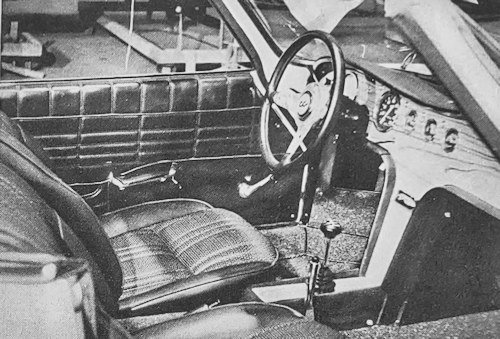
Hoping to compete with the small English and Italian convertibles, the Spider 1000 received a mixed reception. However, the modest performances but the featherweight light of the car allows him to reach 160 km/but the similar price of a much more efficient Matra-Bonnet Djet. In response, a hard-top option then started to be with order on delivery of the car in two versions. This makes it possible to offer a CG spider with a removable hard top but without a hood, which is one of the most expensive elements to manufacture. Throughout the years more simplifications will be able lower the price of the car more.
For the 1968 models, three versions are offered for sale. The Spider 1000 becomes the Spider Convertible alongside the Spider with removable hard top and the Sport 1000. The latter is a stripped-down version with a more aggressive look. The hard top transforms it into a coup and the side windows are replaced by sliding windows. As a result, the door trim gives way to a large storage compartment crossed by a simple zipper acting directly on the opening mechanism of the latter. The seats are replaced by fiberglass buckets, which are much lighter and cheaper to produce. The dashboard is covered with a simple black paint, which will become that of all the following CGs. On the outside, the bumpers as well as the wheel covers disappear and, as an option, two long-range spotlights are integrated into the nose of the car.
Always with a view to performance, Chappe et Gessalin presents engine modifications carried out by the Aveyron-based tuner, Michel Tapie, making it possible to significantly increase the power. The Sport 1000, which was less expensive, gradually supplanted the Spider 1000, production of which was to cease in mid-1968. It was during this same year that Simca offered CG a new engine. A 1118 cc and 49 hp derived from the engine of the Simca 1100 which was equipped the Simca 1000 Special. The last CG type A1000 will therefore be Coupé 1000 S equipped with the engine of the Simca 1000 Special. They will quickly give way to the single 1200 S model launched at the same time as the 1000 Special engine.
The total production of the CG type A1000 is low, estimated at less than thirty copies.
- Details
- Parent Category: C
- Category: CG Automobiles
- Hits: 44
CG 1200S sports car
 |
|
|
Make |
CG Automobiles |
|
Years of production |
1968 to 1972 |
|
Production |
280 |
|
Class |
Sports car |
|
Assembly plant |
Brie-Comte-Robert |
|
Engine |
1,204 cc |
|
Engine position |
Rear |
|
Maximum power |
80-85 hp |
|
Transmission |
Rear-wheel drive, 4 gears |
|
Unloaded weight |
660kg |
|
Maximum speed |
185-188 km/h |
|
Bodywork |
Coupe,Spider 2+2 |
|
Length |
4024mm |
|
Length |
1540mm |
|
Height |
1180mm |
|
Wheelbase |
2232mm |
The CG 1200 S (type B1200) is a sports automobile manufactured by the French coachbuilder Chappe Frères et Gessalin from late 1968 until the end of 1972.
History
The previous CG 1000 equipped with a Simca 1000 engine suffers from an obvious lack of performance. In June 1967, the firm presents a version of 80 horsepower of sporty of its 1000 coupé bodied by Bertone, the 1200 S coupé.
Chappe and Gessalin then decided to present the CG 1200 S around this new engine as a spider or a real coupé (there was no longer a removable hard top as the previous version. It is equipped with a 1,204 cc Poissy engine producing 80 horsepower thanks to the supply of two Solex 35 PHH-5 horizontal carburettors. The CG benefits from all the developments of the Simca 1200 S coupé, such as running gear and rack-and-pinion steering, which in 1968 replaced the screw-box steering of the first models.
Performance
- Engine Capacity 73.47 cu in, 1,204 cu cm
- Fuel Consumption 31.4 m/imp gal, 26.1 mlUS gal, 9 1 x 100 km
- Max Speed 115 mph, 185 km/h
- power-weight ratio: 18 lb/hp, 8.2 kg/hp
- speed in top at 1,000 rpm: 17.8 mph, 28.6 km/h.
- max power (DIN): 80 hp at 6,000 rpm
- max torque (DIN): 76 1b ft, 10.5 kg m at 4,500 rpm
- max engine rpm: 6,600; specific power: 66.4 hp/l
Bodywork modifications allow it to be distinguished from the previous one with an air intake under the front number plate due to the passage of the radiator at the front of the vehicle and improve cooling, additional integrated headlights to the bodywork (previously available as an option), slight fender flares and reversing lights. The bonnet has been changed with a new much more discreet one.
In 1968, the Automobiles CG made it possible to create a tailor-made car it is very difficult to speak of a defined model. The CG 1200 S quickly met with success and production rates continued to intensify throughout the model's career. The coupe finally has the roof attached to the body, even if it continues to be moulded separately. From the 1969 Paris Motor Show, it evolved by adopting the new 85 horsepower " Poissy engine “from the Simca 1200 S coupé. Some models were distinguished by the addition of a pair of additional shock absorbers at the rear.Distribution of weight was 32.8% to the front axleand 67.2% to rear axle. A modification of the upper corner of the door into a sharp angle goes unnoticed in the middle of production, even if it requires a modification of the mould of the roof.
For customers wishing to practice motor racing the manufacturer offers variants of its car. Thus, a CG 548, a version lightened to 548 kg, is started. We reduce the sampling of the polyester skin of the bodywork, the tubes and the chassis sheets, we replace the steel with aluminium, the side and rear windows with plexiglass and we remove the upholstery and the carpet. CG 548 also offers a rigid attachment of the engine to the crossmember supporting the rear axle, making it possible to remove any chassis element behind it and to limit the effect of engine overhang and to rebalance the masses of the car on its running gear. A cooling air vent on top of the car's bonnet also sets this model apart. The possibility of adding a Constantin compressor to increase the power to more than 120 horsepower.
From the summer of 1970, around twenty CG 548s were built. The latest models adopt the appearance of the Simca CG Proto MC spider. The total production of CG type B1200, including competition derivatives CG 548, is about 280 copies.
- Details
- Parent Category: C
- Category: CG Automobiles
- Hits: 85
CG Automobiles (Chappe and Gessalin)
Automotive manufacturer France from 1966 to 1974

Chappe et Gessalin Automobiles CG is a former French car manufacturer active from 1966 to 1974. The company built a sports car from from the Simca its derivatives.
History
Beginning with the production of truck cabins for Delahaye until the early 1950s, it then turned to the repair of passenger cars and sports cars with, among other things, the aluminium bodies of Charles Pozzi 's Talbot and Delahaye, then the transformation and construction of competition cars such as the "Bosvin-Michel-Spéciale", an aluminium barquette with a Renault 4CV engine designed by Camille Bosvin, winner of the 1952 and 1953 Bols d’or.
From 1950, the company was one of the pioneers of fiberglass bodywork and, as such, collaborated with many craftsmen and manufacturers of the time such as Deutsch-Bonnet for some of their racing prototypes and part of the body of the Le Mans convertible. After their separation continued to work with Charles Deutsch, associated with Panhard for the production of the bodywork of the racing Panhard-CDs, and with René Bonnet. It also collaborates with lesser-known companies like UMAP (1957-1959) for his car derived from the 2 CV or the Arista cars of Raymond Gaillard.
The involvement of Chappe and Gessalin in transformations based on the 4 CV led in 1954, Charles Escoffier, a Parisian Renault dealer, to order twenty-five coaches on a 4 CV platform, asking his son-in-law, Jean Rédélé to market them. Renault endorsed the car and the Alpine brand was then born in 1955 .More copies of this A106 coach were finally produced until 1960 and Chappe et Gessalin continued to invest in the following productions, the A108 coach , the 2+2 A108 coupé and then the GT4 .At the beginning of the 1960s , the extension of the manufacturer Alpine leading the latter to build its own bodies, the company Chappe et Gessalin then planned to produce its own car and turned to the car manufacturer Simca to draw from their production the mechanical elements. necessary for its realization and allow the distribution of the car through its network.
At the beginning of 1974, the bankruptcy filing of the Automobiles CG company was scheduled. The last cars were made in the spring and the moulds were sold to the Geriplast company in Coulommier.
The Cars
The CG 1000 spider was first presented in 1966 with a fiberglass body vehicle on an original central beam chassis linking mechanical elements borrowed from the Simca 1000 and the Simca 1000 coupé Bertone. Equipped with a modest engine, it offers a quality finish comparable to the best craft cars of the time. There will be coupe and S versions.
By 1968, Chappe et Gessalin recovered the engine from the Simca 1200 S coupe to offer a sports car capable of competing with the Alpine A110. The CG 1200S was also marketed as a convertible Spider. Only 33 copies left the factory. In 1971, if the production costs remained high and the prices suffered, the brand's beginnings of notoriety and its commitment to competition allowed the production of CG automobiles to reach its cruising speed. In 1972, the CG 1300 benefited from the engine of the Simca 1000 Rallye 2 and a new bodywork.

