
Clénet
Clénet Series III Asha
 |
|
|
Production period: |
1981 to 1987 |
|
Class: |
Luxury Car |
|
Body versions: |
Coupe, convertible |
|
Engine: |
4.9 litres |
|
Length: |
204.50 in, 519 cm |
|
Width: |
74 in, 188 cm |
|
Height: |
54 in, 137 cm |
|
Wheelbase: |
124 in, 315 cm |
|
Curb weight: |
3,740 1b, 1,696 kg |
|
successor |
Clénet Series IV |
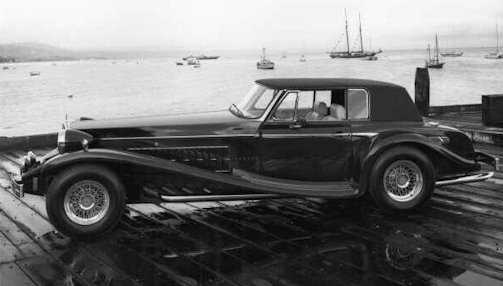
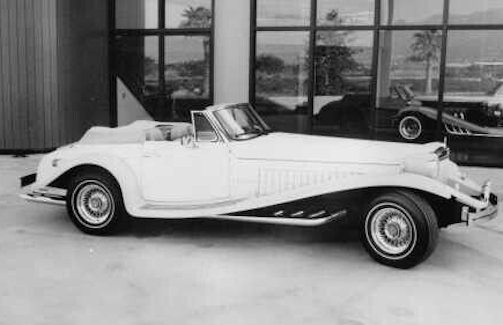
The Clénet Series III Asha was a luxury Coupe and convertible model of the American manufacturer Clénet Coachworks.
History
The range of Clénet was supplemented in the fall of 1981 by another model, the Series III Asha. The additional designation took up the name of Alain Clénets 1978 born daughter. The car was like the Clénet Series IIa four-seater in the neo-classical style, but was a little more compact. The model was more independent than its predecessors; the passenger compartment, for example, was now a separate construction by Clénet. The roof line was more angular, on the side of the bonnet escaping exhaust pipes has now been omitted.
The car continued to use Ford drive technology. The engine had been downsized again compared to its predecessor. For the Asha Clénet moved to an only 4.9-liter eight-cylinder, which gave 136 hp this gave it a Beter weight distribution of 50% front, 50% rear. Thus, the car reached a top speed of 145 km / h with its Select-Shift C-4 automatic transmission, hydraulic torque converter and planetary gears with 3 ratios and overdrive.
The equipment was still complete and essentially corresponded to the predecessor models. A sales leaflet from 1985 mentioned Italian walnut wood, Connolly leather bucket seats, British carpets and a crystal ashtray.
The total production of the Series III includes - depending on the source - 51 or 52 vehicles. As with the Series II, the production is divided into a phase and a phase after the acquisition of the company by Alfred di Mora:
- Between autumn 1981 and summer 1982, 36 new Asha models were produced at the new plant in Goleta. The first 14 were hardtop coupes, the following 22 were convertibles.
- Between 1984 and 1986, 15 or 16 more Ashas were produced in the Carpinteria factory. Although the sales prospectus also offered a hardtop version, only convertibles were sold.
The successor Clénet Series IV created only a few vehicles.
Clénet Cabriolet Series II
 |
|
|
Production period: |
1979 to 1987 |
|
Class: |
Luxury |
|
Body versions: |
Cabriolet |
|
Engines: |
4.9-5.8 litres |
|
Gearbox |
Automatic |
|
Length: |
224 in, 569 cm |
|
Width: |
74 in, 188 cm |
|
Height: |
62.50 in, 158 cm |
|
Wheelbase: |
136 in, 345 cm |
|
Curb weight: |
4,090 1b, 1,855 kg |
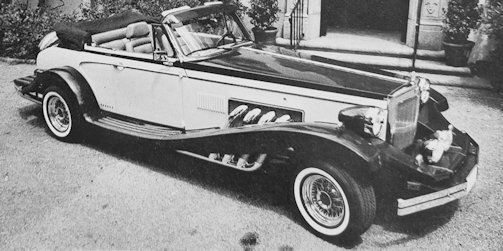
The Clénet Series II was a Neo-classic look car model of the American manufacturer Clénet Coachworks from the late 1970s to the mid-1980s.
History
Alain Clénet's second model was significantly larger than its predecessor Clénet Series I the convertible fitted with 2 doors and 2 separate bucket seats, with reclining backrests and leather upholstery. The chassis a perimeter box-type frame with front suspension independent, unequal A arms, coil springs, anti-roll bar, double-acting telescopic dampers at the rear rigid axle, 4 links, coil springs, double-acting telescopic dampers. The car was designed as a four-seater convertible. Clénet again used a chassis from Ford, but extended it by 40 cm. The passenger compartment came from the VW Beetle Cabriolet, from which the windscreen, the doors and (in some versions) also the fabric roof were taken. Clénet, unlike the case of the Series I with the MG-Midget passenger compartment reused, now received new parts from an American Volkswagen dealer. The drive technology continued to come from Ford.
The engine was significantly smaller with 4.9 and 5.8 litres displacement and with a maximum power of 115 kW (156 hp) also considerably weaker but with even weight distribution of 50% to front, and 50% at rear. This also reduced the performance of the car: the top speed was only 155 km / h. The features were similar to those of the Series I Roadster. With rear driving wheels the gearbox gear lever location on the steering column and a Select-Shift C-4 automatic transmission, with hydraulic torque converter and planetary gears with 3 ratios max ratio of converter at stall 1.97 with possible manual selection ratios the ratios 1st 2.460, 2nd 1,460, 3rd 1, rev 2.200
- PERFORMANCE: 302 cu in, 4,950 cc
max power (SAE net): 130 hp (97 kW) at 3,600 rpm
max torque (SAE net): 230 1b ft, 31.8 kg m (312 Nm) at 1,600 rpm
max engine rpm: 4,000
26.3 hp/l (19.6 kW/l)
power-weight ratio: 31.5 lb/hp (42.1 1b/ kW), 14.3 kg/hp (19.1 kg/kW)
Production of the Series II began in the fall of 1979, after the last Series I had been delivered. Between 1979 and 1987, a total of 180 vehicles. Usually two production phases are distinguished:
- The first phase covered the period from the end of 1979 to the summer of 1982. In these approximately two and a half years, a total of 174 convertibles were built under the direction of Alain Clénet. The production was initially recorded in the previous plant on the airfield of Goleta; By summer 1980, however, the cars were manufactured in Clénets new, also in Goleta (Santa Barbara County) built factory. These vehicles are informally referred to as Goleta-Clénets.
- After the takeover of the company by Alfred di Mora, the production of the Series II was resumed in the spring of 1984. Di Mora relocated to Carpinteria. There emerged another six, referred to as Carpinteria models Series II convertibles, which corresponded in all likelihood technically the Goleta models. In addition, di Mora made two chassis, which were not completed.
The Clénet Series II models were still very expensive vehicles. At launch, the selling price was $ 59,500; The last Carpinteria models were sold for almost twice the price. However, at least the Goleta models were initially very popular; the clientele corresponded to that of the Series I Roadster. Among the well-known Series II drivers was Sylvester Stallone, who acquired two different models within a short time.
Special models
During the production of the Series II Cabriolet Alain Clénet repeatedly thought about model variations:
- At the request of an Arabian customer, a four-door model with two windshields (in the style of a so-called Dual Cowl Phaeton) was created as a single piece. The vehicle was based on the Series II, but carried in detail numerous deviating design features. The vehicle is currently in unrestored condition in the US.
- In addition, Clénet considered the production of a combination car with a side wooden panel, which cited features of the "Woodie" cars from the 1930s. These considerations, however, did not go beyond the stage of pencil sketches; possibly the economic crisis of the company ended in the spring of 1982 further planning.
- The same applies to a four-door hardtop sedan with so-called suicide doors, which went back to the idea of a Clénet dealer from Miami.

