
Commer
Commer Maxiload Lorry
 |
|
| Manufacturer | Commer |
|---|---|
| Production | 1964-1976 |
| Body and chassis | |
| Body style | Lorry |
| Powertrain | |
| Engine | 3-cylinder 135hp |
| Transmission | 5-speed manual |
| Dimensions | |
| Length | 20 tp 27 ft |
The Commer Maxiload Lorry range was introduced in 1964 . with payloads of between 14 and 16 tons.(4 x 2) or option for the Commer 12-ton tractive unit.
History
The Commer Maxiload cab is big, roomy, has a flat floor and the driver's seat is torsion loaded. There is little variation in specification between the 14 and 16-ton versions. The frame and mechanical units are the same, but the tyre equipment and the ratio of the standard single-speed rear axle differ. An identical two-speed rear axle is an option. There is also a change in the suspension design.Both version of the Maxiload are available in three wheelbases-12 ft. 11 in., 14 ft. 8 in. and 17 ft. 11 in. .
With A higher-power version of the Rootes three-Cylinder engines s a supercharged two-stroke opposed piston fuel injection.Number of cylinders 3 known as the Commer Knocker. with a cubic capacity 3.52 litres.
and power of 135 B.H.P Its Rootes diesel,, gives 335 lb. ft. of torque, between 800-2,400 r.p.m.Modifications made to the fuel pump to get an increased delivery, a larger oil cooler was fitted and the diameter for the shafts carrying the rockers which transfer the piston and connecting rod movements to the crankshaft was increased. Gives fast stepping acceleration, less down shifting. The drive from the engine is taken with an hydraulically-operated clutch And more, the Commer Maxiload offers a five-speed synchromesh gearbox with a six-speed overdrive as a optional extra,as well as a Eaton two-speed rear axle .The front and rear brakes of the full air-pressure system are on separate circuits and Westinghouse components are used, including a dual-concentric foot valve and two chamber reservoir.

Ease to drive with of power assisted steering, and full air cam dual circuit service brake and secondary and positive lock park brake. Other features of the design are a full, airbraking system with Westinghouse components, including dual-diaphragm chambers at the rear axle to provide service and emergency brake functions; the extra diaphragm is pressurized on application of the handbrake. The steering box being a Cam Gears cam-and-peg unit with a ratio of 24.5 to I.
The Overall length came in at 20 ft.to 22 ft. 6 in. or 27 ft. for the chassis only and the overall width 7 ft. 11 in.Height (to top of cab) 8 ft. 4in (14 ton), 8 ft. 6in. (16 ton).A new range of six-wheel conversions by Universal Power Drives Ltd. on the Commer Maxiload chassis was also available that features an Eaton 30DT two-speed double-drive bogie with lockable third differential and Hendrickson RT350 two-spring suspension.
The lorrys turning circle 54 ft, 61 ft. or 73 ft.Wheel-base 12 ft. 10 in., 14 ft.or 17 ft. 10in.Track 6 ft. 61 in. or 6 ft. in. front 14 ton), 6 ft. 61 in. (front 16 ton),5 ft. in. (rear).Fuel tank capacity 42 gallons and a gross weight for 14 tons or 16 tons.
Standard and optional items including a 4-65-kW heater, padded facia, windscreen washers, ashtrays and padded sun visors.Two-passenger seat is standard and the driver's seat improved, it being now fully adjustable for rake of the squab as well as having fore-and-aft and seat-height.
Later by the 1970s Commer truck chassis are the CE 16 Maxiload. Heaviest capacity two-axle rigid in the Commer range is the 16 tons gvw Maxiload. This model has the Chrysler 3D 215 three cylinder opposed piston two-stroke diesel which has an output of 121.5 bhp.

Commer Walk-Thru Van
| Commer Walk-Thru Van | |
|---|---|
 |
|
| Overview | |
| Manufacturer | Rootes Group |
| Production | 1961 to 1970 |
| Body and chassis | |
| Body style | Panel van,cab |
| Powertrain | |
| Engines |
four-cylinder.six-cylinder |
| Transmission | 4-speed manual |
| Dimensions | |
| Length | 17 ft. 3 in. |
| Width | 6 ft. 9 in. |
The Commer Walk-Thru Delivery Van was a light commercial vehicle produced by Commer in the UK during the 1960s.
History
First introduced in 1961 with designations ranging from 1 1⁄2-ton, 2-ton and 3-ton.
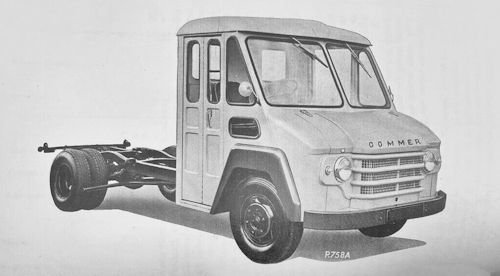
The Walk-Thru came fitted with sliding front doors hence the name, this was offered in the popular van model used for deliveries such as multi drop for newspapers and laundry services, and also a bare bone cab-chassis variant for custom truck fabrication for business needs.
The overall length 17 ft. 3 in. (17 ft. 8 in. with 6-cylinder petrol engine or Perkins 4.203). Fuel tank capacity at 10 gallons.
With a choice of 4- or 6-cylinders diesel or petrol engines. Roots Petrol or diesel fuel injection, Perkins 4.203 fuel injection optional at first. Engine sizes, Cubic capacity 2.266 or 2.965 litres (petrol), 2.26 litres (Rootes fuel injection), 3.33 litres (Perkins 4.203). the power as B.H.P. 56 and 85 (petrol), 56 (Rootes fuel injection), 63 (Perkins 4.203).
This van was also built around the world in places like Europe and as far as New Zealand.
Commer History
from 1905 to 1979
At Olympia's Commercial Motor Show in March 1907, Commer exhibited a motor-bus chassis with a 30–36 horsepower engine and a gearbox invented by Mr Linley, the works manager. Dog-clutches made the change rather than the spur wheels which remained in constant mesh. As well as the bus chassis Commer displayed a char-a-banc for thirty passengers and delivery vans being run by a substantial enterprise.
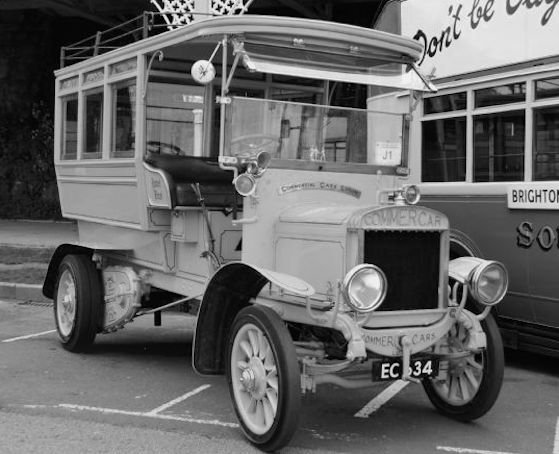
A new "large and powerful" lorry, E43, registration BM 787, took part in the Great Commercial Motor Trials in September 1907. It also had a constant mesh gearbox (Comer (sic) slogan—'dogs which bite with a click'). Unladen weight was (3.7 tonnes) 3 tons 13 cwt, the engine had four-cylinders, its output was 33 horsepower at 800 rpm. It had four forward speeds and was driven by side chains. Length 20 feet (6 metres), width just over (2.1 metres) seven feet and height (1.76 metres) two inches under six feet. The platform was (3.6 metres) twelve feet long. The newspaper noted that a Comercars "chassis" was transporting passengers at Widnes.
Production of the first truck, the 3-ton RC type started in 1907. Their first bus was made in 1909. With the outbreak of the First World War the factory turned to the manufacture of military vehicles for the British Army, and by 1919 more than 3000 had been made.
Though obliged to undergo financial restructure in 1920 in the hope of avoiding creditors, the business was unable to avoid repayment of a debt of £75,000 due to the Treasury, raised in order to pay 60 per cent Excess Profits Duty on wartime activities. Eventually, after agreeing terms with the Receiver in 1925, Commer was bought in 1926 by Humber. In 1931 Humber became a 60-percent-owned subsidiary of the Rootes Group.
The Commer name was replaced by the Dodge name during the 1970s, following the takeover of Rootes by Chrysler Europe. After Peugeot purchased Chrysler Europe in 1978, the Commer factory was run in partnership with the truck division of Renault, Renault Trucks. For some time, it continued to produce the Dodge commercial truck range with Renault badges, and there was a small amount of product development. Eventually, Dodge production was cancelled in favour of mainstream Renault models, and there was a switch to the production of Renault truck and bus engines in the early 1990s.

Many Commer vans and lorries are notable for being fitted with the Rootes TS3 engine, a two-stroke diesel three-cylinder horizontally opposed piston engine, which came to be known as the "Commer Knocker" owing to the distinct noise it produced.Newer Commer vehicles had Perkins and Cummins diesel engines, and, less commonly, Mercedes diesel engines.
Commer Superpoise
| Commer Superpoise From 1939 to 1961 | |
|---|---|
 |
|
| Overview | |
| Manufacturer | Rootes Group |
| Body style | Forward control truck. Numerous adaptations for special purposes |
| Powertrain | |
| Engine | six cylinder petrol and Diesel |
| Transmission | 4-speed manual |
The Commer Superpoise range was introduced in 1939, with both semi-forward and full-forward control options. The line included trucks of 1½ to six tons capacity powered by 6-cylinder petrol or diesel engines.4 speed gear box and 3 seater cabs and double rear axle on larger units.

With the Outbreak of World War II special conversions for military use and more rugged of road abilities help build stronger trucks, from these Lessons learned and the invaluable knowledge acquired during six years of war were applied to the further advancement and performance of post-war vehicles, and by virtue of these improvements they approached a new peak in both conception and workmanship.

Various body styles from flat beds to dumper trucks from 1.5 to 6 tons,
A new Superpoise range with payloads of between two and five tons was introduced in 1955. six cylinder models of 2-3, 3-4 and 5 tons capacity were announced. The striking feature of these models was the new, comfortable full-view cab. The same year a new range of four-cylinder o.h.v. 'Superpoise' models was introduced. This range consisted of a ton 'Pick-Up', and 3/4 and 1-1/4 ton vans.
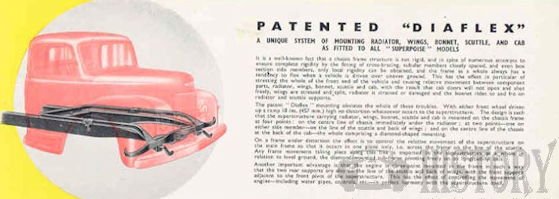
In 1957 it was decided to design a new forward control 5 tonner and in April the new vehicle was announced.

Commer Express Delivery Van
| Commer Express Van | |
|---|---|
 |
|
| Overview | |
| Manufacturer | Rootes Group Chrysler Europe |
| Production | 1950 to 1959 |
| Body and chassis | |
| Body style | Panel van. |
| Powertrain | |
| Engines |
1390cc OHV four-cylinder 1494 cc OHV four-cylinder |
| Transmission | 4-speed manual |
| Dimensions | |
| Length | 160 inch |
| Width | 62 inch |
The Commer Express Delivery Van was a light commercial vehicle produced by Commer during the 1950s.
It was based on the Hillman Minx saloon and evolved in parallel with that model, with designations ranging from Mark III to Mark VIIIB.

1954 Commer express Van
The 1957 model, which featured a load space of 100 cu ft (2.8 m3) with a inside 70 " and 42" high, All lockable doors and bonnet .7 gallon fuel tank.
wheel track 48" front 50" rear with 7" ground clearance. and 2114 lbs weight.

Van was powered by a 1390cc 37 hp four-cylinder Hillman engine and later a 1500cc with 52 hp OHV and was fitted with a four-speed column-change gearbox.
Production ran to 1960 when it was replaced with the new Commer "Cob van"
1959 Commer Express Delivery 1500cc Van rear


