Cadillac
Cadillac Sixteen Concept
 |
|
|
Presentation Year: |
2003 |
|
Vehicle Expo: |
NAIAS |
|
Class : |
Concept car |
|
Body design : |
Sedan |
|
Engine: |
Gasoline:V16 13.6 litres (746 kW) |
|
Length: |
5672 mm |
|
Width: |
2029 mm |
|
Height: |
1392 mm |
|
Wheelbase: |
3556 mm |
|
Empty weight: |
2270 kg |
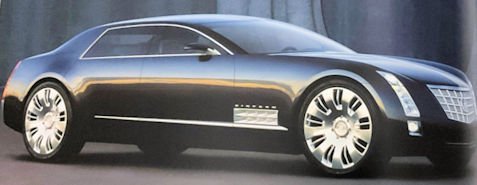
The Cadillac Sixteen is a Concept prototype of a sleek, high-performance Cadillac car launched in 2003.
After the presentation in the Detroit Opera House , this was formally first time in public at the North American International Auto Show.
The car is provided with a 16-cylinder V engine with 13.6 Liters capacity equipped and 32 valves, the Cadillac has developed for this model. The drive to the rear wheels via a four-stage, electronically controlled automatic transmission (4-speed Hydra-Matic 4L85 ). The engine has an electronically controlled cylinder deactivation and can switch off eight or twelve of the 16 cylinders during the driving operation as soon as their power is not needed. All 16 cylinders are only used at full acceleration. Among other things, this consumes the empty 2270 kg heavy vehicle 11.8 l / 100 km. The naturally aspirated engine delivers a maximum of 746 kW (1015 hp) according to the manufacturer. The maximum speed is thereafter 250 km / h with throttled engine. The vehicle can accelerate from 0-100 km / h in 3.7 seconds. The maximum torque is 1356 Nm at 4300 rpm.
The design of the vehicle is based remotely on the Cadillac V16 from the 1930s. The body incorporates styling elements of Cadillac's "Art and Science" design used in 2003 and echoes of the 1967 Cadillac Eldorado . Further elements come from an in-house competition led by GM Vice President Robert A. Lutz . Special features in the interior design of the Sixteen are the eye-catching logo on the steering wheel, which is milled from a solid crystal, and a Bulgari watch in the dashboard.
Although the Sixteen did not enter mass production, it served as an important technology and image carrier in the following years. Especially with his formal language, this influenced the next generation of Cadillacs, especially the revised CTS . As of 2005, there were rumours that a smaller version of the Sixteen as ULS (Ultra-Light Sedan) or XLS (Extra Light Sedan) should be built with a V8 engine or on request with V12 engine, which GM neither denied nor was confirmed. For 2010, a new representation model was announced, but it remained unclear to what extent it would resemble the Sixteen. 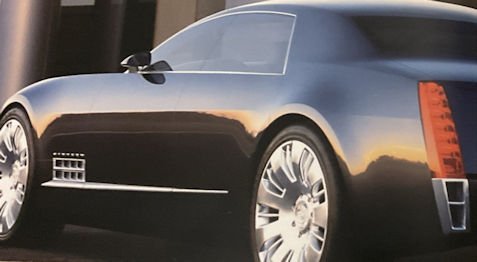
Cadillac BLS
 |
|
|
Manufacturer |
Saab (General Motors) |
|
Production |
2006–2009 (Sweden) |
|
Assembly |
Sweden.Russia: |
|
Designer |
Bryan Nesbitt |
|
Class |
Motor Car |
|
Body style |
4-door saloon |
|
Layout |
FF layout |
|
Platform |
GM Epsilon platform |
|
Engine |
|
|
Transmission |
5-6 speed automatic |
|
Wheelbase |
2,680 mm (105.5 in) |
|
Length |
4,680 mm (184.3 in) |
|
Width |
1,750 mm (68.9 in) |
|
Height |
1,470 mm (57.9 in) |
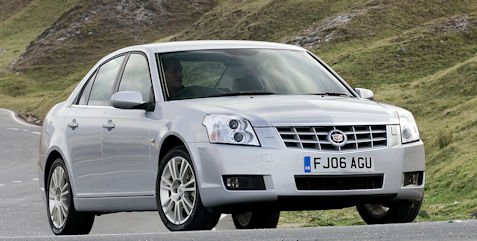
The Cadillac BLS is a mid -size vehicle of the US vehicle manufacturer Cadillac , which was designed as the only Cadillac model to date exclusively for the European market.
History
First shown by General Motors at the Geneva Motor Show in March 2005, the new Cadillac BLS saloon adds another important element to Cadillac’s growing international presence. The front-wheel drive BLS offers availability in both right-hand and left-hand drive with turbo petrol and turbo diesel engines. The first Cadillac with a diesel variant.
“The BLS was developed for luxury customers, with particular attention to the demands of the European and other international markets,”The right-hand drive Cadillac BLS was launched in April 2006 in the UK, and its introduction throughout Europe will help to more than double the brand’s sales volume in Europe during 2006. The saloon was built at the GM plant in Trollhättan, Sweden.
Although Cadillac enjoys a reputation as a premium brand in Europe , the heavy cars with large gasoline engines found little buyers there. Bob Lutz , GM's vice director, intended to make Cadillac sales more global and more responsive to local markets. In the summer of 2003 was created in Cadillac Design Center, the idea of a Cadillac model for Europe, this contact with the design department was Saab Automobile was added (which at that time the European premium brand of GM was), and arranged for the time being separately on the idea work and meet later. In November 2003 the joint presentation took place in Sweden.
The BLS was finally developed as type YSCF by an American-Swedish team at Saab Automobile, where the production took place. In the design team in Mölnlycke u. a. the Cadillac designer Chip Thole, which the Exterior designed, Lars Falk, who was in charge of the Interior, and Simon Padian and Michael Mauer. The foreseeable low quantity resulted in a consistent equal parts strategy, while the BLS does not have a sheet metal part with a sister model Saab 9-3 together, the BLS specific development costs were 1 billion crowns (then around US $ 140 million). As a concept study, the vehicle was at the Geneva Motor Show First presented in formal form in 2005 and as a production model at the IAA of thesame year.
In spring 2006, the notchback sedan of the BLS came on the market. The car was offered in four trim levels: Business, Elegance, Sport and Sport Luxury. The 4.7-metre long Cadillac BLS design was conceived by an international team of designers led by GM Vice President of Design Ed Welburn. The vehicle has clear, sharply defined contours, a striking wedge shape profile and an elegant interior. Its development focused on matching customers’ expectations of performance, ride, handling and refinement to Cadillac‘s unique ‘Art & Science’ design language.
The most striking features of BLS are the vertical lines at the front and rear ,the V-shaped chrome-plated grille, a classic Cadillac design cue, is picked up again by the boot lid.
Internally, the car was called B-segment Luxury Sedan , from which the name is likely to be derived. The purpose of the model was to contribute to the awareness of the brand in Europe and to improve somewhat the lack of capacity at Saab, advance notice of the manufacturer went in advance of low volume, since in Europe offered two different vehicles in the same segment with the BLS. In addition to Europe, the saloon was also offered to several other markets, including South Africa, Arabia, South Korea and Mexico. The beginning of 2007 was followed by the presentation of the BLS Wagon as the first station wagon in the brand history of Cadillac. The formal presentation took place at the IAA 2007.
The Dutch company Kroymans, which in Europe u. a. sold the brand Cadillac as a general importer, went into bankruptcy in February 2009, at the same time it became apparent that GM had before, the troubled subsidiary Saab Automobile (where the BLS was manufactured) to handle. Production of the BLS was set in June 2009, only for the Russian market nor copies in were in small numbers by the end of 2010 Avtotor in Kaliningrad assembled under license. In total, only 7356 copies were created. In September 2012, was ATS presented as a successor model, the end of 2012 they had their sales in Europe.
The BLS is based on the GM Epsilon platform and therefore has front-wheel drive. A close relationship exists with the Saab 9-3 ; Both models were built in the same factory in Sweden. The car was counted to the middle class, but is much larger than other cars in this category, about 90 mm longer than the then Audi A4. The windows are fully retractable, which is structurally possible only with a few models. The audio systems were supplied by Bose.
In front, jewel-like, vertically stacked headlights featuring bi-xenon technology are mounted directly above fog lamps integrated into the bumper, on both sides of the chrome-framed egg-crate grille with prominent Cadillac badge. The deep front bumper with three prominent air intakes. All BLS models are supplied with seven-spoke alloy wheels. The BLS features the latest LED technology in the centre high-mounted brake light, which is prominently positioned on the boot lid and extends across the full width of the vehicle. The vertical taillights are another design element that leaves no doubt the BLS is a Cadillac. The vehicle’s distinctive wedge shape is also very aerodynamic, with a drag coefficient of Cd 0.31. The dual-purpose centre high-mounted stop light also functions as a spoiler to smooth airflow over the rear of the body, reducing fuel consumption and increasing stability. 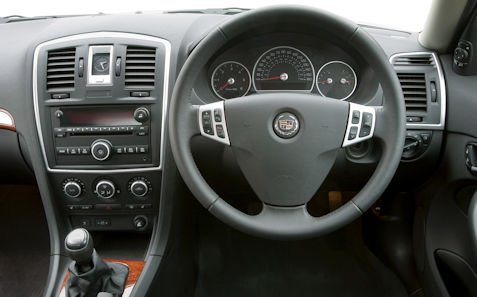
Inside the multi-adjustable front seats have a wide range of movement and seat up to five adults. Adjustable head restraints and three-point seat belts are provided for all five occupants. Headroom in front (988 mm) and legroom in the back (892 mm). The boot capacity of 425-litres can be increased by folding forwards part or all of the rear-seat backrest, which has a 60/40 split. The BLS has a three-spoke leather-covered steering wheel, three dial instrument panel with white numerals and red needles on a black background. The centre stack features a square analog clock set between two large fully adjustable air vents, and above the audio system, the heating and ventilation controls. The centre stack, outboard air vents, instrument dials and twin floor console cup holders are all ringed in chrome.
With a wheelbase of 2675 mm and a wide track of 1524 mm (front) and 1506 mm (rear), fully independent suspension, The suspension features MacPherson struts in front and a four-link system at the rear. The spring and shock absorber rates, the two anti-roll bars, fast-geared (2.97 turns lock-to-lock) rack-and-pinion steering, Turning circle is 10.9 metres, kerb to kerb. The standard wheel and tyres for BLS are with the three trim/equipment levels for Europe. The SE is equipped with 6.5J x 16-inch seven-spoke aluminum wheels shod with 215/55 R16 tyres. Stepping up the range, the ‘Luxury’ models comes with 7.0J x 17-inch alloys and 225/45 R17 tyres. The top of the line ‘Sport Luxury’ models comes with wider, larger, 7.5J x 18-inch alloy wheels equipped with 225/45 R18 tyres.
all-disc braking system features standard ventilated front discs. Sized to make maximum use of the space within the alloy wheels, the SE has 285 x 25 mm front discs and 278 x 12 mm solid discs at the rear. Luxury models have similar front discs and larger, thicker 292 x 20 mm ventilated rear discs. For V6-powered Sport Luxury models, the same size rear discs are used, but the ventilated front discs are upgraded to 314 x 28 mm items.
In addition to four-channel ABS, traction control (TCS) and electronic brake assist, the Cadillac is also fitted with cornering brake control (CBC). When the brakes are applied on a bend, CBC regulates the brake pressure at each wheel individually, increasing cornering stability. The StabiliTrak electronic stability system is fitted as standard for the UK market. Chassis sensors monitor steering angle, yaw rate, wheel spin and road speed, and correct understeer and oversteer by automatic brake application at an individual wheel and/or easing the throttle to reduce engine revs until the car returns to the driver’s preferred path.
Engines
On the engine side, the range is strongly based on the engines of the Saab 9-3. The 1.9-liter four-cylinder is the first turbocharged diesel engine in a Cadillac , previously there was an 1979 Oldsmobile diesel in the then Cadillac Seville . The common-rail unit is a joint development between Fiat and GM and provides in two variants 110 kW (150 hp) and 132 kW (180 hp) The gasoline engines are also turbo aggregates from Saab; The 2.0-liter engine is offered in two output levels with 129 kW (175 hp) and 154 kW (210 hp) and a 2.8-liter V6 engine, by GM-Holden (Australia), with 188 kW ( 255 hp).
Furthermore, a Flexpower mentioned variant of the weaker 2.0-liter four-cylinder offered with both gasoline, as well as E85 can be operated and its performance in the E85 mode by 18 kW to 147 kW increases. All engine variants are available with a six-speed manual transmission or with a five-speed or six-speed automatic transmission for an additional charge.
Diesel engine:
with a turbocharged diesel engine. The 1.9-litre D, 150 hp (110 kW), four-cylinder, 16-valve power unit torque, a maximum of 320 Nm (236 lb ft) from 2000 to 2750 rpm, Acceleration to 62 mph takes just 9.5 seconds and top speed is 131 mph with manual transmission. six-speed manual transmission, the BLS delivers a fuel consumption of 46.3 mpg on the combined cycle, which, in combination with the 58-litre (12.7 gallon) tank, ensures an impressive range of more than 550 miles. Fitted with the six-speed automatic transmission, combined consumption is 39.2 mpg.The engine features four-valve technology, turbocharging with a variable geometry turbocharger and charge-air cooling, as well as Bosch EDC 16 variable multi-point direct fuel injection. Fuel is supplied to the cylinders via a latest-generation high-pressure common-rail injection system maintenance-free diesel particulate filter system with an upstream primary catalytic converter and an under floor catalytic converter.
Petrol engines:
The two 2.0-litre four-cylinder turbo petrol engines develop 175 and 210 hp (129 and 154 kW) respectively, and share the same basic design characteristics. The maximum torque of 265 or 300 Nm (195 or 221 lb ft) respectively, is available at just 2500 rpm, which means high pulling power at low and medium engine speeds.
all-aluminum engines are ‘square’ (both cylinder bore and stroke are the same – 86 mm) and have chain-driven double overhead camshafts operating 16-valves, a counter-rotating balancing shaft and a dual-mass flywheel to ensure maximum refinement and minimum noise and vibrations. The turbocharger is positioned immediately behind the transversely mounted engine, thereby guaranteeing that the front catalytic converter warms up quickly. This reduces cold-start fuel consumption and emissions.
With a manual transmission, acceleration to 62 mph takes 8.5 seconds (175 hp engine) and 7.7 seconds (210 hp), while top speeds are 137 mph and 146 mph. Fuel consumption on the combined cycle is 37.2 mpg and 33.2 mpg respectively. With automatic transmission the ‘combined’ figures are 31.4 mpg and 31.0 mpg.
The aluminum 2.8-litre V6 gasoline engine has a twin-scroll turbocharger and a maximum output of 255 hp. This state-of-the-art unit, part of a new generation of engines used globally by GM, offers plenty of power in all driving conditions, thanks to a maximum torque figure of 365 Nm (258 lb ft) generated at a low 2000 rpm. The intercooled turbocharger, located centrally above the transmission, has an integral charge pressure control valve. The continuously variable, electronically controlled and hydraulically actuated phasing of the intake camshafts ensures rapid response and plenty of torque even at lower engine speeds. They can be rotated with respect to the crankshaft across a range of 50 degrees. This optimally aligns the valve timing and the gas exchange to the engine load and speed. The intake and outlet camshafts are made of high-strength aluminum, which means they are lightweight, heat-resistant. With a manual transmission, acceleration to 62 mph takes 6.7 seconds and top speed is 155 mph. Fuel consumption on the combined cycle is 27.7 mpg and 26.2 mpg with automatic transmission. 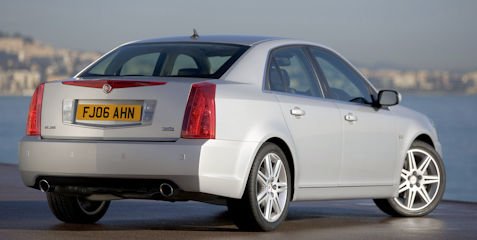
Cadillac ELR
 |
|
|
Production: |
2013 to 2016 |
|
Class : |
motor car |
|
Body versions : |
Coupe |
|
Engines: |
Electric motor : 162-174 kW; Voltec derivative |
|
Length: |
4724 mm |
|
Width: |
1847 mm |
|
Height: |
1420 mm |
|
Wheelbase: |
2695 mm |
|
Curb weight : |
1837 kg |
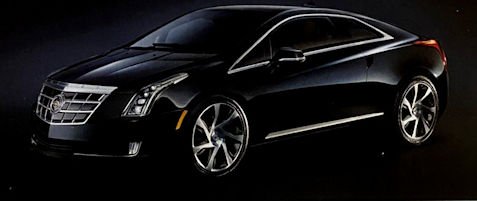
The Cadillac ELR is a plug-in hybrid Electric car with range extender, debuting January 2013 (Detroit)., that of the Cadillac Division of General Motors was built by the end of 2013 to early 2016 in series.
The car was shown under the name Cadillac Converj as a concept study 2009 at the North American International Auto Show , at the same show in 2013 as a production version. In 2015, a change of model of the Chevrolet Volt took place; at the same time the sale of the Opel Ampera was discontinued. In Europe, the Cadillac ELR should then represent this model line as its sister model. This did not happen. Instead, the production was discontinued.
The body is connected to the drive system of the Chevrolet Volt a battery pack, an electric motor with a maximum power of initially 162 kW, later 174 kW and a four-cylinder gasoline engine with a maximum power of 84 hp ( 63 kW) which is connected to a generator, together GM-Voltec system initial output of 155 kW, later 174 kW. The range with only electric drive is 60 km and the maximum speed of the vehicle 171 km / h. The two-door coupé with front-wheel drive can be recharged within four and a half hours. Driving technology is enhanced with selectable drive modes that make the most of efficiency. Regen On Demand allows the driver to temporarily regenerate energy from the ELR's momentum into electricity that can be stored in the battery pack for later use. EREV technology is uniquely tuned for Cadillac in the ELR. Most daily commutes will require zero gasoline resulting in zero emissions. Longer trips are free from electric-vehicle range anxiety because ERE V technology enables the same long-distance freedom as a convention car.
Features :
• Enhanced AT-PZEV emissions. which meet California's criteria for single-occupancy access to high-occupancy vehicle lanes
• Light-emitting diode (LED) headlamps, daytime running lamps and tail lamps. as well as signature front and rear lighting elements
• Twenty-inch wheels paired with tires designed to balance responsive handling and a comfortable ride with efficiency
• Cadillac CUE with Navigation, which comes standard on the ELR
• Cadillac's advanced active safety features, including Safety Alert Seat, Forward Collision Alert and Lane Departure Warning
Cadillac Eldorado Fastback concept
 |
|
|
Presentation Year: |
1965 |
|
Vehicle Expo: |
GM Motorama |
|
Class : |
Concept |
|
Body design : |
Coupe |
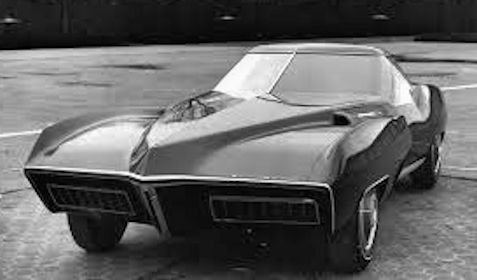
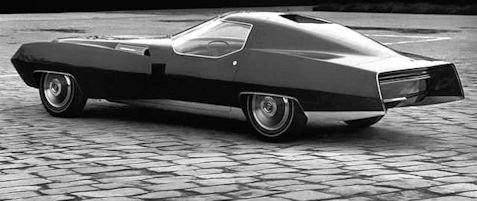
The Cadillac XP-840 Eldorado Fastback was a concept vehicle from the 1960s that introduced the Cadillac Division of General Motors in 1965.
Since 1963, the Cadillac Design Center had been designing a concept vehicle that reminiscent remotely of the Chevrolet Corvette of the 1960s and 1970s. The sports car had an enormously long, contoured bonnet, which was pulled down to the waistline. Under the waistline were the main headlights. The flat windshield had a V-shape and grabbed around the sides to the B-pillars. Typical of the design of this time was the hip crease over the rear wheel cutouts. The hatchback had no rear window, but a slot in the middle, in which a rear view camera could be used, which replaced the interior mirror. The vehicle ended in a recessed, forwardly inclined tail plate.
The concept car, from which several models of different sizes had previously been created, had no engine. However, it was designed for the inclusion of a V16 engine that would have made the car, if it had ever come to mass production, undoubtedly to the supercar. Finally, Cadillac but remained at the good old V8 engine.
Cadillac STS
 |
|
|
Manufacturer |
General Motors |
|
Production |
2004–2011 |
|
Assembly |
United States, China, Russia |
|
Class |
luxury car |
|
Body style |
4-door sedan |
|
Layout |
Front-engine, Rear wheel drive / Front-engine, four-wheel drive |
|
Platform |
GM Sigma/GMX295 |
|
Engine |
2.0 L LDK I4 |
|
Transmission |
|
|
Wheelbase |
116.4 in (2,957 mm) (STS SWB) |
|
Length |
2005–2007: 196.3 in (4,986 mm) |
|
Width |
72.6 in (1,844 mm) |
|
Height |
57.6 in (1,463 mm) (STS SWB) |
|
Curb weight |
3,922 lb – 4,255 lb (1,905–1,930 kg) |
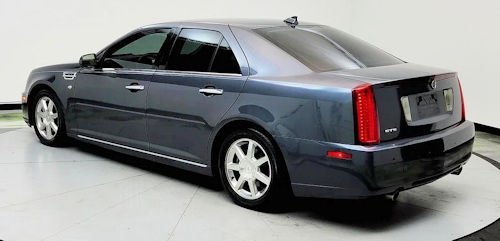
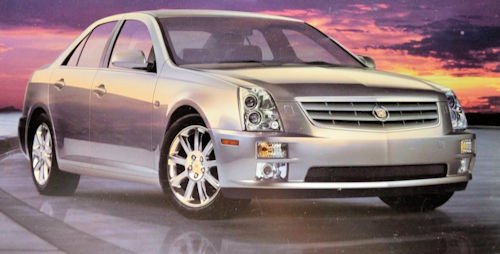
The Cadillac STS is a luxury-class vehicle produced by Cadillac between fall 2004 and mid-2011.
History
The STS replaced in autumn 2004 the model Seville . The name originally stood for Seville Touring Sedan and Sport Touring Sedan . This followed the new Cadillac nomenclature, which provides only abbreviations as a model name. Like the first-generation CTS , GM built it on the sigma platform. Unlike the old Seville STS should act more sporty in its new form. With an overall length of 4985 mm, a wheelbase of 2957 mm and front/rear track of 1596/1581 mm, the STS is the largest saloon in the Cadillac portfolio.Technical features include a Keyless Access system with a push button start; Adaptive Cruise Control (ACC); and reconfigurable four-colour head-up Display (HUD) on the 4.6-litre V8; plus heated & ventilated seats and heated steering wheel.
In the US market, a new make of the STS cost $ 47,495. In the Chinese market a version of the STS was 100 mm longer wheelbase under the name Cadillac SLS.
The STS is offered with the 257 hp (189 kW) 3.6-litre V6 VVT or the 325 hp (239 kW) Northstar 4.6-litre V8. Both engines incorporate variable valve timing (VVT) and are mated to Cadillac’s widely acclaimed five-speed automatic transmissions. Four-cam variable valve timing gives the V6 engine increased efficiency, with benefits in fuel economy, reduced emissions and engine flexibility. the 3.6-litre V6’s peak torque is available across a broad operating range: from 1600 rpm to 5800 rpm.
The engines used for the STS initially a 4.6 -l Northstar V8 engine, which brought it to a maximum power of 239 kW (325 hp) and a 3.6 -liter V6 engine with 189 kW (257 hp ). In Europe, the STS represented the top model of Cadillac within the luxury class , while in the US, the role of the DTS was given.
The 4.6-litre Northstar engine delivers 0-62 mph acceleration in 6.2 seconds. With the V6 the STS achieves 0-62 mph in 7.4 seconds.
The STS-V , which has a 4.4-liter V8 engine with 345 kW (469 hp) of maximum power, was refilled shortly after its introduction.
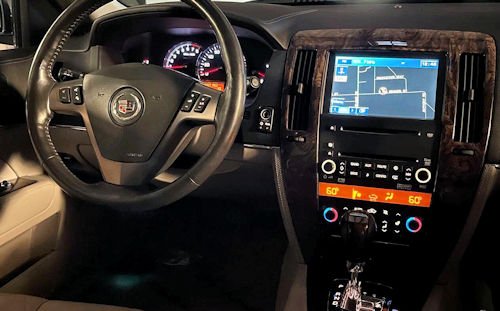
the STS is highly specified as standard, with Tuscany full leather upholstery; eight-way power seat adjustments for the driver and front passenger including a memory package which provides presets for two drivers and automatically adjusts the outside rear-view mirrors; power tilt and telescoping steering wheel position; steering wheel controls for the sound system; and voice recognition. The STS also has a tyre pressure monitoring system, power boot release and rear parking assist, which includes a rear-view LED display and audible warning.
Premium quality materials are used throughout. The interior choices include aluminium trim on both console and instrument panel on the Elegance and two colour choices for wood trim as standard on the Sport Luxury. Dual-firmness leather seats are specially tanned for a softer feel. Natural grained surfaces on the doors and instrument panel the headliner and interior pillar trims, which are soft backed and covered with a Monaco woven fabric.
Additional refinements on the STS include the eucalyptus wood trim package, heated/ventilated front seats, heated steering wheel, power lumbar adjustment on both front seats and a top-of-the-range infotainment system, with a 15-speaker Bose 5.1 Surround Sound system and an integrated six-disc CD/DVD changer, a 203 mm (eight inch) VGA quality touch screen, Bluetooth capability, advanced voice recognition and an advanced navigation system.
Integrated chassis control technologies combine performance with a comfortable ride and include two-mode Magnetic Ride Control with ‘Performance’ or ‘Touring’ selections as standard on the V8. The electronically controlled magnetic-fluid-based real time damping used on STS.The standard StabiliTrak stability control system increases driving safety in high-speed swerves or sudden avoidance manoeuvres. Adapted from the driving dynamics system in the Corvette, the system is highly responsive and can adjust braking at any of the four wheels to maintain vehicle control. StabiliTrak is fully integrated with the traction control and ABS systems.
In autumn 2007, a facelift was made on the STS for the 2008 model year , which included a modified grille, a new rear bumper and a revised interior, as well as new features (such as lane change assistant and a lane departure warning ); The 3.6-liter V6 engine now had a maximum output of 222 kW and direct injection .Formally, the facelift on the NYIAS 2007 was presented In addition, there was from October 2009 to the 2010 model year a new 3.6-liter V6 engine, which now made a maximum of 225 kW.
Beginning of May 2011 the last STS rolled off the line. In spring 2012, the XTS was presented, replacing both the STS and the DTS.
Features
Head-Up Display (HUD) and Adaptive Cruise Control (ACC)
The head-up display (HUD) projects key driving information on to the windscreen. In addition to speedometer and turn signal indicators, the HUD shows audio system data, gear indication, and ACC settings in the driver’s natural line of sight.
Adaptive Cruise Control (ACC) combined with the head-up display, represents a crucial contribution to active safety. A radar sensor at the front of the Cadillac STS constantly monitors the traffic ahead. When the cruise control is engaged, the radar beam can detect when another vehicle is in the same lane and the car is automatically slowed down and maintains a gap pre-configured by the driver. If there is a stationary object ahead, the ACC system sounds an alarm and displays a warning signal for the driver in the windscreen HUD.