Chrysler
Chrysler Series 50
 |
|
|
Production period: |
1927 to 1928 |
|
Class : |
Motor Car |
|
Body versions : |
Touring car , Roadster ,Sedan , Coupe , Landaulet |
|
Engines: |
Gasoline : 2.8 liters (28-33 kW) |
|
Wheelbase: |
106" |
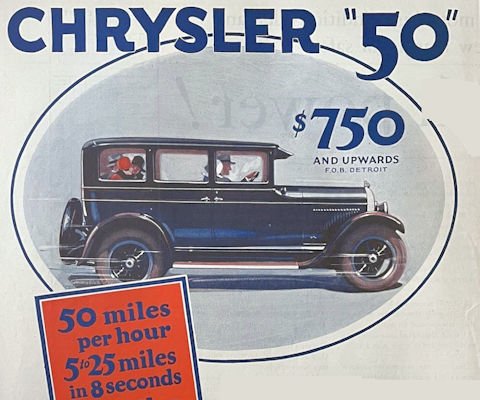
The Chrysler Series 50 was a car that Chrysler manufactured in Detroit in 1927. this replaced the model F-58. There were seven different bodies offered with 2 or 4 doors and even a rumble seat, similar to those of the previous model (only the chassis was shortened by 3 “. Chrysler now had four models: the 50, 60, 70, and 80 Imperial the 50 having the smallest wheelbase price ranged from $750 to around $880 for the Landaulet.
The car had a side mounted four-cylinder in-line engine, as its predecessor, now reduced to 2,790 cc capacity, but still unchanged 38 bhp. The rear wheels were driven via a single-disc dry clutch and a three-speed gearbox with central control. As standard, only the rear wheels were equipped with cable-operated brakes; Brakes for all four wheels with hydraulic actuation were available at extra cost.
By 1928 was the model Chrysler Series 52, without major changes had been made. Engine power increased to 45 bhp (33 kW). standard mechanical rear wheel brakes Hydraulic rear wheel brakes available still at extra cost with other options of Custom coachwork bodies also Steel disc wheels or Wire-spoke wheels on sport models, double bar front bumper and rear fender guards. Side mount spare tires with Leather covers, Heater. Clock. Cigar lighter, Wind wings. Step plates. Rear mount spare. Rumble seat windshield. Outside rear view mirror. Trunk rack. Touring trunk. Dual wipers. Dual taillights all now put the price up if required.
From the series 50 in total 82,412 copies were created, the series 52 was built 76,857 times Series 50 Serial numbers were starting with FWOOOP. Ending: HWOOOW. In model year 1929 Chrysler gave up the production of four-cylinder models. The construction inherited the newly founded subsidiary Plymouth, which brought out the car as a model Q.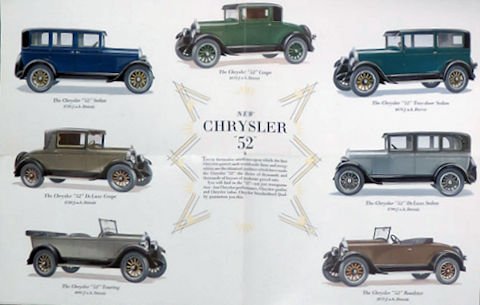
Chrysler PT Cruiser
 |
|
|
Manufacturer: |
Chrysler |
|
Production: |
2000-2010 |
|
Class: |
Motor Car |
|
Engine Type: |
Gasoline, Diesel |
|
Engine Displacement: |
Gasoline 1.6-2.4 liters |
|
Engine power: |
Gasoline (85-164 kW) |
|
Wheelbase: |
2616 mm |
|
Length: |
4288 mm |
|
Width: |
1748 mm |
|
Height: |
1539-1665 mm |
|
Weight: |
1441-1605 kg |
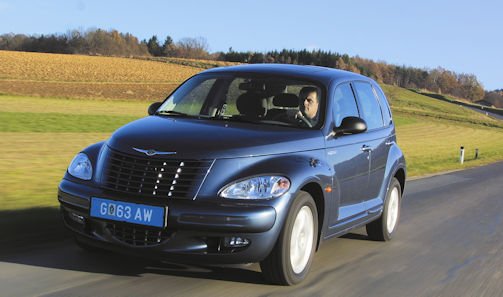
The Chrysler PT Cruiser is a car model made by the American manufacturer Chrysler. The abbreviation PT stands for "Personal Transportation", which was built from early 2000 to summer 2010.The Chrysler PT Cruiser has front-wheel drive and is approved for five people. In the cabriolet variant, the mass increased by about 68 kg due to the reinforced vehicle structure. In Euro NCAP - Crash Test Chrysler PT Cruiser reached 3 out of 5 stars in occupant safety and one of five in the pedestrian safety.
History
Prior to the production model, a preview of the Chrysler PT Cruiser was given with several concept vehicles . The first was the Plymouth Pronto , presented at the 1997 North American International Auto Show (NAIAS) , the second of the Chrysler Pronto Cruizer at the Geneva Motor Show in 1998 and, third, about the same time as the production model, the Chrysler Pronto Cruizer AWD , at NAIAS 1999 designed by designer Bryan Nesbitt as an interpretation of the Chrysler Airflow with Dodge Neon Elements, but built on its own platform (PT platform).
Even after the presentation of the production model, some concept vehicles based on the Chrysler PT Cruiser were presented, most of which did not go into series production, including the Cruiser and the GT Cruiser (production model: PT Cruiser Turbo) at the NAIAS 2000, the concept car for the cabriolet variant at the New York International Auto Show(NYIAS) 2001 or the Chrysler California Cruiser with a preview during the Pebble Beach Concours d'Elegance 2002 and a public premiere at the Mondial de l'Automobile 2002. The PT Cruiser is built on an all-new unibody platform, and some of its mechanical components are similar to the subcompact Neon sedan's. The only engine at first is a 150-horsepower version of Chrysler's familiar 2.4-liter 4-cylinder, linked to 5-speed manual or optional 4-speed automatic transmissions.
The car was from February 2000 until 9 July 2010 in the Chrysler plant Toluca ( Mexico ) built. In addition, the units equipped with diesel engines from July 2001 to July 2002 initially mounted exclusively in the Austrian Eurostar automobile factory . When the location Graz for the PT Cruiser as too expensive proved, took over the Toluca factory assembly of the equipped with diesel engines units.
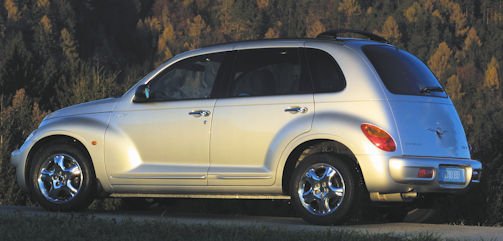
This retro-styled 4-door wagon with many options over the years including available heated front seats and yellow pearl paint.
The production of the convertible began in January 2004 In spring 2004 production version of the four-seat Chrysler PT Cruiser Convertible followed with soft top at the NAIAS 2004. In the spring of 2006, the PT Cruiser received a facelift , which was presented in mid-2005. The front view with new headlights and the interior with new colors and materials was mainly Modified. The engines were also revised slightly. Standard features include a removable 65/35 split-fold rear seat, multi-position rear parcel shelf, air conditioning, tilt steering wheel, floor shift console, and rear wiper/washer on a one-piece liftgate. An optional Touring Group includes a firmer suspension and 16-nch wheels to replace the base 15s. Optional 4-wheel antilock disc brakes supplant rear drums and are bundled with traction control.
The Limited Edition package includes the Touring Group, plus leather upholstery, power moonroof, and a fold-flat front passenger seat. That seat is also included in the 2-F option package, and some of the other tems are available separately. Front and rear power windows are standard. Both are now controlled by switches on the dashboard; previously the rears were operated only by switches at the base of the center console. Those switches remain for use by rear-seat passengers.
The PT Cruiser is therefore content to keep up with the competition in terms of safety and mechanics, two elements that do not alter its outward appearance. Its silhouette therefore remains the same since its very beginnings, while the front end still features a prominent snout, small headlights, and a hot rod-style hood.
The rear end, while still controversial, features the same shape as the original, with its vertical tailgate serving as a rear door. Obviously, opinions will be divided as to the vehicle's beauty. It's not difficult to know what people think of the PT Cruiser. They either love it to bits or hate it to the point of disgust!
Chrysler caims 26 different seating/cargo configurations with the available fold-flat front passenger seat, but you'll have to fold or remove the rear bench for cargo of any size because there's only grocery-bag space with that seat in use. Both rear-seat sections have convenient carry handles and built-in rollers. They're still a bit cumbersome, but not unduly heavy: The larger portion weighs 60 pounds, the smaller 38. Tall and fairly wide rear doors provide plenty of space for slinging them in or out, to the added benefit of passenger access. The load floor is low and flat,and the rear wheel arches don't steal much space. Interior storage is plentiful.
Cruiser's cabin is plenty roomy for four adults and maybe a rear center-seater who doesn't mind a little crowding. The high body build gives all riders abundant head clearance even beneath the power moonroof. Seating is comfortably chair-height, and even 6-footers have good leg space behind a tall front occupant.
Chrysler carries Cruiser's sense of style into the instrument panel, which is tidy and generally well arranged. Audio units sit below dial-type climate controls and are easy to reach and operate.
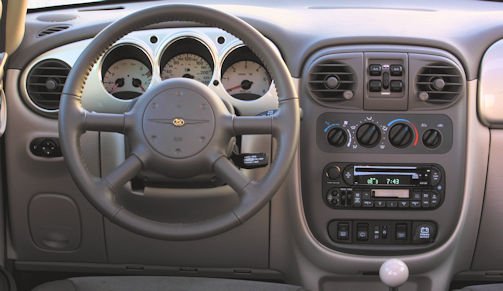
The retro design continues inside with a vintage-inspired dashboard. A four-spoke steering wheel and three large gauges are reminiscent of the racing cars of the past. As for the center console, it incorporates the brand's signature elements, with the radio in the center and the controls at the bottom. The seats are very comfortable and provide good support. when cornering, provided you don't overdo it. The rear seats are generous and easily accessible, which is unfortunately not the case when you want to sit in the back of the convertible version. The location of the front seat belts and the presence of safety belts require you to use bold strategies before attempting the access maneuver. Once seated, however, you'll notice that the space is sufficient and the seatbacks aren't positioned too vertically compared to some other convertible models.
The PT Cruiser comes in different versions.
At the bottom of the scale, the base version with its 4-cylinder liter engine provides the driver with a meager 150 horsepower. In this case, fuel consumption is recommended, but rest assured that performance is not what characterizes this model. It's wiser to opt for the automatic transmission, which does an admirable job with the limited horsepower available. In the middle of the pack is the Touring version, which offers several standard options, including the choice of a 180-horsepower turbo engine. This engine seems best suited to the PT Cruiser, especially when equipped with a manual transmission. Performance is very acceptable, and fuel consumption is quite good.
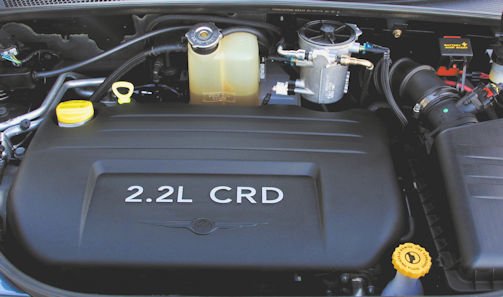
Engine diesel (ECE): 4-cylinder, in-line, 88 x 88.3 mm, 2148 cm³, compression ratio 18.1:1, 110 kW/150 hpat 4200 rpm, 332 Nm from 1600 to 2600 rpm, diesel.
Engine design: 2 overhead camshafts, direct injection, single turbocharger, intercooler. Performance: Top speed (factory) 183 km/h.
The type designation of the PT Cruiser differs depending on the body shape and the side on which the steering is located. The closed model with left-hand steering is designated as type FY, and as right-hand drive type FZ. In the convertible, on the other hand, the type designation JY has been used for the left-hand drive and JZ for the right-hand drive.
STANDARD EQUIPMENT: (Original)
Base: 2.4-liter dohc 4-cylinder engine, 5-speed manual transmission, dual front airbags, air conditioning, power steering, tilt steering wheel, front bucket seats, center console, cupholders, split folding rear seat, power windows,AM/FW cassette, tachometer, rear defogger, rear wiper/washer, visor mirrors, variable intermittent wipers, auxiliary power outlet, floormats, dual out-side mirrors, 195/65R15 tires, wheel covers.
Chrysler Pacifica
 |
|
|
Manufacturer |
Chrysler |
|
Production |
2003 to 2007 |
|
Class |
Motor Car |
|
Body style |
5-door SUV |
|
Layout |
Front-engine, front-wheel-drive-four-wheel-drive |
|
Platform |
Chrysler CS platform |
|
Engine |
3.5 L EGJ V6 3.8 L EGH V6 4.0 L EGQ V6 |
|
Transmission |
4-speed Ultra drive 41TE automatic |
|
Wheelbase |
116.3 in (2,954 mm) |
|
Length |
198.5 in (5,042 mm) (2004–06) |
|
Width |
79.3 in (2,014 mm) |
|
Height |
66.5 in (1,689 mm) (2004–06) |
The Chrysler Pacifica is a car model produced by the car manufacturer DaimlerChrysler from 2002 to 2007, which combines the features of a station wagon, a van and a sports utility vehicle and is therefore referred to as a crossover SUV. Chrysler uses the name Pacifica again since 2016, but this time for a van.
History
The name Pacifica was first used by Chrysler for a concept vehicle based on the NS platform of the Chrysler Town & Country, which was produced on the occasion of its 15th production anniversary.
The vehicle ahead of the concept car went Chrysler Citadel on the North American International Auto Show (NAIAS) in 1999 and a near-series concept car of the same name, the (NAIAS) was shown of 2002. A few months later was New York International Auto Show (NYIAS) presents the production model formally for the first time.
Production of the exclusively North American model began in August 2002 at the Chrysler plant in Windsor, Ontario, Canada. was as the Pacifica in 2004 model year introduced, this was positioned. under the Chrysler Aspen. Design and Special Features: Touring and Limited Pacifica’s can seat up to six people, but the seats are arranged in three rows of two. Base models include a rear bench seat and no third-row seat. The second- and third-row chairs can be easily to fold fiat into the floor, maximizing level loading space with an extra storage bin under the cargo area.
In mid-2006, a facelift version was presented. The production was discontinued in November 2007 after about 400 000 copies due to low demand. The sale finally ended in the model year 2008.As an indirect successor in the Chrysler brand association, the slightly smaller Dodge Journey can be seen. With the 2017 model year, the name Pacifica was again used revived by the Chrysler Town & Country.
Design
Under the direction of Freeman Thomas, the design of the vehicle was born. The approximately 5.05-meter-long car thus founded a new sub-category of SUV - called crossover.
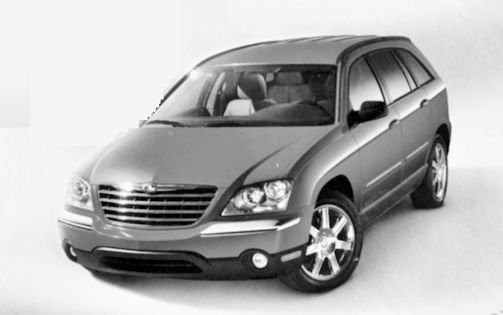
Marked front of a relatively large grille, an indicated underrun protection, slightly more edgy front lights than in the study and two wide chrome inserts in the bumper. The side view is characterized by a light edge, which begins in the fenders and runs out in the tail lights. In addition, depending on the version, as well as on the front and rear, the lower part of the doors covered with dark gray plastic. At the rear, which is simply and straight-lined, the window is widened optically by the roof rails, which run down to the rear lights. In the interior, there are five seats in two rows or six seats in three rows, depending on the equipment, which can be folded down to a flat load compartment. The cockpit is rounded and a special feature is the screen located in the speedometer for the navigation system.
The facelift was mainly the design of the front revised. So, there were now rounder, silver instead of gray coloured headlights and a slightly different grille with three instead of four chrome cross struts. In addition, the front bumper was redesigned and a continuous chrome trim replaced the two-part previous version. At the rear, only the bumper was designed a little differently. In addition, the lateral edges of the light were visually shortened by the new fenders, the exterior mirrors were enlarged and the surface of the bonnet was modified by elongated beads.
The Pacifica is available in three main models base, Touring and Limited. The base model comes with a V6 engine; two-row, five-passenger seating; cloth upholstery, a CD player; full power and keyless entry. The Touring adds a 3.5-liter single-overhead cam VS engine; 17•inch alloy wheels; three-row six-passenger seating (with second-row captain's chairs); and a 10-way power driver seat. An innovative DVD-based navigation system is offered with the screening the instrument cluster for easy viewing by the driver.
Powertrains md Performance: The base front-wheel-drive is powered by a 3.8-liter V6 with 210 and 240 lb-ft of torque.
Safety features optional side curtain airbags for all three rows, ABS, a knee airbag for the driver and an optional tire-pressure system.
Equipment
At the beginning of sales was the simple Pacifica model called the only equipment line, from model year 2005 there were then the versions Base (since model year 2006 LX), the higher-quality Touring version and the Top model Limited and the Special Edition Signature Series. The standard equipment always included a CD radio with six speakers, a multifunction steering wheel with cruise control and an eight-way electrically adjustable driver and a four-way electrically adjustable passenger seat. Furthermore, there were 17-inch wheels, an electric power steering, a tire pressure warning indicator, electrically folding exterior mirrors and a two-zone air conditioning. The safety equipment included ESP, a brake assistant, front and side / head airbags for all rows of seats as well as a knee airbag for the driver and an anti-theft alarm. Special features of the options available depending on the model were the electrically adjustable pedals, leather seats with memory function for radio, exterior mirror and driver's seat, an infinity sound system with CD / DVD changer, a DVD system with screen and remote control for the rear passengers, an electrically operated tailgate, a navigation system or chrome-plated 19-inch alloy wheels.
New light-alloy wheels, a reversing camera and special seat covers made of dirt, water, and Odor-resistant and antistatic material were further features of the facelifted model
Technology
Based on Chrysler RS - platform, the MPV Chrysler Voyager / Grand Voyager and Dodge Caravan / Grand Caravan use, giving a slightly adapted version called CS, which alone the Pacifica used. These changes were necessary because the Pacifica was available with either front or four-wheel drive. Initially, he owned a 3.5-liter V6 gasoline engine with a maximum output of 184 kW (250 hp), taken from the Chrysler 300M and equipped with a four-speed automatic transmission was combined. Later, this was powered by two different six-cylinder V gasoline engines with a maximum output of 160 kW (218 hp) in the 3.8-liter version or a maximum power of 186 kW (253 hp) in the 4.0-liter model replaced.
Chrysler Aspen
 |
|
|
Production period: |
2006 to 2008 |
|
Class: |
SUV |
|
Body versions: |
station wagon |
|
Engines: |
Gasoline: 4.7-5.7 litres (175-280 kW) |
|
Length: |
5101 mm |
|
Width: |
1930 mm |
|
Height: |
1887 mm |
|
Wheelbase: |
3030 mm |
|
Curb weight: |
2207-2287 kg |
The Chrysler Aspen is a sport utility vehicle offered by Daimler Chrysler from 2006 to 2008.
History
The Dodge Durango -based vehicle was formally debut at the North American International Auto Show (NAIAS) 2006 and came in autumn 2006 on the American market. The name Aspen was already used by Dodge as a model name from 1976 to 1980. The Chrysler Aspen is the first for the brand Chrysler SUV developed within the model range of the DaimlerChrysler Group. With the introduction of this vehicle all American car brands had from then on SUV models in their model series. From model year 2009 vehicle with hybrid drive was purchasable.
The Chrysler Aspen was manufactured in Newark (Delaware). The production ended at the end of 2008, after which the plant was closed. Due to the overproduction both models in 2009 were for a time as a new car available.
The Aspen comes as standard with three rows of seats, so that either 7 or 8 people had space - depending on whether the model is equipped in the second row with two single seats or a bench for three people. The tropic is about 12 m, the c Value is 0.391.
The Aspen is powered by rear or four-wheel drive. Power is transmitted via a five-speed automatic transmission.
The 4.7 Liter V8 engine is a flexible-fuel engine, which due to the emission regulations in the US states California, Maine, Massachusetts, New York and Vermont by a 4.7-liter V8 Engine was replaced without these measures. This was identical to the flexible-fuel engine in terms of its power output of up to 175 kW (235 hp) (in model year 2007). The 5.7-l V8 engine found u. a. also used in the Chrysler 300C and was also available for the Dodge Magnum. The control of this engine shuts off four cylinders as soon as less power is required, resulting in a reduction in fuel consumption. If all eight cylinders are controlled, the V8 engine has a maximum power of 257 kW (335 hp) at 509 Nm of torque. In the model 2008, the maximum power of the 4.7-liter engine was 226 kW (303 hp) increases. From the summer of 2008, a version with was a hybrid drive in the offer of a system output of 287 kW (385 hp) The maximum output of the 5.7-liter engine was the model year 2009 to 280 kW (376 hp) increased.
The manufacturer also claims that fuel savings of up to 40% are possible, compared to a standard eco-friendly model. Of course, a hybrid vehicle requires less fuel and therefore fewer polluting emissions. The Aspen and Durango equipped with the powerful 5.7-liter HEMI V8 are therefore eligible for this system, which should reduce fuel consumption to around 12.5 litres per 100 kilometres’, thus bringing the pollution level very close to that of a mid-size sedan. Using the same principle as Toyota products, Chrysler's two-mode hybrid system allows city driving in electric mode only at low speeds, which is assisted by the gasoline engine beyond a certain point.
The hybrid system is more efficient in urban mode or in heavy traffic. However, you should know that the monstrous Hemi is also equipped with a cylinder deactivation system that promotes fuel economy at cruising speeds. The highly tuned HEMI engine is undoubtedly one of the purchasing criteria for many. Not only does it never struggle to move this mass of approximately 2,300 kilos, but it can also tow loads almost twice as heavy. It's paired with a five-speed automatic transmission, efficient in all situations. Comfortable and well-dampened, these vehicles are frankly impressive in terms of handling. The suspension is calibrated to
Chrysler 300 First generation
 |
|
|
Production period: |
2004 to 2010 |
|
Class: |
Luxury Car |
|
Body versions: |
Sedan station wagon |
|
Engines: |
Gasoline : 2.7-6.1 litres (142-317 kW) |
|
Length: |
5015-5047 mm |
|
Width: |
1880 mm |
|
Height: |
1462-1507 mm |
|
Wheelbase: |
3048-3200 mm |
|
Curb weight: |
1805-2050 kg |
|
previous model |
Chrysler 300M |
|
successor |
Chrysler 300 (2011) |
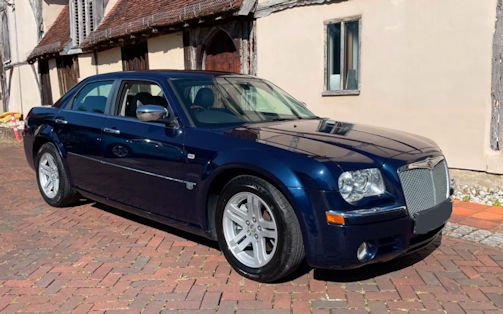
The Chrysler 300 1st generation from 2004 is a passenger car built by Chrysler to 2010.
The 'C' in the model’s name means higher quality equipment that was standard for the European market. The letter C for the trim level was chosen because the Chrysler 300C "letter series" of 1957 served as a model for this successor. Also, optically it was based on the old 300C letter series and thus easily in the so-called retro look designed.
In early 2011, the second generation of the Chrysler 300 was introduced, which was offered in most European countries only under the name Lancia Thema (until October 2014). In the US, however, the model continues to be sold as a Chrysler 300.
The Chrysler 300 was originally a vehicle of the so-called "Letter Series" (letter series) of Chrysler, which was first introduced in 1955. Letter stands for the letter behind the series, which was previously counted with each model year in the alphabet. The name always starts with the model’s name 300, followed by a letter. It was always the most powerful model of the year, which - in contrast to other equipment variants or models - were only available as a two-door coupe or convertible. In 1957 there was already a first 300C. While normal 300s were offered further, the exclusive Letter Series was temporarily terminated with the 300L (1965). Only with the appearance of the Chrysler 300M in 1999, the last representative of the letter cars came on the market.
History
Was presented the new sedan of the Chrysler 300 for the first time in 2003 at the New York International Auto Show (NYIAS) as a near-series concept car, that the station wagon on the IAA in the same year and in the spring of 2004 as a production version whose formal Premiere the North American International Auto Show 2004 took place, for the 2005 model year.
The Chrysler 300 has in contrast to its predecessor rear-wheel drive and offered a level comparable to the predecessor Chrysler 300M comfort at a cheaper price. The 300 was offered in Europe only from the upscale equipment line 300C, the base model 300 was officially unavailable and reserved only for the American market.
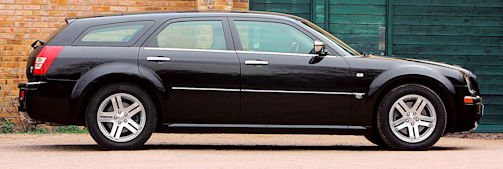
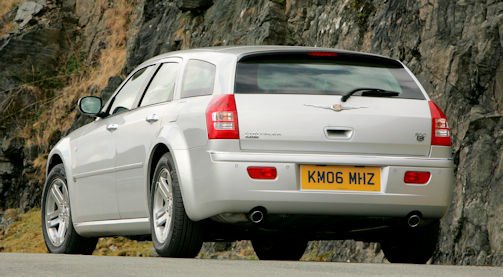
It also offered a station wagon of the 300, which received the name 300C Touring in Europe. In the US, a similar estate model was offered under the name Dodge Magnum.
The body of the Chrysler 300C Touring shares the strong sculptural appearance and the structure of the saloon from the distinctive front grille back to the A-pillars, but it has unique rear side panels, roof and rear liftgate.
The steel liftgate is shaped like an inverted “L,” and the hinges are set back over the load area so that the liftgate rises almost vertically and does not require the operator to step back from the vehicle. This unique liftgate architecture also allows for enhanced access to the rear cargo area. The liftgate, fitted with a two-speed wiper and wash system for additional customer convenience, can be unlocked using the button on the key fob and opened by the centrally mounted external handle.
Both the front and rear seats of the Chrysler 300C Touring are as spacious and comfortable as those of the saloon — with near identical head, leg and shoulder room — but the cargo area is 25 percent larger than in the saloon when the rear seats are up.
With the rear seats occupied, the Chrysler 300C Touring’s load area holds 630 litres (22.2 cu. ft.) of cargo, compared with the saloon’s 504 litres (17.8 cu. ft.). With the rear seats folded, 300C Touring’s cargo capacity is increased to 1,602 litres (56.6 cu. ft.). Within its competitive set, 300C Touring offers exceptional minimum and maximum cargo volume — more than Audi A6 Avant and Saab
9-5 Estate.
The load area features a removable, rollaway tonneau cover, large storage bins in each side panel, four cargo tie-down loops and a 12-volt power outlet. The load floor has a removable tri-fold panel that weighs just 7.25 kg (16 lbs.) and can be partially or fully folded, or completely removed. When used, small items can be stored below this floor panel. When removed, the maximum available load height is increased by 102mm (4.0 in.).
A cargo organiser and management system, which stores below the tri-fold panel, is standard on all UK vehicles. It includes a waterproof liner and folding divider with cargo retaining nets.
Additional cargo can be carried on the optional roof bars that come with two crossbars. Roof bar load capacity is 68 kg (150 lbs.).
In the summer of 2007 found facelift instead: The third brake light was now no longer integrated in the rear window, but in the trunk lid, which was a spoiler in the form of an implied spoiler. The headlights were larger and the taillights redesigned, so that the reversing lights were now at the bottom of the lamp unit. The interior has been designed significantly higher quality. The partial leather seats were now also available in anthracite. The ignition key was taken over by Mercedes-Benz.
All model versions share the Chrysler LX platform, which included numerous components from the Mercedes-Benz E-Class (210 Series) and also served as the platform for the Dodge Charger. Significantly taken over parts are in addition to the chassis, the front seat consoles, the wiring harness, the steering column, the five-speed automatic transmission and derived from the 4MATIC system four-wheel drive.
Drive and equipment
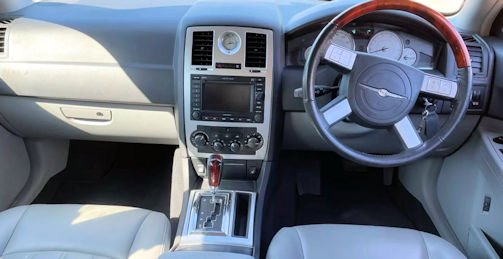
The Touring has the same impressive levels of standard kit as the saloon, with the addition of a rear cargo organiser and cargo cover. Standard features on the Chrysler 300C include Electronic Stability Programme (ESP) and an all-speed Traction Control System, front and rear side-curtain air bags, Xenon High-Intensity Discharge (HID) headlamps, rain-sensing windscreen wipers and a rear park assist system. Air conditioning and heated leather driver and front passenger seats also come as standard on all vehicles in the range.
Two options packs are available on 3.5-litre and 3.0-litre CRD vehicles in the UK. The “Driver’s Pack” comes with full-screen GPS sat-nav with 6-disc CD, and the “Luxury Pack” includes the Driver’s Pack plus sunroof and California walnut wood interior trim.
The 300C 5.7-litre V-8 HEMI® comes with the Luxury Pack as standard, so has an extra £2400 of standard equipment (sunroof, California walnut wood trim, full-screen GPS sat-nav with 6-disc CD) compared to the other cars in the range.
The range starts with the 3.0-litre CRD priced at £27,275. The 3.5-litre petrol is priced at £27,295 and £34,290 for the 5.7-litre HEMI.
In the UK, the Chrysler 300C is covered by Chrysler’s three-year, 60,000-mile warranty. The 300C is built in Graz, Austria.
The basic model 300C 2.7 comes as standard with 18-inch alloy wheels, a tire pressure monitoring system, cruise control, parking assistance, xenon headlights, four-disc brakes, traction control, electronic stability program (ESP), front, side and head airbags and a four- speed automatic transmission, it is powered by a 2.7-liter V6 gasoline engine with a maximum output of 142 kW (193 hp).
Suspension
The suspension architecture is similar in layout to the current Mercedes-Benz E-Class (W211). The short and long arm (SLA) front suspension provides excellent handling and ride characteristics. High upper control arms, which place the upper ball joints above the tyres, provide suspension articulation that helps keep the tyres perpendicular to the road during cornering for high adhesion. Lateral links and tension struts, rather than one-piece lower control arms, position the lower ends of the steering knuckles. These links attach to the steering knuckle via separate ball joints. Multiple bushings offer flexibility to tune for ride and comfort. This architecture creates a virtual pivot point for the tyre to reduce reaction to bumps that would otherwise be perceptible at the steering wheel.
The five-link independent rear suspension system allows independent tuning of handling and ride comfort so that each can be maximised for a no-compromise situation. The rear suspension has been developed to complement the performance of the front suspension for a very balanced vehicle. Multiple aluminium links maintain independent control of camber and toe during suspension movement for excellent handling. Multiple bushings offer flexibility to tune for ride and comfort. Stabiliser bar attachments to the knuckles provide maximum response to vehicle lean in the Chrysler 300C.
The rear suspension is isolated from the passenger compartment to provide a quiet and smooth ride. All rear suspension components, except the coil springs and shock absorbers, mount on a steel cradle that attaches to the body structure through four large rubber mounts. Premium urethane jounce bumpers provide smooth progressive engagement over sharp bumps to minimise harshness.
3.5-litre SOHC V-6 Engine
There is also a 3.5-liter V6 engine with a maximum power of 183 kW (249 hp) in the 300C 3.5.
The 3.5-litre V-6 engine used to power the Chrysler 300C is derived from versions of this engine used in prior Chrysler Group vehicles. An all-new active three-plenum intake manifold provides high power and torque over the entire operating band, with 185 kW (249 hp) at 6400 rpm and 340 Nm (250 lb.-ft.) of torque at 3800 rpm. This engine provides the perfect blend of performance and economy.
The new intake manifold with electronically controlled manifold tuning valve and short-runner valves provides more power to the 3.5-litre engine. Additionally, ETC is used on this engine.
5.7-litre HEMI V-8
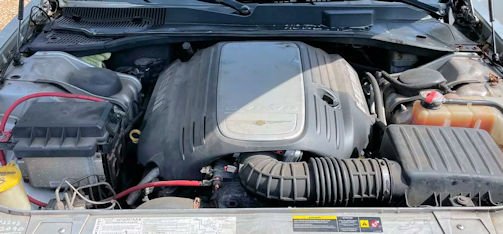
The 300C 5.7 has a 5.7-liter Hemi V8 engine. The control of this engine switched off at low power consumption four cylinders (cylinder deactivation) to reduce fuel consumption. If all eight cylinders are active, the engine delivered up to 250 kW (340 hp) and had a maximum torque of 525 Nm at 4000 rpm.
The introduction of the modern HEMI in Chrysler passenger cars marks several milestones. This engine offers more power and torque than any Chrysler passenger car engine since the legendary 426 HEMI of the ‘60s and ‘70s. Today’s new engine produces 254 kW (340 hp DIN) at 5000 rpm and 525 Nm (387 lb.-ft.) of torque at 4000 rpm.
The new HEMI has been engineered to deliver outstanding performance, while providing minimal noise, vibration and harshness, maximum smoothness and low emissions. Fuel economy has also been improved, but not at the expense of performance. Chrysler Group has developed, and will be the first to offer, a Multi-displacement System (MDS) on a modern, large-volume vehicle produced in North America.
“The Chrysler Group MDS seamlessly alternates between smooth, high fuel economy four-cylinder mode when less power is needed, and V-8 mode when more power from the 5.7-litre HEMI engine is in demand,” said Bob Lee, Vice President — Powertrain Product Team, Chrysler Group. “This optimises fuel economy when V-8 power is not needed, without sacrificing vehicle performance – Chrysler 300C owners will get the maximum benefit without any compromises.”
Owners of the Chrysler 300C will receive the powerful benefit of the HEMI engine with the fuel economy that they would only expect from a smaller, less powerful engine.
“The MDS was part of the engine’s original design,” added Lee. “This resulted in a cylinder-deactivation system that is elegantly simple and completely integrated into the engine design. The benefits are fewer parts, maximum reliability and lower cost.”
Some of the significant technologies enabling the Chrysler Group MDS are the speed of electronic controls, the sophistication of the algorithms controlling the systems and the use of Electronic Throttle Control (ETC). The HEMI will be able to transition from eight cylinders to four in 40 milliseconds (0.040 seconds).
The HEMI engine with MDS has completed more than 6.5 million customer-equivalent miles (10.5 million km) through Chrysler Group's development and durability testing.
The HEMI engine that powers the Chrysler 300C uses aluminium cylinder heads with hemispherical combustion chambers for outstanding airflow leading to high power and torque. Dual ignition (two spark plugs per cylinder) increases peak power and torque, reduces exhaust emissions, increases fuel economy and provides a smooth idle. The combustion system has been refined, and the engine uses direct-mount accessories for quiet operation.
ETC enables several of the technologies used to maximise vehicle smoothness, performance, safety and fuel economy.
The flagship model was the 300C SRT-8 powered by a 6.1-liter Hemi V8 engine with a maximum output of 317 kW (431 hp). It differs in addition to the stronger engine and the corresponding brakes both externally (20-inch wheels, aerodynamics package) and the interior (leather / Alcantara sports seats) of the other equipment versions. The exterior design also omits almost all the chrome elements that make up the other models.
3.0 CRD diesel engine
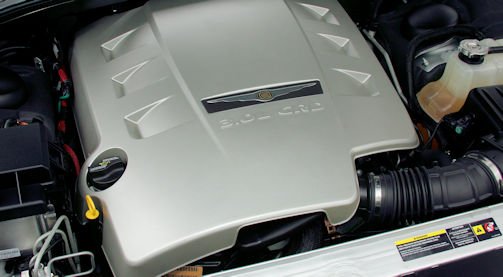
The 300C 3.0 CRD is powered by a six-cylinder diesel engine from Mercedes-Benz with standard particulate filter and a five-speed automatic transmission. This V6 engine with 3.0-liter displacement has a common rail - direct injection with piezoelectrically controlled injector, provides a maximum of 160 kW (218 hp) and developed thereby with a maximum torque of 510 Nm at 1600 rpm.
Based on the latest Mercedes-Benz technology, the CRD engine is fitted with Bosch high-pressure fuel injection (1600+ bar), a variable geometry turbocharger, four valves per cylinder with dual overhead camshafts, and Piezo injectors with a 0.1 millisecond response time. The new engine meets Euro 4 emissions standards and will include an integrated diesel particulate filter. Maximum power is 160 kW (218 hp DIN) and peak torque is 510 Nm (376 lb-ft) from just 1600 rpm.
For this powertrain, the choice of materials, design, fuel injection and engine management system reflect the state-of-the-art engineering adopted during its creation. Unlike many other diesel engines in this displacement and output class, the 3.0-litre V-6 CRD features an aluminium block with cast-in grey iron cylinder liners, which make a major contribution to weight reduction. As a result, the new V-6 weighs only 208 kg (459 lbs., according to DIN).
The diesel engine is an exceptionally smooth-running power unit due to enhancements such as low-friction valve gear, larger bearings for the crankshaft, connecting rods made from a new alloy and a counter-rotating balancer shaft between the cylinder banks. A quick-start glow system shortens preheating time to just a moment, so that the diesel is nearly as quick to start as a petrol engine.
The 3.0-litre V-6 CRD engine embodies third-generation common-rail technology. The result is a reduction in fuel consumption, exhaust emissions and combustion noise. With Piezo fuel injectors, adjust fuel supply to each cylinder. The number of fuel injections per power stroke has been increased from three to five, at a peak pressure of up to 1600 bar.
The engine was developed as a “one-box-concept” with the cylinder block, add-on components and ancillary units forming a uniquely compact power unit. The camshaft bearings are integrated into the cylinder heads and cylinder head covers, which saves space and cuts noise. The four camshafts are driven by a tried-and-tested double-bush timing chain system which also operates the balancer shaft and high-pressure fuel injection pump.
Four additional features are key to outstanding performance of the 3.0-litre V-6 CRD engine. A Variable Geometry Turbocharger (VGT) uses electronic adjustment to rapidly and precisely vary the angle of the turbine blades to maintain charge pressure over a broad range of operating conditions and enable the engine to generate high levels of torque even at low engine speeds. This turbocharger is combined with a downstream intercooler which reduces the temperature of the compressed, heated air by up to 95 degrees Celsius, allowing a larger volume of air to reach the combustion chambers. A newly developed valve control system for the 24 valves reduces both friction and moving masses. Electronically controlled intake port shut-offs adjust the turbulence of air entering the cylinders to optimise the combustion process and ensure three benefits – more power, lower fuel consumption and lower exhaust emissions.
For the 3.0-litre V-6 CRD unit, a W5A580 five-speed automatic transmission offers smooth shifts and optimum fuel economy. It features Electronic Range Select driver interactive shift control wherein the shifter provides fully automatic shifting in the “Drive” position, or the driver can manually select each gear sequentially by moving the shift lever left or right from the “Drive” position. This gives the driver the control to precisely match any driving requirement.
The 3.0-litre V-6 CRD engine is part of an impressive powertrain lineup. The 3.5-litre V-6 engine delivers high output, still with a perfect blend of performance and economy. For the ultimate in performance, Chrysler 300C customers can choose the 5.7-litre V-8 HEMI power unit.
In the 2005 model crash tests, the vehicle was rated according to US NCAP criteria with five stars in a head-on collision and by the IIHS in the attempt "Moderate overlap front" with "Good”.
The Chrysler 300C for markets outside of North America was manufactured in June 2005 at Magna Steyr in Graz. For the North American markets in Brampton, Ontario, Canada. Since the beginning of 2011 there is the eponymous successor Chrysler 300 (2011) , whose development was still running when Fiat was already taking over Chrysler, with new bodywork and other (never available in North America) diesel engine, which continues in the US as the Chrysler 300 in Europe, however, except for example in the United Kingdom, Ireland, Russia and Ukraine as part of the merger of Chrysler and Lancia until October 2014 as Lancia theme was offered. For the Lancia theme, there were matching emblems and conversion kits to make it look like a Chrysler. The technology was adopted to a large extent by the predecessor, so that, for example, in conjunction with the diesel engine continued to work a Mercedes 5-speed automatic transmission.
From 2004 to 2007, Barack Obama, later President of the US, drove a 300C.
Exterior colours include Brilliant Black Crystal Pearl coat; Bright Silver Metallic Clearcoat; Magnesium Pearl coat; Midnight Blue Pearl coat and Mineral Grey Metallic Clearcoat.
In the second season of the television series Desperate Housewives, 'Bree Van De Kamp' drives a Chrysler 300.
Chrysler 300C Safety Features:
- All-speed Traction Control System (TCS): All-speed TCS enhances mobility and prevents wheel slip when accelerating on road surfaces by operating both the brakes and the Electronic Throttle Control (ETC)
- Anti-lock Brake System (ABS): Equipped with electronic sensors that help prevent wheel lockup, the ABS system offers improved steering control under extreme braking and/or slippery conditions
- Auto-reverse Windows: An advanced sensing system automatically engages and reverses the window down to help prevent injuries to children
- Body Structure: Crush beads and stiffeners engineered into the vehicle body help absorb energy, while preserving the integrity of the vehicle compartment. These reinforcements provide additional protection in an offset-type impact
- Child Seat Anchor System (LATCH/ISOFIX): Lower anchors and tethers to ease installation of compatible aftermarket child seats
- Constant Force Retractors (CFR): The front seat belts include a mechanical device designed to distribute the force of a seat belt according to the load or force exerted on it. CFRs are engineered to force-limit the belt system, and gradually release seat belt webbing in a controlled manner during a severe crash
- Electronic Stability Programme (ESP): This feature aids the driver in maintaining vehicle directional stability, providing oversteer and understeer control to maintain vehicle behaviour on road surfaces
- Energy-absorbing Steering Column: Manual-adjust steering columns utilise two hydroformed coaxial tubes that can move relative to each other to allow the column to move forward and provide more energy absorption during a crash. The power-adjust steering column employs a calibrated bending element which deforms during column stroke for optimal energy management
- Enhanced Accident Response System (EARS): In the event of an accident, this system makes it easier for emergency personnel to see and reach the occupants by turning on the interior lighting and unlocking the doors after air bag deployment
- Multi-stage Air Bags: Multi-stage air bags deploy at three different rates depending on the severity of the crash. In lower-severity collisions, the air bag deploys with less force, and the force is increased during more severe collisions
- Pretensioners: During a collision, the impact sensors initiate the front seat belt pretensioners to immediately remove slack from the seat belts thereby reducing the forward movement of the occupant's head and torso
- Rear Park Assist: This system signals an audible warning and rear overhead display to aid in collision avoidance
- Side-curtain Air Bags: The side curtain extends protection to all outboard passengers
- Thatcham category 1 alarm system
- Tyre pressure monitoring system
- Xenon headlamps
Standard Specification
- Patented faux tortoise shell interior accents or optional genuine California Walnut wood accents
- Heated leather driver and front passenger seats
- Eight-way power adjustable front seats
- Driver and front passenger adjustable lumbar support
- Leather-wrapped steering wheel with flush-mounted audio, navigation and trip computer controls
- Dual driver memory system controls for driver’s seat, mirrors and radio presets
- Dual-zone automatic temperature control with infrared sensing
- Air filtration system
- Electronic Vehicle Information Centre (EVIC)
- Cruise control
- Express-up/down power front windows with anti-pinch protection
- Analogue clock
- 60/40 split folding rear seat
- Electrochromic interior and driver’s rearview mirror
- 18-inch five-spoke, split-spoke wheels
- Metallic paint
- Suspension levelling
- FM radio with single CD
- 6-speaker Boston Acoustic Audio System (280 watts)
- Rear cargo organiser and cargo cover
- Diesel engine features diesel particulate filter as standard