
BMC
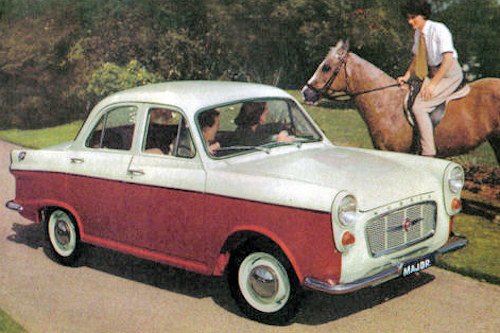
Morris Major Series II
 |
|
|
Manufacturer |
British Motor Corporation (Australia) |
|
Also called |
Austin Lancer |
|
Production |
1959-1962 |
|
Assembly |
Victoria Park, Australia |
|
Class |
Motor car |
|
Body style |
4-door sedan |
|
Layout |
FR layout |
|
Engine |
BMC B-Series engine, 1489 & 1622 cc |
|
Transmission |
4-speed manual, synchromesh on 2,3 & 4 |
|
Wheelbase |
92 in (2,300 mm) |
|
Length |
161 in (4,100 mm) |
|
Width |
61 in (1,500 mm) |
|
Curb weight |
up to 940 kg (2,072 lb) |
The Morris Major Series II are passenger car models which were produced by the B.M.C. of Australia between 1959 and 1962.
History
Because development expenditures were not assigned to them and numerous common parts were used, the Morris Major and Austin Lancer of the first series sold successfully and profitably. Nonetheless, BMC moved fast to invest in a substantial update to the car, the Series II, which is expected to prove even more popular with buyers. The Australian twins differed greatly from their English sister models as a result of the alteration. They were 9" longer on the outside, contributing to a larger wheelbase, and received tail fins, a revised vehicle front, and a modified oil sump to provide more ground clearance for Australian roads.
The styling of the Series II designated as DO1115 was inspired by American ideas and many thought that it helped the cars to look better. Many changes were made to the original design and most should help to better adapt the cars to the harsh Australian road conditions and their competitiveness over the biggest competitors.
Wheel suspensions and suspension were strengthened, front seat was a seat instead of the previous individual seats installed, there were new air outlets for heating and ventilation and a new dashboard. Also, the rear axle of the Series I (a construction by Morris Minor, who did not cope well with the motor) was described as too weak. Axle and differential were thus reinforced, but unfortunately the difficulties with these components in Series I already spoiled the reputation of the model and its manufacturer. The Series II engines were equipped with a single SU-HS2 carburetor and a SU fuel pump and got another oil pan, which provided more ground clearance. The Series II was praised by the engine press because of the many detail improvements, the better handling characteristics and the good price-performance ratio.
BMC 345 350 420 440 EA vans history
 |
|
|
Manufacturer: |
BMC / Leyland |
|
Production period: |
1968 to 1984 |
|
Type: |
commercial vehicle |
|
designs: |
Panel van , flatbed , minibus |
|
Engines: |
Gasoline 2.5 liters |
In 1968, the BMC 350EA launched as the successor to the Morris LD Van / Austin 1000 / 1500kg Van . Following the merger of British Motor Corporation (BMC) and Leyland Motors into the British Leyland Motor Corporation (BLMC), the model was no longer marketed as Morris / Austin and production of the Leyland 2-tonner and Leyland 15/20 discontinued.
The 350 EA was therefore the group's first model to be offered as BMC from the beginning as 345, 350, 420, and larger 440 EA, while for example the BMC 250 JU or the BMC J4 were only renamed models.
Like its predecessor, it was a cab transporter with a built-in between driver and passenger seat engine whose power was transmitted to the rear axle with cardan shaft. From the predecessor he distinguished in the body area some details:
- The box van for door-to-door delivery now had two front sliding doors ex works.
- Minibus and ambulances had as already the flatbed front two folding doors.
- A semitrailer tractor was no longer produced, as this was the BMC FG alone in the segment provided.
- A chassis with engine (cowl) for superstructures was also available again.
- The ambulance now had a special body of its own on the platform of the 350 EA,
- But there was also a patient transport car based on the 350-EA van.
- The payload was now uniformly 1500 kg.
With the same wheelbase, the van had two different lengths with a cargo capacity of 7.7 m³ and 9.1 m³. A 2.5-liter gasoline engine with side camshaft and 51 kW (69 hp) or a 2.5-liter diesel engine with 42 kW (58 hp) powered the vehicle, each with 5-speed manual transmission.
In 1970, BLMC dropped the brand name BMC and the 350 EA was now marketed as Leyland EA. At the same time, the model range was revised. A new long-wheelbase version was introduced, which now has a cargo capacity of 9.1 m³ with short wheelbase and 11 m³ at long wheelbase in the van was available. The payload was increased to 1 ½ to 2 tons, bringing the total weight over 3500 kg and the name 350 was omitted in the name. Now again a chassis with cab for bodies was offered.
In advertising, Leyland spoke of a "box on wheels" or "plain, practical and packed with power." As was the case with BLMC at the time, the quality of construction and reliability varied. As a result, the EA never reached fleet sales like the Morris LD Van , but was nevertheless a familiar sight on the roads of the United Kingdom of Great Britain and Ireland in the 1970s. Apart from the Commonwealth countries , he also achieved some sales successes in continental Europe.
From 1982 to 1984, he gradually replaced the larger versions of the Freight Rover 200-300 / Sherpa .

General Specification
- Manufacturer:BMC / Leyland
- Production period:1968-1984
- Designs:Panel van , flatbed , minibus
- Engines:Gasoline engine :2.5 liters (51 kW)Diesel engine :2.5 liters (42 kW)
- Payload:1.5-2.0 t
- Total weight:3.5-4.0 t
- Previous model:Morris LD Van / Austin 1000 / 1500kg Van Leyland 2-tonner
- Successor:Freight Rover 200-300
Mini Moke
| 1964 to 1993 | |
|---|---|
 |
|
| Manufacturer | BMC Leyland Australia British Leyland Portugal Cagiva |
| Also called | Austin Mini Moke Morris Mini Moke BMC Mini Moke (Military version)Leyland Moke (Australia) |
| Production | 1964 to1993 |
| Assembly | Setúbal, Portugal Longbridge plant, Birmingham, England Zetland, New South Wales, Australia Umtali, Rhodesia |
| Designer | Sir Alec Issigonis |
| Class | utility vehicle |
| Body style | 4 seat convertible 2 seat pickup |
| Layout | FF layout |
| Engine | 850 cc A-series, I4 998 cc I4 1098 cc I4 1275 cc I4 |
| Transmission | 4-speed manual |
| Wheelbase | 2,020 mm (79.5 in) |
| Length | 3,050 mm (120.1 in) |
| Width | 1,300 mm (51.2 in) |
| Height | 1,400 mm (55.1 in)(with cloth roof and windshield raised) |
| Kerb weight | 406 kg (896 lb) — Early models 578 kg (1275 lb) — Later models |
The Mini Moke is a vehicle based on the Mini designed for the British Motor Corporation (BMC) by Sir Alec Issigonis.
History
The name comes from "Mini"—the car with which the Moke shares many parts—and "Moke", which is an archaic dialect term for donkey.The Moke has been marketed under various names including Austin Mini Moke, Morris Mini Moke and Leyland Moke.
The initial design was a prototype for a light military vehicle in the style of the American Jeep, but its small wheels and low ground clearance made it impractical as an off-road vehicle. It was subsequently offered in a civilian version as a low-cost, easily maintained utility vehicle. The Moke finally achieved success as a beach buggy—becoming a popular 'cult' vehicle in the Algarve, Seychelles, Australia, the United States and many tropical resorts in the Caribbean. The original Moke used identical engine, transmission and suspension parts from the Mini Van.
The first Mokes were only built at BMC's Longbridge, Birmingham plant. 14,518 Mokes were produced in the UK between 1964 and 1968, 26,000 in Australia between 1966 and 1981, and 10,000 in Portugal between 1980 and 1993 when production of the Moke ended.
When Issigonis designed the Mini, he planned another vehicle to share the Mini's mechanical parts, but with a more rugged body shell. This was an attempt to take a portion of the military vehicle business from Land Rover. Issigonis had previously designed the Nuffield Guppy in a failed attempt to break into that market. By 1959, BMC had working prototypes of what was codenamed "The Buckboard", later to become the Mini Moke. These prototypes were shown to the British Army as a parachute-droppable vehicle, but poor ground clearance and a low-powered engine did not meet the most basic requirements for an off-road vehicle. Only the Royal Navy showed any interest at all in the Buckboard—as a vehicle for use on the decks of aircraft carriers.
Early promotional material made much of the lightness of the vehicle, showing four soldiers travelling in the Moke off-road, then picking it up by its tubular bumpers and carrying it when (inevitably) its low ground clearance proved inadequate.
In a further attempt to make something for the army, a few four-wheel drive Mokes were made by the addition of a second engine and transmission at the back of the vehicle with linked clutches and gear shifters. This did nothing for the ground-clearance problems, and mechanical complications discouraged development beyond the prototype stage. This vehicle was called "The Twini" and was shown to the US Army—again with no success.
Three of these vehicles were used by the Brazilian Army after being captured during the 1969 Rupununi Rebellion from Guyanese rebels, who had crossed the border into Brazil.
British Mokes
Eventually BMC gave up on the idea of selling the Moke to the military, and in 1963 the decision was made to build a civilian version, targeting farmers and light commercial applications. Several prototypes were built in 1963, one of which is still known to exist in Pinner just outside London, England. The Moke was launched onto the British market in 1964. The British Customs and Excise department decided that the Moke should be classified as a passenger car rather than as a commercial vehicle which meant that it attracted purchase tax, reducing sales in its intended commercial market.
The Moke attracted attention as a 'cult' vehicle as a result of the unprecedented success of the Mini and through media exposure in the popular television series The Prisoner, as well as in the Traffic song "Berkshire Poppies." Despite this, only about a tenth of the 14,500 British produced Mokes were sold in the United Kingdom.Mokes continued to be made in Britain until 1968.
British-made Mokes were fitted with a low-end 848 cc inline-four engine, detuned to use low-octane fuel. They used the same suspension, gearbox and 10 inch wheels as the standard Mini. In the initial offering, passenger seats, grab handles, heater, windscreen washer and a removable canvas top were all optional equipment delivered separately from the vehicle. Owners had to bolt these optional extras onto the vehicle themselves. The base price was GB£ 405. The 'Mk I' Mokes had a single windscreen wiper and a floor-mounted headlight dip switch, and the only colour available was "Spruce Green". In 1967, the 'Mk II' Moke added a passenger-side wiper. Horn and headlight controls were moved onto the indicator stalk. These later British Mokes were also available in white.
The John Player & Sons cigarette company ran a team of Mokes in autocross competitions on grass tracks through 1968. These vehicles were equipped with rollover protection and used the Mini Cooper S 1275 cc engine.
Australian Mokes
The Moke was built in Australia from 1966 to 1981 where it was originally marketed as the Morris Mini Moke and from 1973 as the Leyland Moke. Initially Australian Mokes had the same 10 inch wheels as British Mokes and Mini saloons, however these were soon replaced by 13 inch wheels with longer rear trailing arms, which made them more practical for gentle off-road or beach use than the British version. The solid metal seats of the British Mokes were replaced with tubular-framed 'deck-chair' seats. This variant started with a 998 cc engine which was switched in mid-production to 1,098 cc. In 1976, with the advent of new anti-pollution requirements (Australian Design Rule 27A), the locally manufactured 1,098 cc motor was replaced by an imported version of the 998 cc motor with an air pump and exhaust gas recirculation, which had been developed to meet UK anti-pollution requirements.
PERFORMANCE: 850cc
- engine capacity: 51.74 cu in, 848 cu cm
- fuel consumption: 42.8 m/imp gal, 35.6 mlUS gal, 6.6 1 x 100 km
- max speed: 73 mph, 117.5 km/h
- power-weight ratio: 35.1 lb/hp, 15.9 kg/hp
- max power (DIN) : 34 hp at 5,500 rpm
- max torque (DIN): 44 1b ft, 6.1 kg m at 2,900 rpm
- max engine rpm: 5,500
- specific power: 40.1 hp/l
For a brief period around 1972, Leyland Australia produced a variant referred to in Leyland literature as "Moke, special export", but commonly called a "Californian", which had a 1,275 cc engine and was fitted with side marker lamps and different rear lights to conform to US FMVSS standards. The fuel tank from the Austin Sprite or MG Midget was fitted beneath the rear load area, replacing the standard tank mounted in the left sidebox. The export Californian was readily recognisable by its roof and seats, trimmed in 'Op-pop verve' black and white tiger striped vinyl or 'Orange Bali' vinyl, which looked rather like a fruit salad, and was briefly marketed to the 'flower power' culture in the United States.
The name "Californian" and the 1,275 cc motor were resurrected in 1977 for Australian market Mokes with denim seat covers, more comfortable seats (which concealed the same basic frame within), spoked wheels and complex tubular bumpers (known as 'roo bars').
Australian Mokes were exported to many countries, and pioneered large-scale exports of Australian-made vehicles. Leyland Australia made much of these exports in its advertising. The use of Australian-made Mokes by the Israeli Army (complete with a machine gun tripod mounted in the rear) attracted controversy and media attention.
From 1975, a pickup version of the Moke was produced, with a 1.45 x 1.50 metre (55 x 59 in) drop-sided bed which protruded behind the back of the vehicle, and a cloth top over the cab area. At least two four-wheel drive Moke prototypes were manufactured by Leyland Australia in the late 1970s, but unlike the British version, these used just one engine. Leyland were planning to market this version, but Moke production in Australia ended in 1981 and all that remains of the project is one of the prototypes which is now owned by an enthusiast in Western Australia and a modified differential crownwheel with gearteeth cut in the side to drive the rear tailshaft, in the personal collection of a Melbourne Mini specialist.
In 1977, a 1,275 cc Cooper S-engined Moke (sponsored by Coca-Cola) was entered into the Singapore Airlines London-Sydney Marathon. The car was driven over 30,000 km (19,000 miles) over 30 days and finished in 35th place.
Portuguese Mokes
As Australian Moke production wound down, manufacturing was transferred to British Leyland's subsidiary in Portugal, which made 8,500 of the 'Californian' Mokes in their Vendas Novas plant between 1980 and 1990. Initially these Mokes were identical to late model Australian Mokes; very soon, however, they were altered to use then-current British production Mini saloon components, including the standard-length Mini rear trailing arms and the 12 in wheels with modern low-profile tyres, which the saloon had acquired during the Moke's absence from Europe.
In 1990, British Leyland (by then called Rover Group) sold the "Moke" name to Cagiva—a motorcycle manufacturer in Bologna, Italy. Production continued in Portugal until 1993, when Cagiva transferred the tooling to their factory in Italy with the intention of restarting production in 1995—which they never did. Since Cagiva did not own the "Mini" name, the 1,500 cars they built were sold simply as "Mokes". This brought the total production run of Mokes and Moke derivatives to about 50,000.
Construction and maintenance
The Moke's construction is simple. The body mainly consists of two box-section 'pontoons' or 'sideboxes' running between the front and rear wheels, and include (non-hollow) extensions of that from the back of the car all the way up to the front. These are connected by the floor pan, the firewall and a sturdy lateral torque box that runs under the front seats and stiffens the body in torsion. The left-hand pontoon contains the fuel tank; the right-hand has a compartment for the battery and a small lockable storage area. The 1972 "Moke, Special Export", commonly referred to as a 'Californian' Moke, has an Austin Sprite/MG Midget type fuel tank fitted beneath the rear floor area to meet the American FMVSS safety requirements of the time. Standard Mokes of the same period and later Californian Mokes use the conventional tank mounted in the left sidebox. Later Portuguese Mokes have additional lockable storage space at the rear of the vehicle. The optional cloth canopy has plastic side windows, and is held up by a thin tubular structure that can easily be removed when not needed. In later versions this was replaced with a more solid roll cage. The windscreen can easily be unbolted and removed if not needed. There are just three curved panels in the Moke, the bonnet, the firewall and the floor, each of which is only curved in one direction. This makes it relatively straightforward to reproduce and replace Moke body components without access to sophisticated machine tools.
Because the Moke's A-Series engine, manual gearbox and suspension are identical to those of a standard Mini (which was still in production up to October 2000), most spare parts are still readily available. The Moke has no chassis, so the wheels, brake assemblies and suspension are attached to front and rear subframes which are bolted straight onto the monocoque shell just as with a standard Mini. Mokes tend to require much structural maintenance if they are to stay in good running order.
Kit cars and look-alikes
The true Mini Moke was never available as a 'kit car', but because the basic Mini parts are easily available, many companies have made copies of the vehicle: the Andersen Mini-Cub, the Del Tech Nomad, the Gecko, the Hobo, the Hustler, the Jimini, the Mini-Scout, the Mule, the Navajo, the Ranger, the Mini Scamp, the Stimson, the Warrior and the Yak.
A Austin Mini Moke in You Only Live Twice Movie from 1967

Mini Mokes also Featured briefly in Live and Let Die and later in The Spy Who Loved Me. In Live and Let Die, Bond and Rosie use this vehicle to drive to the harbor to meet Quarrel Jr. In The Spy Who Loved Me, the crew of the Liparus supertanker uses a Mini Moke in their defense against a break out by the submarine crews. Also seen in Moonraker where Bond and Dr. Goodhead are hiding in a trailer (prior to boarding Moonraker 6 as pilots) after escaping from an air vent during Moonraker 5's launch.
Mini Moke in The Prisoner cult TV-Series from the 1960s

Mini Moke from Wheeler Dealers Series 8

Mini limited editions worldwide

Anniversary editions
Mini 25
- Year: 1984 (July)
- Based on: Mini Mayfair
- Engine: 998 cc
- Exterior colour:
- Silver Leaf Metallic (MME - BLVC421)
- Exterior trim: Nimbus Grey
- Decals/badges: Side and rear grey and red stripes with "Mini 25" logos
- Interior: Luxury velvet with red piping, zip pockets fitted to front seats, red seat belts, leather-wrapped steering wheel
- Equipment: 12-inch wheels, 8.4-inch front disc brakes, full-width wheel trim with arch extensions, 1275GT instrumentation, tinted glass, stereo radio cassette, twin door mirrors
- Production: 3,500 in UK, 1,500 exported
Mini 30

- Year: 1989 (June)
- Based on: Mini Mayfair
- Engine: 998 cc
- Exterior colour:
- Cherry Red (COG - BLVC843)
- Black (PMA - BLVC90)
- Exterior trim: Chrome bumpers and grille
- Decals/badges: Coachlines and 1959-1989 crests
- Interior: Half leather/lightning cloth, red piping
- Equipment: Minilite-style wheels, security coded stereo, leather-bound copy of Rob Golding's book ("Mini")
- Production: 3,000 for UK
Of the 3,000 produced for the UK, 2,000 were in Cherry Red and 1,000 were Black; 2,800 were manual and 200 had an automatic gearbox.
Mini 35
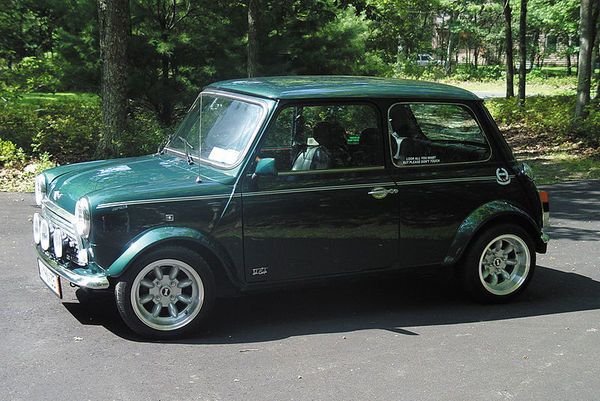
- Year: 1994 (June)
- Based on: Mini Sprite
- Engine: 1,275 cc 1 3/4 SU Carb
- Exterior colour:
- Pearlescent Nevada Red
- Metallic Arizona Blue
- Diamond White
- Metallic British Racing Green
- Exterior trim: Chrome grille, lock set and door handles, auxiliary driving lamps. Electric adjustable headlamp aim. Export option: Webasto sunroof.
- Decals/badges: Silver coachline with special decals.
- Interior: Blue-and-pink "Jamboree" fabric; export option: all-leather, perforated leather inserts, colored piping that matched the exterior. Full walnut wood dash and door cappings.
- Equipment: Opening rear windows, R652 stereo
- Production: 1,000 for UK (RHD), 400 for export (LHD)
The 35 did not come with alloy wheels as standard. An automatic transmission was offered as an option. This limited edition was also offered in France, Italy and Japan, although it was identified by different names in those markets. Four hundred left-hand drive Mini 35 cars were also built for export to Holland and Germany late in the model year (November 1994). They were painted British Racing Green Metallic and had all-leather interior with piping trim that matched the exterior color. They had 13-inch alloy wheels and extended wheel arches. The LHD cars also had the same silver coachlines, special decals, and a special wood-rimmed steering wheel with a 35th Anniversary horn button. Only a few were sold and the rest re-badged and sold as 1995 models.
Mini 40

- Year: 1999 (April)
- Based on: Mini Cooper
- Engine: 1,275 cc MPi (Multi-Point Injection)
- Exterior colours:
- Island Blue (BU5)
- Mulberry Red (CDM - BLVC1274)
- Old English White (WT3)
- Tahiti Blue Metallic
- Exterior trim: Chrome bumpers, grille, and handles. Optional Webasto electric sunroof.
- Decals/badges: Gold "Mini 40" bonnet badge, anniversary decal on the body sides, chrome "GB" on boot
- Interior: Color-matched leather seats with contrasting piping, alloy dashboard, chrome-detailed instruments, and a leather facia top, handbrake, and gear knob.
- Equipment: CD Player, 13-inch Sportspack wheels, Sportspack arches, twin spotlamps
- Production: 250 for UK
London Collection
Mini Mayfair
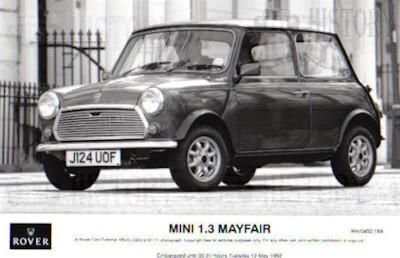
- Year: 1982 - 1996
- Based on: Mini City
- Engine: 998 cc / 1,275 cc
- Exterior colour: Various
- Exterior trim: Various coloured grille, door handles, bumpers, door mirrors, plastic wheel arch extensions and sill finishers, chrome from 1992. Silver plastic wheel covers
- Decals/badges: Coachlines with "Mayfair" logos
- Interior: Various colours, seats and door cards in Chalkstripe velor (1985–1988), Prism velor (1988–1991), Chevron velor (1992–1994), Windsor velor (1995–1996)
- Equipment: 12-inch wheels with alloy option after 1984, opening rear side windows, radio, head restraints, locking fuel cap, tinted glass, tachometer, front disc brakes.
Mini Ritz

- Year: 1985 (January)
- Based on: Mini City
- Engine: 1.9 cc
- Exterior colour:
- purple(MME - BLVC421)
- Exterior trim: Chrome, black-centered grille
- Decals/badges: Red stripes with "Ritz" logos
- Interior: Claret Red, Prussian Blue and Osprey Grey velvet
- Equipment: 12-inch alloy wheels
- Production: 2,000 for UK, 1,725 for export from Italy
Mini Chelsea
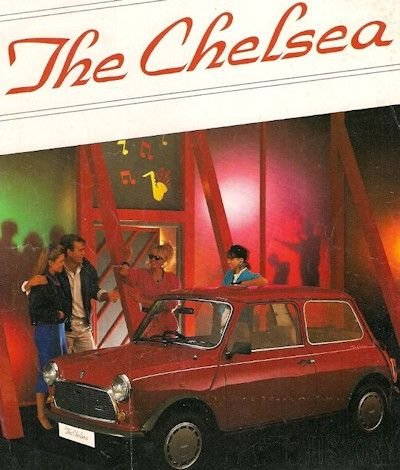
- Year: 1985 (February)
- Based on: Mini City
- Engine: 998 cc
- Exterior colours:
- Targa Red (CNE - BLVC641)
- Silver Leaf (Japan) (MME - BLVC421)
- Exterior trim: Grey bumpers and door handles
- Decals/badges: Silver and red coachlines with "Chelsea" logos
- Interior: Osprey Grey with red piping
- Equipment: 12-inch alloy wheels and opening rear side windows
- Production: 1,500 for UK, more exported
Produced after the supply of Mini Ritz's had been sold.
Mini Piccadilly

- Year: 1986 (May)
- Based: Mini City
- Engine: 998 cc
- Exterior colour:
- Cashmere Gold Metallic (GMD - BLVC422)
- Exterior trim: Chrome bumpers, black-centred grille
- Decals/badges: Twin coachlines with "Piccadilly" logo
- Interior: Bitter Chocolate, Coffee and Claret velvet
- Equipment: Full-width wheel trims, push button radio
- Production: 2,500
Many examples were exported to France and Japan.
Mini Park Lane

- Year: 1987 (January)
- Based: Mini City
- Engine: 998 cc
- Exterior colour:
- Black (PMA - BLVC90)
- Exterior trim: Chrome bumpers and grille surround
- Decals/badges: 'Park Lane' logos on doors and bootlid, stripes on rear side panels
- Interior: Beige/Black velvet
- Equipment: Full width wheel trims, tinted windows, opening side windows, stereo radio cassette
- Production: 4,000 (1,500 for UK, 700 for Japan)
Mini Advantage
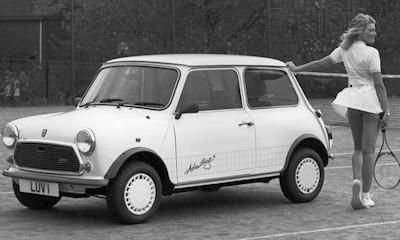
- Also known as: Mini Masters (Germany)
- Year: 1987 (June)
- Based on: Mini City
- Engine: 998 cc
- Exterior colour:
- Diamond White (NMN - BLVC655)
- Exterior trim: Grey bumpers and door handles; black door mirrors; white wheel covers for the 12-inch steel wheels; Nimbus grey plastic wheel arch extensions and sill finishers
- Decals/badges: Tennis-net theme on lower body sides with "Advantage" script logo; Advantage logo on upper right of bootlid
- Interior: Flint Grey and Jade Green "Tennis Net" cloth on seats and door panels
- Equipment: Tachometer, radio-cassette, tinted glass, opening rear windows with chrome surround
- Production: 4,675 (2,500 for UK)
First launched in France in May 1987 to coincide with the French Open, the Mini Advantage also appeared in the UK in June of that year to be available during The Championships, Wimbledon.
Colours
Mini Red Hot

- Year: 1988 (January)
- Based on: Mini City
- Engine: 998 cc
- Exterior colour:
- GPO Red (CNL – BLVC 1073)
- Exterior trim: Chrome bumpers and grille surround
- Decals/badges: Black coachline and 'Red Hot' logos
- Interior: Black velour
- Equipment: Full width wheel trims, opening side windows, tinted glass, push button radio
- Production: ~3,000 (~1,000 for UK)
Mini Jet Black

- Year: 1988 (January)
- Based on: Mini City
- Engine: 998 cc
- Exterior colour:
- Black
- Exterior trim: Chrome bumpers and grille surround
- Decals/badges: Red coachline and 'Jet Black' logos
- Interior: Black velour
- Equipment: Full width wheel trims, opening side windows, tinted glass, push button radiProduction: 3,000 1,000 for UK)
Mini Rose
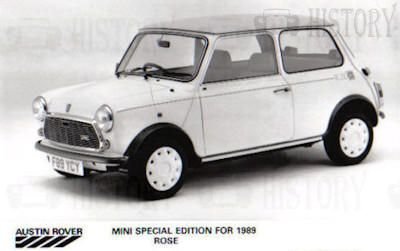
- Year: 1989 (January)
- Based on: Mini City
- Engine: 998 cc
- Exterior colour:
- White (NAL or BLVC 1218) with Pastel Pink (DME)roof
- Exterior trim: Grey bumpers, wheelarches and grille center
- Decals/badges: Coachlines with 'Rose' logo
- Interior: Pink and Blue 'Crayons' fabric
- Equipment: Full-width white wheeltrims, radio cassette
- Production: 500
This 1960s theme was introduced in preparation for the Mini's 30th birthday.
Mini Sky
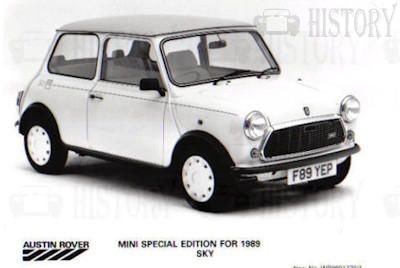
- Year: 1989 (January)
- Based on: Mini City
- Engine: 998 cc
- Exterior colour:
- White (NAL or BLVC 1218) with Pastel Blue (JQN) roof
- Exterior trim: Grey bumpers, wheelarches and grille center
- Decals/badges: Coachlines with 'Sky' logo
- Interior: Pink and Blue 'Crayons' fabric
- Equipment: Full-width white wheeltrims, radio cassette
- Production: 500
This 1960s theme was introduced in preparation for the Mini's 30th birthday.
Mini Racing
- Year: 1989 (January)
- Based on: Mini City
- Engine: 998 cc
- Exterior colour:
- BRG Metallic (HAF - BLVC617) with white roof
- Exterior trim: Chrome bumpers and black grille center
- Decals/badges: Coachlines with 'Racing' logo
- Interior: Black 'Crayons' fabric
- Equipment: Full-width white wheeltrims, radio cassette
- Production: 1,000
Some Mini Racing cars were fitted with the John Cooper 998 conversion. Otherwise, the 'Racing' was identical to the 'Flame' apart from the colour.
Mini Flame
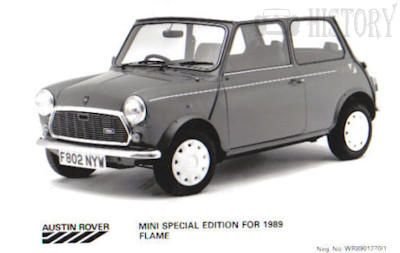
- Year: 1989 (January)
- Based on: Mini City
- Engine: 998 cc
- Exterior colour:
- Flame Red (COF - BLVC818) with white roof
- Exterior trim: Chrome bumpers and black grille center
- Decals/badges: Coachlines with 'Flame' logo
- Interior: Black 'Crayons' fabric
- Equipment: Full-width white wheeltrims, radio cassette
- Production: 1,000
Apart from the color, the 'Flame' was identical to the 'Racing'.
Mini Racing Green
- Year: 1990 (February)
- Based on: Mini City
- Engine: 998 cc
- Exterior colour:
- BRG Metallic (HAF - BLVC617) with white roof
- Exterior trim: Chrome bumpers and grille
- Decals/badges: Coachlines with 'Racing' logo
- Interior: Black 'Crayons' fabric
- Equipment: Three-instrument binnacle, R361 Radio Cassette, option of automatic gearbox
- Production: 2,500 for UK (total for Racing Green, Flame Red & Checkmate), more exported
Fitted with a 3.44 final drive (as was found in the original 1961 Cooper), the 'Racing Green' could be bought with the Rover-approved John Cooper performance kit. Identical to the 'Flame Red' and 'Checkmate' apart from the color.
Mini Flame Red
- Year: 1989 (February)
- Based on: Mini City
- Engine: 998 cc
- Exterior colour:
- Flame Red (COF - BLVC818)
- Exterior trim: Chrome bumpers and black grille with chrome surrounds
- Decals/badges: Coachlines with 'Racing' logo
- Interior: Black 'Crayons' fabric
- Equipment: Three-instrument binnacle, R361 Radio Cassette, option of automatic gearbox
- Production: 2,500 for UK (total for Racing Green, Flame Red, and Check Mate), more exported
Fitted with a 3.44 final drive (as was found in the original 1961 Cooper), the 'Flame Red' could be bought with the Rover-approved John Cooper performance kit. Identical to the 'Racing Green' and 'Checkmate' apart from the colour.
Mini Checkmate
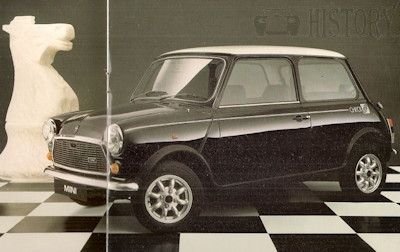
- Year: 1990 (February)
- Based on: Mini City
- Engine: 998 cc
- Exterior colour:
- Black (PMA - BLVC90)
- Exterior trim: Chrome bumpers, grille and sunroof
- Decals/badges: Coachlines with 'Racing' logo
- Interior: Black 'Crayons' fabric
- Equipment: Three-instrument binnacle, R361 Radio Cassette, option of automatic gearbox
- Production: 2,500 for UK (total for Racing Green, Flame Red, and Check Mate), more exported
Fitted with a 3.44 final drive (as was found in the original 1961 Cooper), the Checkmate could be bought with the Rover-approved John Cooper performance kit. Identical to the 'Racing Green' and 'Flame Red' apart from the colour.
Designer
Mini Designer

- Year: 1988 (June)
- Based on: Mini City
- Engine: 998 cc
- Exterior colour:
- White (NMF - BLVC449)
- Black (PMA - BLVC90)
- Exterior trim: Nimbus grey
- Decals/badges: Twin coachlines and "Designer" logos on the rear side panels and bootlid
- Interior: Black and white striped fabric
- Equipment: Tinted glass, opening rear side windows, leather-rim steering wheel and two vanity mirrors in the sun visors
- Production: 2,000
The Mini Designer was often called the "Quant" in reference to the Mary Quant-designed interior and Quant Daisy motifs on the steering wheel and bonnet badge.
Mini Paul Smith
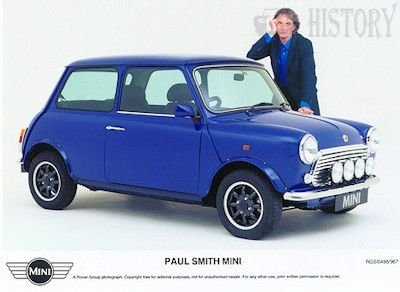
- Year: 1998 (March)
- Based on: Mini Sprite
- Engine: 1,275 cc
- Exterior colour:
- Paul Smith Blue (JFL - BLVC1269)
- Also available in Black and White (Japanese market)
- Exterior trim: Chrome grille, handles, and bumpers; green Great Britain isle badge on grille
- Decals/badges: 9ct gold emamelled "Paul Smith" bonnet badge, Paul Smith rear winder sticker
- Interior: Black leather trim, Paul Smith-scripted instrument graphics; Citrus Green glovebox interior, petrol tank and solid boot liner.
- Equipment: Charcoal grey Minilite alloy wheels, two spotlamps, Special "Paul Smith" denim jack & tool bag
- Production: 300 for UK, 1,500 for rest of world
Paul Smith also designed a one-off Mini with 86 different-coloured stripes.
Cooper
Mini Cooper RSP
- Year: 1990 (September)
- Based on: Mini 30
- Engine: 1,275 cc
- Exterior colour:
- Flame Red (CPQ - BLVC1000)
- Black (PMF - BLVC644)
- British Racing Green (HAF - BLVC617)
- Exterior trim: Chrome Grille and bumpers, body-colored door mirrors and wheelarches
- Decals/badges: White bonnet stripes with John Cooper signatures, Cooper badges
- Interior: Black leather seat inserts, leather bound steering wheel, red carpets
- Equipment: Sunroof, twin driving lamps, tinted glass, alloy Minilite-style wheels, Oil Cooler
- Production: 1,050 for UK, 650 for Japan
The RSP was the first Cooper in 21 years, and the first Mini with a 1,275 cc engine in 10 years. The most powerful carburettor engine (with the S works conversion) and the only non works mini fitted with an oil cooler as standard.
It was an instant success and sold out even before cars began to appear in showrooms, which prompted Rover to put a Cooper in full-time production.
Mini Cooper Monte Carlo
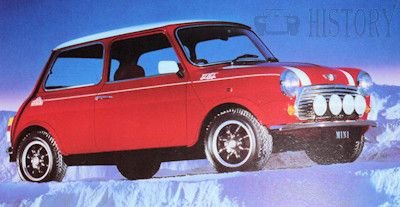
- Year: 1994 (January and July)
- Based on: Mini Cooper 1.3i
- Engine: 1,275 cc
- Exterior colour:
- Flame Red (CPQ - BLVC1000)
- Black (PMF - BLVC644)
- Exterior trim:
- Decals/badges: "John Cooper" signature decals, coachline with Monte Carlo decals
- Interior: Wooden dashboard, red vinyl seats with cream cloth center panels, red seat belts, red carpets, red leather steering wheel, gear knob, and gaiter
- Equipment: Gunmetal Minilite-style alloy wheels, four fog lamps
- Production: 200
The 1994 Monte Carlo was released to celebrate Paddy Hopkirk's return to the Monte Carlo Rally, 30 years after his original win.
Mini Cooper Grand Prix
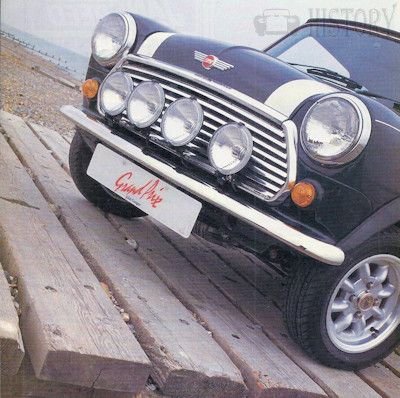
- Year: 1994 (August) - December 1996
- Based on: Mini Cooper
- Engine: 1,275 cc
- Exterior colour: All available Rover Mini Cooper colors
- Exterior trim: Chrome grille, handles and locks
- Decals/badges: Coachlines with Grand Prix decals
- Interior: Leather trim for doors, leather steering wheel and upholstery, glovebox-mounted plaque, walnut 6-gauge dash, door cappings and door pulls
- Equipment: Koni adjustable dampers, four driving lamps, stainless sill plates
- Modifications: big-valve, ported, balanced and flowed cylinder head, special cam and valve rocker assemblies, Weber Alpha fuel injection (except for the last few, which had a remapped Rover ECU), catalyzed Janspeed exhaust, revised air filter, oil cooler
- Production: 35
Only two of the Grand Prix cars were made in a left-hand-drive configuration. The engine produced 86 hp.
Mini Cooper 35

- Year: 1996 (May)
- Based on: Mini Cooper
- Engine: 1,275 cc
- Exterior colour:
- Almond Green (HAK - BLVC1212) with Diamond White roof (NMN - BLVC655)
- Exterior trim: Body-coloured door mirrors and wheel arches
- Decals/badges: Coachlines with "Mini Cooper 1961-1996 Anniversary Edition" decals on sides and bootlid
- Interior: Porcelain Green leather seats with Cooper logos; matching leather steering wheel and gear knob; "Anniversary" badge on steering wheel; wooden dash with cream-faced dials
- Equipment: Gunmetal grey Minilite-style 12-inch alloy wheels, four spotlamps
- Production: 200 (5 of which received John Cooper Garages S specification)
The John Cooper S specification Cooper 35 produced 86 hp.
Mini Cooper Sports LE
- Year: 1998 (May)
- Based on: Mini Cooper
- Engine: 1,275 cc
- Exterior colours:
- Brooklands Green (HFB - BLVC1265)
- Black (PMF - BLVC644)
- Roof: White
- Exterior trim: Chrome grille and handles; white mirrors
- Decals/badges: Twin coachlines with BMC-style rosette with the words "Mini Cooper" to the rear; "V" flash in yellow (similar to British Vita Logo) above the front side indicator; BMC-style rosette with the words "Mini Cooper" on the left hand side of boot lid; white bonnet stripes
- Equipment: Two spotlamps, sports suspension pack, 13x6-inch Sportspack wheels, Sportspack wheelarches
- Interior: Walnut dashboard; dark green leather interior; green carpets; dark green leather and black steering wheel; dark green leather gear change boot and knob
- Production: 100 (50 of each colour); there is some doubt that the production color split was not even and that more green than black cars were produced.
Built to commemorate the 30th anniversary of the Cooper's victory in four Saloon Car Championship races in 1968.
Mini Cooper S Touring
- Year: 1999 (March)
- Based on: Mini Cooper
- Engine: 1,275 cc
- Exterior trim: Stainless steel sill covers, alloy fuel flap, Cooper valve caps
- Decals/badges: "Cooper S Touring" side decals, "Si" boot badge, John Cooper chassis plate under front seat
- Interior: Leather steering wheel, walnut dashboard and door cappings, alloy door handles
- Equipment:
On the Cooper S Touring, the Jack Knight 5-speed gearbox was available as an optional extra.
Mini Cooper S Sport 5
- Year: 1999 (March)
- Based on: Mini Cooper
- Engine: 1,275 cc
- Exterior trim: Chrome bumpers and grille
- Decals/badges: Cooper S Sport 5 decals
- Interior trim: Leather gear knob
- Equipment: 13x6-inch Rover Sportspack alloy wheels, Sportspack wheelarches, 2 auxiliary driving lamps
- Options:
- Leather interior
- Electric sunroof
The Sport 5 was very similar to the Cooper S Touring except that it was offered with the five-speed Jack Knight gearbox as standard.
Mini Cooper S Works
- Year: 1999 (March)
- Based on: Mini Cooper
- Engine: 1,275 cc
- Exterior colour:
- Brooklands Green
- Roof: Old English White
- Exterior trim: Chrome grille, door handles and bumpers
- Decals/badges: Coachlines with "S works" decals. Special red-winged badges front and back.
- Interior: Alloy dashboard, door cappings, door furniture, and foot pedals; leather steering wheel and gear knob
- Equipment: CD player, 12-inch alloy wheels
- Production: 250
- Options:
- Jack Knight 5-speed gearbox
- Sportspack
With 90 hp output from its big-valve high-compression engine, the S Works is the most powerful Cooper ever made.
Mini John Cooper
- Year: 1999 (August)
- Based on: Mini Cooper
- Engine: 1,275 cc
- Exterior colour:
- Brooklands Green (HFB - BLVC1265)
- Roof: Old English White (NNX - BLVC1205)
- Exterior trim: Chrome bumpers, grille, and handles
- Interior: Grenadine red leather upholstery (with black piping for seats) on dash top, door liners, gear gaiter, and door pockets; red carpeting; black leather steering wheel, handbrake grip and gear knob; alloy dashboard
- Decals/badges: John Cooper signature in chrome-plated steel.
- Equipment: 13-inch Sportspack alloy wheels, Sportspack arches, two spotlamps, CD player
- Production: 300
Mini Cooper Sport 500
- Year: 2000
- Based on: Mini Cooper
- Engine: 1,275 cc
- Exterior colours:
- Tahiti Blue (JRJ - BLVC965)
- Anthracite (LQW - BLVC1266)
- Solar Red (CMU - BLVC1278)
- British Racing Green (HAF - BLVC617)
- Roof: silver
- Exterior trim: Chrome bumpers and grille, silver bonnet stripes
- Interior: Black and silver leather; alloy gear knob
- Equipment: Four spotlamps, 13-inch alloy wheels, certificate signed by John Cooper, plaque inside glovebox, high level brake light
- Production: 500 - Last ever to classic Issigonis design.
Export-only
Mini After Eight
- Market: France / Spain
- Year: 1991
- Engine: 998 cc
- Exterior colour:
- BRG
- Exterior trim: Chrome bumpers and door handles; black mirrors and grille
- Decals/badges: "After Eight" script on rear wing
- Interior: Velvet seat covering
- Equipment: 12-inch steel wheels with full wheel covers; front head restraints
- Production: 1,500
This trim package adopted the branding of the After Eight chocolate mint in a partnership with its manufacturer, Rowntree & Company (then owned by Nestlé).
Mini Belfast
- Market: Japan
- Year: 1988
Mini Blue Star
- Market: Germany
- Year: 1996
- Engine: 1,275 cc
- Exterior colour:
- Tahiti Blue Metallic (JRJ)
- Exterior trim: Body-colored wheel arches
- Decals/badges: Coachlines with "Blue Star" script decals
- Interior: Full blue leather seats with gray piping; elm dashboard, door cappings, door pulls, steering wheel, gear knob, and handbrake grip; blue leather gaiter; Magnolia instruments; black carpets
- Equipment: 13x6 alloy "Sportspack" wheels, "German" wheel arches, twin spotlamps
- Production:
The steering wheel used in the Blue Star is a RAID model 13D.
Mini Brighton
- Market: Japan
- Year: 1988
Mini Brooklands
- Market: Germany
- Year: 1998
- Engine: 1,275 cc
- Exterior colour:
- Black
- Equipment: 13x6 alloy "Sportspack" wheels
Mini Cosmopolitan
- Market: France
- Year: 1993
- Engine: 1,275 cc
- Exterior colour:
- Black
- Exterior trim: Black grille and mirrors; chrome bumpers
- Decals/badges: "Cosmopolitan" text on rear wing
- Interior: Fabric-covered seats and door panels
- Equipment: Philips CD player
- Production: 1,000
Mini Jubilee
- Market: Netherlands
- Year: 1975
Mini Kensington
- Market: Japan, Italy, Netherlands, Belgium, Germany
- Exterior color:
- Surf Blue
- Nightfire red
- British Racing Green
- Interior: Leather seats
- Equipment: Air conditioning
- Year: 1996-1997
Mini Lady

- Market: Netherlands, Belgium
- Year: 1977
- Engine: 998 cc
Mini Lapagayo
- Market: Netherlands
- Year: 1998
- Engine: 1,275 cc
- Exterior colour:
- Tahiti Blue Metallic (JRJ)
- Exterior trim: Chrome grille, bumpers, and door handles; white door mirrors; white fuel filler cap
- Decals/badges: Coachlines with "Mini Cooper" decals; "Lapagayo" striping and logos on lower section of doors
- Interior: Blue leather and yellow Alcantara upholstery; walnut dashboard and gear knob; tinted windows
- Equipment: 12-inch Minilite alloy wheels painted white; two spotlamps; package including polo shirt and umbrella
- Production: 20
Named for the Lapagayo fashion brand.
Mini Monza
- Market: Germany
- Year: 1998-1999
- Engine: 1,275 cc
- Exterior colour:
- Tahiti Blue Metallic (JRJ)
- Exterior trim: Body-colored wheel arches, "Monza" petrol cap (highly desirable)
- Decals/badges: Coachlines with crossed-checkered-flag "Monza" decals
- Interior: Black leather seats; burl walnut dashboard and door cappings; black carpets
- Equipment: 13x6 Minilite alloy wheels, Sportspack wheel arches, four spotlamps
- Production: 1250
Mini Printemps
- Market: France
- Year: 1979
- Engine: 998 cc
- Exterior colour:
- Beige metallic
- Production: 500
Mini S
- Market: France
- Year: 1979
- Engine: 998 cc
- Exterior colour:
- Bleu Nuit
- Black
Mini Silver Bullet
- Market: Germany
- Year: 1995
- Engine: 1,275 cc
- Exterior colour:
- Silver Metallic
- Exterior trim: Body-coloured wheel arches
- Decals/badges: Coachlines with "Silver Bullet" decals
- Interior: Full black leather seats with red piping; elm dashboard, door cappings, door pulls, and gear knob; black leather gaiter; Magnolia instruments; black carpets
- Equipment: 13x6 five-spoke "Revolution" alloy wheels, Sportspack wheel arches, twin spotlamps
- Production: 400 for Germany
The steering wheel used in the Silver Bullet is a RAID model 13D.
Mini Silverstone
- Market: Germany
- Year: 1993
- Engine: 1,275 cc
- Exterior colour:
- Black
- Decals/badges: Coachlines and crossed-checkered-flag "Silverstone" decals
- Interior: Leather seat edging with cloth inserts and red piping; birdseye maple dashboard, door cappings, and gear knob; maroon carpets
- Equipment: 6x13 "Revolution" alloy wheels, "German" wheel arches
Mini Twinings

- Market: France
- Year: 1991
- Engine: 998 cc
- Exterior colour:
- Black
Mini Woodbury
- Market: France
- Year: 1992
- Engine: 1,275 cc
- Exterior colour:
- Black
- Interior: Beige leather stamped with "Arc de Triomphe"; walnut dashboard
- Equipment: 12-inch steel wheels with full wheel covers
- Production: 500
Other
Mini 1000 'Stripey' LE
- Year: 1976 (January)
- Based on: Mini 1000
- Engine: 998 cc
- Exterior colours:
- Brooklands Green
- White
- Exterior trim: Chrome, chrome mirrors
- Decals/badges: Gold coachlines
- Interior: Striped orange MGB-style 'deckchair' seats
- Equipment: Reclining seats, face-level vents, two door mirrors
- Production: 3,000
Mini 1100 Special
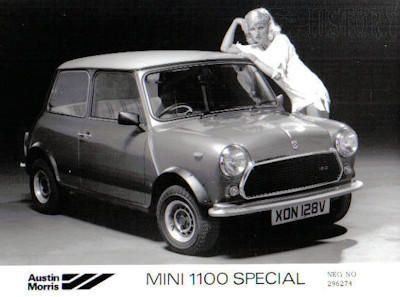
- Year: 1979
- Based on: Mini 1000
- Engine: 1098 cc
- Exterior colours:
- Metallic Silver (MMB - BLVC202)
- Metallic Rose (CMM - BLVC303)
- Exterior trim: Chrome Clubman-style rear bumpers, black-centered grille, vinyl roof
- Decals/badges: Wide shaded side stripes, Mini special A-panel decals, "Special" grill badge, "Mini 1100" boot badge
- Interior: Tartan check trim with centre console, two-spoke sports steering wheel
- Equipment: Exacton 10-inch alloy wheels, 165/70x10 tyres, Innocenti wheelarch extensions, side indicators, twin door mirrors, 1275 GT instrumentation, radio, clock and cigarette lighter
- Production: 5,100
Built to celebrate the Mini's 20th anniversary, the 1100 Special was the only round-nose Mini to be supplied with the 1098 cc engine in the UK. British Leyland supplemented the original run of 2,500 cars with an additional 2,600 due to its popularity.
Mini Sprite
- Year: 1983 (August)
- Based on: Mini City
- Engine: 998 cc
- Exterior colours:
- Cinnibar Red (CMT - BLVC399)
- Primula Yellow (FMP - BLVC442)
- Exterior trim: Black bumpers and grille centre
- Decals/badges: Tapering side stripes with "Sprite" logo
- Interior: Grey Herringbone seat facings
- Equipment: Exacton 10-inch alloy wheels with 165/70R10 tyres, Mini special wheel arch extensions, twin door mirrors, 1275GT instrumentation
- Production: 2,500
The Mini Sprite was released in anticipation of the 25th anniversary of the Mini. Its name revived the old Austin-Healey name last used in 1971. The Sprite was intended to be an intermediate trim level between the "City" and the "Mayfair".
Mini Studio 2
- Year: 1990 (June)
- Based on: Mini City
- Engine: 998 cc
- Exterior colour:
- Black (PDE - BLVC373)
- Nordic Blue (JQV - BLVC863)
- Storm Grey (LOZ - BLVC867)
- Exterior trim: Chrome grille, black bumpers
- Decals/badges: Studio 2 Decals, green stripe and three green dots below the window line
- Interior: Doeskin seat covers with green diagonal stripe, three-spoked steering wheel with unique green Mini badge.
- Equipment: full-width wheeltrims, opening rear quarterlights and an R750 stereo, 12' steel wheels with hubcaps, front disc brakes.
- Production: 1,500 for UK (RHD), 500 for Germany (LHD)
The Studio 2 name was first used on the Metro in 1987/88.
Mini Neon

- Year: 1991 (February)
- Based on: Mini City
- Engine: 998 cc
- Exterior colour:
- Nordic Blue (JQV - BLVC863)
- Pearlescent Caribbean Blue (UME - BLVC911)
- Exterior trim: Chrome bumpers, door handles, grille surround and exhaust tailpipe
- Decals/badges: Coachlines with "Neon by Mini" decals.
- Interior: Chevron velour with Neon badge on steering wheel.
- Equipment: Full-width wheel trims, standard passenger side door mirror, R280 digital radio/cassette, hinged rear windows
- Production: 1,500
The "Neon" was originally meant to be produced in Caribbean Blue Pearlecent, but problems with the new paint meant that the production version was made in Nordic Blue, at least one was produced in Caribbean Blue and sold by Startins of Redditch. The "Neon" decals on the car still had a Caribbean Blue border, which was meant to blend with the paintwork, so looked a little odd on the Nordic cars.
Mini Cabriolet
- Year: 1991 (June)
- Based on: Mini Cooper
- Engine: 1275 cc
- Exterior colour:
- Pearlescent Cherry Red
- Exterior trim: "LAMM" body kit
- Decals/badges: Cabriolet badge on boot. Coachlines with "LAMM" decals
- Interior: Wood-grain dash, three-instrument binnacle, wooden door cappings and gear knob, Mayfair seats and trim, leather steering wheel
- Equipment: Clarion CRH50 stereo, Revolite alloy wheels
- Production: 100
Rover first ordered 75 cars from Lamm Autohaus, and this was shortly followed by an order for an additional 25. After the success of this limited edition, Rover went into full-time production on the Mini Cabriolet.
Mini British Open Classic
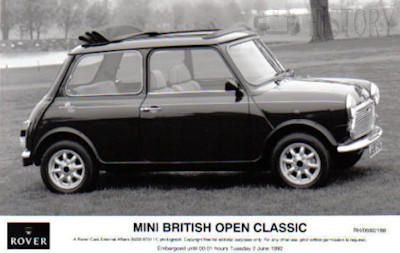
- Year: 1992 (June)
- Based on: Mini Mayfair
- Engine: 1,275 cc
- Exterior colour:
- British Racing Green (HAF - BLVC617)
- Exterior trim: Chrome bumpers, grille, and handles; body-color door mirrors; black wheelarch extensions and sill finishers
- Decals/badges: Coachlines with "British Open Classic" decals and coat of arms
- Interior: Stone Beige Countryman Tweed upholstery with leather inserts and green piping, cream leather steering wheel, matching doorcards and seatbelts, label stitched to seats reading "By Appointment to Her Majesty the Queen"
- Equipment: Electrically operated full-length Webasto sunroof, Minilite-style alloy wheels, R552 stereo, opening rear windows
- Production: 1,000 for UK
The folding sunroof that appeared on the British Open Classic had been an option on Japanese cars for some time.
Mini Italian Job

- Year: 1992 (October)
- Based on: Mini Mayfair
- Engine: 1,275 cc
- Exterior colour:
- Flame Red (COF - BLVC818)
- Metallic British Racing Green (HAM - BLVC1216)
- Diamond White (NMN - BLVC655)
- Electric Blue (NMN - BLVC997)
- Exterior trim: Body-coloured wing mirrors, white grilles, black bumpers.
- Decals/badges: Bonnet stripes, "Italian Job" badge, crossed Italian and British flag decals
- Interior: Black tweed, three-spoke steering wheel with Italian flag on steering wheel and front seats
- Equipment: Tinted glass, twin driving lamps, opening rear quarter windows
- Production: 1,000 for UK, 750 for Italy
Inspired by the 1969 film "The Italian Job", these cars were made to look like Coopers though they produced only 50 hp.
Mini Rio
- Year: 1993 (June)
- Based on: Mini Sprite
- Engine: 1,275 cc
- Exterior colour:
- Black (PDE - BLVC373)
- Pearlescent Caribbean Blue (UME - BLVC911)
- Metallic Polynesian Turquoise (UMG - BLVC966)
- Exterior trim: Chrome bumpers
- Decals/badges: "Rio" Decals on flanks and boot
- Interior: Black with bright green Spira panels on doors and seats.
- Equipment: R562 radio/cassette
- Production: 750
The colours offered on the Rio were usually extra-cost options on the standard Mini Sprite.
Mini Tahiti
- Year: 1993 (October)
- Based on: Mini Sprite
- Engine: 1,275 cc
- Exterior colour:
- Tahiti Blue (JMP - BLVC65)
- Exterior trim: Chrome bumpers
- Decals/badges: "Tahiti" Decals with silhouetted palm trees on flanks and boot
- Interior: Black trim with blue-and-black door and seat inserts, colour-coded seat belts
- Equipment: Minilite-style alloy wheels, R652 radio/cassette
- Production: 500
Mini Sidewalk

- Also known as: Mini Tartan (Japan)
- Year: 1995 (June)
- Based on: Mini Sprite
- Engine: 1,275 cc
- Exterior colour:
- Charcoal Metallic
- Kingfisher Blue
- Diamond White
- Exterior trim: Chrome bumpers
- Decals/badges: "Sidewalk" decals
- Interior: Red seat belts and blue tartan trim
- Equipment: Radio/cassette
- Production: 1,000 for UK
Mini Equinox

- Year: 1996 (April)
- Based on: Mini Sprite
- Engine: 1,275 cc
- Exterior colour:
- Ameranth (KMN - BLVC1223)
- Charcoal Grey (LVD - BLVC574)
- Platinum Silver (MNX - BLVC1209)
- Exterior trim: Chrome bumpers and grille
- Decals/badges: Coachlines with "Equinox" Decals (astrological theme)
- Interior: Purple and black moon-and-stars printed fabric seat inserts with leather edging
- Equipment: Tinted glass, opening rear quarter windows, R660 radio/cassette, alarm/immobilizer
- Production: 750
Mini ERA Turbo
- Year: 1990
- Engine: 1,275 cc Turbocharged
- Exterior colour:
- Flame Red (COF - BLVC818)
- British Racing Green (HAF - BLVC617)
- Other special order colours:
- Black
- White
- Silver
- Exterior trim: Body kit, grille with ERA badge, five-spoke wheels with ERA emblem, rear windscreen wiper
- Decals/badges: Turbo bonnet badge, ERA badge fitted to rear, ERA ID plate on slam panel
- Interior: Available in full- or half-leather modified Austin Metro seats
- Equipment: Two speakers fitted to parcel shelf, radio (same manufacturer)
- Production: 99 UK & 337
Mini History & Variants (1959-2000)

The Mini is a small economy car made by the British Motor Corporation (BMC) and its successors from 1959 until 2000. The original is considered a British icon of the 1960s.Its space-saving front-wheel drive layout – allowing 80 per cent of the area of the car's floorpan to be used for passengers and luggage – influenced a generation of car makers. The vehicle is in some ways considered the British equivalent of its German contemporary the Volkswagen Beetle, which enjoyed similar popularity in North America. In 1999 the Mini was voted the second most influential car of the 20th century, behind the Ford Model T.
This distinctive two-door car was designed for BMC by Sir Alec Issigonis. It was manufactured at the Longbridge and Cowley plants in England, the Victoria Park / Zetland British Motor Corporation (Australia) factory in Sydney, Australia, and later also in Spain (Authi), Belgium, Chile, Italy (Innocenti), Malta, Portugal, South Africa, Uruguay, Venezuela and Yugoslavia. The Mini Mark I had three major UK updates – the Mark II, the Clubman and the Mark III. Within these was a series of variations, including an estate car, a pick-up truck, a van and the Mini Moke – a jeep-like buggy. The Mini Cooper and Cooper "S" were sportier versions that were successful as rally cars, winning the Monte Carlo Rally four times from 1964 through to 1967, although in 1966 the Mini was disqualified after the finish, along with six other British entrants, which included the first four cars to finish, under a questionable ruling that the cars had used an illegal combination of headlamps and spotlights.
On introduction in August 1959 the Mini was marketed under the Austin and Morris names, as the Austin Seven and Morris Mini-Minor. The Austin Seven was renamed to Austin Mini in January 1962 and Mini became a marque in its own right in 1969. In 1980 it once again became the Austin Mini and in 1988 the Rover Mini.
Designated by Leonard Lord as project ADO15 (Amalgamated Drawing Office project number 15) and the product of the Morris design team, the Mini came about because of a fuel shortage caused by the 1956 Suez Crisis. Petrol was once again rationed in the UK, sales of large cars slumped, and the market for German bubble cars boomed. Lord, the somewhat autocratic head of BMC, reportedly detested these cars so much that he vowed to rid the streets of them and design a 'proper miniature car'. He laid down some basic design requirements: the car should be contained within a box that measured 10×4×4 feet (3.0×1.2×1.2 m); and the passenger accommodation should occupy 6 feet (1.8 m) of the 10-foot (3.0 m) length; and the engine, for reasons of cost, should be an existing unit. Issigonis, who had been working for Alvis, had been recruited back to BMC in 1955 and, with his skills in designing small cars, was a natural for the task. The team that designed the Mini was remarkably small: as well as Issigonis, there was Jack Daniels (who had worked with him on the Morris Minor), Chris Kingham (who had been with him at Alvis), two engineering students and four draughtsmen. Together, by October 1957, they had designed and built the original prototype, which was affectionately named "The Orange Box" because of its colour.
The ADO15 used a conventional BMC A-Series four-cylinder, water-cooled engine, but departed from tradition by mounting it transversely, with the engine-oil-lubricated, four-speed transmission in the sump, and by employing front-wheel drive. Almost all small front-wheel-drive cars developed since have used a similar configuration, except with the transmission usually separately enclosed rather than using the engine oil. The radiator was mounted at the left side of the car so that the engine-mounted fan could be retained, but with reversed pitch so that it blew air into the natural low pressure area under the front wing. This location saved vehicle length, but had the disadvantage of feeding the radiator with air that had been heated by passing over the engine. It also exposed the entire ignition system to the direct ingress of rainwater through the grille.
The suspension system, designed by Issigonis's friend Dr. Alex Moulton at Moulton Developments Limited, used compact rubber cones instead of conventional springs. This space-saving design also featured rising progressive-rate springing of the cones, and provided some natural damping, in addition to the normal dampers. Built into the subframes, the rubber cone system gave a raw and bumpy ride accentuated by the woven-webbing seats, but the rigidity of the rubber cones, together with the wheels' positioning at the corners of the car, gave the Mini go kart-like handling.
Initially an interconnected fluid system was planned, similar to the one that Alec Issigonis and Alex Moulton were working on in the mid-1950s at Alvis. They had assessed the mechanically interconnected Citroën 2CV suspension at that time (according to an interview by Moulton with Car Magazine in the late 1990s), which inspired the design of the Hydrolastic suspension system for the Mini and Morris/Austin 1100, to try to keep the benefits of the 2CV system (ride comfort, body levelling, keeping the roadwheel under good control and the tyre in contact with the road), but with added roll stiffness that the 2CV lacked. The short development time of the car meant this was not ready in time for the Mini's launch. The system intended for the Mini was further developed and the hydrolastic system was first used on the Morris 1100, launched in 1962; the Mini gained the system later in 1964. Ten-inch (254 mm) wheels were specified, so new tyres had to be developed, the initial contract going to Dunlop. Issigonis went to Dunlop stating that he wanted even smaller, 8 in (203 mm) wheels (even though he had already settled on ten-inch). An agreement was made on the ten-inch size, after Dunlop rejected the eight-inch (203 mm) proposition.
Sliding windows allowed storage pockets in the hollow doors; reportedly Issigonis sized them to fit a bottle of Gordon's Gin. The boot lid was hinged at the bottom so that the car could be driven with it open to increase luggage space. On early cars the number plate was hinged at the top so that it could swing down to remain visible when the boot lid was open. This feature was later discontinued after it was discovered that exhaust gases could leak into the cockpit when the boot was open.
The Mini was designed as a monocoque shell with welded seams visible on the outside of the car running down the A and C pillars, and between the body and the floor pan. Those that ran from the base of the A-pillar to the wheel well were described as 'everted' (lit., 'turned outward') to provide more room for the front seat occupants. To further simplify construction, the hinges for the doors and boot lid were mounted externally.
Production models differed from the prototypes by the addition of front and rear subframes to the unibody to take the suspension loads, and by having the engine mounted the other way round, with the carburettor at the back rather than at the front. This layout required an extra gear between engine and transmission to reverse the direction of rotation at the input to the transmission. Having the carburettor behind the engine reduced carburettor icing, but the distributor was then exposed to water coming in through the grille. The engine size was reduced from 948 to 848 cc (57.9 to 51.7 cu in); this, in conjunction with a small increase in the car's width, cut the top speed from 90 mph (140 km/h) to 72 mph (116 km/h).
The Mini shape had become so well known that by the 1990s, Rover Group – the heirs to BMC – were able to register its design as a trademark in its own right.
Variants
The popularity of the original Mini spawned many models that targeted different markets.

Wolseley Hornet and Riley Elf (1961–1969)
Built as more luxurious versions of the Mini, both the Wolseley Hornet and the Riley Elf had longer, slightly finned rear wings and larger boots that gave the cars a more traditional three-box design. Wheelbase of the Elf and Hornet remained at 2.036 m (6.68 ft), whereas the overall length was increased to 3.27 m (10.7 ft). This resulted in a dry weight of 638 kg (1,407 lb)/642.3 kg (1,416 lb) (rubber/hydrolastic suspension) for the Elf and 618 kg (1,362 lb)/636.4 kg (1,403 lb) for the Hornet respectively. Front-end treatment, which incorporated each marque's traditional upright grille design (the Hornet's grille with a lit "Wolseley" badge), also contributed to a less utilitarian appearance. The cars had larger-diameter chrome hubcaps than the Austin and Morris Minis, and additional chrome accents, bumper overriders and wood-veneer dashboards. The Riley was the more expensive of the two cars. The name "Wolseley Hornet" was first used on a 1930s sports car, while the name "Elf" recalled the Riley Sprite and Imp sports cars, also of the 1930s. The full-width dashboard was a differentiator between the Elf and Hornet. This dashboard was the idea of Christopher Milner the Sales Manager for Riley. Both the Riley Elf's and Wolseley Hornet's bodies were built at Fisher & Ludlow under their "Fisholow" brandname. Plates in the engine compartment on the right side fitch plate bear evidence of this speciality. Very early Mark I versions of both cars (e.g. press photo of 445MWL) had no overriders on the bumpers and a single piece front wing (A-panel and wing in one piece, no outside seam below scuttle panel) that was soon given up again, allegedly due to cost. The Elf's and Hornet's special bumper overriders first appeared in 1962. Early production Mark Is also had a combination of leather and cloth seats (Elf R-A2S1-101 to FR2333, Hornet W-A2S1-101 to FW2105) whereas all later models had full leather seats. Mark I models were equipped with single leading shoe brakes on the front.
Both the Elf and the Hornet went through three versions. Initially, they used the 848 cc (51.7 cu in) 34 bhp (25 kW) engine (engine type 8WR) with a single HS2 carburettor, changing to a single HS2 carburettor 38 bhp (28 kW) version of the Cooper's 998 cc (60.9 cu in) power unit (engine type 9WR) in the Mark II in 1963. This increased the car's top speed from 71 to 77 mph (114 to 124 km/h) . Therefore, Mark II cars also came with increased braking power in the form of front drum brakes with twin leading shoes to cope with the increased power output. Both Mark I and Mark II featured four-speed, gearboxes (three synchromesh gears) with rod gear change, a.k.a. "magic wand" type. Automatic gearboxes became available on the Mark II in 1965 as an option. The Mark III facelift of 1966 brought not only wind-up windows and fresh-air facia vents, but disc brakes replaced front drum brakes, too. Concealed door hinges were introduced two years before these were seen on the mainstream Mini. The gear selecting mechanism was updated to the rod type, as seen on all later Mini type cars. Automatic gearboxes were available to the Mark III in 1967 again. Full-four synchromesh gearing was eventually introduced during 1968. 30,912 Riley Elfs and 28,455 Wolseley Hornets were built. Production ceased in late 1969 when British Leyland discontinued the Riley and Wolseley brand names.
Vehicle Identification – Serial Number Prefix Letter Code:
- First prefix letter – name: R-Riley, W-Wolseley
- Second prefix letter – engine type: A
- Third prefix letter – body type: 2S – 2-door Saloon
- Fourth prefix – series of model: 1 – 1st series, 2 – 2nd series, 3 – 3rd series
- Fifth prefix (used to denote cars different to standard right hand drive): L – left hand drive
Code example: R-A2S1-154321 (Riley, A type engine, 2 door saloon, 1st series, serial number "154321")
Morris Mini Traveller and Austin Mini Countryman (1961–1969)
Two-door estate cars with double "barn"-style rear doors. Both were built on a slightly longer chassis of 84 inch (2.14 m) compared to 80.25 inch (2.04 m) for the saloon.
The luxury models had decorative, non-structural wood inserts in the rear body which gave the car a similar appearance to the larger Morris Minor Traveller which had some of the look of an American-style 1950s Woodie. Approximately 108,000 Austin Mini Countrymen and 99,000 Morris Mini Travellers were built.
Mini Van (1960–1982)
A commercial panel van (in US English, a sedan delivery) rated at ¼-ton load capacity. Built on the longer Traveller chassis but without side windows, it proved popular in 1960s Britain as a cheaper alternative to the car: it was classed as a commercial vehicle and as such carried no sales tax. A set of simple stamped steel slots served in place of a more costly chrome grille. The Mini Van was renamed as the Mini 95 in 1978, the number representing the gross vehicle weight of 0.95 tons. 521,494 were built.
Mini Moke (1964–1989)

A utility vehicle intended for the British Army was built with a twin-engined 4-wheel-drive. Although the 4WD Moke could climb a 1:2 gradient, it lacked enough ground clearance for military use. The single-engined front-wheel-drive Moke enjoyed some popularity in civilian production. About 50,000 were made in total, from 1964 to 1968 in the UK, 1966 to 1982 in Australia and 1983 to 1989 in Portugal.The Moke was marketed in holiday locations such as Barbados and Macau, where they were also used as police cars. "Moke" is archaic British slang for a donkey.
Mini Pick-up (1961–1982)
A pick-up truck (technically a coupé utility by definition), 11 ft (3.4 m) in total length was built on the longer Mini Van platform, with an open-top rear cargo area and a tailgate. The factory specified the weight of the Pick-up as less than 1,500 lb (680 kg) with a full 6 imperial gallons (27 l; 7.2 US gal) tank of fuel.
As with the Van, the Pick-up had stamped metal slots for airflow into the engine compartment. The Pickup was basic, although the factory brochure described a "fully equipped Mini Pick-up is also available which includes a recirculatory heater." Passenger-side sun visor, seat belts, laminated windscreen, tilt tubes and cover were also available at extra cost. Like the van, the Pick-up was renamed as the Mini 95 in 1978.
A total of 58,179 Mini Pick-up models were built.
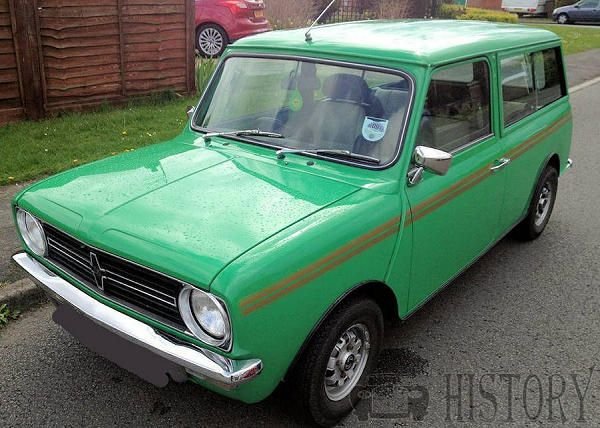
Morris Mini K (March 1969 – August 1971) , Australia
Built in the Australian British Motor Corporation factory at Zetland, New South Wales, using 80% local content, the Morris Mini K was advertised as the "great leap forward". The Mini K ('K' standing for Kangaroo) had a 1098 cc engine and was the last round-nose model to be produced in Australia, originally priced at A$1780. The Mini K was offered in 2-door sedan and 2-door van body styles.
Throughout the 1980s and 1990s the British market received numerous "special editions" of the Mini, which shifted the car from a mass-market item into a fashionable icon. It was this image that perhaps helped the Mini become such an asset for BMW, which later bought the remnants of BMC as the Rover Group. It was even more popular in Japan, which took the lion's share of the circa 40,000 Minis produced annually in the early 1990s. It was seen there as a retro-cool icon, and inspired many imitators. The ERA Mini Turbo was particularly popular with Japanese buyers.
In 1994, under Bernd Pischetsrieder, a first cousin once removed of Issigonis, BMW took control of the Rover Group, which included the Mini, fitting an airbag to comply with European legislation.
By March 2000, Rover was still suffering massive losses, and BMW decided to dispose of most of the companies. The sell-off was completed in May that year. MG and Rover went to Phoenix, a new British consortium; and Land Rover was sold to Ford Motor Company. BMW retained the Mini name and the planned new model, granting Rover temporary rights to the brand and allowing it to manufacture and sell the run-out model of the old Mini. By April 2000, the range consisted of four versions: the Mini Classic Seven, the Mini Classic Cooper, the Mini Classic Cooper Sport and—for overseas European markets—the Mini Knightsbridge. The last Mini (a red Cooper Sport) was built on 4 October 2000 and presented to the British Motor Industry Heritage Trust in December of that year. A total of 5,387,862 cars had been manufactured.
After the last of the Mini production had been sold, the 'Mini' name reverted to BMW ownership. The new BMW Mini is technically unrelated to the old car but retains the classic transverse four-cylinder, front-wheel-drive configuration and iconic "bulldog" stance of the original.
The last Mini to leave the Longbridge plant did so in 2012, when a 1970s 1275GT which was used by staff to travel around the car plant was recovered from the disused tunnels under the plant. The car was damaged by a storage container falling on it and had been left without an engine or gearbox for around 30 years before being recovered during work to infill the tunnels. This car was sold at auction in July 2013 for £1400.
Timeline
- August 1959: Introduction of the Austin Seven, Morris Mini-Minor and Morris Mini-Minor DL 2-door saloons, all with transversely mounted 848 cc engine and 4-speed manual gearbox.
- 1960: Introduction of the Austin Seven Countryman and Morris Mini-Minor Traveller 3-door estates, both with 848 cc engine from the saloon models. 116,667 cars built in the first full year of production.
- 1961: Introduction of the Austin Seven Super and Morris Mini-Minor Super 2-door saloons.
- 1961: Introduction of the Austin Mini Cooper and Morris Mini Cooper 2-door saloon, both with larger 997 cc 55 bhp (41 kW) engine.
- January 1962: All former Austin Seven models now officially called Austin Mini.
- March 1962: pvc seat covers replaced cloth upholstery on entry level model ("basic Mini").
- 1962: "De Luxe" and "Super" designations discontinued. "Super de Luxe" designation introduced. Modified instrument panel now included oil pressure and water temperature gauges.
- March 1963: Introduction of the Austin Mini Cooper 1071 S and Morris Mini Cooper 1071 S 2-door saloons, both with larger 1071 cc 70 bhp (52 kW) engine.
- 1964: Introduction of the Mini Moke.
- April 1964: Introduction of the Austin and Morris Mini-Cooper 998, Mini-Cooper 970 S and Mini-Cooper 1275 S. 1275 S models have 1275 cc 76 bhp (57 kW) engine. Automatic transmission available as an option for the 998 cc Austin Mini-Cooper 998 and 1275 S. Previous Mini-Cooper 997 and 1071 S models dropped.
- 1965: Mini Cooper 970 S discontinued.
- October 1965: Automatic transmission now available as an option on standard Austin/Morris Mini and Morris Mini SDL.
- October 1967: Mark 2 range launched with facelift and upgraded equipment. Austin Mini range as follows: 850, 1000, Cooper 998 and Cooper 1275 S 2-door saloons and 1000 Countryman 3-door estate. Morris Mini range as follows: 850, 850 SDL, 1000 SDL, Cooper 998 and Cooper 1275 S 2-door saloons and 1000 Traveller 3-door estate. Optional automatic transmission available on all Austin models (except 850) and Morris Mini 1000 SDL saloon.
- September 1968: Manual four speed gear box with synchromesh on all four forward ratios introduced.
- March 1969: Launch of the Morris Mini K an Australian-only model manufactured in the Australian British Motor Corporation factory at Zetland NSW using 80% local content
- October 1969: Separate Austin and Morris badging now merged into Mini 850/Mini 1000 badging. Range reduced to: 850, 1000, Clubman, Cooper S and 1275 GT 2-door saloon and Clubman 3-door estate. Optional automatic transmission available on all except 1275 GT.
- April 1974: A heater became standard equipment on the entry level Mini 850 (having now already been included in the standard specification of the other models for some time).
- 1980: The Mini becomes the Austin Mini.
- 1988: The Austin Mini becomes the Rover Mini.
Limited editions

From the Mark IV onward, many special limited-production editions of the Mini were offered. These included models that were created to commemorate racing victories or to celebrate an anniversary of the Mini marque. Limited editions generally came equipped with a unique combination of interior and exterior trim and special decals. Examples include Mini 1100 Special, Mini Rio, Mini Mayfair, Mini Park Lane, Mini Italian Job, Mini Cooper RSP, Mini Flame, Mini Red Hot, Mini Jet Black, Mini Racing and the Mini Monza.
Concepts and unproduced prototypes
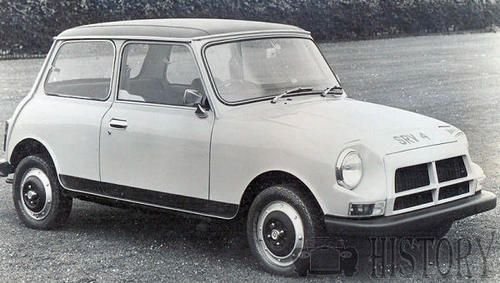
From 1967 to 1979, Issigonis had been designing a replacement for the Mini in the form of an experimental model called the 9X. It was longer and more powerful than the Mini, but due to politicking inside British Leyland (which had now been formed by the merger of BMC's parent company British Motor Holdings and the Leyland Motor Corporation), the car did not reach production.
A number of prototypes produced for vehicles based on the Mini but which never saw production are held and sometimes displayed at the British Heritage Motor Centre museum at Gaydon, Warwickshire. These included the Twini, a re-engineered four-wheel-drive Moke with two engines—one at the front and another at the back; the Austin Ant, a second attempt to produce a four-wheel-drive vehicle, this time using a transfer case; and a two-seater convertible MG edition of the Mini, cancelled due to it being perceived as competition for the MG Midget.
In 1992, a project considering possible improvements to the Mini was started. Codenamed Minki ("Mini" plus K-Series engine), it included a redesigned dashboard, a two-piece rear door or tailgate instead of a boot, fold down rear seats, Hydragas suspension and a 3-cylinder version of the K-Series engine with a 5-speed gearbox.
However, the project was cancelled by management within Rover, who decided that the cost of engineering the changes, and achieving compliance with modern crash testing standards, was too great for the production volumes that could be expected of an updated Mini.
In 1995 the idea to update the Mini again surfaced but this time with BMW management. As part of the process of deciding how to replace the Mini, a vehicle representing what the current Mini could have become, if it had been developed further over its production history, was commissioned. This resulted in the Minki-II, designed to house the 1.4L MPI K-Series engine with an extensive redesign inside, but without the original Minki's tailgate. The car had to be widened by 50mm and lengthened by 50mm to accommodate the new engine and gearbox, with Hydragas suspension and dashboard from a Rover 100. The Minki-II was used for Hydragas development work, this suspension being considered at the time for the R59 project, later to become the Mini Hatch.

