
Bond
Bond Equipe
 |
|
| Manufacturer | Bond Cars Ltd |
|---|---|
| Production | 1963 to 1970 |
| Produced | 4,389 |
| Assembly | Preston, UK |
| Class | Sports car |
| Body style | 2-door saloon 2-door convertible |
| Engine | Triumph 1147, 1296 or 1998 cc |
| Transmission | 4-speed manual optional overdrive on 2 litre |
| Wheelbase | 93 in (2,362 mm) |
| Length | 160 in (4,064 mm) |
| Width | 60 in (1,524 mm) |
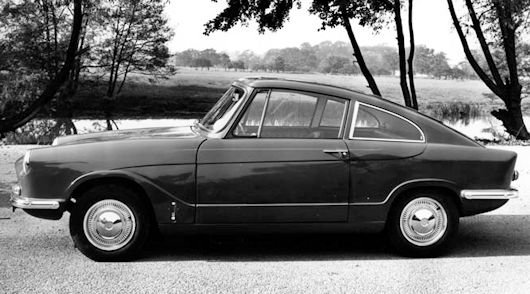
The Bond Equipe was an English 2+2 sports car, manufactured by Bond Cars Ltd. It was their first 4-wheeled car, and production started in April 1963.
History
The 2 + 2 Equipe first made in in May 1963,With two years of the original licensing agreement to run between Bond and Standard-Triumph, who supply
most of the components, a three-year extension has already been agreed.
The original Equipe, the GT, was based on the Triumph Herald chassis with a double backbone, channel section with outriggers and fastback fibreglass body and also utilised further Triumph parts including the windscreen / scuttle assembly, and doors. The more expensive and roomy GT4S has now completely super-seded the earlier 2+ 2 so that all Equipes now have two more inches of headroom at the back, an outside boot lid and rather heavy treatment for the four embedded headlights.
The well finished glass fibre body built round a (steel) Herald scuttle structure and doors. It looks from the outside like a fastback two-seater but in fact it will accommodate four small adults in greater comfort than many bigger GT cars.
Excellent front seats giving superb lateral support allow a keen driver to exploit the good handling and excellent brakes even more than in a Herald to which the Bond naturally has a strong family resemblance.
The ride from the all-independent suspension is firm but not uncomfortable except on really bad bumps. The cornering power is only moderate but the handling is good and allows a keen driver to throw the car about. the Equipe is very controllable on its Dunlop C41 tyres. With strong kick-back through the rack-and-pinion steering, the seats provide the sort of lateral support against cornering that is rarely found outside a competition car.
The heating is simple and normally effective enough with, as the Herald, two push/pull knobs on the facia controll. standard of finish set by the polished wood Herald facia.The black upholstery is particularly smart and luxurious and there is a wood-rimmed steering wheel and carpet on the floor. Excellent luggage qualifies the Bond for its GT label rear seat cushion can be removed to make another useful for suitcases, at the expense of passengers.with a carrying capacity of 353 1b, (160 kg). There is also locker on the facia. From a safety the adjustable steering is collapsible and there is padding on the dash
The backbone chassis and all-independent suspension coil and wishbone at the front, swinging axles behind are still basic Triumph Herald but the engine now comes from the Mk Il Spitfire; with 67 b.h.p.The top speed of 85.7 m.p.h.the 10-gallon petrol tank, which has a reserve tap, gives an excellent range of up to 360 miles.
The September 1964 GT4S model saw revisions to the body with twin headlights and an opening rear boot. It was powered by the same, mildly tuned up (63 bhp, later increased to 67 bhp), Herald-based 1147 cc engine used in the Triumph Spitfire. The engine was switched to the 75 bhp (56 kW) 1296 cc Triumph Spitfire engine in April 1967, just one month after the Spitfire itself had undergone the same upgrade,the revised model being identified as the GT4S 1300. An increase in claimed output of 12% resulted. the distribution of weight: 54% to front axle, and 46% to the rear axle At the same time the front disc brakes were enlarged and the design of the rear suspension (one component not carried over unmodified from the Triumph Spitfire) received "attention" with independent, swinging semi-axles, transverse leafspring upper arms, swinging longitudinal trailing arms, telescopic dampers.
PERFORMANCE 1300cc
max power (DIN): 70 hp at 6,000 rpm
max torque (DIN): 75 1b ft, 10.3 kg m at 4,000 rpm
max engine rpm: 6,700
specific power: 54 hp/l
power- weight ratio: 23.1 lb/hp, 10.5 kg/hp
carrying capacity: 706 1b, 320 kg
speed in direct drive at 1,000 rpm: 15.7 mph, 25.3 km/h.

The GT4S was joined by the 2-litre GT with a larger smoother body directly before the London Motor Show in October 1967. This model was based on the similar Triumph Vitesse chassis and used its 1998 cc 95 bhp (71 kW) six-cylinder engine. The 2-litre GT was available as a closed coupé and, later, as a convertible. The car was capable of 100 mph (161 km/h) with respectable acceleration. Horsepower and suspension improvements were made in line with Triumph's Mark 2 upgrade of the Vitesse in Autumn 1968, and a convertible was introduced at the same time.
PERFORMANCE 2.0cc
Engine Capacity 121.92 cu in, 1,998 cu cm
Fuel Consumption 23.7 ml imp ga
max power (DIN): 95 hp at 5,000 rpm
max torque (DIN): 117 1b ft, 16.1 kg m at 3,000 rpm
max engine rpm: 6,000
specific power: 47.5 hp/l
power-weight ratio: 201.1 lb/hp, 9.1 kglhp
acceleration: standing 1/4 mile 18 sec, 0—50 mph (0—80 km/h) 11.5 sec
speed in direct drive at 1,000 rpm: 17.3 mph, 27.8 km/h
Production
- Bond GT 2+2: April 1963 - October 1964; 451 (including 7 known pre-production cars)
- Bond GT 4S: September 1964 - January 1967; 1934
- Bond GT 4S 1300: February 1967 - August 1970; 571
- Bond Equipe 2-Litre Saloon: January 1967 - January 1970; 591
- Bond Equipe 2-Litre Convertible: January 1968 - January 1970; 841
Total Equipe Production = 4389 (including one known Mk.3 prototype made at Tamworth)
Production ended in August 1970 when Reliant, which had acquired Bond in 1969, closed the factory.
In Film and Television
Bond Equipe GT4 in Monty Python Flying Circus TV series

Bond Bug
 |
|
| Manufacturer | Bond Cars Ltd/Reliant |
|---|---|
| Production | 1970 to 1974 |
| Built | 2,270 made |
| Assembly | Tamworth, United Kingdom |
| Class | Motor Car |
| Body style | Microcar 1-door coupé |
| Engine | Reliant 700 cc, later 750 cc |
| Transmission | 4-speed manual |
| Wheelbase | 6 ft 5 in (1,956 mm) |
| Length | 9 ft 2 in (2,794 mm) |
| Width | 4 ft 7 in (1,397 mm) |
| Height | 4 ft 2 in (1,270 mm) |
| Curb weight | 868 lb (394 kg) |
| Designer(s) | Tom Karen (Ogle Design) |
The Bond Bug is a small British two-seat, three-wheeled sports car built from 1970 to 1974 in Great Britain .
History
Vehicle design was by Tom Karen , who was employed by Ogle Design . The vehicle captivated with its It is a wedge angular shape. To get in and out, the upper part of the body made of plastic was folded up to the front of the microcar, with a lift-up canopy and side screens instead of conventional doors. It was only delivered in an orange color, with the exception of a small series of Bond Bugs, which were released in a bright yellow.
Reliant manufactured the vehicle under the Bond Bug name after buying out Bond Cars Ltd , first in Preston , then in Tamworth The original concept was explored by chopping down a production Regal vehicle and used some Reliant Regal running gear on a newly designed chassis .
The drive unit is the front-mounted and came from the Reliant Regal a light-alloy four-cylinder unit and had a displacement of 700 cc. In the last few years of production, the 750 cc engine from the Reliant Robin was also offered.
Three variants were offered. In addition to the basic model, there was an E variant, which was equipped with a heater, among other things. The ES model was delivered with even better equipment, a more powerful engine and low-profile tires.
- PERFORMANCE: 700
max power (DIN): 29 hp at 5,000 rpm
max torque (DIN): 34 1b ft, 4.7 kg m at 3,000 rpm
max engine rpm: 5,700
power 41.4 hp/l
max speed: 75 mph, 120 km/h
power-weight ratio: 30.9 lb/hp, 14 kg/hp
fuel consumption: 54.3 m/ imp gal, 45.2 m/ US gal
The Reliant unit which protruded into the passenger cabin. At launch 29 bhp (22 kW; 29 PS) was claimed for the less expensive 700 and 700E models. The more up-market 700ES incorporates a redesigned cylinder head which permitts the compression ratio to be increased from 7.35:1 to 8.4:1. This provided a power increase to 31 bhp (23 kW; 31 PS) as well as improved torque for the then range topping 700ES.
- PERFORMANCE: 700 ES
compression ratio: 8.4: 1
max power (DIN): 31 hp at 5,000 rpm
max torque (DIN): 38 1b ft, 5.2 kg m at 3,000 rpm
power 44.3 hp/l.
power-weight ratio: 28.9 lb/hp, 13.1 kg/hp.
The Bond Bug 700ES also offers more supportive seats as well as more padding over the engine cowl, twin mudflaps, an ashtray, a rubber front bumper and a spare wheel
The British Webster Motor Company manufactured a number of four-wheel vehicles from 1990 to 1991, the design of which was based on the Bond Bug.
The car enjoyed an upbeat launch, at which Reliant's Ray Wiggin stated: "The fact it has three wheels is quite incidental. It's a new form of transport. So now, in fact, we think it's going to appeal to a much wider section of the market than we originally envisaged."
The Bug was available in a bright orange colour, although six white Bugs were produced for a Rothmans cigarette promotion - one of which was also used in an advertisement for Cape fruit and at the moment a Dulux Bond Bug is said to be under commission. Its fame was helped along by a distinctive Corgi Toys die-cast toy car. Although it had a fairly short production run (1970 to 1974), it has a dedicated following today.
In contrast to the image of three-wheeled Reliants as being slow, the Bond Bug was capable of some 76 mph (126 km/h), well in excess of the UK national speed limit (70 mph), and comparable to small saloon cars such as the basic 850 cc Mini (72 mph) and the Hillman Imp (80 mph). However, it could not match the speed of the Mini Cooper S (96 mph) or larger saloons such as the Ford Cortina Mark III (104 mph in the highest-powered variant), or even aging models of two-seater sports cars, such as the MG MGB (103 mph) or the Lotus Seven, where by 1970 even the lowest-powered version of the S4 could reach 108 mph.
The Bond Bug was sold as being fun to drive, with the low seating position giving a similar exaggerated impression of speed as in a go-kart, while the actual speed was similar to that reached by high performance cars only a few years earlier (indeed, earlier versions of the Lotus 7 had a top speed of 76 mph right up till 1968, and their trim level, e.g. side curtains instead of windows, was also similar).
The Bug was, however, not cheap. It cost £629, while a basic 850 cc Mini, a four-seater much faster round corners but with considerably inferior acceleration, cost £620. Also, while a basic Lotus Seven (with much faster acceleration and good cornering) cost £945 in 1970, it was also available as a complete knocked down kit much more cheaply, partly because of more favourable tax treatment.
Throughout the new millennium, the car has enjoyed an increased following through publicity with appearances from stars such as Robbie Williams in the "Millennium" promo and the infamous 118 guys.
Film and TV
Tom Karen oversaw the design and production of Luke Skywalker's landspeeder from Star Wars: one of the models was built upon the chassis of a Bond Bug - the wheels hidden by mirrors angled at 45° to the ground.

The Wheeler Dealers television program purchased and restored a Bond Bug 700ES and, after completion, sold it on to make a profit. Since then, the Bug has been on display at the 2011 NEC Classic Car Show in Birmingham, where Wheeler Dealers presenters Mike Brewer, Edd China and Mechanic/Technical Assistant Paul Brackley were reunited and signed the Bug.
A Bond Bug (Reg No: ABN 583L) was featured in many of the earlier episodes of Hollyoaks as a vehicle belonging to one of the characters in the series.
The Wheeler Dealers Series 7 Bond bug

Bond 875
 |
|
| Manufacturer | Bond Cars Ltd |
|---|---|
| Production | 1965-1970 3431 made |
| Assembly | Preston, UK |
| Predecessor | Bond Minicar |
| Class | microcar |
| Body style | 2-door saloon 2-door van |
| Engine | Rootes Commer Imp van, 875 cc, 34 b.h.p. |
| Transmission | 4-speed manual |
| Wheelbase | 78 in (1,981 mm) |
| Length | 116 in (2,946 mm) |
| Width | 55 in (1,397 mm) |
The Bond 875 was a small three-wheeled car partly designed by Lawrence "Lawrie" Bond and manufactured by Bond Cars Ltd in Preston, United Kingdom from 1965 to 1970. There was also a van version from 1967, known as the Ranger.
The car was announced in August 1965, though volume production got underway only during the summer of 1966. The 875 used the lower-compression (8:1) four-cylinder 875 cc 34 b.h.p. four-stroke engine used in the Commer Imp Van from the Rootes Group. Crucially for the dynamics of the vehicle, this was rear-mounted, unlike in most other British three-wheelers of the era. It was the same basic layout as used in the Hillman Imp, installed as a complete package along with the Imps' transmission, rear suspension and rear wheels: however, thanks to the fact that the 875 had a fibreglass body along with aluminium doors, and weighed less than 400 kg (882 lb), the performance was good — better than the Imp. The low-compression engine meant it was able to run on "2-star" low-octane petrol, which was cheaper than varieties used by larger and more highly tuned engines.

The car's light weight enabled it to qualify for motorcycle road tax rates, and be driven on a motorcycle licence but in order to keep the weight down the interior trim and fittings were minimal.
Racing driver John Surtees unofficially broke the saloon car lap record at Brands Hatch, managing to attain 100 mph (161 km/h).
Development

A van version, the Ranger, was introduced in April 1967.
Styling changes, rectangular headlamps, front grille, a larger bonnet opening and revised seats heralded the "Mark II" announced in April 1968. Other changes included the fitting of a heater as standard equipment.
Specification and performance
- Capacity: 875 cc, 34 b.h.p.
- Weight: < 400 kg (882 lb)
- 0-60 mph: 16 seconds (car), 14 seconds (van)
- Top speed: 80 mph (129 km/h) (car), 95 mph (153 km/h) (van)
- Fuel economy: 50 mpg-imp (5.6 L/100 km; 42 mpg-US) - 55 mpg-imp (5.1 L/100 km; 46 mpg-US)
- Tyres: Michelin X radial
- Price new: £500
Road Test
The British "Autocar" magazine tested a Bond 875 in September 1966. The car had a top speed of 82.8 mph (133.3 km/h) and accelerated from 0-60 mph (97 km/h) in 22.5 seconds. An "overall" fuel consumption of 34.5 miles per imperial gallon (8.19 L/100 km; 28.7 mpg-US) was recorded. This put it usefully ahead of the contemporary 850 cc Morris Mini on maximum speed and acceleration as well as on fuel economy: the car's superior power-to-weight ratio converted into superior performance outcomes. The Bond's £506 manufacturer's recommended price was significantly higher than the £478 price on the Mini, but less than the recommended retail price of £549 for the comparably sized Imp. The testers commended the Bond's performance and economy, but found the three-wheeler unstable at high speed. They thought the gear box and brakes good but were disappointed by 'poor seats and detail finish'.

Bond Minicar Mark F
 |
|
| Production | 1958–1963 6,493 made |
|---|---|
| Successor | Bond Minicar Mark G |
| Body style | Convertible, Saloon Coupe, 4 seater Family Saloon and Ranger Van |
| Engine | Villiers 31A 247 cc (15 cu in) Single cylinder 2 stroke |
| Transmission | 4-speed manual |
| Wheelbase | 5 ft 6 in (1,680 mm) |
| Length | 11 ft 0 in (3,350 mm) |
| Width | 5 ft 0 in (1,520 mm) |
| Height | 4 ft 0 in (1,220 mm) |
| Kerb weight | 672 lb (305 kg) for all models |
The 1958 London Motorcycle show was used to launch the Minicar Mark F.As with the change from the Mark C to D, the designation was primarily to denote significant mechanical progression from the Mark E rather than any notable difference in the cars external appearance. Three versions of the new model were shown, the Mark F Tourer, the Mark F Saloon Coupe and the Mark F 4-Seater Family Saloon. The Tourer and Coupe were identical to the Mark E versions but the 197 cc (12 cu in) Villiers 9E engine was replaced by a 247 cc (15 cu in) Villiers 31A, Though this engine boasted 12 bhp (9 kW; 12 PS) at 4,500 rpm (an increase of 3.6 bhp (3 kW; 4 PS)), the fuel consumption, dimensions and weight of the unit were almost identical to the 9E. Tests during the summer of 1958 included climbing a 28% gradient "without a struggle" and stop and restart tests two-up on the same slope. Top speed was given as 55 mph (89 km/h) with an average fuel consumption of 60 mpg-imp (4.7 L/100 km; 50 mpg-US). The 4-Seater Family Saloon was identical to the Coupe from the outside, but inside, the rear deck was cut back to allow space for a forwards facing hammock style rear seat, just big enough for two children. Unlike the similar seats in the Mark D Family, this could be completely detached for load carrying. All three models offered optional reverse gear.

A fourth model, the Bond Ranger light van was introduced in March 1960. This utilised the body with the cut out behind the front seats from the Family Saloon and married it with a similar hardtop roof without side windows, but with the addition of an opening flap around the rear window. Very much an economy model, in standard form it came finished in primer with topcoat as an optional extra. A few cars of this type were recorded on factory production records as a Van rather than a Ranger. This is believed to denote that they were only fitted with a single front seat to increase load capacity, much like the 1952 Minitruck. UK law at the time also meant that this type of lightweight, single-seat three-wheeler could be driven unaccompanied on learner L-plates without the need to pass a driving test.

Bond Cars Ltd History
(Sharp's Commercials)

Sharps Commercials Ltd was a British car maker. It changed its name to Bond Cars Ltd in 1963. The company was taken over by the Reliant Motor Co Ltd of Tamworth, Staffs in 1970 who quickly closed the Preston factory, transferring the spare parts business for the Bond Minicar, 875 saloon, 875 Ranger van and Equipe models to a firm called Bob Joyner & Son in Oldbury in the English Midlands. Reliant nevertheless continued to use the Bond name until 1974 on Bond Bug models made at their own Tamworth plant.
Sharp's Commercials began production of an economical three-wheeled car early in 1949. It was called the "Bond Minicar" (retrospectively to be called the Mark A) and was powered by a single-cylinder two-stroke Villiers engine of 122 or 197 cc. Bodywork was mostly aluminium, though some later models used fibreglass for parts of the car. It proved very popular at the time owing to post-war economies.
The Minicar moved on through several different incarnations, culminating in the "Mark G" in 1961. Convertibles were offered, as were van and estate versions. The engine was upgraded, first to a single-cylinder 250 cc and then to a 250 cc twin-cylinder Villiers 4T (optional on the Mark G). The engines were essentially motorcycle units and therefore had no reverse gear. However, this was a minimal inconvenience, because the engine, gearbox and front wheel were mounted as a single unit and could be turned by the steering wheel up to 90 degrees either side of the straight-ahead position, enabling the car to turn within its own length.
Reverse gear of a sort was offered on later models, but using this involved stopping the engine and starting it backwards. This was done by reversing the Siba Dynastart unit, a device which doubled as both starter and generator. It operated as a starter motor when the starter button was pressed but when the engine was running it generated power instead and recharged the battery.
The last Bond Minicar, a Mark G, was made in November 1966.
Bond Equipe 1963 - 1970
The Equipe GT was Bond's first four wheel car, a sports car, with fibreglass two door body. Essentially it was a Triumph Herald chassis cab, complete with bulkhead, windscreen and doors, with the Triumph Spitfire 1147 cc engine The doors had slightly revised glass, to accommodate the fibreglass, fastback roof and rear assembly. The Herald's forward hingeing bonnet was replaced with a revised version giving an excellent, clean, sportscar appearance. This was replaced by the GT4S model in 1964, offering 4 seats, and an opening boot lid. In front, the beautiful, Italianate bonnet styling was spoiled by the addition of Reliant Scimitar, quad headlights, flanking a, cut-down version of the original Herald grille. A bonnet scoop was also added. A 1296cc engine was introduced in 1967. During the life of this car, it was not uncommon to see Triumph Heralds, modified by the fitting of a Bond Equipe bonnet, as all the side body lines matched perfectly. Less common were Bond Equipes, bizarrly, fitted with Herald front ends.
In 1967, three years before the take-over by Reliant, the new Equipe 2 Litre was introduced. Based on styling proposals by Trevor Fiore, the doors had new skins and all external traces of the Triumph Herald were gone, unless you paid particular attention to the windscreen surround. The Reliant Scimitar headlamps were retained, but now incorporated into a, stylish, full width grille. In the rear, gone were the Lucas, triple-bullet tail-lamps and this elevation began to resemble the, later, Reliant Scimitar SS1, which would not be along for another twenty years. This model had the six-cylinder 2-litre Triumph Vitesse chassis and engine, uprated to the Mk.2 version in 1968, at which time a convertible version was also offered.
Bond 875 1965 - 1970
The Bond 875 was a three-wheeler with a rear-mounted four-cylinder 875 cc four-stroke, Hillman Imp-derived Coventry Climax engine. It was dropped from the range in 1970, when Reliant took over the company, as it was a superfluous competitor to Reliant's own products.
Bond Bug 1970 - 1974
The Bond Bug was perhaps the best known vehicle to bear the Bond branding. This was a three-wheeler with a Reliant 700 cc four-cylinder engine and a top speed of 75 mph (121 km/h). Most were finished in bright orange, and with a body styled by Tom Karen of Ogle Design, were a fashion statement in the 1970s. Entry was gained by swinging the roof forwards on a front hinge. The concept and test vehicle, for this design, was simply a Reliant Regal with the rear of the body cut away to just aft of the back wheels. This could be seen, for many years, in the yard of the Tamworth factory, by anyone looking through the railings, from the canal towpath.
Other products
Other products produced by the company included Motorscooters, a power ski, trailer tents, suitcases, etc.

