
Bentley
Bentley Eight
 |
|
| Manufacturer | Bentley |
|---|---|
| Class | Luxury car |
| Production | 1984 to 1992 |
| Engine | 411.9 cu in, 6,750 cc V8 |
| Transmission | 4-sp 4L80-E automatic |
| Wheelbase | 120.47 in, 306 cm; |
| Length | 209.05 in, 531 cm |
| Width | 74.41 in, 189 cm |
| Height | 58.66 in, 149 cm |
| Kerb weight | 4,950 1b, 2,245 kg |
The Bentley Eight was a luxury car built from 1984 to 1992.
History
The Bentley Eight was introduced, as a cheaper and more simply equipped version of the Mulsanne, offering The Eight as Bentley's "entry-level" from 1984 until 1992.With 4 doors and 5 seats distinguished mainly by a wire-mesh grille radiator instead of vertical slats on the Mulsanne, the Eight also had somewhat less equipment than the similar Mulsanne on which it was based but the Eight was offered at a significantly lower price than the regular Mulsanne The number of paint finishes possible as standard had also been reduced. This brought the introductory price to under the psychologically important £50,000 mark at the time of introduction, £6,000 less than the Mulsanne.
The large 4 stroke; 8 cylinders in Vee engine with 411.9 cu in, 6,750 cc only achieved a fuel consumption of 16.1 m/imp gal, 13.4 m/US gal.The Eight was only available with a short wheelbase. A firmer suspension offered slight handling improvements. The Eight was so popular that sales expanded from the original UK market to Europe and the United States. the UK version came fitted with 2 SU type HIF7 horizontal carburettors and dual exhaust system while the USA market to meet emission standards came fitted with exhaust emission control, exhaust gas recirculation, catalytic converter, Bosch K- Jetronic injection. Similar exhaust emission control also for Australia.
The Chassis has front and rear auxiliary frames the front suspension independent type lower wishbones, coil springs, anti-roll bar and telescopic dampers at the rear also independent, trailing arms, coil springs, auxiliary gas springs, anti-roll bar, automatic levelling control, telescopic dampers.
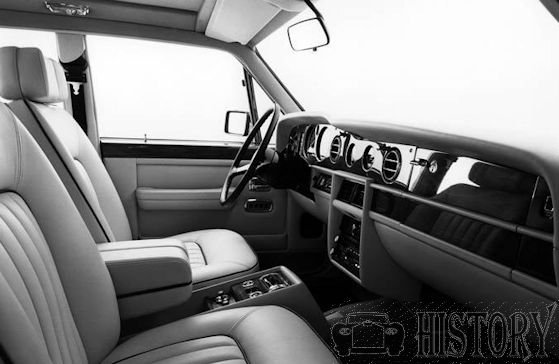
The Eight was introduced with more simple dashboard design. Fuel injection and anti-lock brakes were added in 1986, leather upholstery and power memory seats were added in 1987, and automatic ride height adjustment was added in 1990. In Britain, catalytic converters became optional in 1990 – although they had been available long before in markets where such were required. The three-speed automatic transmission
Bentley Mulsanne Turbo
 |
|
|
Manufacturer |
Bentley |
|
Production |
1982 to 1985 |
|
Class |
luxury car |
|
Body style |
4-door sedan |
|
Layout |
FR layout |
|
Engine |
6.75 L Bentley Turbo V8 |
|
Wheelbase |
120.47 in, 306 cm |
|
Length |
209.05 in, 531 cm |
|
Height |
58.66 in, 149 cm |
|
Weight |
5,052 1b, 2,291 kg. |
The Bentley Mulsanne Turbo is a performance luxury car which was produced by Bentley Motors Limited from 1982 until 1985.
History
At the Geneva Motor Show in February 1982, Bentley presented the Mulsanne Turbo, which was produced until 1985 it still held faith with the Bentley tradition of silence and
sumptuous comfort known as the "silent sports car", with significantly higher performance. The engine was forced ventilated via Solex 4 Al downdraught 4-barrel carburetor with Garrett AiResearch T 04B turbocharger with a compression ratio of 8: 1 to 1. Given numerous modifications, the Mulsanne Turbo was about 100 kg heavier than the base sedan at 5,052 1b, 2,291 kg.
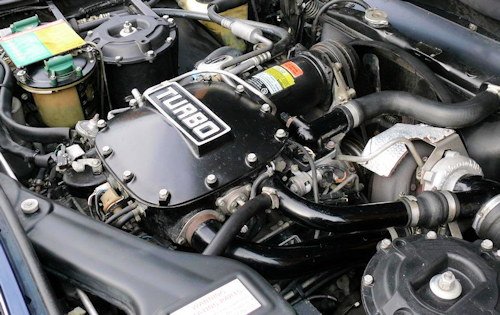
The power increase was less in the area of top speed and more in terms of acceleration: the Mulsanne Turbo completed the sprint from 0 to 60 miles per hour (96 km/h) in 7.0 seconds via a Turbo-Hydromantic 400 automatic transmission. The front and rear suspension was independent along with rack-and-pinion, servo assisted steering the turning circle at 39 ft, 11.9 m. The wheels special 6-inch rims and 235/70 VR x 16 tires.
PERFORMANCE: Bentley Mulsanne Turbo
- 0 to 60 mph in 7 seconds
- Top speed 138 mph
- max speeds: (1st) 52 mph, 83 km/h; (2nd) 82 mph, 132 km/h; (3rd) 135 mph, 217 km/h
- Fuel consumption: 16.3 m/imp gal, 13.6 m/US gal, 17.3 1 x 100 km at 75 mph, 120 km/h.
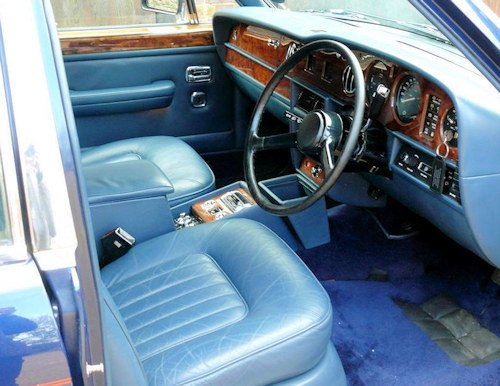
There was the usual highly polished walnut veneered fascia, blemish-free leather and carpets and headlining of pure wool for the interior. for four people in an
environment of unparalleled refinement. 498 short wheelbase and 18 long wheelbase Mulsanne Turbos were built.
In 1985 the Mulsanne Turbo was replaced by the Turbo R, which used a fuel injected version of the same engine.
Bentley 4½ Litre
 |
|
| Manufacturer | Bentley Motors Limited, Cricklewood, London |
|---|---|
| Production | 1927 to 1931 (supercharged from 1929) |
| Produced | 720 |
| Assembly | Cricklewood, United Kingdom |
| Body style | as arranged with coachbuilder by customer |
| Layout | FR layout |
| Engine | 4.4 L I4 and 4.4 L supercharged |
| Transmission | 4-speed manual |
| Wheelbase | Standard: 130 in (3,300 mm) SWB (8 made): 117.5 in (2,980 mm) |
| Length | 4,380 mm (172.4 in) |
| Width | 1,740 mm (68.5 in) |
| Kerb weight | 4½ Litre: 1,625 kg (3,580 lb) Blower: 1,727 kg (3,810 lb) |
| Designer | Walter Owen Bentley |
The Bentley 4½ Litre was a British luxury four seater sports car built from the late 1920s.
History
Successor to the original 3-litre Bentley was the 4½ Litre, which made its first appearance at Le Mans in 1927, and won the race in 1928. Replacing the Bentley 3 Litre based on a chassis built by Bentley Motors, it is famous for prewar British motor racing and for its popular slogan "there's no replacement for displacement", created by the founder of Bentley, Walter Owen Bentley. Bentley sought to produce a more powerful race car by increasing engine displacement sold as a Chassis and body work built by coachbuilders such as Vanden plas .
In 1927 the Bentley 3-litre was developed into a 4½ Litre variant still with four cylinders and development pushed its output up ultimately from 100 bhp to 130bhp. The standard model had a 10 ft. 10 in. wheelbase and with a 3.53:1 back-axel ratio, a power output of 110 b.h.p. at 3500 rpm.This gave the basic model a top speed of of 92 m.p.h.The model was altered surprisingly little during its period in production,one of the modifications being the substitution in 1928, of the heavy and cumbersome plate clutch for the previous cone clutch item.
The four racing cars fitted to subsequent unsupercharged litre engines. Power output was 175 b.h.p., and the maximum speed 103m.p.h. A 4 1/2-litre car won at Le Mans in 1928.In 1930 a main production Roots-blown edition was available which now had a clear 100 m.p.h. maximum speed ,coupled with remarkable smoothness and flexibility and a quite uncontrollable thirst for petrol. A radiator badge with different colours used for the different model types the 4½ as Black While other models as blue red and green.
Although the Bentley 4½ Litre was heavy, weighing 1,625 kg (3,580 lb), and spacious, with a length of 4,380 mm (172 in) and a wheelbase of 3,302 mm (130.0 in), it remained well-balanced and steered nimbly. The manual transmission, however, required skill, as its four gears were unsynchronised.The robustness of the 4½ Litre's latticed chassis, made of steel and reinforced with ties,was needed to support the heavy cast iron inline-four engine.The engine displacement was 4,398 cc (268.4 cu in): 100 mm (3.9 in) bore and 140 mm (5.5 in) stroke. Two double carburetters and dual ignition with Bosch magnetos were fitted. The engine produced 110 hp (82 kW) for the touring model and 130 hp (97 kW) for the racing model. The engine speed was limited to 4,000 rpm A single overhead camshaft actuated four valves per cylinder, inclined at 30 degrees. This was a technically advanced design at a time where most cars used only two valves per cylinder. The camshaft was driven by bevel gears on a vertical shaft at the front of the engine, as on the 3 Litre engine.
The luxurious Bentley cars attracted attention. But after two years without success, Bentley convened a group of wealthy British men, "united by their love of insouciance, elegant tailoring, and a need for speed," to renew Bentley's success.Both drivers and mechanics, these men, later nicknamed the "Bentley Boys", drove Bentley automobiles to victory in several races between 1927 and 1931, including four consecutive wins at the 24 Hours of Le Mans, and forged the brands reputation.
It was within this context that, in 1927, Bentley developed the Bentley 4½ Litre. Two cylinders were removed from the 6½ Litre model, reducing the displacement to 4.4 litres. At the time, the 3 Litre and the 6½ Litre were already available, but the 3 Litre and 6½ Litre's was under-powered performance models .
For many people the 'Blower Bentley'—the supercharged 4 1/2 litre car is the ultimate sports car from the time. Developed by Sir Henry Birkin, one of the 'Bentley Boys', the car was used in some of the top competition events of the period, including Le Mans. At the French Grand Prix in 1930 Bentley came in second.Birkin, aided by a former Bentley mechanic, decided to produce a series of five supercharged models for the competition at the 24 Hours de Le Mans Mercedes-Benz had been using superchargers for years.Thus the 4½ litre Blower Bentley was born.

The first supercharged Bentley had been a 3 litre FR5189 which had been supercharged at the Cricklewood factory in the winter of 1926/7. The Bentley Blower No.1 was officially presented in 1929 at the British International Motor Show at Olympia, London. The 55 copies were built to comply with 24 Hours de Le Mans regulations The car was put into limited production in a more cooler type form by Bentley. Fifty machines were made. The Roots-supercharged engine now had a stronger crankshaft.
The essential difference between the Bentley 4½ Litre and the Blower was the addition of a Roots-type supercharger to the Blower engine by engineer Amherst Villiers, who had also produced the supercharger. W. O. Bentley, as chief engineer of the company he had founded, refused to allow the engine to be modified to incorporate the supercharger. As a result, the supercharger was placed at the end of the crankshaft, in front of the radiator. This gave the Blower Bentley an easily recognisable appearance and also increased the car's understeer due to the additional weight at the front. A guard protected the two carburettors located at the compressor intake. Similar protection was used, both in the 4½ Litre and the Blower, for the fuel tank at the rear, because a flying stone punctured the 3 Litre of Frank Clement and John Duff during the first 24 Hours of Le Mans, which contributed to their defeat.
Between 1927 and 1931 the Bentley 4½ Litre competed in several competitions, primarily the 24 Hours of Le Mans. The first was the Old Mother Gun at the 1927 24 Hours of Le Mans, driven as a prototype before production. Favoured to win, it instead crashed and did not finish. Its performance was sufficient for Bentley to decide to start production and deliver the first models the same year. The 'blower' cars were later raced under the sponsorship of the Hon. Dorothy Paget.
In 1928 Barnato and Rubin drove a 'four-and-a-half to victory at Le Mans to underline Bentley's grip on this trial of endurance and speed. Meanwhile Sir Henry 'Tim' Birkin decided that to achieve optimum performance from W .0.'s design, supercharging should be adopted. The original designer never approved of supercharging as a method of obtaining increased power, always following the dictum that 'there is no substitute for cubic inches'— when he required more urge, he preferred to enlarge the engine capacity. The Hon. Dorothy Paget financed Birkin's plan for a supercharged 4.5-litre Bentley and the cars were modified in her premises at the resultant 'Blower Bentley The crankshaft, pistons and lubrication system were special to the Blower engine. It produced 175 hp (130 kW) at 3,500 rpm for the touring model and 240 hp (180 kW) at 2,400 rpm for the racing version, which was more power than the Bentley 6½ Litre developed. A total of 54 'Blower' Bentleys were built, the vast majority for sale as road cars.
A total of 720 4½ Litre were produced between 1927 and 1931, including 55 models with a supercharged engine known as the Blower Bentley. A 4½ Litre Bentley won the 24 Hours of Le Mans in 1928. Though the 4½ Litre Bentley's competitive performance was not outstanding, it set several speed records, most famously in 1932 at Brooklands with a recorded speed of 222.03 km/h (138 mph).
Far from being the most powerful in the competitions, the 4½ Litre of Woolf Barnato and Bernard Rubin, raced neck and neck against Charles Weymann's Stutz Blackhawk DV16, setting a new record average speed of 111.12 km/h (69 mph); Tim Birkin and Jean Chassagne finished fifth. The next year, three 4½ Litres finished second, third, and fourth behind another Bentley, the Speed Six, which possessed two more cylinders.
The naturally aspirated 4½ Litre was noted for its good reliability. The supercharged models were not; the two Blower models entered in the 1930 24 Hours of Le Mans by Dorothy Paget, one of which was co-driven by Tim Birkin, did not complete the race. In 1930, Birkin finished second in the French Grand Prix at the Circuit de Pau behind a Bugatti Type 35. Ettore Bugatti, annoyed by the performance of Bentley, called the 4½ Litre the "fastest truck in the world." The Type 35 is much lighter and consumes much less petrol. Blower Bentleys consumes 4 litres per minute at full speed
In 1930, the Daily Herald offered a trophy for the fastest driver at an event at Brooklands. The first year, Tim Birkin and Don Kaye competed and Don Kaye won with a speed of 137.58 mph (221.41 km/h). In 1932, Tim Birkin won driving his red Blower "Monoposto," clocking 137.96 mph (222.03 km/h).
In November 1931, after selling 720 copies of the 4½ Litre - 655 aspirated and 55 supercharged.

Bentley 4.5 Litre in Film And TV
Steed also amongst other things drives a Bentley 4.5 Litre in the 1960s Avengers TV Series.

Ian Fleming's character James Bond drives a 1930 Blower Bentley in three of the 007 Novels, Casino Royale, Live and Let Die and Moonraker. In the books, Bond drives one of the last Blower Bentleys built, a battleship grey Convertible Coupé.
The Casino Royale Bentley 4½ Litre 1967 film
Bentley Car Production Figures
| Model Numbers Built | |
| 3 Litre (1922 - 29) | 1,622 |
| 4½ Litre (1927 - 31) | 665 |
| 6½ Litre (1925 - 30) | 545 |
| 8 Litre (1930 - 32) | 100 |
| 4½ Litre s/c (1929 - 31) | 55 |
| 4 Litre (1931 - 32) | 50 |
| 3½ litres (1933-36) | 1,177 |
| 4¼ litre (1936-40) | 1,234 |
| MK V (1939-40) | 35 |
| MK VI (1946-52) | 5,368 |
| R Type (1952-55) | 2,486 |
| R Continental (1952-55) | 208 |
| S1 (1955-60) | 3.107 |
| S1 Continental | 431 |
| S2 (1960-62) | 1,922 |
| S2 Continental | 388 |
| S3 (1962-65) | 1,318 |
| S3 Continental | 312 |
| 'T' (1965-76) | 1,721 |
| 'T' 2 (1977-81) | 568 |
| Corniche Saloon | 63 |
| Corniche Convertible | 77 |
| MPW Saloon | 98 |
| MPW Convertible | 77 |
| Continental | 433 |
| Continental Turbo | 8 |
| Various Special Bodies | 17 |
Bentley T-series T1
 |
|
| Manufacturer | Bentley Motors (1931) Limited, Crewe, Cheshire |
|---|---|
| Production | 1965–1977 |
| Class | Full-size luxury car |
| Body style | 4-door saloon 2-door saloon 2-door convertible |
| Layout | FR layout |
| Platform | monocoque |
| Engine | 6230 cc (from 1971) 6750 cc Rolls-Royce - Bentley L Series V8 engine |
| Transmission | 4-speed automatic transmission / 3-speed automatic transmission (GM400) |
| Wheelbase | 119.5 in (3,040 mm) |
| Length | 203.5 in (5,170 mm) |
| Width | 71 in (1,800 mm) |
| Height | 59.75 in (1,518 mm) |
| Kerb weight | 2,103 kg (4,636 lb) |
| Related | Rolls-Royce Silver Shadow Rolls-Royce Camargue Rolls-Royce Corniche/Continental |
The Bentley T-Series is an automobile which was produced by Bentley Motors Limited in the United Kingdom from 1965 to 1980. It was announced and displayed for the first time at the Paris Motor Show on 5 October 1965 as a Bentley-badged version of the totally redesigned chassis-less Rolls-Royce Silver Shadow.
The Bentley T series was available as a four-door saloon and as a long wheelbase four-door saloon. A small number of two-door saloons were built with coachwork by James Young and Mulliner Park Ward and a two-door convertible with coachwork by Mulliner Park Ward was introduced in September 1967.
Point of difference
The Bentley was differentiated from its Rolls Royce sibling by its simpler and lighter front grille. The other point of difference to attract comment was said to result from the lower production cost of the Bentley grille. In October 1966, the T saloon's pretax 'list price' of GBP 5375 undercut that of the Rolls-Royce by GBP 50.

The Bentley, being technically an identical twin of the Rolls-Royce, seems to have been bought mostly by owners wishing a little more understatement.
The formerly more sporting image of Bentley motor cars differing from Rolls-Royces was gone by the time the Silver Shadow/Bentley T was introduced and thus couldn't motivate buyers any more. "For a while Bentley´s sporting character has been as absent and as lamented as [deceased racing driver] Mr Seaman. The last batches of Bentleys have, to be rather frank, been a little hard to distinguish from their Rolls-Royce stablemates" was the opinion of Archie Vicar in the Motorist´s Illustrated Digest (Dec 1965).The same correspondent gave the car a favourable review, especially in comparison to its Rolls-Royce stablemate
The outward appearance of a Bentley T is slightly more dynamic because the bonnet design is a few centimetres lower and the radiator shell shape with its rounded edges is smoother. In addition, the badging on wheel covers, boot lid and gauges featured Bentley motifs rather than Rolls-Royce ones.
- PERFORMANCE: T1 Series 4-door Saloon
- Engine capacity: 380.15 cu in, 6,230 cu cm
- Fuel consumption: 15 m/imp gal, 12.5 m/US gal, 18.8 | x 100 km
- Max speed: 120 mph, 193.2 km/h max speeds: 31 mph, 49.9 km/h in 1st gear; 45 mph, 72.4 km/h in 2nd gear; 82 mph, 132 km/h in 3rd gear; 120 mph, 193.2 km/h in 4th gear
Fundamental redesign
The T series is the first Bentley (or Rolls-Royce) without a separate chassis. It is totally different from its predecessor the S series.new steel and aluminum monocoque body with subframes to mount the engine and suspension, more space inside but smaller outside, more passenger room, particularly in the rear compartment, more luggage space dimensions: - radiator grille 5 inches lower and 2 inches wider; the whole car - 7 inches shorter, 5 inches lower and 3 1⁄2 inches narrower independent suspension on all four wheels with automatic height control according to loading

Other major improvements:
- disc brakes on all wheels with a triplicate hydraulic braking system patented from Citroen that also supplied pressure for the self leveling suspension.
- new and lighter power steering, improved automatic transmission, eight-way adjustable electric front seats, weight reduced 150 lbs, larger fuel tank
- Engine is the least changed unit but a re-designed cylinder head allows a speed increase to 118 mph
Production of Bentley T-Series
| Model | Period | Units |
|---|---|---|
| Bentley T1 | 1965-1977 | 1703 |
| Bentley T1 LWB | 1971–1976 | 9 |
| Bentley T1 Coupé | 1966–1971 | 114 |
| Bentley T1 Pininfarina Coupé | 1968 | 1 |
| Bentley T1 Convertible | 1967–1971 | 41 |

Bentley T-series Used in the tv program Heartbeat


