
BMW
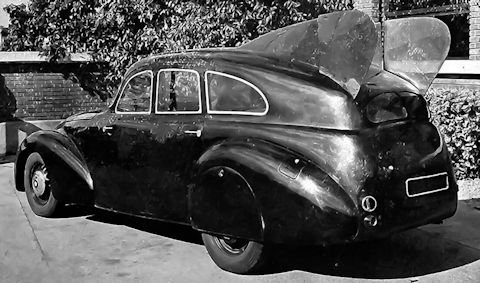
BMW Kamm K4 streamlined prototype
 |
|
|
Year: |
1939 |
|
Class: |
Prototype test car |
|
Body design: |
4 door Saloon |
|
Engine: |
Gasoline: 3.5 litres (66 kW) |
|
Length: |
5000 mm |
|
Width: |
1700 mm |
|
Height: |
1500 mm |
|
Wheelbase: |
2984 mm |
|
Empty weight: |
1500 kg |
The BMW Kamm K4 was a war time test car of the Bavarian engine works AG (BMW) from the year 1939/40 on the basis of the BMW 335.
It was similar to the test car BMW K1 of the K-Line manufactured in the year before in the 1930s a high-speed four-door sedan of luxury class with comfortable features and five full-size seats, pontoon body in streamlined form with incorporated fenders, ridge rear and 3.5 -Liter six-cylinder inline engine. The BMW K4 was from the beginning as a test car, so not designed for mass production. In 1939 and 1940 extensive test drives took place, whereby at times - as with the K1 - two large vertical air deflectors were temporarily mounted at the end of the roof. The advanced bodywork and technical innovations proved to be functional and efficient. However, even in this tempered form, the outer shape with its pontoon body, the unusual rear, the fully covered rear wheels and the temporarily mounted roof fins differed greatly from the then-production vehicles. The appearance of this model also came in the audience partly harsh criticism. The K4 therefore remained a unique piece as well. The body of the K4 was as in the test car K1
The car was not built in the BMW headquarters in Munich or in the automobile production BMW factory Eisenach (the former Dixi -Werk), but by Professor Wunibald kamm in the Research Institute of Automotive Engineering and Vehicle engines (FKFS) in Stuttgart. Special features of the K4 were similar to the K1 - its aerodynamic bodywork as well as numerous technical innovations, some of which moved into mass production only decades later.
The K4 was the fourth workable result of the work of the FKFS and Kamm and after the K1 the second test car based on the "big" BMW 335. In between, the models K2 and K3 were on the chassis of the smaller and lighter Mercedes-Benz 170 V, with the K2 was similar to the extremely aerodynamically shaped K1, while the K3 similar to the K4 was designed a little more conservative.
The BMW K4 carries, unlike the intended for mass production BMW pre-war cars from 1933 starting with the model 303 (1933-1934), no model name with three digits and a "3" at the beginning. Like many later concept vehicles, this received a model designation with a letter and a one-digit number. The K stands for "comb-wagon" and "comb-tail", the 4 for the fourth vehicle of this series of the FKFS.
The most striking feature of the BMW K4 is its unusual, aerodynamically sophisticated body with yet very spacious and comfortable interior. The low drag coefficient was achieved through a streamlined pontoon body with sash profile and fenders, a relatively round and low-pulled front with fitted flush headlamps, fully panelled rear wheel wells and a smooth, cased underbody. Another detail was the four-segment windscreen with only rounded side elements, as curved glass was still expensive and unusual. In addition, there were relatively smooth body side panels and flush-fitted front, rear and side windows. Of particular importance was the relatively long, gently sloping hatchback with gently retracted side panels and relatively straight-cut rear end.
Unlike the K1, the K4 wore the usual on other models since 1933 BMW kidney grill. Equally typical was the arrangement of the four doors, as they had already proven on the Model 326: the front doors were hinged behind (so-called " suicide doors "). The doors were thus in opposite directions, the door hinges each attached to the B-pillar .The two large vertical tail fins, which were temporarily mounted on the roof of the K4 , should conduct the air flow above the roof and behind the vehicle a cheap test fitment; in practice, the advantages of the fins as with the K1 - proved to be too low, since they also deteriorated the crosswind stability and straight-line stability . Since the test drives took place during the Second World War, had the large round headlights usually the war-typical headlight panels, which let out the light only through a narrow slot the front and side windows were relatively steep and allowed a spacious interior. In the rear was a large, accessible from the outside trunk. The interior was complex and comfortable. Due to the bulkier body compared to the original model BMW 335 and the elaborate interior, the weight of the K4 with about 1500 kilograms was relatively high and significantly higher than that of the standard 335.
The design body was built in 1940 according to the plans Kamm’s and FKFS of the Stuttgart bodywork Reutter & Co. GmbH. is known, the company mainly through the manufacture of automobile bodies for Porsche (before and after the Second World War). It was one of the last civilian vehicles before only military or military vehicles were produced in Germany due to the Second World War .
The BMW K4 had - like the K1 - a pre-production chassis of the model 335 thus also a box frame with a front suspension from upper arms and a transverse leaf spring below and a track width of 1306 millimetres. Rear he had a rigid axle with two longitudinal spring bars and a gauge of 1404 millimetres. The wheelbase was 2984 millimetres. Fitted with rack and pinion steering as well as hydraulically operated internal drum-drum brakes on all four wheels with cable-operated handbrake on the rear wheels. The innovative feature was a tire pressure regulating system, which made it possible to increase the tire pressure from the dashboard while driving and thereby reduce the rolling resistance of the tires something only seen today. The car was later seized from a Stuttgart research base at the end of World War 2.
Engine and Transmission
The BMW K4 was as the K1 - with the newly designed engine of the 335 provided, so a water-cooled six-cylinder four-stroke engine with 3485 cc capacity and long-stroke design (bore 82 mm, 110 mm stroke). With a compression ratio of 1: 5.8 two double carburettors equipped gave the motor 66 kW / 90 hp at 3500 rpm. The power transmission took place in the usual way by single-disc dry clutch on a manual four-speed transmission with rear-wheel drive. A special overdrive enabled the engine speed to be reduced at higher speeds, further reducing fuel consumption.
BMW M4 DTM First generation
|
|
|
|
Class |
Race Car |
|
Constructor |
BMW |
|
Chassis |
Carbon-fibre monocoque |
|
Suspension |
Double wishbones with H&R spring and ZF Sachs damper units to front and rear axles, actuated via pushrods |
|
Length |
4,775–5,010 mm (188–197 in) |
|
Width |
1,950 mm (77 in) |
|
Height |
1,200 mm (47 in) |
|
Axle track |
1,950 mm (77 in) |
|
Wheelbase |
2,750 mm (108 in) |
|
Engine |
BMW P66 (2014-2016) later P66/1 (2017-2018) 4.0 L (244 cu in) V8 90° naturally-aspirated, front engined, longitudinally mounted |
|
Transmission |
Hewland 6-speed sequential semi-automatic paddle shift |
|
Fuel |
Aral Ultimate unleaded 102 RON racing gasoline |
|
Lubricants |
Castrol Edge (2014) later Shell Helix Ultra (2015-present) |
|
Brakes |
AP Racing carbon brake discs with 6-piston callipers and pads |
|
Clutch |
ZF 4-plate carbon fibre reinforced plastic clutch |
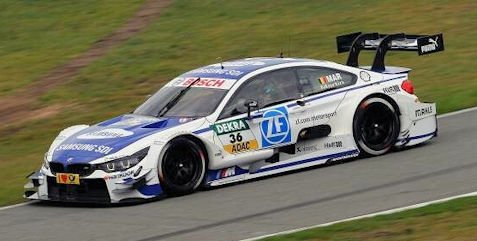
The BMW M4 DTM first generation is a prototype racing car of the German automobile manufacturer BMW , which was designed for exclusive use in the DTM and has been racing there since 2014 . The M4 DTM replaced the since 2012 and used M3 DTM through to 2018.
Like all DTM racing cars since 2012, the BMW M4 DTM is based on a standardized monocoque made of carbon fibre reinforced plastic (CFRP) with an integrated 120-liter fuel tank and steel roll cage. But the appearance, however is based on a production vehicle of the BMW F82.
The racing car was powered by a BMW P66 naturally aspirated V8 engine with four litres, whose power around 353 kW (480 hp) is and delivers a maximum torque of 500 Nm. The acceleration from 0 to 100 km / h is in about three seconds. The sequential manual gearbox with six forward gears, which is the same for all DTM vehicles, is fitted with the rear differential ( transaxle design) on the driven rear axle. All wheels are individually hung on double wishbones. The brake system with brake discs made of carbon fibre reinforced plastic is the same for all DTM vehicles , the car is equipped with a Drag Reduction System (DRS).
The DTM vehicles were not allowed to be further developed from the 2014 season for reasons of cost savings. During the 2015 season, however, it became clear that the BMW M4 DTM lagged behind the competition. Therefore, BMW could start the season in 2016 with a wider rear wing and less weight. The model for the 2017 season has many changes, especially in the field of aerodynamics. Thus, the bumper on the vehicle front forms a completely new shape. In addition, the rear and the rear wing have been redesigned. So far, the rear wing consisted of only one profile and folded when triggering the DRS completely down. The wing of the new BMW M4 DTM now consists of two profiles, the upper one of which works upwards when the DRS is activated. The setting range for the system is up to 40 degrees in 2017. In addition, venting channels were used at the rear wheel arches for the first time.
Starting in the 2019 season, the racing car is now the second generation powered by a four-cylinder engine with two litres of displacement and turbocharger . By charging the BMW P48 achieved , despite halving the number of cylinders and displacement compared to the previous engine, an output of about 456 kW (620 hp).
BMW K1 Prototype
 |
|
|
Presentation Year: |
1938/39 |
|
Built: |
single piece |
|
Class : |
prototype |
|
Engine: |
Gasoline : 3.5 litres |
|
Length: |
5000 mm |
|
Width: |
1700 mm |
|
Height: |
1500 mm |
|
Wheelbase: |
2984 mm |
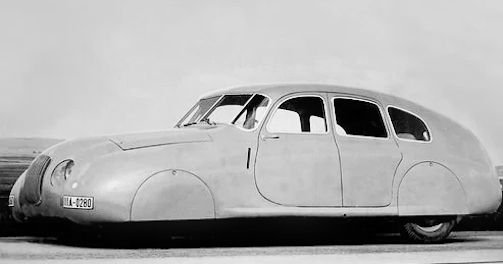
The BMW K1 was an innovative test car the Bayerische Motoren Werke AG (BMW) from the year 1938/39 based on the BMW 335 .
History
As early as April 1, 1930, Kamm was appointed Professor of Automotive Engineering and Vehicle Engines at the Technical University of Stuttgart . In the same year he founded the non-profit research institute for automotive engineering and vehicle engines Stuttgart (FKFS) . This allowed him, in collaboration with industry research work outside the rigid university structures, especially with the companies based in southern Germany Daimler-Benz and BMW .It was a designed for high travel speeds and low consumption four-door sedan of the luxury class with comfortable furnishings and five full-size seats, pontoon body in a streamlined shape with comb-rear and 3.5-liter six-cylinder - inline engine.
The K1 was not developed in the BMW plant in Munich or in Eisenach (the former Dixi plant ) which was responsible for automobile production , but by Professor Wunibald Kamm at the Research Institute for Automotive Engineering and Vehicle Engines (FKFS) in Stuttgart . Special features of the K1 were its aerodynamically extremely favourable body as well as numerous technical innovations, which moved in some decades later in mass production.
Until the 1930s, the aerodynamics in vehicle construction - apart from a few record and racing cars - played no significant role. This changed in the 1930s with higher performance, better stability, and improved suspension technology . These have now allowed in passenger cars speeds over 100 kilometres per hour, from which the air resistance increasingly affects. Added to this was the rapid expansion of the Reich motorways in Germany . Therefore, in the late 1930s, there was a need for aerodynamically cheaper bodies in order to achieve higher speeds and a more favourable fuel consumption.
Rumpler and initially also Jaray chose superstructures that were relatively tall and narrow and where the air was directed past the side of the body. It turned out that this shape was not yet optimal, even if Jaray's designs already showed the aerodynamically favourable wing profile. Derived from this was the streamline "with cut off tail".The flow is largely guided over the gently sloping roof to the rear with laterally retracted, almost straight-capped tail. Wunibald Kamm had already explained this form in his lectures in 1933, but did not patent it and initially did not put it into practice. Koenig-Fachsenfeld also claimed to have discovered or (co) developed this aerodynamically form.
A first vehicle according to this principle put Emil Everling , a lecturer at the Technical University in Berlin-Charlottenburg completed in 1938, the E-car , built at full & Ruhrbeck in Berlin was followed in the same year by the BMW K1 of Kamm and BMW.From 1935 research on streamlined vehicles in the German Reich was subsidized by the state. The financial resources, which in particular flowed to the FKFS under its head comb, came from 1937 by the specially established for this purpose Reichsforschungsrat .
The first workable result of the work of the FKFS and Kamms in 1938/39 was the test car BMW K1 with its extremely wind-shaking bodywork and numerous technical innovations in the engine and chassis area. Three more sedans followed between 1939 and 1940, of which the models K2 and K3 on the chassis of the smaller Mercedes-Benz 170 V , while the BMW K4 built like the K1 on the "big" BMW 335 . Furthermore, Kamm provided the pattern for the later in racing, especially at the Mille Miglia successful BMW-328 - "racing sedan".
The BMW K1 was from the beginning as a test car, so not designed for mass production. In 1939 and 1940 extensive test drives took place, with temporarily mounted two large vertical airflow fins at the end of the roof. The advanced bodywork and technical innovations proved to be functional and highly efficient. However, the outer shape with its full-pontoon body, the unusual rear, the fully covered front and rear wheels and the temporarily mounted roof fins differed extremely from the then-production vehicles. The look came in the audience on some very harsh criticism. The K1 therefore remained a unique piece.
There was no predecessor in the strict sense for the K1 neither at BMW nor at Kamm or the FKFS . Similar to the idea was the test car of Paul Jaray based on a Dixi 6/24 hp type G 2. This was a narrow, high streamlined sedan with the nicknamed "whale", which was presented at a motor show in 1923 and the Was offered, but came across widespread rejection of the audience. The relation between the two models results from the fact that the automobile manufacturers Dixi 1928 BMW was acquired.
The BMW K1 name, unlike the intended for mass production BMW cars prewar from 1933 starting with the model 303 (1933-1934), no model name with three numbers and a "3" at the beginning. Like numerous later concept vehicles, he received a model designation with a letter and a single-digit number, similar to the later BMW E1 . Unlike the BMW M1 or the BMW Z1, however , the BMW K1 did not find its way into series production in this form.The BMW K1 is the only BMW car that shares its name with a BMW motorcycle model , the 1988 presented innovative sports touring BMW K1 with aerodynamically clad front wheel, full fairing including small luggage suitcases, a motor with regulated catalyst and one of the first anti-lock braking systems in the bicycle shop. The name derives in this case from the BMW K-series , a motorcycle series with longitudinal inline engines instead of the traditional two - cylinder boxer engines, Whether the motorcycle model is based on the name of the car model K1 in terms of the name , is not known, but in view of the sophisticated in both cases aerodynamics and the status as an innovation carrier to assume.
The most striking feature of the BMW K1 is its extremely unusual, then aerodynamically ideal body with its very spacious and comfortable interior.The low coefficient of drag was achieved by an aerodynamic full-wing wing-pontoon body, an unusually round and low-drawn front with flush mounted headlamps, full fairing front and rear wheel wells and a smooth, cased underbody. Another detail was the four-segment windshield with laterally rounded elements, as curved windscreens were still unusual. In addition, there were completely smooth body side panels, flush fitted front, rear and side windows and the absence of external door handles for the rear doors. Aerodynamically particularly important was the relatively long, gently sloping hatchback with gently retracted side panels and relatively straight cut rear end.
For a BMW untypical the K1 wore not the otherwise usual since 1933 BMW kidney , but an oval, standing, in the flowing body lines integrated and clad with longitudinal struts cooling air opening. Typical of BMW pre-war models, however, was the arrangement of the four doors, as they had already proven on the Model 326 : the front doors were struck behind (so-called " suicidal doors "), the rear doors, however, front. The doors were thus in opposite directions, the door hinges each attached to the B-pillar .The two large vertical tail fins, which were temporarily mounted on the roof of the K1 , should conduct the air flow above the roof and behind the vehicle cheaper; In practice, the advantages of the fins proved to be too low, since they deteriorated both the crosswind stability and the straight-line stability .
The design was aerodynamically extremely consistent and designed without regard to the contemporary taste, which is why outside was dispensed with any chrome elements and other ornaments, as well as on bumpers that could have avoided damage to the body in everyday life.The body had been built by the company Walter Vetter body and vehicle in Fellbach near Stuttgart to the plans Kamms and FKFS . known were the still existing companies at that time mainly by the production of car bodies based on Mercedes-Benz -Fahrgestellen, but also bus superstructures in streamlined form for a license of Paul Jaray.
The interior dimensions of the K1 were due to the wide full-pontoon body without flared fenders and running boards, but with hatchback extremely generous. Contributing to this were the - despite the goal of the best possible aerodynamics - relatively steep front or side windows. In the rear was a large, accessible from the outside trunk. The interior was complex and comfortable to meet the demand of a long-distance touring sedan. Because of the respect to the initial model BMW 335 bouffant body and the sumptuous interiors was the weight of the K1 with about 1,500 kilograms relatively high and well above the standard 335 . 335 pre-production chassis that BMW provided to FKFS under the direction of Kamm 1938. Constructively, it was derived from the model 326 , but in comparison to this reinforced and extended by 234 millimetres to 2984 millimetres. The K1 thus had also a Tiefbett- box frame with a front suspension from upper wishbones and a transverse spring below and a track width of 1306 millimetres. At the back he had a solid axle with two longitudinal spring bars and a gauge of 1404 millimetres. This was considered more comfortable, but less sporty than the rigid axle with semi-elliptical leaf springs of the 327 and 328 , which better suited the claim of the K1 as a comfortable travel sedan. It had rack- and- pinion steering as well as hydraulically-operated internal drum brakes on all four wheels with cable-operated handbrake on the rear wheels.
Innovative feature of the BMW K1 was a tire pressure control system , which made it possible to increase the tire pressure from the dashboard while driving and thereby reduce the rolling resistance of the tires ; As a result, fuel consumption was significantly reduced on the well-developed new highways, especially at higher speeds.
Engine and transmission
The BMW K1 also received the newly designed engine of 335 , so the water-cooled six-cylinder four-stroke -Reihenmotor with 3485 cc capacity and long excursion ( bore 82 millimetres Stroke 110 mm). It had - just like the smaller 2.0-liter version - a crankshaft mounted only four times and a side camshaft with overhead valves ( OHV valve control ), the bumpers and rocker arms were pressed. In contrast to the 2.0-liter version, the camshaft of the 3.5-liter version was not driven by duplex chain , but by Novotex spur gears. At a compression ratio of 1: 5.8 made with the two double register carburettor’s equipped engine 66 kW (90 hp) at 3500 min -1 . The power transmission was done in the usual way via a single-disc dry clutch on a manual four-speed transmission with rear-wheel drive .
Innovative feature special overdrive enabled the engine speed to be reduced at higher speeds, further reducing fuel consumption. In test runs, the obtained FKFS and BMW for that time outstanding consumption of 7.6 Liters per 100 kilometres at a constant 100 km / h and 10 litres per 100 kilometres at an average of 120 km / h, and 12 Liters per 100 kilometres at a constant 140 km / h. With the same power of 66 kW (90 hp) reached the BMW K1a top speed of then and now - especially considering the size of the vehicle and the respectable 183 km / h compared to 145 km / h of the series BMW 335 .
For BMW , the experience of testing the K1 was so helpful that it helped Kamm in the following year in the development of the slightly more conservative BMW K4 . Furthermore, the experience of BMW with the K1 and K4flowed into the development of various planned production vehicles: the BMW 332 , intended for 1940 successor to the successful model BMW 326 , and the BMW 337 , planned for 1941 luxury and upper-class model above of the BMW 335 .
BMW F 76 79
 |
|
|
Manufacturer: |
BMW |
|
Production period: |
1932 to 1934 |
|
Class: |
Commercial vehicle |
|
Body: |
various |
|
designs: |
truck 3 wheel |
|
Engines: |
Gasoline: 0.2-0.4 litres |
|
Power: |
4.4 - 8.8 kW |
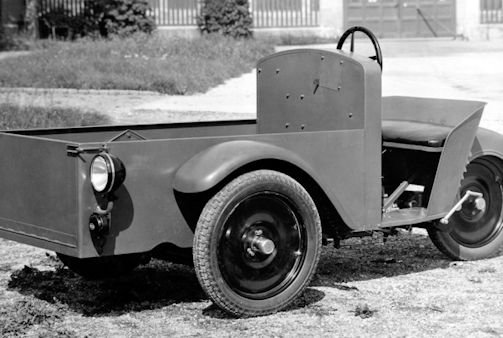
The BMW F 76 was a small three wheel delivery van that BMW built from 1932 to 1933 in Eisenach . In 1933 this was updated to the BMW F 79 with a larger engine, which was manufactured until 1934.
History
With poor sales of expensive panel van version of the BMW 3/15 (with only 435 vehicles from May 1929 to February 1932) in the Great Depression and the simultaneous success of other manufacturers with three-wheeled trucks , BMW developed in Munich from 1931 a separate "muzzle loader" with two side-by-side seats using existing single-cylinder motorcycle engines. A one-seat variant was tested, but not included in the series ; as well as a version as a passenger car.
The BMW plant in Eisenach built from autumn 1932 F 76 for the license-free vehicle class with a maximum of 200 cc capacity at a retail price of 1,350 Reichsmarks. Already in January 1933 followed the F 79 with 400 cc capacity, which cost 1500 Reichsmark. The basic price contained only a horn and a speedometer. Windshield, windscreen wiper, cab, doors, electric winker, spare wheel, spare wheel holder and jack were additional; as well as all modified versions of the loading area. In front of the rear wheel driver and passenger sat on a car seat, under which the stationary single-cylinder engine was installed. Driver and passenger seats were to be provided at an extra cost with a closed cabin with 2 doors. A steering wheel was installed in front of the driver and a small platform (1,600 mm × 900 mm) was set up on the front axle. Under the bunk there was a transport box with front flap.
After only 600 copies (250 F 76 and 350 F 79 ), the construction of the vehicles, which actually came too late for the Great Depression, was discontinued in mid-1934 due to lack of customer interest.
As single-cylinder four-stroke engines with enclosed OHV cylinder heads, the engines largely corresponded to the motorcycle engines of the BMW R 2 and BMW R 4 , from which they were derived with minor modifications.
For engine cooling, there were at least two variants: a simple solution with V-belt, four-leaf fan in front of the cylinder, which was seen only in the test vehicles , and a more complex design with impeller on the front crankshaft stub and air baffles for cooling air flow, which also in manuals and spare parts lists. The rear wheel was driven via a three-speed gearbox with reverse gear and a cardan shaft .The tricycle had a powered rear wheel and two steerable front wheels. The rigid front axle was suspended by two leaf spring packs, which were installed longitudinally. At the rear wheel, BMW used a casted one- arm swinging arm , in whose longitudinal spar the cardan shaft ran. The foot brake pedal and the detectable handbrake lever acted on cables on all three drum brakes.
The complex design offered the following advantages:
- the rear wheel was easy to remove
- the disc wheels were interchangeable
- The joint disc of the double-ball bearing cardan shaft was located exactly in the axis of rotation of the rocker
- The bike guidance was very torsionally stiff
- The universal drive was maintenance-free and pollution-free every 10,000 kilometres compared to the usual chain drives except for the oil change
Bertone BMW 2800 Spicup Concept
 |
|
|
Presentation Year: |
1969 |
|
Vehicle Expo: |
Geneva Motor Show |
|
Class : |
Concept |
|
Body design : |
Coupe |
|
Engine: |
Petrol: 2.8 Liters |
|
Length: |
4150 mm |
|
Width: |
1780 mm |
|
Height: |
1207 mm |
|
Wheelbase: |
2340 mm |
|
Empty weight: |
1330 kg |
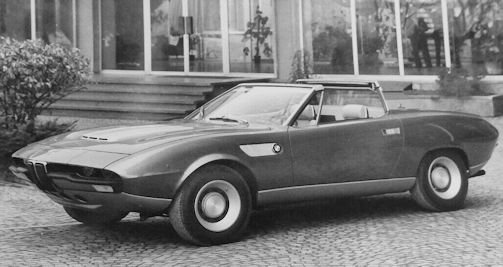
The Bertone-BMW 2800 Spicup is a concept car that the Italian design studio Bertone developed and built on the technical basis of a BMW sedan in 1969.
History
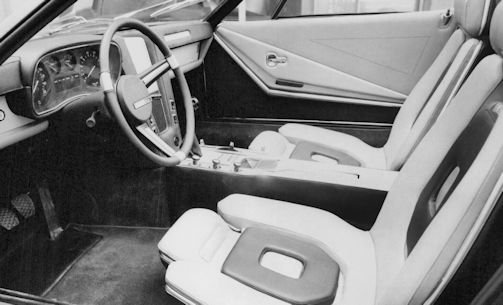
The Spicup was completed in early March 1969 as a ready-to-drive exhibit. Shortly after the completion it appeared for the first time at the Geneva Motor Show in March 1969. The car was not shown at BMW, but on Bertone's booth. The car was painted in the unusual light green, the interior covered with olive and silver leatherette. Following the exhibition Bertone the last public presentation of the visually and technically unchanged car took place in September of the same year at the International Motor Show in Frankfurt am Main , after which the Spicup was sold.
In the 1960s, the Carrozzeria Bertone began to offer not only classic body design and the production of complete automobile bodies but also technical detail solutions for automobiles. These included an electrically operated hardtop for coupes, which Bertone had developed in 1968. This construction, described as a "lamellar roof", was originally designed for the successor of the Fiat 850 Spider.Already in the early development phase, however, it became apparent that the "lamellar roof" was very expensive due to its complex mechanics, so that a use in the small Fiat sports car, which should be offered as an inexpensive mass vehicle, was out of the question. Accordingly, the show car has car Bianchi runabout , the conceptual predecessor of X19 Bertone tried to establish his roof construction in a higher market segment. In the fall of 1968, the company decided in favour of a concept car based on a BMW equipped with the "louvered roof". This choice was based on the fact that Bertone had business relations with BMW since the early 1960s and, starting with the luxury class coupe 3200 CS , had designed or coached several BMW bodies in an advisory capacity. From this emerged in the first months of 1969, the Spicup.Contrary to Bertone's expectations, neither BMW nor any other manufacturer could be won over to take over the "lamellar roof"; even a hoped-for production of the Spicup in small series by Bertone did not materialize.
Design
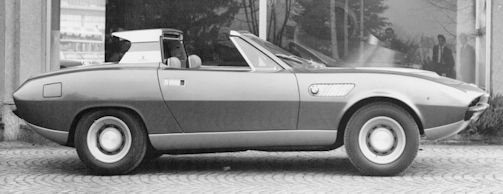
The "lamellar roof", the most unusual design element of the Spicup, was based on an idea by the Bertone mechanic Enzo Cingolani. It was conceptually a further development of the Targa roof and was an attempt to use for the purpose of space saving existing safety reasons roll bar for housing the hard top. was the conventional Targa roof located between the windshield and the roll bar usually to remove manually located middle part; then it had to be stowed separately in the trunk or in the interior of the vehicle. In contrast, the electrically operated "slat roof" of the Spicup disappeared space-saving and almost automatically in the roll bar. The roof of the Spicup was above the passenger compartment of two different sized stainless-steel panels, which were arranged transversely to the direction of travel. The front, adjacent to the windshield smaller panel could be pulled by an electric motor in the rear, larger panel. Thereafter, both panels disappeared - the front in the rear - in the roll bar, thus freeing the space above the passenger compartment. As a result, the car was therefore either with a solid metal roof as a coupe and, open, as a convertible or spider.
Among the disadvantages of the concept in addition to the complex, cost-intensive mechanics, above all, the need for a wide roll bar, whose dimensions must be designed so that they can accommodate the panels more or less complete. In the case of the Bertone Spicup limited weather worthiness was added. Contrary to the representations in the advertising brochure from 1969 it was Bertone failed to seal the individual panels complete so regularly larger amounts of water arrived in rainy trips into the interior of the vehicle.
The French body manufacturer Heuliez developed the idea in the following years. With a similar concept was born in 1971 an Espace called Targa version of the Citroën SM , in which the panels were arranged parallel to the direction of travel and disappeared in a central bridge between windshield and roll bar. Heuliez produced two copies of the Espace, one of which was sold.
The Bertone BMW 2800 Spicup is designed as a two-door, two-seat notchback coupé with removable roof centre section. The design of the Spicup bodywork is a work of Marcello Gandini , the then chief designer Bertones. In the area of the front end Gandini oriented himself on the (also designed by him) Alfa Romeo Montreal, like this, the Spicup also has half-hidden headlamps, often referred to in the contemporary press as "bedroom views", and a forward-sloping front end. In the front fenders functionless ventilation grilles are embedded, which are reminiscent of a design feature of the well ten years older BMW 507. The front bumpers are broken by a stylized BMW kidney, the halves of which are not used as cooling air openings, but are closed with dark plastic covers. The wide, trapezoidal roll bar is coloured. In the upper part it is wider than at the base. This design was necessary to make room for the roof panels. The vertical rear window is electrically lowered. The interior was from Designed by Eugenio Pagliano . Numerous attachments came from the BMW series production.
Technology
The technical basis of the Spicup was a vehicle of the BMW E3 series . Specifically, it was a pre-production copy of the BMW 2500 without chassis number, which had been used in 1967 and 1968 in the factory as a test vehicle and had covered a total of nearly 100,000 kilometres. Bertone reduced the wheelbase by 350 mm to 2.34 m; the total length of the spicup is 4.15 m. Shortly before its completion, the Spicup was equipped with a 2.8-liter, 170-horsepower six-cylinder engine from the BMW 2800, which did not fit through its height under the low mounted bonnet. Gandini solved the problem with a so-called Shaker Hood: He cut an opening in the hood near the engine and installed a fixed, color-coded cover over the engine block, which broke through the bonnet.


