
Berkeley
Berkeley B95 B105
 |
|
| Production | Mar 1959 – Dec 1960 200 approx produced. |
|---|---|
| Body style | 2-door roadster |
| Engine | 692 cc transverse four stroke twin, air-cooled |
| Wheelbase | 70 in (1,778.0 mm) |
| Length | 125 in (3,200 mm) |
| Width | 50 in (1,270.0 mm) |
| Height | 45 in (1,143.0 mm) |
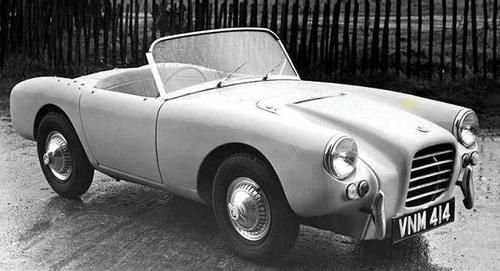
The B95 and B105 models were launched at the 1959 Geneva Motor Show and boasted more power from twin-cylinder Royal Enfield 692 cc four-stroke engines, with the 40 bhp (30 kW; 41 PS) Super Meteor engine in the B95 and the 50 bhp (37 kW; 51 PS)
Show since the marque's switch-over from two-stroke to four-stroke power. Engine of the B95 sports two.seater, in common with the reat of the range, is now a vertical twin,fitted to some of the larger Royal Enfield motorcycles, The 4-gpeed gearbox, too. is of motorcycle type, with two-stage chain transmission.
The rest of the specification follows familiar Berkeley practice, with all- independent suspension (swinging half-axles at the back, wishbones in front, coil springs at both ends), and
a unitary hull made from resin-bonded glass-fibre with light alloy reinforcements at critical points.
Constellation unit in the B105 which could reputedly exceed the magic 100 mph (160 km/h). The engines featured Berkeley-design primary chain cases to accommodate a Lucas Bendix starter motor, an external Lucas dynamo mounted above the gearbox, and a duplex (or double-row) chain drive to the differential. Kerb weight increased to 402 kg (890 lb). B95 engine numbers have the unique prefix 'SMTB', while B105 engines are prefixed 'SMUA'.
- Power: B95 41 @ 5.500 rpm B105 51 hp @ 6.250 rpm
- Fuel consumption: 45 mpg
- Top speed: 70mph
The prototype car was SE492 chassis number 638, which was modified to add bracing to withstand the extra power and weight of the four-stroke engine, a taller bonnet (US hood) with large grille to accommodate the engine, and unfaired headlights. In mid-February 1959 this car spent two weeks at the Royal Enfield factory, during which time it covered 500 miles of general road use and 1,000 mi (1,600 km) of endurance testing at MIRA.
By the time of the press release announcing the launch of the B95 in March 1959, a further 2,500 mi (4,000 km) of road and track tests had also been carried out by Berkeley factory drivers. Perhaps to address the reputation for breaking down that the two-strokes had developed, especially in export markets, it was emphasised by the factory that during this testing there had been no involuntary stops or any form of mechanical failure, and that further testing would be performed until a total of 15,000 mi (24,000 km) had been completed.
At its launch, the B95 cost £659 fro hard top and £627 for soft top version . About 200 B95 and B105 models were made, with chassis numbers following-on from the SE492 series and chassis number 670 (the earliest known B95) was registered at the end of March 1959. The first B105, chassis number 686, was delivered about one month later from 1960 chassis numbers from 834 up.
About half of the four-stroke cars were exported, and both the B95 and B105 were in production at the time the company was declared insolvent in December 1960. A few cars were assembled from parts following the factory's closure.

Berkeley Sports SE328
 |
|
| Production | Jan 1957 – Apr 1958 1259 approx produced. |
|---|---|
| Body style | 2-door roadster |
| Engine | 328cc transverse two stroke twin, air-cooled |
| Wheelbase | 68 in (1,700 mm) |
| Length | 122.5 in (3,110 mm) |
| Width | 50 in (1,300 mm) |
| Height | 43.5 in (1,100 mm) |
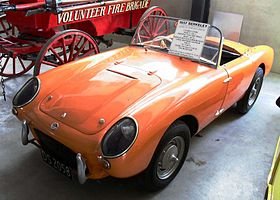
After 163 of the SA322 cars had been manufactured, a change was made to the SE328 model with a 328 cc Excelsior engine offering 18 bhp (13 kW; 18 PS). The production run ran from Jan 1957 to April 1958 with chassis numbers from 164 to 1422, many being exported to the United States where it sold for approximately $1600 (equivalent to $13.1 thousand today). The manufacture touted the number 70, meaning it could reach 70 mph and had an average fuel economy of 70 mpg. The export model was differentiated by having separate headlamps whereas on the home market they were faired into the wings, although the export type lamps could be specified.
Early cars from Jan 1957 to about chassis number 476 in June 1957 still used a column gear change. During their production run a Deluxe model was offered which was bodily the same but featured polished wheel trims and spinners, tachometer and twin carburettors. The chassis plate was similar to the Anzani type on the early cars but was later changed to a printed type fitted to the bulkhead above the brake master cylinder. The printed type chassis plate had type ‘SE328’ printed on it. Most of these cars had the three-speed gearbox similar to the Anzani except for the mounting flanges. All of the cars had the sloping leading edges to the doors.

Motor magazine tested a 328 cc Berkeley in 1957 and found it to have a top speed of 62.1 mph (99.9 km/h) and acceleration from 0-50 mph (80 km/h) in 30.6 seconds. A fuel consumption of 58.3 miles per imperial gallon (4.85 L/100 km; 48.5 mpg-US) was recorded. The test car cost £574 on the home market including taxes of £152 (equivalent to £10.3 thousand today).
The SE328 enjoyed considerable success and press exposure through their involvement with lightweight motor racing, and their famous drivers included Pat Moss who drove one in the 1958 Liège-Brescia-Liège rally for cars up to 500cc. The Berkeley team – a works-supported entry of six cars including BBC commentator Robin Richards – led as far as Slovenia, but slow climbing in summer heat found their weakness and Pat ended up being towed back to Italy by another Berkeley. None of the Berkeleys finished the event.

Berkeley Sports SA322 (B60)
 |
|
| Production | Oct 1956 - Jan 1957 163 approx produced. |
|---|---|
| Body style | 2-door roadster |
| Engine | 322cc transverse two stroke twin, air-cooled |
| Wheelbase | 70 in (1,800 mm) |
| Length | 123 in (3,100 mm) |
| Width | 50 in (1,300 mm) |
| Height | 41.5 in (1,050 mm) |
| Curb weight | 605 lb (274 kg) |
Berkeley's first production car was the 'Sports' (type SA322), announced in September 1956 and produced from October 1956 to January 1957. Production began with two prototypes (registered RMJ395 and RMJ946), which were seen being tested with enthusiasm around the neighbourhood of Biggleswade in the late summer of 1956. Stirling Moss drove one at Goodwood in September, and the car was launched to the public at the 1956 London Motor Show - one year ahead of the Lotus Elite which was also to be of fibreglass monocoque construction.
Bond's attractive 2-seater open tourer design capitalised on Berkeley's GRP experience, and consisted of three large mouldings (floor or 'punt', nose, tail) with no conventional chassis. The front edges to the doors slanted forward so that when the doors were opened they hinged upwards and then closed by themselves. Although usually configured as a two seater with simple bench seat, a hatch could be removed from behind the front seat revealing a compartment normally containing the spare wheel and some luggage space which could double as a basic seat for a small child.Equipment was basic, even the fuel gauge was an optional extra.
Power was provided by a British Anzani twin-cylinder 322 cc two-stroke engine producing 15 bhp (11 kW; 15 PS) and mounted transversely driving the front wheels via a chain and three speed gearbox. The engine was already used by various motorcycle manufacturers such as Cotton and Greeves, but in the Berkeley was fitted with a Siba Dynastart to provide both battery charging and electric starting. It was a very advanced two stroke engine which incorporated a rotary inlet valve mechanism in the centre of the crankshaft. The gearbox was a three speed Albion HJR5, utilising a steering column-mounted gearchange.
The car had all round independent suspension by coil springs and in spite of the tiny engine gave remarkably good performance owing to its light weight (kerb weight 605 lb (274 kg) and excellent roadholding. Girling hydraulic brakes with 7 in (180 mm) drums were used.
The identification plate was a plain stamped alloy rectangle fitted on the engine bay side wall just above the Dynastart and marked SA322 B1 etc. (Sports Anzani 322cc Berkeley Chassis number 1).


