
Buick
Buick Y job Concept car
|
|
|
|
Manufacturer |
Buick (General Motors) |
|
Model years |
1938 |
|
Designer |
Harley Earl |
|
Class |
Concept car |
|
Body style |
2-door convertible coupe |
|
Engine |
5.2-liter (320 ci) Buick straight-8 |
|
Wheelbase |
126 in (3,200 mm) |
|
Length |
208.7 in (5,301 mm) |
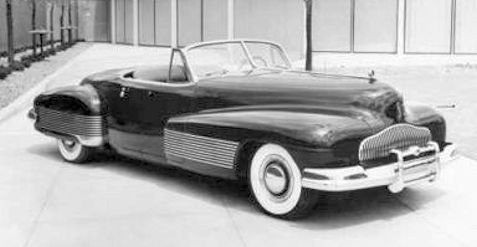
The Buick Y-Job is the first concept vehicle in history . Developed by the manufacturer Buick in 1938 to show new technology and car design features. It was intended to show what futuristic cars GM and Buick could design, but it was also conceived of as classy personal transportation for Earl to use.
It was designed by Harley Earl . Harley Earl came to Hollywood. His father, JW Earl, had been working as a coachbuilder since 1889 and initially devoted himself to horse-drawn carriages, but founded the Earl Automobile Works in 1908 and from then on manufactured special bodies and components for cars. In 1938, the Styling Division, under Earl's supervision, designed and built the Buick Y-Job, the first style study in the history of the automobile. Although one-offs with special bodies had been produced before, the Y-Job was the first car from a mass manufacturer that served the sole purpose of attracting the attention of the media and the masses.The Y-Job was presented to the public and driven daily by Earl thereafter. The Y-job was started in 1938, using a current chassis and Buick 320-cubic inch straight 8. A convertible with bench front seat.
Its low overall height of 58-inches was helped by its small 13-inch wheels. The car had pneumatically operated pop-up hidden headlamps , a radiator's figurine reminiscent of a rifle, special door handles, and styling details that Buick used until the 1950s. It was the first vehicle with power windows. Smoothed in fenders with ribbed trim, no running boards, a boat tail-like trunk. The top folded into a compartment ahead of the trunk.
There are several explanations for the name "Y": All test vehicles were called "X", so Earl simply used the next letter in the alphabet. The name "Y" was chosen by Earl because it was widely used in the aviation industry, where it referred to the most advanced prototypes. The Y-Job was shown to the public after. its completion, but not like the concept cars of today. Its main purpose was the personal transportation of Earl. He reportedly drove it regularly from 1940 until well past the second world war.
Buick Velite 5
 |
|
|
Production period: |
2017-2019 |
|
Class : |
Motor Car |
|
Body versions : |
hatchback |
|
Engines: |
2 electric motors :110 kW + |
|
Length: |
4579 mm |
|
Width: |
1811 mm |
|
Height: |
1494 mm |
|
Wheelbase : |
2694 mm |
|
Curb weight : |
1610 kg |
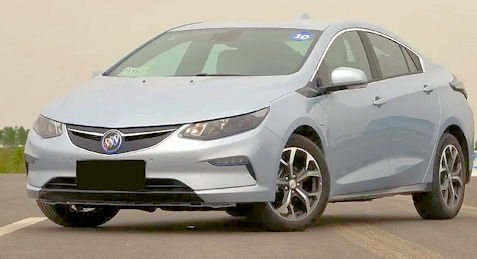
The Buick Velite 5 is a compact class plug-in hybrid vehicle owned by Buick, a company owned by General Motors .
History
The car was announced in November 2016 at the Guangzhou Auto Show as concept vehicle Buick Velite Concept . The standard vehicle debuted in April 2017 at the Shanghai Auto Show and was until April 2019 exclusively in China sold. The Velite 5 was from Buick Velite 6 .The Velite 5 is identical to the second-generation Chevrolet Volt sold since 2015 in North America . However, unlike this, was built in China by the Shanghai-GM joint venture .
Introduced at NYIAS in 2004, the roadster concept car Buick Velite has nothing in common with the plug-in hybrids.
The drive from the Chevrolet Volt. This combines two electric motors with a 78 kW (106 hp) 1.5-liter gasoline engine , which serves as a range extender . With a total output of 110 kW (150 hp), the vehicle accelerates to 100 km / h in 9.2 seconds and reaches a top speed of 160 km / h. The electric range of the plug-in hybrids is 116 km, the maximum range is given by General Motors with 768 km.
Buick Rendezvous
|
|
|
|
Production: |
2001 to 2007 |
|
Class : |
SUV |
|
Body versions : |
Station wagon |
|
Engines: |
|
|
Length: |
4737 mm |
|
Width: |
1869 mm |
|
Height: |
1750 mm |
|
Wheelbase : |
2845 mm |
|
Empty weight : |
1825-1938 kg |
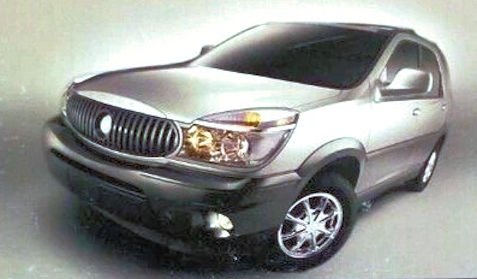
The Buick Rendezvous is a crossover SUV produced by the US car manufacturer Buick . It was in 2001 offered to 2007 exclusively in North America and Taiwan.
The Rendezvous was conceived to combine the properties of vans (with up to seven seats and a large load capacity) with the comfort and driveability of luxury vehicles and the design and available all-wheel drive of SUVs in one vehicle. It was produced together with the Pontiac Aztek in Ramos Arizpe in Mexico .
The Rendezvous was equipped as standard with front-wheel drive and, at an additional cost, with a fully automatic, permanent all-wheel drive , which gave it good traction in wet and snowy conditions and was also able to cope with easy terrain. Buick based its chassis design on Park Avenue in terms of comfort and handling , which is why all Rendezvous models were equipped with independent rear suspension .
The base engine was initially a 3.4-l V6 engine with 138 kW, from the 2006 model year a 3.5-l V6 engine with 150 kW. A 3.6-liter V6 engine with 183 kW was initially available as an option together with the Ultra equipment variant. The power was transmitted via a 4-speed automatic . In 2004 there was a slight facelift .
Features
5 person total seating capacity; bucket front seats; cloth upholstery; driver seat with adjustable lumbar support, passenger seat with adjustable lumbar support; bench rear seat; split-folding power steering; front, rear and 3rd row cupholders; front seatback* storage; cargo net; front and rear 12.' power outlet; front console with storage; retained accessory power; climate control; front and rear reading lights; dual vanity mirrors; front and rear floor mats; cargo area light; front side-mounted airbags: rear centre 3x int belt 2 front headrests; 2 rear headrests; 2 third row headrests; remote anti-theft system; daytime running lights; dusk sensor headlamp's; auto delay Off headlamps; front fog lights; cornering lights variable intermittent wipers: privacy glass; rear De-fog; rear window wiper, remote power door locks; 1 touch power windows; power mirrors; AM.FM CD stereo; 6 speakers
The rendezvous was a success for Buick, which was also urgently needed due to an aging regular clientele. With the rendezvous, the traditional brand attracted a younger as well as wealthy customer base. The success was largely due to the price; a Buick Rendezvous cost about US $ 8,000 less than a comparable Lexus RX . The sales figures far exceeded expectations with regard to the initially targeted 30,000 to 40,000 copies. With the exception of the last year of production, between 60,000 and 70,000 units were manufactured annually. Overall, during the five-year production period rolled around 305,000 copies by the band.
In mid-2007, the Buick Enclave was introduced to replace the rendezvous.
Buick Verano
 |
|
|
Manufacturer |
Buick |
|
Production |
2011 to 2017 |
|
Assembly |
USA |
|
Class |
Motor Car |
|
Body style |
4-door sedan |
|
Layout |
Front-engine, front-wheel drive |
|
Platform |
Delta II platform |
|
Engine |
|
|
Transmission |
|
|
Wheelbase |
105.7 in (2,685 mm) |
|
Length |
183.9 in (4,671 mm) |
|
Width |
71.4 in (1,814 mm) |
|
Height |
58.4 in (1,483 mm) |
|
Curb weight |
3,300 lb (1,500 kg) |
The first generation of the Buick Verano was called the Opel Astra in Europe, Buick Excelle in China.
The first generation of the Buick Verano was presented just before the North American International Auto Show (NAIAS) 2011, its formal premiere then took place at this very same vehicle show.
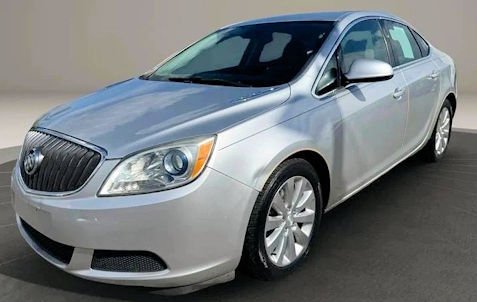
The Buick Verano is a compact car, which from 2011 by the American manufacturer General Motors (GM) in the US GM plant was built Orion in Michigan until 2016 and GM joint venture SAIC-GM in China is built. With the Verano Buick extended his offer to a smaller model. Like the Buick Regal introduced a year earlier , which is based on the Opel Insignia , he showed a clear trend towards smaller cars in the US. Last Buick offered in the 1980s with the Buick Skyhawk a car of comparable size.The vehicle of the first generation is based on the Delta platform and is related to the notchback sedan of the Opel Astra J and (like this) in a broader sense with the Chevrolet Cruze J300 and the minivans Opel Zafira Tourer and Chevrolet Orlando .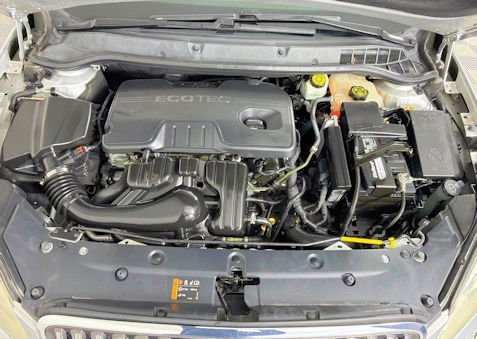
There was the Verano of the first generation only with four doors and notchback. There were two four-cylinder engines to choose from: standard was a 2384 cc large naturally aspirated engine , for an additional charge, there was a 1998 cc large turbo engine , which provides the higher performance thanks to the charge despite the smaller displacement. Like the Regal, it features a cascading grille in black chrome,blue translucent headlights, the distinctive Buick air intakes, and the same sloping roofline that ends in a steeply raked windshield. 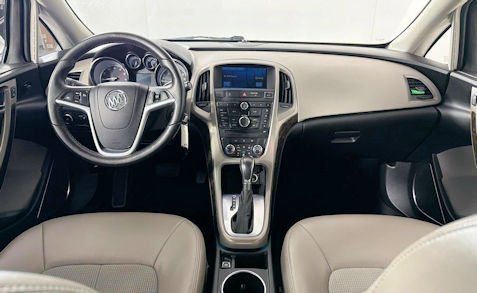
INTERIOR Just like the exterior, the styling remains consistent with the other sedan models in the brand's lineup, the Regal and Lacrosse. The decorative wood-look trim pieces aren't to everyone's liking. It's the slightly old-fashioned side of Buick.The seats are comfortable and well-shaped. They are available in fabric, leatherette, and genuine leather in the higher trim levels. A central column integrated into the dashboard houses the infotainment system screen, as well as the controls for the climate control and the Bose audio system.
You have a push-button start, and heated seats and steering wheel are available as options, and these can be linked to the remote starter. If the temperature is below 7°C, the steering wheel and seat heating is automatically activated. The Verano naturally adopts the OnStar system in its version compatible with the mobile phone application which allows, for example, to remotely check the mileage, fuel level and everything else.Buick also used its Quiet Tuning technology, which consists of using acoustic laminated glass, triple door seals, and refined chassis dynamics to reduce noise.Standard 17-inch special multi-spoke forged alloy wheels minimize road noise. The electric power steering is the same as that of the Buick Regal, so it will be well calibrated.
The production of the first generation at GM's Orion plant was discontinued in October 2016. The sale was carried out until spring 2017. The second generation Verano is available only in China, but not in North America.
Buick Park Avenue 1st generation
 |
|
|
Production period: |
1990 to 1996 |
|
Class |
Lucury Car |
|
Body versions: |
limousine |
|
Engines: |
Gasoline engines:3.8 litres(127-177 kW) |
|
Length: |
5230 mm |
|
Width: |
1882 mm |
|
Height: |
1400 mm |
|
Wheelbase: |
2814 mm |
|
Curb weight: |
1600-1650 kg |
The Park Avenue debuted in April 1990 as a base model as well as a slightly refined top model called the Park Avenue Ultra. Both versions were initially of a Buick own 3.8-liter V6 engine (173 hp) with 127 kW, of its performance over was a standard four-speed automatic transmission type GM Turbo Hydra-Matic 4T60E transferred to the front wheels,
Compared to the decidedly small-looking styling of the first Park Avenue generation due to the energy crisis in the early 1980s, the Park Avenue of the 1990 vintage put on nearly a quarter of a meter and again demonstrated its size and elegance with a Jaguar-inspired styling.
From 1992, the Park Avenue Ultra received a 153 kW (208 hp) compressor variant of the V6. The equipped with mechanical charging models had completely in contrast to the standard model of reinforced plastic bumpers and made part of the date of construction and the customer's other wheels. The interior was also slightly upgraded, which also benefited the standard models in the later years of construction.
In 1993 slight retouches were made to the grille and rear lights; In 1994, the performance of the supercharged engine in the Park Avenue Ultra increased to 168 kW (228 hp). At the same time, the equipment was extended by a passenger airbag.
In 1995, the base model received a completely redesigned cast-iron 3.8-liter V6 engine (Series II) with 153 kW, the compressor version initially made 168 kW. In 1996, the power of the supercharged engine was increased to 179 kW (243 hp).
Performance:
Max speed approx 121mph/195kmh
power to weight ratio from 12.8kg/kW (9.4kg/PS);
consumption approx 11-17L/100km (25.7-16.6mpg) [21.4-13.8USmpgl
The first two generations of Park Avenue were also sold in Europe; these versions differed from the US models with orange indicator lenses at the front, a larger recess for the license plate between the (modified) tail lights, larger rear-view mirrors and the absence of the radiator grille above the radiator grille - although some early export models still had them. In the last two years of construction, the European version received new bumpers with much lower metal content and new side protection strips. However, the Park Avenue Ultra with supercharged engine was never officially offered in Europe.
The second generation of the Park Avenue was characterized by a very good aerodynamics, its c W value (drag coefficient) was only 0.31, which corresponded to one of the main demands from the specifications of the development.
Another peculiarity was the relatively low curb weight of 1604 kg (Ultra: 1651 kg) for a car of this size, which combined with the very low engine speed resulted in remarkably low fuel consumption in cautious driving (this applies even more to the models from 1995 onwards) with the newly designed V6 engine). Therefore, this series was used as well as for comfort and reliability in Europe, especially on long-haul routes. The 3.8-liter V6 engine effortlessly reaches mileage far beyond 300,000 kilometres.
From first generation Park Avenue, Buick made 410,000 from spring 1990 to mid-1996.

