
Bitter
Bitter Blazer
 |
|
| Production period: | 1976 |
| Type: | off road |
| Built : | 1 |
The bitter Blazer was a one-off.modification of the Chevrolet Blazer for Europe in the mid 1970s
with new Europeanized front end, by a horizontally extending grille and light units from Opel Admiral B. Added to this was a refined interior. This followed the concept of the Monteverdi Safari . The vehicle remained a unique piece.
In 1976, Erich Bitter made an attempt to introduce the American SUV Chevrolet Blazer on the European market, which was slightly “enriched” with parts from the Opel Admiral B for example, front and rear optics, as well as a radiator grill, were borrowed from it.
The interior was upscale leather and added with wood panels.
Together with a 175-horsepower V8 carburetor V8 with a volume of 6.5 liters, and a 3-speed automatic transmission, and by default the car had four-wheel drive with a connected front axle.
Unfortunately, it did not build much interest with Europeans, and only one was built by Bitter.
Bitter Tasco
 |
|
| Production period: | 1991 |
| Type | prototype |
| Built | 1 |
| Body | coupe |
| Engine: | mid-engine |
The Tasco was a two-seat mid-engined sports car from Chrysler, which Bitter developed with Japanese funding. The body was designed by Tom Tjaarda. Mass production did not materialize; and only two copies of the Tasco were made.
History
Three years after the presentation of Type 3, Bitter at the next Frankfurt Motor Show surprises the public with a promising supercar named Tasco.
For the first time in the history of the brand, the car received a mid-engine layout, and its design was developed by Tom Tjarda, who had previously had a hand in De Tomaso and Lancia cars. Financial support was provided by Japanese investors, and technical assistance in the creation and refinement of the supercar was provided by MGA Developments from Coventry, who developed an aluminium monocoque for this model, to which external panels made of composite materials were to be attached.
In theory, the newcomer was supposed to compete with high-speed models of such eminent brands as Lamborghini or Ferrari, and under the hood - to accommodate a V-shaped "eight" from the Chrysler engine line, equipped with a turbocharger. The giant V10 from Dodge Viper, known to many, was also mentioned, but the model debuted in Frankfurt only as a model with a detailed interior, but without a power unit.
The car did not receive a decent continuation, was built in a single copy and is currently on display at the Coventry Museum of Transport.
Bitter CD 2
 |
|
| CD 2 | |
|---|---|
| Production period: | 2003 |
| Engine: | 6.2 liter V8 |
| Type : | prototype |
| Power: | 400 hp |
| Built: | 2 |
| Body: | coupe |
| Doors : | 2 |
The CD2 was a two-door hatchback coupe based on the Australian Holden Monaro and the identical Pontiac GTO . The vehicle was presented in 2004 at the Geneva Motor Show. There were only two prototypes.
History
Bitter pursued the concept of modifying heavily motorized Australian GM vehicles for the European market with the Vero model.On 70th birthday, Erich Bitter makes a great present for himself and his fans: he announces the revival of the Bitter brand. In parallel, the company celebrates the 40th anniversary of the brand and its first CD model. As a result, at the Geneva Motor Show in 2003, the second-generation Bitter CD coupe premiered.
Erich Bitter slightly changed the front of his brainchild, for the first time abandoning the rising headlights. However, it is worth noting that retractable headlights in a raised form pose a danger to pedestrians when hitting, and therefore, according to European safety requirements, they are simply prohibited for use.
The standard equipment of the new supercar included air conditioning, a navigation system, leather and wood trim, electric windows and mirrors, and cruise control, unusual for Europeans. It was supposed to start serial production of the car at a price of 127 thousand euros, but the order portfolio was not even formed, and Erich Bitter was able to build only two of these cars.
The two-door is based on the Holden Monaro model with the 6.2 liter V8 Chevrolet LS2 engine with 400 hp output. and a torque of 546 Nm, which is transmitted to the rear axle using a six-speed “mechanics” Tremec T-56 or a four-speed automatic transmission. Maximum speed reaches 290 km / h.

Bitter SC Car range
 |
|
| Bitter SC | |
|---|---|
| Production period: | 1981-1989 |
| Body versions : | Coupé , Cabriolet ,Sedan |
| Engines: | 3.0-3.9 liters (132-154 kW) |
| Length: | 4910-5060 mm |
| Width: | 1820 mm |
| Height: | 1350-1370 mm |
| Wheelbase : | 2683-2683 mm |
| Curb weight : | 1515-1635 kg |
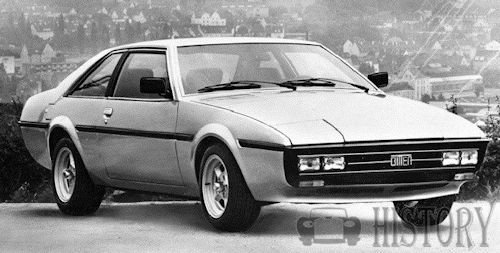
The Bitter SC was the second model of the German manufacturer Bitter . It replaced the Bitter CD and was also based on mass production technology from Opel. The official presentation of the Bitter SC Coupé took place in the spring of 1980 on the occasion of the Grand Prix of the Formula 1 of Monaco , where it was used as a safety car .
The SC was produced from the beginning of 1981 and was available over the years in three body versions. In addition to the coupe, the volume model of the series, from the spring of 1983, a convertible and from late summer 1985, a four-door sedan sedan called SC Sedan offered.
Until the discontinuation of production in the late autumn of 1989, a total of 488 copies of the Bitter SC series were produced. The indirect successor should be the prototype Type 3.
History
The concept
In the SC Erich Bitter repeated the conceptual approach of the CD. Again, he created an elegantly designed vehicle with Italian-style body and unproblematic mass production technology. Erich Bitter explained his preference for mass production technology with the following words: "I want my car to start without problems even after five days in the mountains after I have parked it in the mountains and gone skiing. What is the point of having a car that does not drive in difficult conditions? "
In the case of the SC withdrew a resort to the sovereign motorized Diplomat technology: Opel had ceased production of the great diplomat in the summer of 1977. Although Bitter still had a number of diplomatic parts, due to which the continuation of the production of the CD was secured for another year; after that, however, the idea of a new Bitter model was inevitable. Back in the spring of 1977, Bitter was able to secure the right to use Opel Senator A , which had not even been presented at the time, as the technical basis for a new coupé. The advantage of this technique was its reliability and easy availability.
In terms of sportiness and exclusivity, she remained well behind the diplomat's eight-cylinder. Some observers considered the technique downright bourgeois and saw it as a major reason for the low prevalence of SC .
Unlike the CD, Bitter received no significant support from Opel except for the provision of the technical components. Bitter therefore had to carry out the development work on his own; It lasted two years and cost about 8 million German marks . Bitter was only able to do this by investing externally, namely by a Swiss industrialist.
Body
Erich Bitter initially thought, as in the case of the CD only a coupe variant. The first draft of the body came from Erich Bitter himself. Unlike the CD of the new SC had no hatchback, but a saloon with a distinctive trapezoid line clear in the by Pininfarina -designed Ferrari 400 remembered and a similar elegance in appearance and in detail had. Like this, the Bitter SC had folding headlights. Bitter's design was then revised by Opel designers Henry Haga and Georges Gallion. The details of the design and the bodywork were finally by Giovanni Michelotti executed in Turin. All in all, the new car used many Opel parts, which were certainly not readily apparent on the exterior. Attachments such as lights and door handles came from mass producers, the rear lights, for example, were taken over by the Lancia Beta Montecarlo (and not, as often suspected, the Fiat X1 / 9 ), the front light units of the Ferrari Mondial .
BODY: All steel load bearing body shell—5 person seating capacity—front and rear zones computer programmed for controlled impact absorption—integrated roll-over bar—recessed safety door handles—laminated windscreen, heated rear window—wide rubber side protection mouldings—noise insulated interior—integral rear towing hook—vertically stored spare wheel in side of boot.
RUST PROTECTION: Body surface cataphoresed as well as manually primer coated and painted—underbody protected by p, V.C. coating, including wheel arches and at sides of floor panels.
LIGHTING: Four halogen headlamps with low/ high beam. Integrated direction indicators combined with warning lamps—variable intensity instrument lighting—door courtesy switch controlled interior lighting with additional switch on instrument panel; two additional lamps in the rear passenger compartment.
Technology
In the early development phase, there were plans to equip the SC with an eight-cylinder engine as before. As drive sources engines of Lamborghini - here the 3.5-liter eight-cylinder engine from the Urraco - and Holden were considered and certainly tested on test benches. However, this idea failed because of the noise and emissions performance of large engines . Instead, Bitter made extensive use of the drive technology of the Opel Senator and the Opel Monza . The car was initially with a not significantly changed six-cylinder in- line engine equipped with a capacity of 2968 cc from the Senator. In the last model years, he was also equipped with a 3848 cc in-line six-cylinder Tuner Mantzel. Individual vehicles eventually received a four-wheel drive from Ferguson.
PERFORMANCE:
3.0 Litre Engine
Maximum Speed . Manual Transmission 133 m.p.h. 0-62 m.p.h 8.5 seconds
Maximum Speed Automatic Transmission 130 m.p.h. 0-62 m.p.h 9.4 seconds
3.9 Litre Engine
Maximum Speed Manual Transmission 142 m.p.h. 0-62 m.p.h 7.6 seconds
Maximum Speed Automatic Transmission 137 m.p.h. 0-62 m.p.h 8.5 seconds
EQUIPMENT
Central door locking system, tachometer, electronic 2 speed windscreen wiper with interval wiping—ANindscreen washer electric pump and contact—cigar lighter and ashtray in middle of instrument panel—two adjustable upholstered sun visors—safety interior mirror with anti-glare position—remote control mirrors, right and left (electric)—large console on centre tunnel with storage space and upholstered arm rest—arm rests with integral grap handles on roof frame—colour co-ordinated velour headliner—velour carpet—boot Compartment carpeted in velour—boot illumination—engine compartment illumination—heat absorbing tinted glass standard—electrically operated windows—light alloy wheels.
Standard equipment: Cruise control; Philips Cassette/ Radio with 4 speakers (2 front, 2 rear) automatic antenna, wooden panels for switch, and centre console.
Option: Electric Sun-roof. WARRANTY: 2 years or 24,000 miles.
INSTRUMENTS: Upholstered instrument panel—instrument cluster—speedometer with trip distance temperature gauge—oil pressure gauge—control lights for high beam—direction indicators—hazard warning flashers and handbrake (combined with clutch warning and brake system warning clock. Switches for: heated rear window (with control lamp), and provisions for installation of switches for fog lamps, heated seat—combined switch for headlamps, instrument and interior lamps—switch for infinitely variable instrument lighting—illuminated switch group for fresh air and heating—pressure switch for hazard warning lights on steering column—combination lever on steering column for directional indicator, high beam, windscreen wiper and windscreen washer—starter switch combined with steering and ignition lock on steering column.
HEATING AND VENTILATION: Multi-adjustable ventilation and heating systems (accurate temperature control through fresh air blending) with four speed radial blower and warm air outlets for windscreen and footwells. outlets (variable in direction and airflow) in upper part of instrument panel for ventilation Of side windows and interior, as well as two adjustable fresh air outlets in centre of instrument panel—additional leg room heating in rearcompartment. Standard Equipment: air conditioning.
SEATS: Standard Equipment: Half leather upholstery; Anatomically correct, fully reclining front seats with headrests (foam rubber with spring base) mounted on ball-bearing runners, infinitely variable seat height adjuster, storage pockets on back of front seats—centre console with upholstery arm rest and storage box—storage pockets in the doors—folding centre rear seat armrest—three point seat belts front and rear.
The production
As with the Bitter CD, the production of the SC was largely outsourced. According to the common concept for small series manufacturers, the body was to be manufactured in an external factory before being transported to Bitter in Schwelm and assembled there with drive technology. At the CD the body had been made by Baur .
However, this path was eliminated for the SC. After the last CD had left the band at Baur at the end of 1979, Baur had found an alternative with the production of the BMW M1 , which was so exhausted that there was no capacity left to build the new Bitter. Erich Bitter therefore deviated to northern Italy, where for decades there were a large number of small, independent bodyworks, which made for other vehicle manufacturers either by hand or in small series superstructures. First, the choice fell on the Carrozzeria OCRA in Turin , a relatively young company with little experience. Between early 1981 and early 1982, OCRA introducedA total of 79 bodies ago, the overall were of poor quality. Given the use of Soviet recycled sheet metal, the cars were extremely rust-prone; Some vehicles began rusting just a few months after delivery.
In the spring of 1982, Bitter terminated the contract with OCRA . The production was then relocated to the also based in Turin Carrozzeria Maggiora , a company as experienced as well as renowned, which at that time also produced bodies for Maserati and Bristol . Individual vehicles are said to have been completed at Zagato . The leather for the interior was sourced from SALT in Turin . By the end of 1983, the vehicles were completed at Bitter in Schwelm. However, the small plant soon came to its limits, because there usually only one car per week could be completed.
In view of the planning for an expansion of production, Bitter finally found the opportunity to complete the cars at Steyr Daimler Puch in Graz . There, about three to four cars were produced weekly by the end of 1989 .
Body versions
Coupe
The SC Coupe came in spring 1981 as the first version on the market and thus represented the volume model of the series dar. With 461 manufactured copies, it was also the most common variant.

Cabriolet
In the spring of 1983, the series was supplemented by the SC Cabriolet. The hood was based on a design that had developed the supplier Keinath for a limited series of 144 convertibles based on the Opel Monza.
By the end of 1989, only 22 convertibles.

Sedan
The Sedan supplemented from late summer 1985, the model range. This was a four-door limousine sedan, which was designed primarily for sale in the US . The vehicle was based on an extended chassis.
The first prototype was created in 1984. The SC Sedan was an extended version of the coupe dar. Drive technology and roof height remained unchanged. The prototype was powered by the 3.0-liter six-cylinder Opel Senator and had a manual five-speed gearbox. The production cars, which were manufactured from mid-1985, deviated in some details from this prototype. All production vehicles had a higher roof. They were powered by the 3.9-liter mantzel engine and all had an automatic transmission.From SC Sedan until the middle of 1988, only four production vehicles were produced. Three of them still exist; they are in the USA. The prototype today belongs to a Dutch collector .

Bitter & Co History
Automotive manufacturers Schwelm; Germany from 1973 until 2012

Erich Bitter Automobil GmbH (Bitter) is a premium sports-luxury automobile marque produced in Germany and later Austria. Founder Erich Bitter, a former racing driver turned automobile tuner, importer and ultimately designer began crafting his own vehicles after business ventures with Italian manufacture Intermeccanica ended.
Bitter specialises in rebodying other manufacturer's vehicles and its initial production was between 1973 and 1989, selling vehicles in Europe and the United States. Thereafter, several prototypes followed with an eye on resuming low-volume production, but none of those plans came to fruition until the launch of the Bitter Vero in 2007.
Bitter Blazer (1976)
The bitter Blazer was a modification of the Chevrolet Blazer with new Europeanized front end, by a horizontally extending grille and light units from Opel Admiral B were characterized. Added to this was a refined interior. He followed the concept of the Monteverdi Safari . The vehicle remained a unique piece.
Bitter Rally GT (1984)
The Rally GT was a compact two-seat sports car based on the Opel Manta . The vehicle had a removable Targa-style central roof section and had been developed by Bitter and Isdera . Erich Bitter predicted a sales price of 40,000 DM. However, he dropped production of a series production because the supply of technical components was not secured in the long term.
Bitter Type 3 (1987)
The Bitter Type 3 was a 2 + 2-seater Cabriolet , which was introduced in 1988 as a successor to the SC and was intended primarily for sale in the US .
The technical basis was the Opel Omega A , whose bottom section was shortened by 35 millimeters. The body had been designed by Bitter himself; it had front folding headlights and round taillights of the Chevrolet Corvette C4 . The drive was a 3.0-liter six-cylinder provided by Opel, whose performance was stated in a sales prospectus with 177 hp.
Bitter Tasco (1991)
The Tasco was a two-seat mid-engined sports car from Chrysler , which Bitter developed with Japanese funding. The body was designed by Tom Tjaarda. Mass production did not materialize; only two copies of Tasco were made.
Bitter Berlina (1994)
The Bitter Berlina was a four-door sports sedan based on the Opel Omega MV6 , which was similar in basic features to the Type 3 Sedan. Striking was a sloping front end with pop-up headlights. Taillights of the Opel Calibra were used at the rear end . There was only one prototype presented at the 1994 Geneva Motor Show . The admission of the series production failed because of the unsecured financing.
Bitter CD 2 (2003)
The CD2 was a two-door hatchback coupe based on the Australian Holden Monaro and the identical Pontiac GTO . The vehicle was presented in 2004 at the Geneva Motor Show. There were two prototypes. Bitter pursued the concept of modifying heavily motorized Australian GM vehicles for the European market with the Vero model.
Main Models
CD
The Bitter CD, a three-door hatchback coupe featuring a 227 hp (169 kW) Chevrolet V8 with a 327ci displacement, was built between 1973-1979.
The CD was first shown in prototype form on 9 September 1969 at the Frankfurt Auto Show, as the Opel Coupé Diplomat ("CD") derived from the sedan version. It was designed by Charles M. "Chuck" Jordan (Opel's Design boss between 1967-1971 and later vice-president of General Motors (GM)) with the assistance of George A. Gallion, David Holls, Herbert Killmer and Hideo Kodama, as well as Erhard Fast (Director of the Opel Designstudios 3 for Advanced Design from 1964). The tail was inspired on a proposal by Erhard Fast's for the 1969 Opel Aero GT.
SC
The first SC model launched was the coupé in 1979, followed by the convertible in 1981 at the Frankfurt Auto Show and the sedan in 1984. Like the CD, the SC was based on Opel's largest model at the time, the Opel Senator. It remained in production until 1989.
CD II
In 2003, in an attempt to resume its small-scale production, Bitter presented a modern reincarnation of the CD, known as the CD II. It was based on the Australian-made Holden Monaro but rumoured to feature a V12 engine. Investors were sought but the car never reached full production.
Vero
In 2007, Bitter resumed small-scale production by launching the Vero at the 2008 Geneva Motor Show. This car was derived from the Australian-made Holden Caprice (WM) sedan (the long-wheelbase luxury derivative of the Holden Commodore (VE)), believed to be purchased directly from Holden thanks to Erich Bitter's friendship with Holden's former Peter Hanenberger.
Vero Sport
In 2009, Bitter unveiled a "Vero Sport" at the Geneva Motor Show. Unlike the regular Holden Caprice (WM)-derived Vero, the Sport was directly based on the short-wheelbase Holden Commodore (VE) SS sedan, also sold as the Chevrolet SS in the United States. Like the Vero, the Vero Sport was also discontinued in 2012.

