
Benz
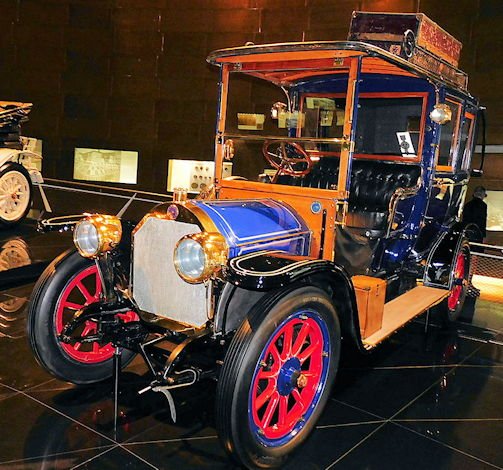
Benz 20/35 hp
 |
|
|
Production period: |
1909 to 1911 |
|
Class : |
Motor Car |
|
Body versions : |
Double Phaeton ,Sedan , Landaulet |
|
Engines: |
Gasoline :4.85-5.2 litres |
|
Wheelbase: |
3090-3210 mm |
|
Curb weight : |
1050-1200 kg |
|
previous model |
Benz 28/30 hp |
|
successor |
Benz 16/35 hp |
The Benz 20/35 hp was an evolution of the Benz 28/30 hp in the 1910s .
History
Technical progress caught up with Benz, who thought he had devised the perfect motor-car, and left him far behind. By 1902, when the original type was finally discontinued, the feeble, frail-looking, elementary Benz with its lazy horizontal engine, belt final drive, vestigial power output, and gentle 15—20 m.p.h. pace, which had been so popular up to 1900, was now a museum piece. The car was initially equipped with a four-cylinder in-line engine with 5195 cc capacity, which developed 35 hp (26 kW) at 1400 rpm One German fiscal horsepower corresponded to 16 cubic inch engine displacement. The engine power was transmitted via a leather cone clutch to a four-speed gearbox and from there, depending on the customer's request via chains or a cardan shaft to the rear wheels.
The firm took a long time to make up the lost ground (which meant catching up with Mercedes and Renault from the time the new designer, Marius Barbarou, formerly of Clement-Gladiator, were an advance on their predecessors, but were still too conservative to be competitive. However, in 1904, Barbarou (who went back to France, and Delaunay-Belleville) was replaced as works manager by Hans Nibel, who produced a line of cars of conventional modern design, quite expensive, some medium- sized but owing their reputation to the big, fast cars in the range. All were fours until 1914, with pair-cast cylinders. The early Nibel cars had side valves in a T head, but he adopted the L-head layout in 1909. Shaft drive could be fitted to the 18/28 PS of 1905—8 as an option, but the largest machines could only be had with chain drive until 1908, and only in that year
was a model offered with shaft drive alone. The top speed was 45mph ( 75 km/h), the fuel consumption at 22 l / 100 km. 1910, the capacity was reduced while maintaining power to 4850 cc.
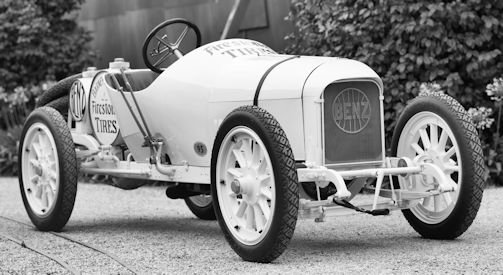
Benz Prince Heinrich (Henry) Race Car
 |
|
|
Production period: |
1908 to 1911 |
|
Class : |
race car |
|
Body versions : |
Touring car |
|
Engines: |
Gasoline engines : 5.7-7.5 liters |
|
Length: |
Various |
|
Width: |
Various |
|
Height: |
Various |
|
Wheelbase : |
3000 mm |
|
Curb weight : |
1350 kg |
The Benz Prinz Heinrich car also know and sold as Prince Henry was a racing car of the Benz & Cie. , which was built as a reminiscence of the victories of the racing driver Fritz Erle at the Prinz Heinrich ride 1908 (reached with a Benz 50 HP ). It was built only on customer request in individual pieces.
The cars had wooden spoke wheels with pneumatic tires and rigid axles with semi-elliptic leaf springs. They were equipped with a four-speed gearbox, which was connected by a cardan shaft to the rear axle.
The front axle and steering-heads are similarly encased to produce a stream-line form. The same practice is also. applied to the back axle, and there is even evidence of it on the front ends of the rear springs, the Prince Henry type Benz. sheet-metal pyramids attached to them. The front dumb-irons, for a similar reason, are made to look like scythes.
Transmission takes place through a leather-faced cone- clutch, in which a somewhat marked peculiarity is the very slight amount of taper on the cone. The gear-box, which is of the standard sliding-spur-wheel type, gives four forward speeds and a reverse, and the back-axle is of the usual Benz pattern.Alternative gear-ratios are available for altering the gear of the car, and their design is such that the driving-bevel and the crown can be changed for another pair of different ratio without altering the setting. The crown- wheels are dished to a different degree in order to allow for the different number of teeth, and it is thus a very simple matter to make the change. 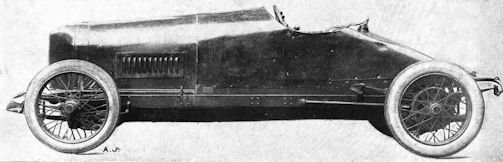
The question of reducing the air-resistance of racing cars has quite taken the place of the former all-important problem of reducing the weight. In the early days races were run for classes of cars restricted to certain weights, Two views Of the engine on the Benz racer. Each cylinder two magnetos working in unison and under these circumstances it was, of course, essential to bring the weight within the specified limit, which in many cases involved drilling away every superfluous scrap of metal that could by any means be eliminated. we find racing cars such as this constructed very much in the same straightforward manner as touring cars, and the attention of the designers is being concentrated on reducing the air-resistance. 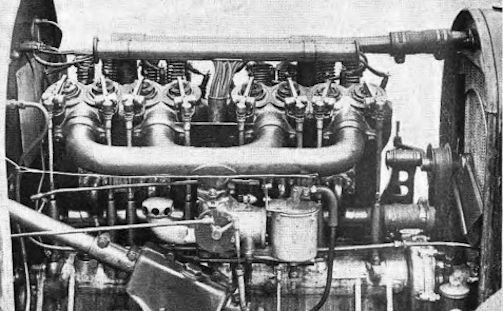
The 80 hp machine an moderate-sized racing car although it is by no means a small engine its bore and stroke are only 105 by 165 mm. The great feature of interest about the engine is the duplication of the valves and the magneto. There are two inlet-valves and two exhaust-valves to every cylinder, and there are two magnetos simultaneously in action on two sets of plugs. The valves are set diagonally in the cylinder heads, the exhaust-valves being on one side and the inlet-valves on the other. The valves are interchangeable. The ignition-plugs lie between the valves, and each set of plugs is independently coupled up to its own magneto. Both plugs are normally in action, but if one or other misfires, the remaining plug continues to do its duty alone.
The magnetos are situated together on one side of the engine, one magneto being a little below the other, for it is obviously impossible to couple them up in tandem owing to the presence of the contact-breaking mechanism, which occupies one end of the magneto as at present constructed. Each piston has two rings, and a special feature of its construction is the provision of an oil pipe which runs diagonally from the centre of the gudgeon-pin to a recess in the piston walls. At the bottom of each stroke this recess comes opposite to an orifice in the cylinder walls and has injected into it a charge of oil, which is fed by a reciprocating pump. When the piston is at the bottom of its stroke the connecting-rod big-end comes under the action of the same oil feed ; this is essentially a supplementary form of lubrication to the main system, which relies on the splashing from the oil chamber.
The lubricator itself is of the multiple plunger type, and lies along-side the engine, its mechanism is enclosed in a rectangular box, which serves as an oil reservoir. A tell-tale on the dashboard indicates whether the pumps are in operation.
The circulation of the cooling-water on this model is effected by a gear- wheel pump, and great care has been taken to strain the water free of any solid particles by a strainer situated on the suction side.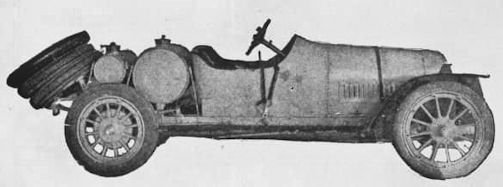
Benz Victoria and Vis-à-Vis
1893 to 1900

Benz Victoria motor car
The Benz Viktoria was a car made by the Benz motor company from 1893 to 1900.
It sold in large numbers across Germany when it was first sold.Up to the beginning of the eighteen-nineties.
One of the reasons for the poor commercial success of Benz's first vehicle was that it was a tricycle. So from 1891 Benz embarked on
solving the front wheel steering problem. Two years later he did so by swiveling the wheels independently on king pins, and he was granted
a patent. The new car was called Victoria symbolizing victory over the steering problem.
With the design of an effective axle-pivot steering (DRP 73151 of 28th Februar 1893) this path was paved for four-wheeled vehicles.
In 1893 Benz the model "Victoria" available was also a four-seated version with face-to-face seat benches,called the model "Vis-à-Vis".
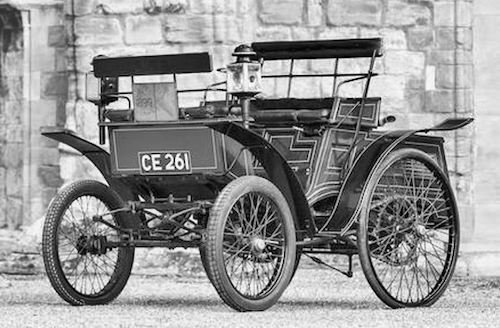
1899 Benz Vis a Vis
The vehicle's excellent properties were tested not only in city traffic but also on longer distances. In 1894, the year Count Albert de Dion organized the very first Paris- Rouen car racer a textile industrialist, Baron Theodor Liebig entered for a long-distance race in Liberec, now in Czechoslovakia, at the wheel of
his Victoria. He and his friend Stransky chose the route from Liberec via Mannheim to Rheims and back On the first day they reached the
small town of Waldheim, having averaged 13.5km/h (8.4mph). The town was some 195 km (121 mi) from Liberec, and the car reached a
top speed of 22km/h (14mph), The next stop-over was at Eisenberg and Eisenach. The fourth day was the most strenuous, a non-stop
drive to Mannheim, the Victoria's home town, The drive took 26 hours, Karl Benz personally welcomed the intrepid Baron Liebig and organized
a ball in his honour. The following day the drive continued to Gondorf with a longer stop-over. By now the automobile had covered 1000 km
(620 mi). The pace from Condorf to Rheims and back to Liberec was less hectic. Liebig recorded his experience in a diary, ending up with
the following: 'One of the things we appreciate highly is that Benz's car has made us aware of all the beautiful places that exist in the
German countryside'.

Baron Theodor Liebig and Karl Benz
The Benz Victoria, in which Baron Liebig covered the 2500 km (1550 mi) route, was fitted with a horizontal single-cylinder engine.
With bore and stroke dimensions of 130><150mm it had a capacity of 2000 cc and developed 3kW (4hp) at 400 rpm. This four-stroke
water-cooled engine was mounted at the rear, and it drove the rear axle by means of flat belts and two chains. The hand-brake controlled the
back wheels, which were fitted with solid rubber tyres.
The vehicle weighed 650kg (1431b) and it was 2.9m (9ft 6in) long.
The Victoria was Benz's favourite car. It was made in different versions, such as Vis-å-vis or Phaeton, until 1899.
Both variations recieved displacement and performance changes ,that were continuously enlarged and improved up to the end of production in 1900.
Benz Patent Motor car
1886 to 1893
 |
|
Three wheels |
|
Tubular steel frame |
|
Rack and pinion steering, connected to a driver end tiller; wheel chained to front axle |
|
Electric ignition |
|
Differential rear end gears (mechanically operated inlet valves) |
|
Water-cooled internal combustion engine |
|
Gas or petrol four-stroke horizontally mounted engine |
|
Single cylinder, Bore 116 mm, Stroke 160 mm |
|
Patent model: 958 cc, 0.8 hp, 600 W, 16 km/h |
|
Commercialized model: 1600 cc, ¾ hp, 13 km/h (8.1 mph) |
The success of the company gave Benz the opportunity to indulge in his old passion of designing a horseless carriage. Based on his experience with, and fondness for, bicycles, he used similar technology when he created an automobile. It featured wire wheels (unlike carriages' wooden ones) with a four-stroke engine of his own design between the rear of the three wire-spoked wheels, with a very advanced coil ignition and evaporative cooling rather than a radiator.
The "Velocipede" Power was transmitted by means of two roller chains to the rear axle. Karl Benz finished his creation in 1885 and named it "Benz Patent Motorwagen".
It was the first automobile entirely designed as such to generate its own power, The engine output was 0.75 hp (0.55 kW) not simply a motorized stage coach or horse carriage, which is why Karl Benz was granted his patent and is regarded as its inventor.
The Motorwagen was patented on 29 January 1886 as DRP-37435: "automobile fueled by gas". The 1885 version was difficult to control, leading to a collision with a wall during a public demonstration. The first successful tests on public roads were carried out in the early summer of 1886. The next year Benz created the Motorwagen Model 2, which had several modifications, and in 1889, the definitive Model 3 with wooden wheels was introduced, showing at the Paris Expo the same year.
Benz began to sell the vehicle (advertising it as "Benz Patent Motorwagen") in the late summer of 1888, making it the first commercially available automobile in history. The second customer of the Motorwagen was a Parisian bicycle manufacturer Emile Roger, who had already been building Benz engines under license from Karl Benz for several years. Roger added the Benz automobiles (many built in France) to the line he carried in Paris and initially most were sold there.
The early 1888 version of the Motorwagen had no gears and could not climb hills unaided. This limitation was rectified after Bertha Benz made her famous trip driving one of the vehicles a great distance and suggested to her husband the addition of brake linings to act as brake pads.
Bertha Benz's long-distance drive
An important part in the Benz story is this first long distance automobile trip, where the entrepreneurial Bertha Benz, supposedly without the knowledge of her husband, on the morning of 5 August 1888, took this vehicle on a 106 km (66 mi) trip from Mannheim to Pforzheim to visit her mother, taking her sons Eugen and Richard with her. In addition to having to locate pharmacies on the way to fuel up, she repaired various technical and mechanical problems and invented brake lining. After some longer downhill slopes, she ordered a shoemaker to nail leather on the brake blocks. Bertha Benz and sons finally arrived at nightfall, announcing the achievement to Karl by telegram. It had been her intention to demonstrate the feasibility of using the Benz Motorwagen for travel and to generate publicity in the manner now referred to as live marketing. Today, the event is celebrated every two years in Germany with an antique automobile rally. In 2008, the Bertha Benz Memorial Route was officially approved as a route of industrial heritage of mankind, because it follows Bertha Benz's tracks of the world's first long-distance journey by automobile in 1888. Now everybody can follow the 194 km of signposted route from Mannheim via Heidelberg to Pforzheim(Black Forest) and back. The return trip was along a different, slightly shorter, itinerary, as shown on the maps of the Bertha Benz Memorial Route.
Benz's Model 3 made its wide-scale debut to the world in the 1889 World's Fair in Paris; about twenty-five Motorwagens were built between 1886 and 1893.


