Berliet
Berliet PCM Bus
 |
|
|
Make |
Berliet |
|
Years of production |
1965 to 1971 |
|
Class |
Bus |
|
Energy |
diesel |
|
Motor (s) |
L6 Berliet - MAN DO636HM8U 6 cyl Flatbed Diesel (PCMR and RE) |
|
Engine position |
Longitudinal right forward |
|
Displacement |
7034 (MAN) cc |
|
Maximum power |
135 (150) DIN ch (99 kW) |
|
Transmission |
Propulsion - Pont-à-Mousson Bidisque Dry Centrifugal Coupler (Wilson License) for PCMR |
|
Gearbox |
Manual or automatic R107 |
|
Unloaded weight |
8120 (PCMR) 9800 (PCMRE) kg |
|
Maximum speed |
60 km / h |
|
Bodywork (s) |
2 door bus - Aluminium - Configuration 442 (2 agents) - 444 (1 or 2 agents) - 044 - 144 - 424 (PCMRE) - 422 (proto PCMRE) |
|
Frame |
Separate chassis |
|
suspensions |
Pneumatic - Telescopic shock absorbers - Rear stabilizer bar |
|
Length |
11000 (PCM) 9825 (PCMRE) mm |
|
Width |
2500 mm |
|
Height |
2970 (PCM) 4350 (PCMRE) mm |
|
wheelbase |
5580 (PCMR) 4560 (PCMRE) mm |
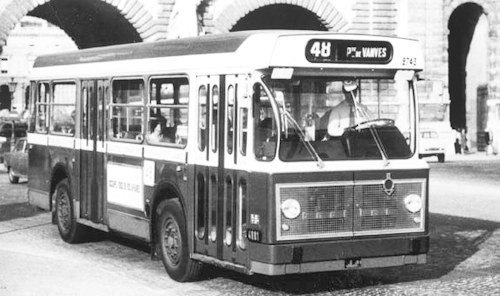
The Berliet PCM is a bus manufactured by the French brand Berliet from 1965 to 1971.
History
The Berliet PCM is a bus Berliet manufacturer to the specifications defined in 1958 by the RATP and the UTPUR (Union of Urban and Rural Public Transport) for a "standard bus “with a length of 11 m a flat floor at 63 .5 cm from the ground at most, an interior height of 2.20 m minimum with high windows 1.78 m from the floor, an anti-reflective windscreen and a 150 hp engine lying under the driving position.
The French manufacturers Berliet and SAVIEM and Verney presented a prototype on March 23, 1962, the SAVIEM SC 10, the Berliet PCM and the Verney AUS. This last manufacturer, not having the industrial capacity to ensure the planned production, withdrew almost immediately.
The lines of the PCM are very angular. The design is signed by designer-stylist Philippe Charbonneaux. Berliet is betting on an aluminium body bolted to a low-slung chassis with side members.
Equipped with the same MAN engine limited to 135 hp as the first SAVIEM SC 10.U, the Berliet PCM is more expensive to purchase because its aluminium body is bolted to a steel frame. This constructive choice makes the vehicle lighter and therefore more manageable than its competitor and its suspension is fully pneumatic with level correction, offering very good comfort.
However, corrosion sets in very quickly at the contact points between the steel of the chassis and the aluminium of the PCM body and the maintenance costs are very high. Berliet interrupts, as soon as December 1971, the production of the bus best suited to urban service that it has ever had in its catalogue to replace it with the PR 100, very noisy in its first versions and not designed for heavy load lines operated in self-service due to the absence of a rear door.
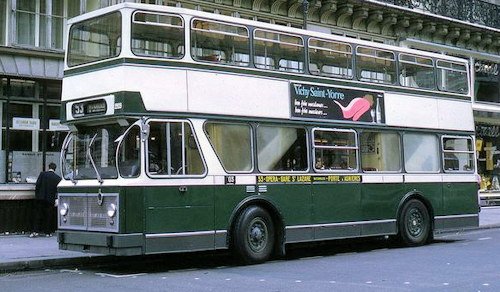
The Berliet PCMR-E is a double-decker city bus like you see everywhere in London. In the mid-1960s, the RATP launched a call for tenders for a double-decker bus in order to reduce the surface area occupied by buses while increasing transport capacity, the RATP decided to carry out an experiment by taking the example on London's double-decker buses.
Berliet responded to demand by producing, in 1966, a prototype based on the PCM in its shortened version with a second level: the PCMR-E. Presented at the RATP, this prototype received criticism because the ceiling height was too low for users. But the volume of the future market is too low for a manufacturer to launch a study for a brand-new model. The RATP ordered 25 units of the Berliet PCMR-E which entered service in 1967.
Although it received a warm welcome because passengers are attracted by curiosity, the RATP quickly noticed that users no longer went upstairs: those who take the bus for medium distances prefer to stay downstairs and save money. thus, to climb the steps and especially the ceilings are low: 1.89 meters at the bottom and only 1.70 meters at the top. 26 units built in 1968 for the RATP who reformed them in 1977 after transformation for a single agent use in 1972. They were used on lines 94 and 53. Fleet No. 2200 (prototype) at 2225.
The RATP will use for a short decade the Berliet PCMR-E which did not convince. The 26 examples built in 1968 will be reformed in February 1977.
The PCM-R 750 RATP copies. Park number: 4151 to 4500 - 4601 to 5000. (Prototype 4451)
PCM-UC It was at the request of the Marseilles network that Berliet adapted, in 1966, the body of the PH on a PCM chassis, thus giving the PCM-UC version. This strange and heterogeneous vehicle was heavily penalized by its very heavy steel body, whereas the PCM had an aluminium body. Only 16 copies will be produced.
PGR, the little PCM In the early 1960s, traffic in Paris became very difficult. Reserved lanes are not yet envisaged and the idea of seeing only 11 m buses replacing the old ones which measured 9.15 or 9.75 m frightens the Prefecture of Police, which imagines them blocking traffic at crossroads. The RATP ends up admitting the relevance of a less cumbersome bus than the SC10 and PCM. The Berliet PCMRE bus, 9.83 m long, double-decker, goes in this direction.
Berliet imagined removing the PCMRE stage and then offered a reduced version of the PCM, but without the MAN engine lying under the driver. Paul Berliet wants to avoid getting supplies from his rival SAVIEM, now the exclusive importer of MAN engines. The engine is therefore a vertical 4-cylinder Berliet positioned at the front, the M420.30 of 5.88 l (120 × 130 mm), developing 120 hp. The gearbox is a four-speed Wilson semi-automatic in the middle of the chassis. The rear axle is also an adaptation of the lowered one of the PCM. The mixed suspension comprises traditional steel blades as well as four air bags at the rear and two at the front (“Airlam” concept).
The body, in aluminium, is of a design close to that of the PCM with the famous cylindrical domed windscreen. It is 9.00 m long overall and 2.25 m wide, with the same large doors as the standard version. The floor is 65 cm from the ground. The vehicle takes the name of PGR, the "P" being the prefix of all Berliet coaches and buses, "GR" for "Reduced size".
With the exception of its engine, the vehicle retains all the characteristics of the standard and the project excites the RATP, especially since Berliet arrived (on 5/8/1966) at a very tight price of 122,478 F excluding tax on the basis of 100 units produced, when a PCM is worth 243,000, an SC10 235,000 and a PCMRE 247,300.
The first prototype was commissioned in Paris from November 28, 1968 to January 9, 1969. The RATP then orders a first tranche of 100 copies, then another of 460, to benefit from a price reduction on the totality. They are all fitted out for one agent with 45 places, including 28 seated and 17 standing.
The PGRs will cost Berliet dearly, not just because of an undervalued price but because the RATP has set high late penalties. While 76 PGR were to be delivered at the end May 1970, only 61 have been. In addition to this production delay, there are penalties for immobilization on breakdown. The addition, at the end of May 70, already amounted to 400,000 F (61,000 €). The breakdowns relate to the breakage of the legs of the seats, the compressor supports, the engine supports. The 4-cylinder Berliet engine is not only noisy but it vibrates the body which, poorly studied, amplifies the stresses. Added to this is a faulty idle. The engine is well suited for GAK and Stradair trucks that go on the road, much less on a bus that just starts and stops. The PGR breaks the record for the number of breakdowns per 10,000 km, 1.583 against 0.663 for the Saviem SC10and 0.989 for PCM. Some defects will be corrected in after-sales service and on new vehicles from the 64th unit manufactured.
With the introduction of the orange card in 1975, Parisians regained a taste for the bus. The unreliable PGR has also become too small and leaves its place, without regret, to the new 2nd generation SC10s. The last PGRs were reformed in 1983. In total, Berliet produced 606 examples of the PGR.
Renault PR 100
 |
|
|
Make |
Berliet Renault |
|
Years of production |
Berliet : 1970 - 1980 |
|
Class |
Bus |
|
Assembly plant |
France, Venissieux |
|
Fuel |
Diesel |
|
Motor (s) |
V8 ( 8.4L ) Perkins V8.510 (XA) |
|
Engine position |
Longitudinal Right Rear Cantilever (V8) |
|
Displacement |
8 350 cm 3 |
|
Maximum power |
174 DIN hp (128 kW ) |
|
Gearbox |
Wilson Automatic Electric Manual Voith &ZF |
|
Unloaded weight |
9,460 kg |
|
Maximum speed |
90 km / h limited |
|
Mixed consumption |
About 25 L / 100 km |
|
Bodywork (s) |
Standard bus 2 or 3 doors (pneumatic) |
|
suspensions |
Pneumatic Airlam |
|
Direction |
Hydraulic rack-and-pinion |
|
brakes |
Pneumatic drums |
|
Length |
11 230 mm |
|
Width |
2500 mm |
|
Height |
2,900 mm |
|
wheelbase |
5,600 mm |
|
Routes |
2,077 mm |
The PR 100 is a bus created by Berliet from 1970 to 1980 then taken over by Renault after the purchase of this brand from 1980 to 1984.
History
The PR 100 Prototype will be built in 1970 in only two copies. Compared to other vehicles of his time, he will have a new design and aesthetics, more square and angular. It will also have a lowered floor, for ease of movement of travelers, and a very large interior, luxurious and bright; a simple and easy-to-access driving position.
Between 1970, date of its presentation and 1984, many variants of this bus were manufactured.In addition to this range, there are also versions in the PR 180 articulated version and the ER 100 and PER 180 H trolleybus versions . Berliet launch along the PR 100, the PH 100 and PCM.U .It owes its name to its capacity of 100 seats (29 seats and 70 standing).
At the end of the 1960s, some urban network operators wanted to rejuvenate their vehicle fleets and benefit from more powerful vehicles. The manufacturer Berliet proposed a brand new concept: the PR 100 . The two prototypes built in 1970 and the following year four other items from the pre-series called PR 100.P . They will serve as a demonstration model.
The PR 100 will be unveiled in May 1971, as part of the International Week For in Monte Carlo . It marks an air of renewal, after the failure of the twin of the SC 10: the PCM with only 1,162 units produced.
The first service models, the PR 100.PA , were delivered to the Dijon network in September 1972. Produced up to 1976, 1,173 items are coming out of the Berliet plants. Like the PR 100 P, they have a Perkins V8.510 engine .In 1973, Berliet launched a new variant, the PR 100.PB or .B (B for the Berliet engine), identical to the previous except for the engine which is a Berliet V800. This bus has been marketed to 296 copies.
In 1974, the RATP acquired 10 PR 100.R , the latter having a specific windshield and a Perkins engine.In 1976, Berliet created the PR 100.PRS, a suburban version produced in 17 copies.From 1977, the PR 100 MI makes its entry, allowing to forget the defects of youth of the vehicle. It is powered by a new six-cylinder in-line engine of 200 horsepower. This series, produced with 2,308 copies, makes it the largest in number.
May 1971 Berliet conjured first four pre-serial bus during the 20 International Week of the coach to Monaco: PR 100.P (P for Pre-series).
The front, whose model is deposited by Berliet, is quite intriguing with a flat windshield, whose anti-reflective tilt is 11 ° backwards in compliance with the standard of near visibility. This is due to a gap of 90 cm between the floor and the bottom of the glass allowing wide visibility to the driver including the addition of two triangular side bays, docking windows facilitating maneuvering. The rear window is identical to the windshield, it is standardization, except that it is reversed! Its design is based on the principle of the self-supporting beam box with a length of 11,230 meters (11,350 meters with the mounting of bumpers on bumpers). Its floor is 645 mm from the ground to the front, in the center (640 for SC 10). The suspension is of AIRLAM type composed of a combination of air cushions and leaf springs: it is found on the Stradair truck , on the PH series coaches and Cruisair.
The PR 100 is not the first French rear-engined bus although it has been attributed this praise to its release: going back to the fifties, we find the precursors Million-Guiet-Tubauto B 9 and Isobloc 655 DHU . The PR 100 starts with a British Perkins V8.510 engine with 187 hp (reduced to 175 due to excessive oil consumption and lower vehicle noise) associated with a Wilson Diwa and Pont-à- semi semiautomatic gearbox. Monsoon HVD with manual electric control with optional Voith Diwa and Pont-à-Mousson.
Mr. Alfred Engels, then head of the design office will propose to take the AR bezel which is flat and reverse it to make the windshield which is a big saving of tools because with a tool, glassmakers go to make bezel and windscreen .
In July 1972, 1173 buses were distributed in the cities of France. The very first will be marketed in Dijon . The city of Toulon will receive sixteen PR 100.PA with three-door option. They will be the first designed for self-service.
The .PA will have the same engine as the first six PR 100 built by Berliet. Several options will be available, such as chrome hubcaps, fog lights, bumper bumpers, a third door, tilting or sliding windows, different types of upholstery ...
In 1973, Berliet will launch the PR 100.PB or .B (B for the Berliet engine replacing the Perkins). Its new V8 engine, named Berliet V800, will make 170 hp. It will be more powerful and less noisy. Its radiator will be placed on the left side, while that of the Perkins was placed at the rear facing the engine. Thanks to this, the .PB are differentiable to .PA by their ventilation grid. They also differ in their bridges. That of PR 100.PB will be longer, which will allow it to reach 90 km / h (instead of 74 for .PA).
Only 296 PR 100.B will be produced. The city of Grenoble was one of the cities to have the most with 72 copies.It will mainly be used for suburban lines.
Its engine, type BERLIET MIP 06.20.30, is integrated in a soundproof compartment and equipped with silencers on the exhaust. The entry and the exit of air repeal the critics on the first engines (Perkins and Berliet V 800): excessive noise nuisance, emissions of too polluting fumes. In the PR 100 MI, a new driving position and easier access are introduced, consisting of three small steps instead of two large ones. What external difference? it can be recognized by its pressed molded in the bottom of each door leaf (under the corresponding glazing), the radiator grille located in the right rear overhang (previously left), the fuel tank and its filler chute moved into the wheelbase, to the roof gutter which is lowered at the upper line of the bays and finally to the liftable engine hood (instead of two "cabinet" type gates). A three-door version is proposed for a "self-service" operation, which makes it easy to climb and descend. The third door is mounted in the wheelbase and not the rear overhang due to the position of the engine that would have required a number of prohibitive steps.
It allows a renewal of the following trolleybus networks: Lyon, Marseille, Grenoble, Saint-Etienne and Limoges. The engine is built by Traction-Electro-Mechanical Company-Oerlikon (TCO) or Alsthom : it is a 58 hp diesel, fitted as an option, allowing autonomous operation in case of failure of the electrified or deflected network.
Renault brand (1980 - 1984)
The Renault diamond (designed by Vassarely) is affixed to vehicles since 1980 and the monogram "RENAULT" on the back. This series is produced until 1984, date of arrival of the Renault PR 100.2.Between 1983/1984 and 1996, Heuliez develops its own range of standard ( GX107 ) and articulated ( GX187 ) vehicles built on the Renault PR 100 & PR 180 chassis and their evolution.The GX 107, also released a declination: the GX 113, which is a GX 107 whose interior is specially designed for Marseille .This range of buses also enjoyed significant success with French networks.
Worldwide PR 100
Without making a specific detail, note that several types of PR 100 are licensed under Berliet and then RVI around the world with many modifications sometimes, such as driving right in Australia. Some do not have the appearance - aesthetically - French PR 100.
The Spanish bodybuilder also relied on the standard PR 100 chassis to develop the PR.B (city bus) and PR.C (interurban bus) in 1997.
- The PRS in 1976
- The PR 80S, in 1985, is a PR 100.2-built bus with a specific front face, single swivel doors replacing the double one, and a raised floor for 53 seats in the direction of travel.
- The PR 120S is simply a PR 180, except that it is equipped with swinging doors, a raised floor for the insertion of seats in the direction of travel as a coach. Only two copies are built. One was destroyed in the eastern countries. The other 2 , in poor condition, was preserved by a Rennes association (Interconnection), having been withdrawn from service in 2012. The PR 80S is the standard version of PR 120.S.
- Poland: Jelcz PR100 produced between 1973 and 1977; Jelcz produces the PR 100 under license, hence two monograms on vehicles (Berliet / Jelcz). Renault VI no longer refers to Polish production. The Jelcz PR110 is an extended version of 12 meters and elevated 10 cm developed only for Poland. There are 110 seats (36 seats, 74 standing), powered by a Leylandengineand equipped with a third door in the rear overhang. There are 205 PR110s in Berliet's registers, of which only sixteen are built entirely in Venissieux. The remaining 184 are shipped in CKD to Poland. The manufacturing will then be licensed as the PR 100 even reaching variants "coaches" called interurban and tourism.
- Algeria: Sonacome PR 100.V8 (Sitra / Deutz engine );
- Spain is also adopting PR 100.2, some of which are powered by Daimler-Benz engines ;
- Australia: Renault PR 100.2 ( Mack engine ), PR 180.2 (Mack engine), PR 100.3 (→ Creation of the bodybuilder Austral Denning from a PR 100 then an R312 , Mack engine ). Some of the buses were stamped Mack-Renault. In particular, Transperth in Perth operated until 2010; in Canberra , ACTION has operated more than 200, of which another 71 are in service in November 2018 .
Berliet VXB-170
| VXB-170 1973 to present | |
|---|---|
 |
|
| Type | Armoured personnel carrier |
| Place of origin | France |
| Service history | |
| In service | |
| Used by | France, Gabon, Senegal |
| Production history | |
| Manufacturer | Berliet |
| Specifications | |
| Weight | 12.7 tonnes (12.5 long tons) |
| Length | 5.99 m (19 ft 8 in) |
| Width | 2.5 m (8 ft 2 in) |
| Height | 2.05 m (6 ft 9 in) |
| Crew | 1 or 2 |
| Passengers | 11 troops |
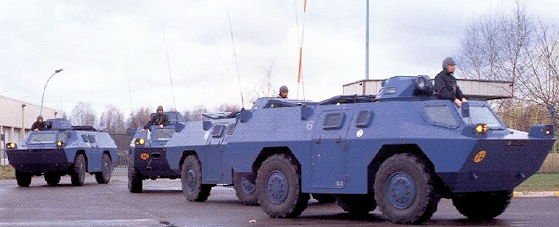
The Berliet VXB-170 is a four-wheel armoured vehicle produced by Berliet until Berliet was merged with Saviem to form Renault Trucks (now as Renault Trucks Défense).
The Armored Wheeled Vehicle of the Gendarmerie (VBRG) is the most common name of Berliet VXB 170 in France . It is an armored four-wheel drive vehicle intended primarily for law enforcement missions .
Designed by Berliet in the late 1960s , the VXB 170 was adopted in 1972 by the French National Gendarmerie, which put it into service from 1974 under the name of VBRG . But it is not retained to equip the French Army which chooses the armored vehicle of Saviem (Renault group) and it knows a limited success to the export. Its production is stopped after only 179 copies of series
History
Its design dates back to 1969 as part of the BL-12 project, which maximizes the use of brand heavy-vehicle components . It will be put into production under the reference VXB 170 in the Bourg-en-Bresse factory. 170 indicates the power of its engine (170 hp).
Various versions are proposed for the Gendarmerie, which selects it in 1972, as well as for the Army and for the export. Berliet will present prototypes equipped with different armaments : 20 mm gun, 20 mm two-tube gun for anti-aircraft defense, 90 mm gun , etc.
In 1974, Berliet, which had been owned by Citroën since 1967, was sold to Renault. The same year, the French Army chooses the VAB for its future troop carrier and the VXB, though cheaper, becomes redundant in the offer of Renault, which will lead to the cessation of production.
The VXB 170 is a Armored Personnel Carrier fairly standard built around a rectangular box welded steel of 7 mm thick at maximum .
This armored based on a suspension by rigid bridge , chosen for its robustness and simplicity . Two driving axles are present, each supporting two wheels .The VXB 170 is equipped with the V800 engine, already proven on board the buses of the brand. This 8-cylinder V, placed at the rear left of the vehicle, develops a maximum power of 170 hp .
The driver is located at the front left of the vehicle. A second place is installed on his right. The driver can see the road from a large central windshield and two windows on both sides of the windshield. Protective grilles are installed for law enforcement operations. In the event of a fight, armored shutters can be positioned in front of the windows. In this case, the vision is made by three episcopes located on the roof .Behind them is the turret operator's post. Finally, a group of 6 to 8 men can settle on a double bench and four seats. Access to the interior of the vehicle is via two side doors and a smaller one at the rear, next to the hatch of the engine compartment.
The VXB can tackle slopes of 60 % . It is amphibious and can receive - as an option - hydrojets (but this equipment was not retained by any customer).In the early 1970s , there is the problem of replacing half-tracks. But the experience of the events of May 1968 , during which the use of bulldozers to destroy the barricades was conclusive , led the Gendarmerie to launch a tender for a machine equipped with a blade and / or a winch and whose main mission is no longer the fight but the maintenance of order . It will choose Berliet VXB after a competition against the Panhard M3 from July 1971 to January 1972 .Beginning in 1974 , the VXB 170 entered service in the mobile gendarmerie under the name of wheeled armored vehicle of the Gendarmerie (VBRG). 155 copies are ordered .
In the VBRG configuration, the crew (a driver, an operator in the turret and a skipper)is completed by a tactical group carried consisting of 6 to 8 gendarmes.The staffing of a platoon was initially four gears. It was successively reduced to three and then two armored vehicles - nine for a full GBGM squadron (all mobile gendarmerie squadrons changed to a "quaternary" format - four squadrons per squadron - in the early 2000s) .
Initially armed with a circular rail machine gun, it will then be equipped with a single-seat turret equipped with a 7.62mm AA52 machine gun and a 56mm Cougar grenade launcher (after different versions of turrets and hoods have been tested). It may also be provided with a tear disperser .
Versions
There were originally three versions, internal security, reconnaissance and patrol, and light combat. The VXB was produced by both Berliet and Saviem, the Berliet version is equipped with hydrojets.
The VBRGs, exclusively intended for law enforcement operations, all receive the blue livery of the Gendarmerie to distinguish them from combat vehicles .The VBRG is available in four variants :
- Basic VBRG;
- "blade" version with a hydraulically operated tappet on the front;
- version "winch" with a winch at the front;
- "PC" version equipped with reinforced radio loudspeaker .
Armor 7 mm