
British Leyland
- Details
- Parent Category: B
- Category: British Leyland
- Hits: 124
Leyland Sherpa Van
| 1974 to 1982 | |
|---|---|
 |
|
| Overview | |
| Manufacturer | British Leyland (Austin Morris) |
| Also called | Morris Sherpa |
| Production | 1974–1982 |
| Body and chassis | |
| Class | Van |
| Chronology | |
| Predecessor | Morris J4 |
| Successor | Freight Rover Sherpa |
History
Hewn from the Morris/BMC J4 & JU250 vans of the 60s, the core vehicle went through a series of developments, the main one being the revision of the forward control layout of the J4 and moving the engine ahead of the cab and accessible via a bonnet. This allowed the wheelbase to be extended resulting in greater stability, payload, side loading and the distinctive 'Sherpa' profile (though the last of the J4s and the first Sherpa are largely identical from the rear).

The Sherpa gave way to the Freight Rover 200 Series and in turn the Leyland DAF 200 Series before finally becoming the Pilot after LDV was formed in 1993. It was originally designed to be built on car production lines which led to it having a narrow track. This feature was made into a virtue in later publicity by stressing its ability in narrow city streets.

Originally developed by British Leyland the model was launched in 1974 under the nameplate Leyland Van. A year later the name of the model was changed to the Leyland Sherpa. The Sherpa would then be branded by Morris and later Freight Rover.
The initial Sherpa line-up consisted of vans in 185, 215 and 240 versions (where 185 denotes a GVW of 1.85 tons, and so on); pick-ups in 215 and 240 versions; a 240 crewbus and minibus; and various chassis-cab options in 220 and 250 versions.

Payloads were quoted as 13/14cwt for the 185; 18/19cwt for the 215 and 220; and 22/23cwt for the 240 and 250. Loadspace, at 190 cubic feet (5.4 m3), was considerably higher than that of the J4 and only just short of the 250JU's.

In 1978 the 1.7- and 2.0-litre O-series engines replaced the original 1622 cc and 1798 cc B-series petrol units, while the 1798 cc B-series diesel stayed put. The range was redesignated accordingly:- vans: 200, 230 and 250; pick-ups: 230 and 250; minibus and crewbus: 250 only; chassis-cab: 255 only. A few months later, the Sherpa was rebadged as a Morris. In 1981, BL created the Freight Rover division as part of the Land Rover group, so the Sherpa's badges were changed again.

Film appearance
A first generation Sherpa van made an appearance in the 1977 James Bond film The Spy Who Loved Me which was driven by the villainous Jaws (Richard Kiel) on a journey through the Sahara Desert, with Bond (Roger Moore) and his partner Anya Amasova (Barbara Bach) hiding in the back in their quest to recover a microfilm crucial to their mission. They managed to escape in the vehicle after retrieving the microfilm but were unable to complete their journey due to the damage that Jaws had inflicted upon it in his earlier attempt to prevent them from escaping. In Billy Elliot movie there was a Leyland Sherpa (1984)

Sherpa van in James Bond The Spy Who Loved Me film
Leyland Sherpa van Jaws Used by Jaws posing as a telephone engineer. He subsequently tears it apart trying to thwart Bond and Anya's escape. The van's engine eventually overheats and seizes in the middle of the desert
- Details
- Parent Category: B
- Category: British Leyland
- Hits: 70
Austin Morris 18-22
| 1975 | |
|---|---|
 |
|
| Overview | |
| Manufacturer | British Leyland |
| Also called | Austin & Morris, 1800 & 2200 |
| Production | March to September 1975 |
| Designer | Harris Mann |
| Body and chassis | |
| Class | large family car |
| Body style | 4-door saloon |
| Powertrain | |
| Engine | 1.8 L B-Series pushrod straight-4 2.2 L E-series SOHC straight-6 |
| Transmission | 4-speed manual all-synchromesh 3-speed automatic |
| Dimensions | |
| Wheelbase | 105 in (2,667 mm) |
| Length | 175.4 in (4,455 mm) |
| Width | 68.1 in (1,730 mm) |
| Height | 55.5 in (1,410 mm) |
| Chronology | |
| Predecessor | Austin 1800 and 2200 |
| Successor | Princess |
The car, which was given the design code ADO71, was originally marketed as the Austin / Morris / Wolseley 18–22 series. In 1975 the range was renamed "Princess". This was a new marque created by British Leyland although it had previously been used as a model name on the Austin Princess limousine from 1947 to 1956. The Princess is often referred to as the Austin Princess. Although this name was not used in the UK market, it was used in New Zealand. The car later appeared in revamped form as the Austin Ambassador, which was produced from 1982 until 1984 and only ever sold in Britain.
Princess sales, although strong for the 1976 model year, tailed off more quickly than forecast, primarily because of quality and reliability issues. Also by 1977 many of its competitors had gained a versatile fifth door which the Princess lacked, and the medium large-car sector fell victim to a poor economic climate further compounded by the OPEC oil crisis of the day. Total production amounted to 224,942 units.
The car was launched to critical acclaim on 26 March 1975 as the 18–22 Series, "the car that has got it all together". The number designation 18–22 referred to the engine sizes available carried forward from the 1800 cc and 2200 cc BMC B-series-engined BMC ADO 17 "Landcrab". For the first six months of production three badge-engineered versions were produced: Austin, Morris and Wolseley. The Austin model bore the original "design intent", featuring trapezoidal headlights and a simple horizontally-vaned grille. The Morris and Wolseley cars had a raised "hump" permitting a larger, styled grille for each model; the Morris one was a simple chrome rectangle with Morris in the lower right-hand corner, while Wolseleys had a chrome grille with the traditional illuminated company logo, with narrower vertical bars either side set back within the chromed surround. Both of these versions had four round headlights, and the Wolseley model was only available with the six-cylinder engine and luxury velour trim. Apart from their bonnet and headlamp designs, and of course their badging, the Austin and Morris models were virtually identical.
Models
| Models | Years | Engine Types | Transmissions |
|---|---|---|---|
| Austin 1800 | March 1975–September 1975 | 4-cyl 1798 cc B Series | 4-speed Manual 3-speed Automatic |
| Austin 1800 HL | March 1975–September 1975 | 4-cyl 1798 cc B Series | 4-speed Manual 3-speed Automatic |
| Austin 2200 HL | March 1975–September 1975 | 6-cyl 2226 cc E Series | 4-speed Manual 3-speed Automatic |
| Morris 1800 | March 1975–September 1975 | 4-cyl 1798 cc B Series | 4-speed Manual 3-speed Automatic |
| Morris 1800 HL | March 1975–September 1975 | 4-cyl 1798 cc B Series | 4-speed Manual 3-speed Automatic |
| Morris 2200 HL | March 1975–September 1975 | 6-cyl 2226 cc E Series | 4-speed Manual 3-speed Automatic |
| Wolseley Saloon | March 1975–September 1975 | 6-cyl 2226 cc E Series | 4-speed Manual 3-speed Automatic |
1976 Update showing headlights and grill as the "Princess"

- Details
- Parent Category: B
- Category: British Leyland
- Hits: 70
Morris Marina
| 1971 to 1980 | |
|---|---|
 |
|
| Overview | |
| Manufacturer | British Leyland |
| Also called | Austin Marina Leyland Marina (Australia) Morris 1700 |
| Production | 1971–1980 |
| Assembly | Cowley, Oxford, United Kingdom Zetland, Australia Panmure, New Zealand Blackheath, South Africa |
| Designer | Roy Haynes |
| Body and chassis | |
| Class | midsize car |
| Body style | 4-door saloon 5-door estate car 2-door coupé 2-door coupé utility (pick up)2-door van |
| Powertrain | |
| Engine | 1.3 L A-Series 57hp Straight-4 1.8 L B-Series Straight-4 (1971–1978) 1.7 L O-Series Straight-4 (1978–1980) 1.5 L B-Series Straight-4 Diesel 1.5 L E-Series Straight-4 (Australia) 1.75 L E-Series Straight-4 (Australia) 2.6 L E-Series Straight-6 (Australia/South Africa) |
| Dimensions | |
| Wheelbase | 96 in (2,438 mm) |
| Length | 166 in (4,216 mm) (4-door) 163 in (4,140 mm) (2-door) 167.5 in (4,255 mm) (estate) |
| Width | 64 in (1,626 mm) |
| Height | 56.125 in (1,426 mm) |
| Chronology | |
| Predecessor | Morris Minor |
| Successor | Morris Ital |
The Morris Marina is an automobile that the Morris division of British Leyland manufactured in the UK throughout the 1970s—a period of great turbulence and difficulty for the British car industry. It was known in some markets as the Austin Marina, Leyland Marina, and Morris 1.7.
The 1980 replacement for the Marina, the closely related Ital, was essentially a body facelift and a change to the front suspension that replaced lever dampers with telescopic dampers but still retained torsion bars, to address criticism from the motoring press. Still, it sold reasonably well.
The Marina has been described by Top Gear presenter Jeremy Clarkson as one of the worst cars of all time, although it was one of the most popular cars in Britain throughout its production life, narrowly beating the Ford Escort to 2nd place in the UK car sales table in 1973 and regularly taking 3rd or 4th place. The car was also exported throughout the World, including North America, and assembled with varying degrees of popularity in Australia, New Zealand and South Africa.
Development
The Marina was developed under the ADO 28 codename. The impetus for its development came when Leyland Motors merged with British Motor Holdings in 1968, thus forming British Leyland. BMH was the corporate parent of the two biggest car manufacturers in the UK, Austin and Morris. The new BL management, made largely from ex-Leyland Motors staff, were shocked to learn that apart from the Austin Maxi (then entering the final stages of development) and a tentative design for a replacement for the Mini (the 9X) BMH had no new cars under development. The company's products aimed at the mass-market consisted of the Morris Minor, dating from 1948, and the 'Farina' range of mid-sized Austin and Morris saloons that were a decade old. BL rapidly implemented a plan to develop a replacement for both the Minor and the smaller Farina models that could be produced as quickly as possible and would be on sale for no more than five years until a genuinely 'all new' product could be launched in its place.
To try and introduce some clear distinctions between its multiple brands BL decided to release conservative, traditionally engineered cars under the Morris name, and sell more adventurous cars as Austins, or even as new marques—such as the Austin Allegro and Princess. Specifically this meant that Austins use the groundbreaking transverse-engine front-wheel-drive layout developed by Alec Issigonis. It was thus decided that the ADO 28 would be badged as a Morris. It would use a conventional rear-wheel drive, live rear axle drivetrain as found on other popular mass-market cars such as the Ford Escort and Vauxhall Viva. This strategy was also intended to improve sales in BL's export markets. Commonwealth markets such as South Africa, Australia and New Zealand were large buyers of BL products, but the innovative BMC cars were considered too fragile and complex for use in such countries, as well as being fitted exclusively with small, low-powered engines. As a result, the Marina was unadventurous but simple by making use of tried and trusted BMC components derived from the Morris Minor and MGB, as well as using mainly Triumph Dolomite transmission and running gear from the former Leyland side of the organisation. The car was designed by Roy Haynes, the same man who designed the Ford Cortina Mark II, with which it shares some stylistic similarities. Lacking the budget to develop two cars to directly compete with the Escort and the Cortina the ADO 28 was sized in between the two benchmark Ford models. Haynes' original idea was to produce the car in coupe and saloon versions with the coupe pitched as a premium, sporting version in a similar mold to the Ford Capri- a coupe based on Cortina running gear- to appeal to younger buyers while the saloon was for the crucial company car market and families.

Roy Haynes also attempted to put forward a system that many manufacturers now use - a common floor pan shared between models. The Marina was the first car design that this idea. Although this idea carried great potential benefits for a company selling cars under numerous different brands across multiple market sectors it was looked on as too radical by the management of British Leyland and Triumph designer Harry Webster was drafted in to push the project forward. Roy Haynes soon left the company. This protracted development period and the numerous changes made to the design by the various people working on it had a major effect on the Marina. It meant that the Marina (a car intended to be basic and conventional) cost more to develop than the Austin Allegro, its technically and aesthetically advanced stablemate. This is often held up as a prime example of British Leyland's poor project and cost management.
The Board decided to build the Marina at the ex-Morris Motors plant at Cowley in Oxford, which been largely unchanged since the 1920s. Furthermore, the plant had insufficient capacity (British manufacturers had trouble just meeting demand in the postwar years). This increased design and production costs significantly, since Leyland had to rebuild the plant from the ground up.
The Marina was originally designed to use the E-series OHC BMC engines. These engines had a number of design problems. A modular series, the E series had standard bores, with capacity increased using more cylinders or larger strokes. However, small capacity sixes fell out of favour as postwar Britain became increasingly affluent.
To increase capacity, BL preferred increasing stroke, which added little to the cost of production. This resulted in a tall engine. It was not possible to slant the engine, because of the location of the fuel pump. Furthermore, the engine had to be "siamesed"—that is, the water jacket was shared between pairs of cylinders. These factors contributed to overheating and oil burning in the Austin Maxi, so the board decided to adopt the more reliable A- and B- series engine for indigenous production. (Australia and South Africa continued with the E series.) However, the body had already been designed, so the Marina was forever cursed with "full nappy" rear end styling (needed to even the lines between the necessarily bloated front and the rear).
The cost was further exacerbated by the fact that Leyland had to build an overpass for the engine assembly line, which was bifurcated by a municipal road. (The Birmingham council agreed to sell the road to Leyland after the overpass had been completed.) This increased the cost even further.
Numerous redesigns also meant that the final design of the Marina was rushed as the project's final deadline grew near. The car went from design stage to production in just 18 months.As a result, the board decided to "cut costs" and abandon Macpherson struts in favour of an old design for the Morris Minor. They also abandoned a project to design a new 4-speed BMC gearbox. As a further cost-cutting measure the coupe version of the Marina would now use the same front doors as the saloon version. This produced significant costs in tooling and assembly but left the coupe as obvious styling derivative of the saloon rather than having a different, more sporting image as Roy Haynes had originally proposed. This made it impossible to pitch the coupe as a more premium product and so it was decided that the 2-door coupe version of the Marina would be the cheaper of the two bodystyles, competing with the 2-door saloon versions of the Escort and the Hillman Avenger. This gave the coupe a rather conflicted image- the sporty bodystyle led many buyers and testers to have expectations of the Marina coupe that the final product was never intended to meet, being mechanically identical to the standard saloon version.
The indigenous engines were the venerable A-Series and B-Series units in 1.3- and 1.8-litre capacities, respectively, which drove rear wheels through a live axle. It featured torsion bar suspension at the front, leaf-spring suspension at the rear—and five body styles: saloon, estate, coupé, pickup, and van. The estate (station wagon) came in 1972, almost a year and a half years later than the other models. for extra performance, TC versions were equipped with a twin carburettor engine similar to that in the MG MGB for extra performance. These could be fitted with a body kit from BL Special Tuning that added front and rear spoilers, alloy wheels, extra lighting and other details. A 1.5-litre diesel version, using an engine developed from the B-Series, was offered in a few European countries where the tax rates favoured diesels. With no more than 37 or 40 hp on offer (depending on your source), performance must have been lethargic. 3,870 diesels were built between 1977 and 1980.
- PERFORMANCE: 1.3L
max speeds:(IV) 82 mph, 132 km/h
max power (DIN): 60 hp at 5,250 rpm
max torque (DIN): 69 1b ft, 9.5 kg m at 2,500 rpm
max engine rpm: 6.500; 47.1 hp/l
power-weight ratio: 29.3 lb/hp, 13.3 kg/hp
acceleration: standing 1/4 mile 22 sec, 0-50 mph (0-80 km/h) 12.5 sec
fuel consumption: 34 m/ imp gal, 28.3 m/ US gal, 8.3 1 x 100 km. - PERFORMANCE: 1.8L
max speeds: (IV) 95 mph 153 km/h
max power (DIN): 82 hp 5,250 rpm
max torque (DIN): 98.5 1b ft, 13.6 kg m at 2000 rpm
max engine rpm: 5,600; 45.6 hp/l
power-weight ratio: 23.6 lb/hp, 10.7 kg/h
acceleration: standing 1/4 mile 20 sec, 0-50 mph (0-80 km, 9.5 sec
fuel consumption: 23.7 m/ imp gal, 19.8 m/US gal
The new car was launched on the domestic market on 27 April 1971, with a night shift added at the Cowley plant in May 1971. At that time the manufacturers reported they were producing 2,000 cars per week, projecting, as things turned out, optimistically, to increase this to 5,000 cars per week by the end of 1971. Nevertheless, eleven months after launch, on 29 March 1972, the 100,000th Marina, a 1.8TC version, emerged from the Cowley plant and by February 1973 the company was able to announce that 250,000 Marinas had already been built in less than two years. The Marina continued in production from 1971 to 1980, when it was replaced by the Morris Ital (a reworking of the Marina) that continued in production until 1984, when the Morris marque was axed and the Austin badge featured on the Montego that replaced it. In Australia and in South Africa, it was known as the Leyland Marina, in New Zealand as the Morris 1.7 (for 1979–81, in face-lifted O-Series form), and North America as the Austin Marina.
With the discontinuation of the Morris 18-22 - also sold as an Austin and Wolseley - the Marina car and the Ital were the only non commercial vehicles sold with the Morris badge after 1975.
The car was popular with families and undemanding car buyers, and was available in the typical BL colours of the day – Russet Brown, Harvest Gold, Limeflower Green, Midnight Blue, Teal Blue, Blaze Orange, Damask Red and a characteristically 1970s purple called Black Tulip. It was intended to compete with the generally similar Ford Cortina (and to some extent the smaller Escort); the Vauxhall Viva and later Vauxhall Cavalier; and the Hillman Avenger and Hunter. It shared its basic styling with all these cars, adopting a "transatlantic" look that took elements of car styling from contemporary American cars (especially the front-end treatment in the Marina's case) and offered them at a scale acceptable to the European market. As with its mechanics, the Marina was not intended to be visually innovative or particularly interesting – its Austin Allegro stablemate was the entry in that area of the market. A point of criticism with the Marina was that the windscreen wiper setup was "opposite" to the driver. This was decided pre-production after drivers of the prototypes reported that airflow at certain speeds made the wiper closest to the A-post lift off the windscreen, potentially disrupting the driver's line of sight. The problem was judged sufficiently serious that the car went on sale with a wiper position as if for driving on the other side of the road, though subsequent road testers questioned the effectiveness of this decision and the basis for it.
BL was beset with problems including industrial action throughout the period, and the Marina was one of a number of models that suffered. While the BL workers gradually eroded their own employment, manufacturers in Europe and Japan introduced innovative designs (such as the VW Golf) that the Marina and its like were never likely to compete with. Problems were compounded as the cars to replace the Marina and BL's other mid-size offerings were repeatedly delayed (eventually appearing as the Austin Maestro and Austin Montego in 1983/4). By this point, Leyland had abandoned the idea of separate Austin and Morris ranges. There was not enough money to develop a full range of rear-wheel-drive Morris cars and an equivalent front-wheel-drive (FWD) Austin range, and FWD was increasingly accepted across the market.
There were changes however, albeit small ones. A facelift in 1975 gave the Marina new radiator grilles, dashboard, seats, suspension modifications and increased soundproofing. In May 1977 Marinas started to appear at dealers equipped with Allegro style seats: apart from rationalising the procuring and production processes, this was said to give the Marinas more comfortable and supportive seating. The overhead camshaft O-Series engine (that was also used for Leyland Princess) appeared in 1.7-litre form in 1978 to replace the larger B-Series 1.8 models. A changed grille, including driving lights, a front spoiler and redesigned bumpers and rear lights were added to all models.
Under severe financial strain, BL was bailed out by the government under the Ryder Report of 1975, and Sir Michael Edwardes was brought in to oversee the company. Under his leadership, BL made an attempt to update the Marina, by enlisting the help of Giorgetto Giugiaro's ItalDesign. ItalDesign, however, did not design the car, which was an in-house product — it merely productionised it. The result of this exercise, the 1980 Morris Ital features large rear lamp clusters and a new front end, but the 1971 vintage of the design was obvious. The Ital lasted four years and was replaced by the Austin Montego in early 1984, thus bringing to an end use of the Morris name on passenger cars.

Popularity
The Marina's public life did not get off to a good start. The rushed final stages of design and production, especially in regard to the suspension, meant that many of the press fleet cars had an incorrect front suspension set-up whereby there was no camber change when the car rolled, which in turn produced "almost heroic" levels of understeer:Autocar reported that the car they were driving ended up on the wrong side of the road when taking a sharp corner. This was a particular problem with the more powerful 1.8 and 1.8TC cars, which were unfortunately the models the press were most likely to test, though the 1.3-litre models with their lighter engine did not suffer from the problem to the same extent. Early production 1.8 Marinas were fitted with the original front suspension although a different lower link-arm (trunnion) was fitted quite quickly. The best estimate is that about 5,000 cars with the original suspension were sold to the public: many, though not all, had their front suspension set-up retrospectively corrected by dealers and before September 1971, less than six months after launch, front suspension "uprights" were being modified on the production line.The Marina was never intended, or designed, to have particularly exciting or sharp handling, but the early problems led to less-than flattering road test reports and it was undeniable that the Marina's handling always tended towards understeer, which for a rear-wheel-drive car was unusual, and body-roll. What Car?, in a very typical review, described the understeer as "noticeable", but called the car as a whole "unobtrusively well designed".
More comprehensive suspension changes were made with the Mark 2's introduction in 1975, which added anti-roll bars that calmed the earlier car's wayward tendencies. In 1982 the Ital changed its Marina-derived front lever arm shock absorbers for telescopic shock absorbers.
Despite heavy criticism from the media and motoring press, the car's lack of technical sophistication let it be keenly priced. The Morris Marina was a very popular car in Britain, and was among the country's best selling cars throughout its production life, peaking at second place in 1973—only surpassed by the Ford Cortina. In many ways, the car fulfilled its design goal of being an unpretentious, high volume, mass-market car for average-income families and business people.
The deliberately simple and 'old-fashioned' design of the Marina was intended mainly to appeal to company car and corporate fleet buyers. This market was dominated by Ford with the Escort and Cortina. BL's Austin products, with their advanced front-wheel drive and suspension systems were more expensive to buy and more costly to maintain, and so suffered poorer sales in these crucial markets. The Marina's front-engined, rear-wheel-drive, live-rear-axle layout was identical to the Ford products and most other mass-production saloons of the day. Although Ford remained dominant by a large margin, the Marina did succeed in capturing a larger share of the fleet/hire market and this contributed to its high sales but also its image as a rather dull, 'workaday' vehicle.
Marina production lasted almost 10 years, and in that time no fewer than 807,000 were sold across Britain, though it was less popular on export markets. Whilst intended as a 'stop gap' design until a more up-to-date replacement could be developed, the problems faced by British Leyland in the mid-to-late 1970s meant that the Marina remained in production essentially unchanged other than some light facelifting and interior changes, as the competition moved ahead. Coupled to the continuing quality problems suffered by the car and the increasingly poor perception of BL cars as a whole, this sealed the Marina's poor reputation despite its high sales.
Over the years, it has frequently been described by journalists, authors and motoring critics as one of the worst cars of all time.
Engines
- 1971–1980 - 1275 cc A-Series Straight-4, 60 hp (45 kW) at 5250 rpm and 69 ft·lbf (94 Nm) at 2500 rpm
- 1971–1978 - 1798 cc B-Series Straight-4
- 1971–1978 - 1798 cc B-Series Straight-4 Twin carburettor
- 1977–1980 - 1489 cc Straight-4 Diesel
- 1978–1980 - 1695 cc O-Series Straight-4
Running Gear
The Marina was a conventional design, a fully unitary spot welded body (no sub-frames were used except on the six-cylinder) with a longitudinally mounted engine driving through the transmission and naked propeller shaft to a solid live axle suspended on semi-elliptic leaf springs with telescopic dampers. For ease of production and to reduce costs the body featured a strong central 'spine' around the transmission tunnel where most of the unit's strength was. The rear dampers were inclined inboard from the axle to their top mounts on this 'spine', rather than being mounted vertically on dedicated top mounts built into the body at the rear wheel arches. This limited the effectivness of the dampers somewhat (they were dissapaiting vertical motion when mounted at an angle) and, when combined with the live rear axle, made the rear end prone to 'bump steer' on rough roads. A similar setup was used on the early Ford Escort for the same reasons of cost-effective construction but Ford revised the arrangement on later models. Bl lacked the funds to significantly retool the Marina's design and so all models were fitted with this less-than-ideal setup.
The front suspension was closely derived from that on the Morris Minor, using longitudinal torsion bars for springing. The rest of the front suspension consisted of lower arms pivoting on trunnions with upright kingpins supporting the wheel and acting on hydraulic lever arm dampers. These provided superior ride comfort over rough roads when compared to early telescopic dampers at the expense of 'sloppy' handling and body control at high speeds. Improvements in road surfaces, the development of the motorway network, the huge increase in the performance of even standard family cars and advances in the design of telescopic dampers since Minor was launched in 1948 made this type of damper wholly obsolete by 1971. Nonetheless this setup was adopted to keep development and tooling costs to a minimum.
British Leyland's Special Tuning department (which primarily handled development of BL's 'works' motorsport cars and technical support to private entries using BL products) produced a variety of upgrades for the Marina, which were (technically) available on road cars through special order. Amongst the S/T products were a kit to adapt the front suspension to use telescopic dampers (eventually fitted to the 'Marina' in its last days as the Morris Ital and adaptor kits to convert the rear dampers to a more effective vertical orientation using separate turrets. The S/T suspension upgrades produced significant improvements in handling and ride over the standard Marina but were not widely publicised on the general market, remaining the preserve of specialist motorsport interests.
The troublesome manual gearbox was a four-speed unit with synchromesh on all gears except reverse and was derived from the Triumph Toledo unit, controlled by a floor-mounted lever. Automatic transmission was a conventional Borg Warner Type 35 3 Speed transmission and was offered at extra cost.
North America
The Marina was available in the United States as the Austin Marina from 1973 to 1975 in 2- and 4-door form. It was marketed as an Austin because Morris was a virtually unknown brand in the US and to capitalise on the success of the Austin-Healey marque.The 1973 model still had the normal small bumpers, but the 1974/5 models had large bumpers to comply with new US regulations. It was only produced with the 1800 cc engine, and was soon strangled by the emissions equipment that U.S. law required—an air pump and exhaust air injection. The US government soon accused BL of "dumping" cars in the US, which—combined with tales of poor quality—made it a poor seller, and they were not exported to the US after 1975.
The Marina was also marketed in Canada as the Austin Marina, in 2-door coupé and 4-door saloon form, from 1973 to 1978, using only the 1800 engine, fitted with US-style heavier bumpers and emissions equipment. Sales stopped when the 1.8 L engine was replaced by the 1.7 L engine, which was not emissions-certified in Canada. While its simple rear-wheel-drive layout and mechanicals appealed to many Canadian drivers, the Marina's body was prone to extremely fast rust-out on the salted winter roads of eastern Canada, which limited sales in later years.
Denmark
In Denmark, the Morris 1100 & Morris 1300 models were marketed under the Morris Marina name from 1962 to 1972.
Australia
The Marina was introduced to the Australian market in April 1972 as the Morris Marina and then, following a change in marketing policy, sold there from 1973 under the Leyland Marina name. From that time a restyled grille was used on all models. The Australian Marina, which was sold in sedan and coupé forms only, used the OHC E-Series four-cylinder motor in 1500 cc, 1750 cc and 1750 cc twin carburettor form. Additionally, in an attempt to compete with the Holden Torana and Ford Cortina 6-cylinder models, the Marina was also offered from November 1973 with a 121 hp (90 kW) 2600 cc E-series six-cylinder engine. This indigenous Marina variant was capable of 0–60 mph in under nine seconds.
The Australian Marinas were built from CKD kits sent from Cowley in England, but used high levels of local content, including different running gear, axle, interiors, seals, seats, uprated dampers and mounts, uprated wheels and a higher grade of fit and finish. The Marina Six used a separate front sub-frame to support the weight of the Big Red engine and different front struts in an attempt to improve handling. Base model featured a 3-speed manual gearbox - sourced from General Motors Holden - to meet local content requirements. The locally manufactured Borg-Warner automatic was, however, the variation most popular in the local market.
Leyland Australia were known for their own development and a version of the Rover V8 was converted into a V6 and test fitted to a Marina saloon, allegedly running in a race at Mount Panorama. Production of the Marina in Australia ended in 1975, when Leyland Australia's Victoria Park, Zetland factory (home of the Leyland P76) closed. A replacement model, the P82, was under development in 1974 but did not reach production. Over 30,000 Marinas were produced in Australia.
New Zealand
The Morris Marina was a popular car on the New Zealand market, imported by the New Zealand Motor Corporation. Imports began with built-up British sourced saloons and coupes (in 1.3 and 1.8L forms) in 1971, but local assembly of Australian sourced (E-Series engines) models began in 1972 after the release of the Marinas there. Six cylinder models were added in 1973. In 1974, before the demise of Leyland Australia's manufacturing operations, local assembly switched to British sourced models again in saloon, estate, van and pick-up forms. Batches of fully built UK-sourced cars also came in 1973 and 1974 when the government allowed additional import licences due to the inability of local assembly plants to keep pace with demand for new cars.
In 1979 the Marina received a facelift and the BL O-Series OHC 1.7L engine, however at the time the Marina name was perceived as negative by the New Zealand public – hence the Marina name was dropped completely, the car being renamed Morris 1.7. The Morris 1.7 had high equipment levels and included front spoilers and driving lights on all models. The related van and pickup models were renamed Morris 575.
Production of this car ceased in 1981, and the car was replaced locally by an expanded range of NZMC Honda products.
Rallying
In 1970, Donald Stokes ordered the BMC Competitions Department closed and disbanded. By the time the Marina appeared, it was becoming obvious that Stage Rallying was gaining popularity and in early 1971 it was decided to use the new model in the 1971 RAC rally, the following November. Luckily for BL, Special Tuning had a rally driver on its books by the name of Brian Culcheth and so with no team, no mechanics, no funding and initially no sponsorship a team of talented engineers developed a 1.3 Coupe into a rally car, funded purely by sales of performance parts from Special Tuning.
Knowing that the 1.8 engine was too heavy for decent handling, they concentrated on the 1.3 engine and using Mini components got good horsepower figures from it; then they played a flanker to pen the field in the 1.3 classes. All rally teams used one particular course to test, so the car was fitted with a full-race 1.8 and blasted around the track in front of the Ford rally team — consequently they withdrew from the 1.3 class allowing the car to claim 1st in Class for the 1971 Rally.
Subsequently, the car was entered in seventeen more national and international rallies until 1975, either being placed or winning class honours in twelve of them, the others being crashes/failures.
For 1976, BL management decided to move to the Triumph Dolomite Sprint for its main rallying weapon.
In 1974 Foden commissioned a Rover V8-engined Marina to compete in the London-Sahara-Munich rally. This stormed through several stages before suffering rear-axle failure in the desert. The rear axle had been the only part sourced from outside the BL parts bin.
The BBC2 motoring show Top Gear has featured several Morris Marinas; all of which have been destroyed. A running gag throughout the series involves dropping a piano on a Marina every time the car is featured. The first Marina was set on fire after Jeremy Clarkson raced it against a Lada driven by James May in the Communist Cars episode. Next, following complaints from an online Morris Marina web forum, the presenters claimed that they had bought their own Marina to restore. They ended up dropping a piano on it, which they claimed new delivery firm "Careless Airways" was responsible for. In the Rear Wheel Drive Challenge, May was forced to drive a Marina after his own Ford Capri broke down. It was entered in an ice race against Clarkson in a Porsche 944 and Richard Hammond in a Nissan 300ZX, not to mention several professionals such as Frenchman Olivier Panis. Although the Marina ultimately came first among the three presenters' cars in the ice race, another piano was dropped on top of it. In the Lancia Challenge, a Marina (driven by Hammond) raced against a Lancia Beta HPE (driven by Clarkson). The Lancia caught fire and the Marina broke down. Hammond had strapped a piano to the roof of the Marina to prevent another one landing on it, but another one was dropped anyway. In his DVD Duel, Clarkson was about to race an Aston Martin V12 Vantage against a Marina (driven by The Stig) in a 24-hour endurance race, but the race was canceled when a piano was dropped on the Marina. In the Top Gear book Crap Cars by Richard Porter, the Marina was named 4th worst car of all time.

- Details
- Parent Category: B
- Category: British Leyland
- Hits: 43
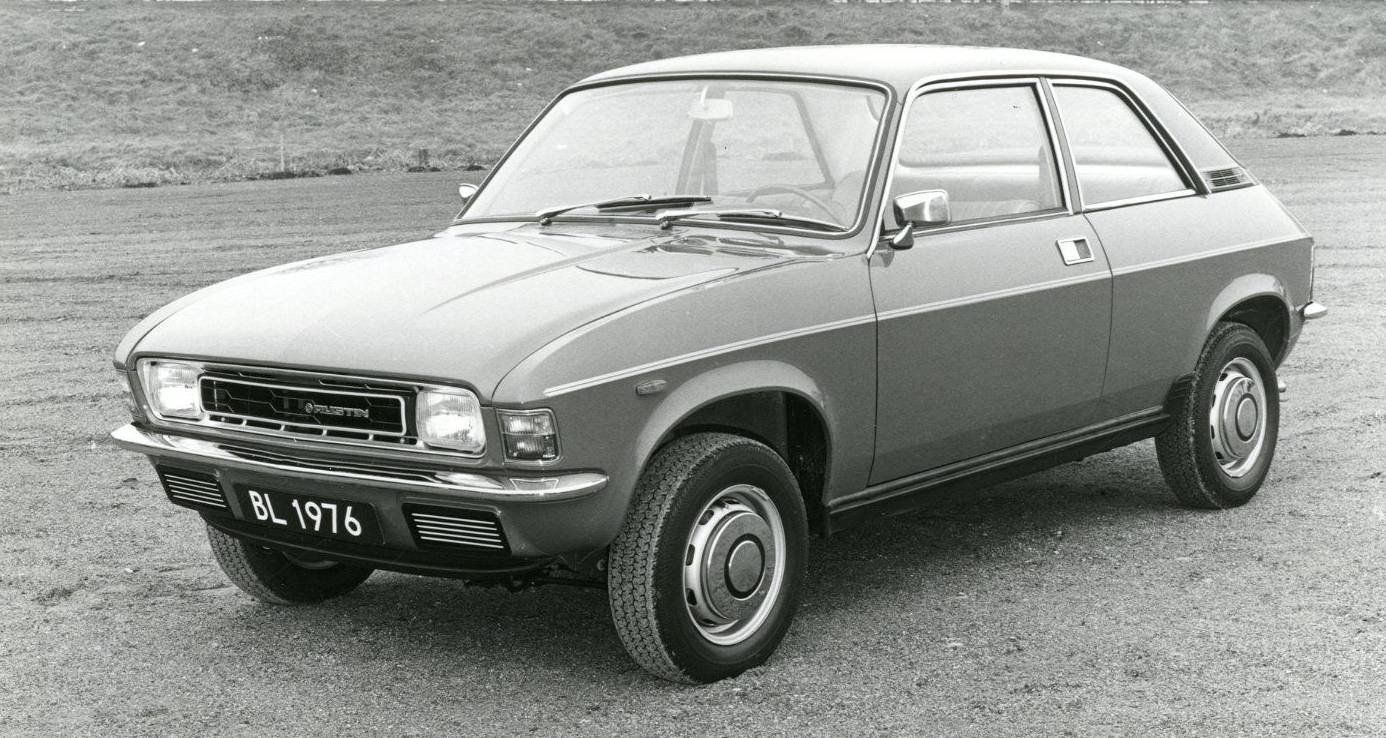
Austin Allegro Mk 2
(1975 to 1979)
Dimensions
Overall length: 3852 mm (152 in)
Overall width: 1613 mm (63 in)
Height: 1398 mm (55 in)
Wheelbase: 2442 mm (96 in)
Track: 1346 mm (53 inches)
Weight: 869 kg (1915 lb)
Tyre size: 145 x 13 (155 x 13 on 1750 and Sport)
Launched in time for the London Motor Show in October 1975, the Allegro 2 had the same bodyshells but featured a new grille, reversing lights on most models and some interior changes to increase rear seat room. The Estate gained a new coachline running over the wing top lip and window edges. Changes were also made to the suspension, braking, engine mounts and drive shafts.
In April 1975 a 3-door estate car version was added to the range: Allegros were now coming off the production line with the same conventional steering wheel as the Morris Marina, although the company waited till early June 1975 to announce, rather quietly, the demise of the Allegro's quartic steering wheel, presumably to give time for older cars to emerge from the sales and distribution network. Similar to the 2-door saloon the Allegro estates featured a rear wash wipe and coachline like the saloon models: the spare wheel was housed under the rear load floor area. They were only in production for approx 100 days before the arrival of the Series 2 model, making Series I Allegro estate rarer than most other models in the range.
There was a similar situation in New Zealand where the New Zealand Motor Corporation, which at the time had CKD kit assembly plants in Newmarket and Panmure, Auckland, and Petone, Wellington, began Allegro assembly in 1975 - with the circular steering wheel. Only a few hundred 'Mark Ones' - among the first locally built car models to have a factory-fitted heated rear window - were built before the 'Mark Two' was launched. Most Allegros sold in New Zealand had the 1300cc A-series OHV engine and four-speed manual gearbox. Later, the 1.5-litre OHC engine with four-speed automatic 'box was offered but this was eventually dropped. NZMC, moving away from UK sourced cars to models from its Honda franchise (it began Civic assembly in 1976 with the Accord following in 1978), later rationalised Allegro output to offering just two paint colours - metallic brown or solid dark blue - with a cream vinyl roof and brown interior trim. One batch of 48 'Mark Three' CKD kits was shipped from England after NZMC had decided to drop the Allegro in 1980 and these were assembled and sold - also in brown or cream; these rare cars have four round headlights rather than two square units and different tail lights plus a restyled dashboard
At the end of 1976 British Leyland confirmed that they were holding exploratory talks with trades union representatives concerning the possible transfer of Allegro production from Longbridge to the company's plant at Seneffe in Belgium.The Belgian plant was already assembling the cars for continental European markets using CKD kits shipped from the UK.The stated objective of the transfer was to free up capacity at Longbridge for the manufacture of the forthcoming ADO88 Mini replacement. In the event the ADO88 project was abandoned and the eventual Mini replacement, the less ambitiously engineered Austin Metro, did not reach the market place for another four years. Whether for reasons of politics or of customer demand or of cost at a time of rapid currency realignment, Allegros for the UK market continued to be manufactured in the UK; the Belgian plant was closed in the early 1980s, by which time Allegro demand in continental Europe had faltered and BLMC's Austin-Morris division clearly had more production capacity than product demand.
Some models of Allegro 2 made for non-UK markets were equipped with four round headlights, rather than the usual tworectangular items.
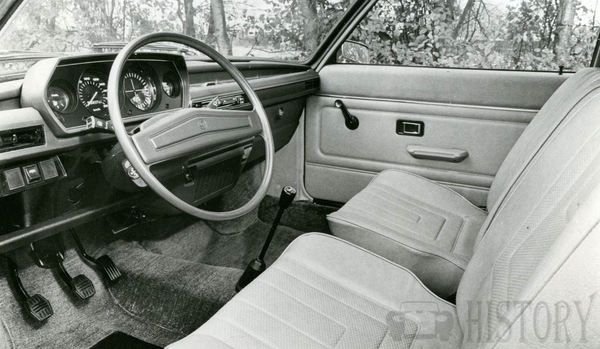
Austin Allegro Mk 2 interior
Engines
- 1975–80: 1098 cc A-Series Straight-4, 45 bhp (34 kW) at 5250 rpm and 55 lb·ft (75 N·m) at 2900 rpm
- 1973–80: 1275 cc A-Series Straight-4, 59 bhp (44 kW) at 5300 rpm and 69 lb·ft (94 N·m) at 3000 rpm
- 1973–82: 1485 cc E-Series Straight-4, 69 bhp (51 kW) at 5600 rpm and 83 lb·ft (113 N·m) at 3200 rpm
- 1973–82: 1748 cc E-Series Straight-4, 76 bhp (56 kW) at 5000 rpm and 104 lb·ft (141 N·m) at 3100 rpm
- 1974–?: 1748 cc E-Series twin-carburetted Straight-4, 90 bhp (67 kW) at 5000 rpm and 104 lb·ft (141 N·m) at 3100 rpm

Austin Allegro 2 1500 2 door Estate
- Details
- Parent Category: B
- Category: British Leyland
- Hits: 53
Austin 3-Litre
| 1968 to 1971 | |
|---|---|
 |
|
| Overview | |
| Manufacturer | British Leyland |
| Production | 1968–1971 9,992 made |
| Body and chassis | |
| Class | full-size car |
| Body style | 4-door saloon 5-door estate (Crayford Conversion) |
| Powertrain | |
| Engine | 2912 cc C-Series Straight-6 |
| Dimensions | |
| Wheelbase | 114.5 in (2,908 mm) |
| Length | 185.75 in (4,718 mm) |
| Width | 67 inches (1695 mm) |
| Height | 56.6 in (1,438 mm) |
| Curb weight | 3,304 lb (1,499 kg) |
| Chronology | |
| Predecessor | Austin A110 |
| Successor | Austin 2200 |
The Austin 3-Litre was a British saloon car introduced by British Leyland at the London Motor Show in 1967. It became apparent that BMC were not geared up to producing the car: few or none seem to have been sold that year, but by July 1968 it was reported that the cars had begun to leave the factory. By that time the square headlights seen at the 1967 motor show had been replaced by conventional round twin headlamp units, and by the time of the October 1968 show the car had also acquired front quarter lights. In July 1968, with cars beginning to emerge from the plant, the manufacturers were asked to detail improvements reportedly implemented since the car's "launch" the previous October. Mention was made of orifice modifications to hydraulic valves in the rear suspension, and it was stated that there was a "new" final drive ratio of 3.9:1, though this was actually the same final drive ratio included in the launch information the previous October.

Codenamed ADO61, the car was intended to be BMC's offering in the 3-litre executive class and was originally designed in the early 1960s, before the British Leyland era. Unlike the visually similar (but smaller) front-wheel drive ADO17 range, the 125 bhp 3-litre engine (a 7-bearing modification of the BMC C-Series with twin SU carburettors) drove the rear wheels through a conventional 4-speed gearbox. The car used Hydrolastic suspension with self-levelling hydraulic rams at the rear and was praised for its excellent ride and handling. Alec Issigonis, who designed the front-wheel drive cars, had no part in the 3-Litre, which he was reportedly keen to point out.
- PERFORMANCE:3-litre Saloon
- Engine capacity: 177.69 cu in, 2,912 cu cm
- Fuel consumption: 21.7 m/imp gal, 18.1 mlUS gal, 13 1 x 100 km
- Max speed: 100 mph, 161 km/h
- Max power (SAE): 125 hp at 4,750 rpm
- Max torque (SAE): 157 1b ft, 21.7 kg m at 2,500 rpm
- Max engine rpm: 5,700
- Specific power: 42.9 hp/l
- Power-weight ratio: 26.5 lb/hp, 12 kg/hp
To cater for its intended market the interior was luxurious, featuring wood veneers and cloth headlining (but leather upholstery was not available, being replaced with a good-quality vinyl) and the boot was longer than that of the 1800, contributing to an overall length of 186 inches (4,700 mm) (the 1800 was 167 inches (4,200 mm) long).

Luxurious Wolseley and Vanden Plas 3-litre versions both reached prototype stage, but went no further. A small number of estate models were built however, converted by Crayford. In the early days of British Leyland proposals for a Rover-branded version were considered to replace the Rover P5 3-Litre but these did not progress beyond the drawing board.
Sales were very poor. The standard version had been withdrawn by 1969 while the de luxe version soldiered on until the model was discontinued completely in May 1971, after less than 10,000 had been produced. It suffered from a perception that it was merely an enlarged ADO17 "Landcrab" (indeed, it gained the nickname "Land-lobster"), with which it shared its central section and doors, although it was in fact a quite different car.
No replacement car was made by Austin in this class since by the time one would have been required, Rover and Triumph were also within British Leyland, and this was seen as a market segment more properly served by those marques.


