
Austin
Austin A110 Westminster
 |
|
| Overview | |
|---|---|
| Production | 1961–1968 |
| Assembly | Longbridge, England |
| Produced | 26,105 |
| Body style | 4-door saloon |
| Layout | FR layout |
| Related | Wolseley 6/110 Vanden Plas Princess 3-litre Mark II Vanden Plas Princess 4-litre R |
| Engine | 2.9 L C-Series I6 |
| Transmission | 4-speed manual: synchromesh on top 3 ratios Borg Warner 3-speed automatic |
| Wheelbase |
110 in (2,794 mm) |
| Length | 188 in (4,775 mm) |
| Width | 68 in (1,727 mm) |
| Height | 4 ft. 11 in. (1.51 m.) |
| Turning circle | 41 ft. (12.50 m.). |
The Austin A110 was an upper midsize four-door sedan released by Austin Motor Company in 1961 as the successor to the Austin A99 .
History
Built at the same time the Wolseley 6/110 was produced with the same body but a slightly more powerful 120 bhp engine The same body type was also used for the luxury Vanden Plas Princess 4 Litre R fitted with larger Rolls Royce engine .
The six-cylinder engine taken from its predecessor with a displacement of 2912 cm³ and 82 kW of power that drove the rear wheels and brought the car up to 104 mph, 167.4 km/h. The predecessor's pontoon-shaped body gave way to a fashionable version with tail fins and an extended wheelbase.
Engine: in-line, water-cooled, overhead valve, 6-cylinder, 4-bearing counterbalanced crankshaft, with bore 3.281 in. (83.34 mm.), stroke 3.5 in. (89 mm.) and cubic capacity of 177.7 cu. in. (2,912 c.c.) the compression ratio 8.3:1 or 7.3:1 if required. Maximum b.h.p. 120 at 4,750 r.p.m., maximum torque 163 lb./ft. at 2,750 r.p.m.Fitted with twin S.U. carburetters, type H4; S.U. electric fuel pump, type SP, mounted in boot; single unit air cleaner with twin paper elements.Internal gear-type pump driven by camshaft; full flow external oil filter, gauze in sump; sump capacity approximately 11 pt. (6.25 litres) plus pt. (0.71 litre) for fitter, 12-volt, coil and distributor with aUtomatic and vacuum control; pressurised radiator with pump, fan and thermostat; Capacity approximately 19 pt. (10.83 litres); twin down pipes merge into a single pipe having 3 silencers.
The petrol tank capacity of 16 gal.(72.74 litres) with fuel filter in pump and fuel tank.

The clutch spring diaphragm type, of 9 in. (0.23 m.) diameter, hydraulically operated by pendent pedal; gearbox: 4-speed with synchromesh' on second, third and top speeds; central floor-mounted change speed lever; oil capacity approximately 5 1/2 pt. (3.14 litres).The ratios, first 2.637, second 2.071, third 1.306, top 1.00, reverse 3.391 : 1; overdrive with synchromesh gearbox only optional at extra cost, ratio 0.77:1 with automatic gearbox (optional at extra cost), fully automatic with hydraulic torque converter coupling; hydraulically controlled planetary gear set provides 3 forward speed ratios and reverse, engaged by multi-disc clutches and brake bands, oil capacity approximately 15 pt. (8.52 litres), ratios, first 2.39, second 1.45, top 1.00, reverse 2.09:1.
Speed selector lever mounted on steering column.Power to propeller shaft: open, with needle-roller-bearing universal joints; rear axle:three-quarter floating with hypoid bevel crown wheel and pinion, oil capacity 3 pt. (1.71 litres), ratios 3.9:1 (synchromesh gearbox), 3.55:1 (automatic gearbox); overall gear ratios (synchromesh gearbox), first 10.31, second 8.10, third 5.11, top 3.91, reverse 13.26:1; overall gear ratios (automatic gearbox), first 8.48, second 5.15, top 3.55, reverse 7.42:1; road speeds in m.p.h. at 1,000 r.p.m. (synchromesh gearbox), first 7.17, second 9.12, third 14.46, top 18.90; road speeds in m.p.h. at 1,000 r.p.m. (automatic gearbox), first 8.71, second 14.35, top 20.81.
For Steering: high efficiency cam and peg, ratio 20:1, 2-spoke in. (0.44 m.) diameter dished safety-type steering wheel; turning circle 41 ft. (12.50 m.) optional extra power assisted steering.
The suspension: front, independent wishbone type, with coil springs and hydraulic shock absorbers, anti-roll bar, rear, semi-elliptic leaf springs, and telescopic shock absorbers which also control lateral sway.
Brakes: front, disc-type 10 in. (0.25 m.) diameter; rear, drum-type 10 in. x 3 in. (0.25 m. x 0.08 m.) with automatic adjustment; hydraulic operation by pendent pedal with vacuum servo assistance, pull-up handbrake lever at side of driver's seat operates on rear wheels.wheels and tyres: pressed steel disc, 5-stud fixing; 7.50-13 Dunlop tubeless tyres.
Electrical: 12-volt generator and starter motor; 57-amp./hr. battery at 20-hr. rate; double-dipping sealed beam head lamps, with foot-operated dip switch; side lamps mounted below head lamps and combined with flashers; stop/tail lamps reflectors and flashers combined in twin units at rear; number: plate lamp mounted on rear bumper; luggage compartment lamp; self-cancelling flashing direction indicators, having steering-column mounted switch lever with warning tamp; warning lamps on facia to indicate generator not charging, head lamps high beam position, of brake servo vacuum and dirty oil filter element; combined ignition and starter switch; twin windtone horns; heater/demister unit. 'A110' Mk.II Saloon: single interior lamp on door pillar operated by integral switch and courtesy switches on front doors; concealed instrument illumination with switch which operates when side lamps are 'on'; twin, single-speed self-parking windscreen wipers. 'A110' Super De Luxe Saloon: 2 interior lamps, 1 on each door pillar, operated by integral switch and courtesy switches on front doors; concealed instrument illumination with switch which operates when side lamps are 'on' twin, 2-speed self-parking screen wipers; clock centrally mounted on facia; head lamp flasher switch mounted on steering column.
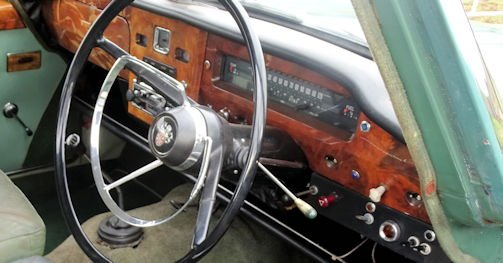
Instruments: 'A110' Mk.II : speedometer with trip and total distance recorders; 3-in-l instrument containing water temperature, oil pressure and fuel gauges; Super De Luxe Saloon: ribbon-type speedometer, with trip and total distance recorders, combined with fuel and water temperature gauges; ammeter and oil pressure gauge centrally mounted In facia. Bodywork: 4-door, 4-light, 5/6-seater Saloon of all-steel unitary construction; facia panel top surface is trimmed in black plastic to prevent glare, and also incorporates a padded crash roll; glovebox on passenger's side and full-width parcel shelf beneath; split bench- type front seats, adjustable on slides; parcel shelf behind rear seat squab; ashtrays fitted in back of front seats and in each front door; all doors and panels trimmed in Vinyl-coated fabric; 4 wind-down windows of toughened glass all with ventilating louvres and stainless metal surrounds; all doors hung on concealed hinges at forward edges; push-button exterior lock handles, with private locks on front doors; children's safety-catches are fitted to all doors and are inaccessible from within when doors are closed; curved, wrapround windscreen and rear window of toughened glass with stainless metal surrounds over rubber moulding; lockable luggage compartment has spring-balanced lid, and handle with push-button release; spare wheel carried in tray below boot, lowered by means of starting handle; bonnet lock controlled from inside car; chromium-plated bumpers front and rear; tinted interior rear view mirror; 2 sun visors; windscreen washer, built-in anchorage points for seat belts; heater/demister unit. lower surface of facia panel has facsimile wood finish, upper surface has black 'crackle' finish; front seat cushions consist oF rubber diaphragms with polyether pads; squabs are of spring case type with polyether toppings; rear seat cushion and squab are of spring case type with Polyether pad and topping; all seats trimmed in Vinyl-coated fabric; luggage platform covered with Vinyl-coated felt; floor covering of rubber-backed flock pile and cork-backed Vinyl-coated rubber mats; front grille has anodised aluminium horizontally ribbed mesh with stainless metal surround; monotone paint finish.
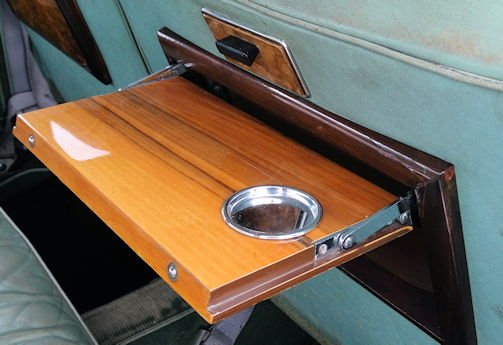
'A110' Super De Luxe Saloon:features facia panel of highly polished veneered walnut, glovebox lid has magnetic catch and forms a table when open; armrests, map pockets and veneered walnut cappings are fitted to all doors; front seat cushions and squabs consist of rubber diaphragms with polyether pads; squabs can be fully reclined or held in any intermediate position by lever control; folding armrest in each seat squab; veneered walnut folding picnic table in back of each front seat; rear seat cushion and squab are of spring case type with polyether pad and topping; folding armrest in centre of squab; all seat contact surfaces trimmed in high quality hide; floor, front and sides of luggage compartment lined with carpet; fitted carpet with felt underlay on floor of front and rear compartments; cigar lighter; front and rear bumper overriders; front grille has chrome horizontal bars with chrome surround; monotone or duotone paint finish.

At the end of May 1964 the A110 Westminster and Wolseley 6/110 were announced in their Mk. II versions, the changes over their predecessors being not very great mechanically but quite pronounced in general finish and trim. The A110 came out in two guises, Saloon and De Luxe Saloon, the former being priced at under £1,000 and being very basic in its standard of finish, the latter virtually having as good a finish as the more expensive Wolseley model.
Mechanical changes included a new improved suspension having special heavy-duty twin-valve front shock absorbers and the road wheels were reduced in size from 14 to 13 in. diameter, thereby reducing unsprung weight by some 10 1b at each wheel and dropping the height of the car in. Longer rear leaf springs (by 4 in.) combined with new telescopic shock absorbers set at an angle to absorb roll forces as well considerably improved rear suspension. Instead of the 3-speed and overdrive gearbox, a 4-speed non-overdrive box is fitted with the option of overdrive as an extra. Also as an extra was the new Borg-Warner automatic transmission, this being a larger version of the Model 35 having a 11-in. torque converter.
In 1968 the A110 model was discontinued and replaced by the Austin 3-litre .
PERFORMANCE:
- MAX SPEED: 104 mph, 167.4 km/h;
- max power (SAE): 126 hp at 4750 rpm
- max torque (SAE): 163 1b ft, 22.5 kgm at 2750 rpm
- max number of engine rpm: 4800
- specific power: 43.3 hp/l
- max speed in 1st gear: 29.2 mph, 47 km/h
- max speed in 2nd gear: 54.7 mph, 88 km/h
- max speed in 3rd gear: 102 mph, 164.2 km/h
- max speed in overdrive: 104 mph, 167.4 km/h
- power-weight ratio: 26.7 lb/hp

Austin 1100-1300 Countryman
 |
|
| Overview | |
|---|---|
| Manufacturer | BMC British Leyland |
| Production | 1966 to 1974 |
| Designer | Sir Alec Issigonis |
| Class | Motor car |
| Body style | 2-door estate |
| Layout | Front engine, front-wheel drive |
| Wheelbase | 93.50 in, 2,375 mm |
| Length | 146.75 in, 3,727 mm |
| Width | 60.35 in, 1,533 mm |
| Height | 53.87 in, 1,368 mm |
| Dry weight | 1,815 1b, 823 kg (1300) |
| Cost new | From £645 |
The Austin 1100,1300 Countryman is a 2-door estate version based on the BMC ADO16 built from 1966 to 1974
History
BMC ADO16 were economical small family cars built by the British Motor Corporation (BMC) and, later, British Leyland. It was first launched in 1962 and the Austin Countryman from 1966 Although most of the cars were manufactured in England, this estate car/station wagon had 2 doors plus 1 rear door with 4-5 seats with option for reclining backrests.
The original Mark I models were distinctive for their use of a Hydromantic suspension with independent, wishbones, hydrolastic (liquid) rubber cone springs, hydraulic connecting pipes to rear wheels. In March 1966 just before the launch of the mark II a three-door station wagon became available, badged as the Austin 1100 Countryman with carrying capacity of 882 1b, 400 kg. The engine from 1966 and available until 1974 was the 1098 cc A-Series.

From 1967 the new mark II version was first built at the end of May 1967. And The Mark II versions of the Austin models were announced, with the larger engine making it into these two makes' UK market ranges in October 1967 as the Austin 1300. An 1100 version of the Mark II continued alongside the larger-engine models. On the outside, a slightly wider front grille, extending a little beneath the headlights, and with more detailing, differentiated Austin Mark IIs from their Mark I predecessors Austin and Morris grilles were again differentiated, the Austin having wavy bars and the Morris straight ones. The 1100 had been introduced with synchromesh on the top three ratios. And now with the 1,275cc engine as the 1300 Countryman along with option for automatic gearbox, fitted with hydraulic torque with 2 conic bevel gears (twin enteric differential-like gear clusters) with 4 ratios (1st 2.689, 2nd 1.846, 3rd 1.460 rev 2.689), operated by 3 brake bands and 2 multi-disc clutches.
PERFORMANCE:1300 Countryman
- max power (DIN): 60 hp at 5,250 rpm
- max torque (DIN): 69 1b ft, 9.5 kg m at 2,500 rpm
- max engine rpm: 5,900
- specific power: 47.1 hp/l
- fuel consumption: 34 ml imp gal, 28.3 ml US gal, 8.3 1 X 100 km
- max speed: 85 mph, 136.8 km/h
- power to weight ratio: 30.2 lb hp, 13.7 kg/hp
In September 1971 the Mark III was introduced and built until 1974.The ADO16 was then replaced by the Austin Allegro. This ADO16 production overlapped for more than a year with the Allegro.
The Austin Countryman 1100 estate version from 1966, appeared in the "Gourmet Night" episode of Fawlty Towers, in which Basil Fawlty (John Cleese) gave it a "damn good thrashing". This episode was also first shown in the 1970s

Austin Big 7 car history
 |
|
|
Manufacturer: |
Austin |
|
Production period: |
1937 to 1939 |
|
Class : |
Motor car |
|
Body versions : |
Saloon ,2 or 4 door |
|
Engines: |
Petrol 0.9 liter |
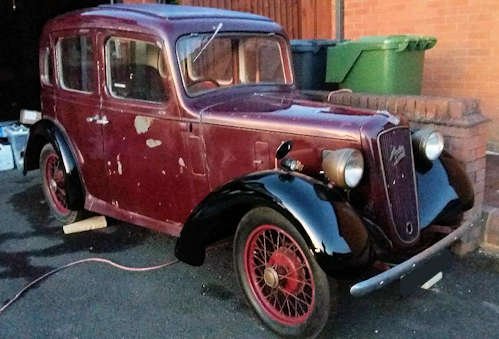
The Austin Big 7 was a compact car of the Austin range of the late 1930s, built by the Austin Motor Co in 1937 as a supplement to the Austin 7 between the Seven Ruby range. By 1939, after three years the production was stopped. Successor was the Austin 8 .It was not a great success, although in total 23,514 were produced.This model filled the gap in the Austin range of the late 1930s, between the Seven Ruby, which continued in parallel with the 747 cc engine and was a refined version Of the immortal Seven, and the contemporary 10/4.
The Big 7 had by now a dated chassis came just before Austin committed to the semi-unitary construction and the chassis layout of the Ruby was used, The Big 7 price at around £160 was not highly regarded in its day with little space even with suicide doors the 'boot' had space for only the spare wheel,the luggage had to be carried in its open boot with the lid open.The Austin "Big Seven" Although its name implies it to be a larger edition of the ' 'Seven," the design is completely new. The engine, developing 25 b.h,p. at 4.000 r.p.m., is a 4-cylinder, water-cooled unit. A new type of flexible clutch takes up the transmission. The gearbox has 4 speeds, and the final drive is by open propeller shaft with needle-bearing universal joints and torque tube to the spiral-bevel drive in the three-quarter floating rear axle. Girling-type brakes are fitted, and 'shock absorbers -are large area friction type. The patented triangular chassis frame is similar to that used on the Austin "Seven," with a transverse semi-elliptic spring at the front and quarter-elliptic springs at the rear.

The Big 7 was about 12 inches longer than the Austin 7 The overall length is 11 ft. 2 in., wheelbase 7 ft. 3b in., track at rear 3 ft. 9 in. ,There were four seats, , with a steel body in two and four-door saloon body and had a larger four-cylinder engine .The 900 cc engine offered little power advantage over the 747 cc Seven unit. From 900 cc 25 bhp (18 kW ). So the car top speed of aound 90 km / h.
Engine: 4 cylinders, bore 56.77 mm. (2.235 in.). stroke 88.9 mm. (3.5 in.), cubic capacity 900 c.c. (54.97 cu. in.). Tax {6. It is mounted on live rubber at three points, two forward and one rear. The 4 cylinders and crankcase are cast in one unit with detachable head and sump. The side valves are slightly inclined and are on the nearside of the engine, while the pistons are of anodised low-expansion aluminium alloy. The counter-balanced crankshaft is carried in three bi-metal bearings, which are lubricated by a gear-type pump. 14 mm. plugs are fitted. Carburation : A Zenith down-draught carburettor with an intake silencer and air-cleaner is fitted.A 6-gallon capacity petrol tank is mounted at the rear of the chassis, the fuel being fed to by means of a mechanical pump. An electric gauge mounted on the instrument panel records the fuel contents. An integral casting incorporating inlet and exhaust manifolds with adequate hotspot is provided. Carburettor control is made possible by a foot-operated accelerator and hand-operated strangler.
Cooling System : Thermo-syphon cooling is assisted by fan, and water passages surround all cylinders.
Lubrication : The engine is lubricated by means of a pump driven Off the camshaft. Oil returning to the sump is filtered through a gauze before entering into the circulation system. The main, big-end and camshaft bearings receive their lubricant under pressure through drilled oil passages. An Enot's grease-gun is provided for chassis lubrication at twelve accessible nipples.
Ignition : Ignition is by coil and battery with automatic advance and retard mechanism incorporated in the distributor.
Gearbox : The 4-speed gearbox, which forms a unit with the engine, has synchromesh engagement for second, third and top, ensuring smooth,positive and noiseless gear-changing. All gears are of specially treated steel so that they withstand constant hard use. The gear ratios are : 22.394, 13.52, 8.522 and 5.125 to l, with 28.79 to 1 reverse gear.
Transmission : A new type of flexible clutch, in which a single spring plate carrying the two friction rings transmits the drive from the engine through the gearbox is employed. A smooth take-up is the result, and pedal operation is light.
Final Drive : An open propeller shaft with needle-bearing universal joints and a torque-tube-enclosed bevel pinion shaft (which is mounted on rubber to the frame cross member) transmits the drive from the gearbox through the three-quarter floating rear axle, spiral-bevel driven, to the
road wheels.

Austin K4 Truck history
 |
|
|
Manufacturer: |
Austin Motor Company |
|
Type: |
Commercial vehicle |
|
Production period: |
1939 to 1955 |
|
model: |
Truck |
The Austin K4 was a heavy British truck that the Austin Motor Co. built in World War II and afterwards.Austin trucks in this style were manufactured from January 1939 in various forms. They were seen as active members of all important second war fronts in the period 1939 to 1945.
The vehicle number is divided into three parts, with the first part indicating the capacity (K2: 2-tonner / K4: 5-tonner), the second part is the type of vehicle, and the third part is the chassis number. For ordering spare parts, with overhead valve 6 cylinder gasoline 60 hp engine only the serial number was required.All three models have identical cab, hood, hood and fenders. Outwardly, the only difference is that the two-toners have six lug nuts, while the five-toners have eight.

SPECIFICATION
Production period: 1939 to 1948
Body designs: Various LWB:SWB
Weight capacity: 5-ton
Engines: 6 cylinders 3.5 l
Length: 4720 mm to 6480 mm
Width: 2130 mm
Wheelbase: 2850 mm to 4010 mm
All models were built in three series:
- 1939-1948 Series
- 1948-1949 Series I
- 1949-1955 Series II (Loadstar)

From February 1946, a new cab with a new grille was installed with centrally vertical ribs They were equipped with a 4-liter engine 90 hp engine. The postwar models received an updated radiator grille., previously they were consistently horizontal. It is the only visible difference.
From 1945, three models were built for the civilian market:
- 2-tone LWB (K2)
- 5-tone LWB
- 5-tone SWB Tippers

Austin FX4 Taxi
| 1958 to 1997 | |
|---|---|
 |
|
| Overview | |
| Manufacturer | Austin, Carbodies, LTI |
| Production | 1958–97 |
| Body and chassis | |
| Body style | 2-door funeral 4-door saloon |
| Dimensions | |
| Wheelbase | 2,810 mm (110.6 in) |
| Length | 4,570 mm (179.9 in) |
| Width | 1,740 mm (68.5 in) |
| Height | 1,770 mm (69.7 in) |
| Curb weight | 1,600 kg (3,527 lb) |
| Chronology | |
| Predecessor | Austin FX3 |
| Successor | LTI TX1 |
The FX4 is the classic Black Cab. While the majority are black, there is in fact no requirement for them, or indeed any other make of London taxi to be black. Over the years, the FX4 has been sold under a number of different makers' names. More than 75,000 FX4s had been built.
Design and launch
The FX4 London taxi was the successor to the Austin FX3, which was produced between 1948 and 1958. In its day the FX3 was the most widely used taxi in London. Like the FX3, the FX4 was designed by Austin in collaboration with Mann & Overton, the London taxi dealership that commissioned it (and paid for half of its cost) and Carbodies, the coachbuilder that built the body and assembled the cab ready for sale. The design team included Albert Moore from Austin’s engineering division, Jack Hellberg from Carbodies and David Southwell of Mann & Overton. The original design was by Austin’s Eric Bailey and it was engineered for production by Carbodies' Jake Donaldson. It would be the first London taxi to go into production that had four doors, since earlier London taxis had featured a luggage platform, open to the elements, on the pavement/sidewalk side at the front of the cabin, beside driver's compartment.
Like the FX3, the FX4 had a separate chassis, but with independent front suspension and dual-circuit hydraulic brakes. The first FX4, registration number VLW 431, was delivered in July 1958 and went on test with York Way Motors. The official launch was later that year at the Commercial Motor Exhibition.

The Austin models
The first model of FX4 was fitted with a 2178cc Austin diesel engine and a Borg-Warner automatic transmission. In 1961, the manual transmission from the Austin Gipsy was available as an option. From 1962, the Austin 2199cc petrol engine was available. However, almost all FX4 taxis were fitted with a diesel engine and, until the mid-1970s most had a manual transmission.
In 1969, the cab was altered, to offer a new version in place of the abandoned replacement model and to amend some of the shortcomings of the original. The original Austins were provided with small rear stop and taillights and roof-mounted turn indicators, commonly known as "bunny ears". On the revised model, the rear wings were modified to accept the taillights and turn indicators from the MkII Austin 1100/1300. Front indicators were also provided below the headlights and repeater indicators fitted to the front wings. The "bunny ears" were abandoned. The interior was also changed, with black vinyl seats and an altered partition to give the driver more legroom.

In 1971, the 2178cc diesel engine was replaced by a larger, 2520cc version. This engine proved to be better for use with an automatic transmission and gradually fewer cabs with manual gearboxes were sold. The petrol engine was discontinued in 1973.
In 1973, Carbodies' owner BSA, by now confronting imminent bankruptcy, was bought by Manganese Bronze Holdings, who were happy to continue making the FX4. Detail changes, such as burst-proof door locks and push-button door handles, safety steering and moulded rubber overriders (designed because the original tooling for the chrome overriders had worn out) were implemented.
The Carbodies FX4
In 1982, Carbodies, who had been producing the FX4 for Austin and Mann & Overton, took over the cab's intellectual property rights when BL, Austin's parent company lost interest in it and began to produce it under their own name. The old Austin engine was no longer available because, during Michael Edwardes' reconstruction of British Leyland, the plant had been sold to India. Carbodies selected the Land Rover 2286cc diesel engine in its place and also offered the similar-sized Land Rover petrol engine as an option. The new model was branded the FX4R, with R standing for Rover. The FX4R had some improvements over the previous FX4 models, including power steering and full servo brakes, but its performance and reliability were poor and the cab gained a bad reputation.
Some proprietors replaced the Land Rover engine with the Perkins/Mazda 2977 cc diesel, which improved the performance of the cab dramatically. Whilst powerful and reliable, the Perkins conversion gained a reputation for being noisy at idle and, mistakenly for causing cracks in the chassis. The chassis problem, which was also occurring on late model Austins was traced to a manufacturing fault.
In order to regain lost sales due to the FX4R's failure, Carbodies took old chassis and suspension and refurbished them, fitting new bodywork and the original-type 2520cc diesel engines re-imported from India. Because these vehicles used refurbished chassis and suspension components, they were required to have a registration mark starting with the letter Q rather than the current year letter and thus this model was known as the FX4Q. All were fitted with automatic gearboxes, but not the power steering fitted to the FX4R. Sold by the dealer Rebuilt Cabs Ltd, they were marginally cheaper than the FX4R.
The LTI FX4
In 1984 London Taxis International (LTI) was formed after Manganese Bronze Holdings bought the London taxi dealers Mann & Overton. LTI replaced the 2286cc Land Rover diesel engine with the new 2495cc version. The new model was called the FX4S. New rocker switches replaced the old toggle switches on the dashboard, the wipers were controlled by a stalk on the steering column and draught proofing was added to the bottoms of the doors and black rolled steel bumpers fitted, but basically it was an updated version of the cab that had been around for almost 30 years. At this time, Carbodies were developing a replacement for the FX4, the CR6, which is why this 'stopgap' FX4S was introduced. However, the CR6 was abandoned in 1985 and MBH decided to carry on making the FX4 until such time as it could fund a new cab. The FX4S was superseded in 1987 by the FX4S-Plus, which had a rear compartment redesigned to allow five passengers, the trim changed to grey. A new grey plastic moulded dashboard was also fitted. This was received very well by the trade, as a sign that their needs were actually being listened to.
The Department of Transport was keen to see wheelchair accessible taxis and the FX4W wheelchair conversion, which was available from early 1986, enabled the FX4 to provide that facility. In this, the curb side passenger door was made capable of opening 180° and the nearside part of the partition could be moved forward to accommodate the rearward facing wheelchair in place of the nearside tip-up seat.
In February 1989 the Fairway was introduced. It was fitted with a 2,664 cc Nissan TD27 diesel engine. This made the FX4 a faster and more reliable cab. It had full wheelchair accessibility, in line with a new law that came into force in January 1989. The Fairway was the best version of the FX4 ever built,and enabled LTI to sell to overseas markets, as well as move into provincial UK markets they had not been able to tackle. Much of this increase in sales was due to local authorities insisting on wheelchair accessible cabs being used in their areas.
Between 2011 and 2012 the It's on the Meter expedition drove a heavily modified FX4 43,319.5 miles (69,716.12km) around the world, through more than fifty countries, and set new world records for the longest journey ever by taxi and the highest altitude ever reached by taxi.
As part of a programme to develop a replacement model, AP Lockheed were commissioned to design and develop front disc brakes, and in conjunction, GKN designed a new suspension system to allow disc brakes to be fitted whilst maintaining the mandatory 7.6m turning circle. These modifications were fitted to a new model, the Fairway Driver, which was introduced in February 1992. The very final Fairway made, with registration mark R1 PFX (i.e. RIP FX), was built on 1 October 1997 and was presented to the National Motor Museum at Beaulieu.
Transport for London, (TfL) who had taken over control of the Public Carriage Office ruled that by 2006 all taxis licensed in London should comply with Euro 3 exhaust emission regulations. The Fairway, and for that matter its replacement, the TX1, which used the same Nissan engine only complied with Euro 2, but most proprietors were reluctant to get rid of their very reliable and economical Fairways. In the face of pressure from the trade, TfL allowed different conversions systems to be developed that could be fitted to the Nissan engine to make it comply. These were the STT Emtec Clean Cab turbocharger system and the Van Aaken exhaust gas recirculation system. Only 80 Austin- and Rover-engined cabs remained on the road, which made it uneconomical to develop conversions for them so they were granted an exemption. Although some owners of older Fairways got rid of them, many owners opted to spend almost £2000 having their cabs converted, rather than buy a new or second-hand TXII, which was considered to be very unreliable. In late 2009, only six of the earlier Rover- or Austin-engined cabs remained in service the street, most having covered more than a million miles each.
The Fairway was replaced in late 1997 by the TX1, which was subsequently replaced in 2002 by the TXII. This in turn was replaced in 2007 by the current model, the TX4.

A 1975 Austin FX4 in the James Bond film Octopussy, from 1983
Used by British Intelligence, Smithers follows Kamal Khan from Sotheby's

1958 Austin FX4 taxi in The Italian Job, Movie, from 1969


