
Allard
Allard J2X2
 |
|
|
Manufacturer |
A.H.A |
|
Production |
1981-1987 |
|
Assembly |
Canada |
|
Class |
Sports car |
|
Body style |
Roadster |
|
Layout |
Front engine, rear-wheel drive |
|
Transmission |
4-speed manual |
|
Wheelbase |
100 in, 254 cm |
|
Length |
163 in, 414 cm |
|
Width |
63 in, 160 cm |
|
Height |
46 in, 117 cm |
|
Kerb weight |
2,180 1b, 981 kg |
The Allard J2X2 is a sports roadster that was made by A.H.A. Manufacturing Company Limited from the early 1980s in Canada.
History
To note the Allard J2X2 is not a replica. It is the resumed production, after 30 years, Of the Allard J2X, altered from the original by as much modern hardware
and as could be incorporated without compromising the intended J2X feel and look with the blessings of the Allard family and the participation of Allan Allard (son of Sidney) as European distributor.
Beginning in Canada from 1981 A.H.A. Manufacturing Company Limited, revived the original J2X concept as the J2X2 this was built by Mel Stein and Arnold Korne, who owned the coachbuilding company. The J2X2 came fully built but was also now available in kit form. The car also now received protection from the elements in the form of all-weather equipment with loose side windows and a hood and option for second side-mounted spare tyre. A right-hand drive version was available for overseas British buyers the original home of the Allard cars with approval from Allard's son Alan on the European distribution all be it in limited numbers with Turbo from there factory.
A number of changes were carried out to bring up to date compared to the original Allard design including rack and pinion steering rack. With the lightweight bodywork longer than the original made from fibreglass and aluminium giving the car a weight distribution: 61% to front, and 39% at the rear. while the front suspension was changed to an independent type with wishbones, coil springs, telescopic dampers at the rear was rigid axle type fitted with adjustable coil springs, telescopic dampers and Watts linkage. The brakes were power assisted discs at the front, and rear drums.
The fully built version received Chrysler's 318 cu in 5.2-liter V8 engine with bore and stroke of 3.91 x 3.31 in, 99.2 x 84 mm a 5-bearing crankshaft and compression ratio of 8.5:1 fitted with a single Holley downdraught twin barrel carburettor giving a max power of 130 hp (97 kW) at 4,000 rpm and top speed of 140 mph, (224 km/h).
PERFORMANCE Allard J2X2
- Max speed: 140 mph, 224 km/h
- Power-weight ratio: 16.8 lb/hp (22.8 lb/kW), 7.6 kg/hp (10.3 kg)
- Max power (SAE net): 130 hp (97 kW) at 4,000 rpm
- Max torque (SAE net): 230 1b ft, 31.8 kg m (312 Nm) at 2,000 rpm
- Max engine rpm: 4,200; 24 hp/l (18.6 kW/l)
Fitted with a four-speed manual gearbox with single dry plate diaphragm and gearbox ratios of 1st gear 3.090, 2nd 1.670, 3rd 1, 4th 0.730, and reverse 3, although an automatic unit was also available with 3 ratios (1st 2.450, 2nd 1.450, 3rd 1, rev 2.200).
There was also a competition version with optional turbocharger fitted with a shorter aero windscreen and fitted without the modern bumpers.
Allard J2R
 |
|
|
Production period: |
1953 to 1957 |
|
Class: |
race car |
|
Body versions: |
Roadster |
|
Engines: |
Gasoline 5.4 litres |
|
Length: |
12ft 6in (381 cm) |
|
Width: |
5ft 1 lin (180 cm) |
|
Height: |
2ft 10in (86 cm) |
|
Wheelbase: |
8ft (244 cm) |
|
Curb weight: |
2,200 1b (1,000 kg). |
|
Price newl |
£2,440 incl |
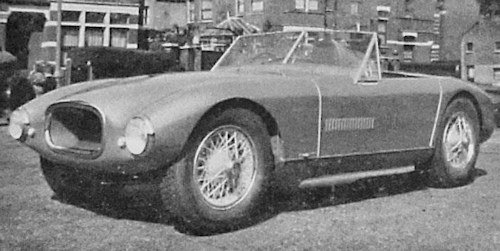
The Allard J2R was a 1950s sports race car, which was first developed in 1953 by Allard.
History
In 1946, British car dealer and racing driver Sydney Allard founded Allard Motor Company Ltd, a company involved in the construction of sports and racing cars. Allard had already built racing cars in the 1930s and now put the production on a professional footing.
In the 1950s, the models J2, J2X and J2R emerged the J2R had a full-body bodywork. The structure of the chassis was taken over by the J2X. The engine was supplied by Cadillac. The 5.4-liter V8 O.H.V. engine with compression ratio, 9.0 to 1, delivering 270 bhp (199 kW) at 4,600 r.p.m. and accelerated the car to about 210 km / h fitted with various options for number of gearbox speed ratios and overall ratios for final drive.Divided front axle indepndently sprung with coil and parrallel axis forward projecting radius arms. De Dion type rear coil springs. and twin parallel radius and twin triangulated A brackets. Telescopic hydraulic shock round. For braking Lockheed hydraulic two-leading shoe front, leading and trailing rear and 6.50-16 inch tyre size .
Inside fitted with single Two seater body of lightweight aluminium construction conforming with International Sports Regulations. Dash with speedometer. rev counter. oil pressure water gauges. ammeter. etc. in sports car racing for the first time ever, a J2R was driven by Sydney Allard himself at a national sports car race in the United Kingdom, where he finished third. At the 1953 Le Mans race in 1953, Philip Fotheringham-Parker took the lead in a J2R in the first four laps before an early braking defect forced him to give up.
Identification:
- Chassis Number Stamped on plate attached to bulkhead under bonnet.
- Engine Number (Cadillac Engine) Stamped into metal on nearside of clutch bell housing.
Allard J2
 |
|
|
Production period: |
1949-1954 |
|
Class: |
race car |
|
Body versions: |
roadster |
|
Engines: |
petrol V8 engines :3.6–4.4 litres |
|
Length: |
3937 mm |
|
Broad: |
1727 mm |
|
wheelbase: |
2540 mm |
|
curb weight: |
940 kg |
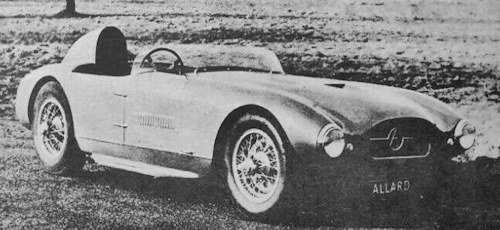
The Allard J2 is a racing roadster developed by the British Allard Motor Company Ltd. built as a successor to the J1 model.
History
The was intended for the US market Sydney Allard saw the potential of the US market and developed a special competition model as the J2.
The J2 roadster was a lightweight, with a hand-formed aluminium body The standard engine of the models delivered in Great Britain was the side-valve V8 engines from the Ford Pilot, with an output of 85 bhp (62.5 kW) from a displacement of 3622 cc. A 4.4 litre Mercury V8 engine producing 110 bhp (81 kW) was also available and the Ford "flathead" V8 was fitted in the USA market along with other V8s.

American enthusiasts also installed V8 engines from from Chrysler, Buick, Oldsmobile and Cadillac instead. The J2s sold in the US were delivered without an engine. Motors were then installed to the buyer's wishes. This approach proved to be very successful; because the US components made the search for spare parts in the USA easy to find.
The front wheels fitted on a swing axle with coil springs. A De Dion rigid axle was installed at the rear, which was also fitted with coil springs. Fitted with inboard rear brakes
The J2 proved competitively race car in the 1950s A total of 90 Allard J2s were built in 1950 and 1951.

Available both in street trim and stripped down for racing, the J2 proved successful in competition on both sides of the Atlantic, including a third place overall at Le Mans in 1950 (driven by Sydney Allard himself, who also placed first in the Monte Carlo Rally in 1952 driving an Allard P1 saloon car). Of 313 documented starts in major races in the 9 years between 1949 and 1957, J2's compiled a list of 40 first place finishes; 32 seconds; 30 thirds; 25 fourths; and 10 fifth place finishes. Both Zora Duntov (the father of the Corvette) and Carroll Shelby (the father of the Cobra) raced J2's in the early 50's. 90 J2's were produced between 1950 and 1952.
In an effort to extend a line growing obsolete in the face of advances in sports car design, Allard introduced an extended model in late 1951, the J2X. In an attempt to improve handling, the front suspension's rear attaching radius rods were redesigned with forward ones, which required a forward cross member and extending the nose out past the front wheels. This, in turn, allowed the engine to be moved forward, yielding more cockpit room. There is much confusion on the internet as to labelling of J2 and J2X types – the most obvious differences being that the J2 nose does not extend past the front tires and has two vents below the grill, while the J2X nose extends past the front tires and usually has a single vent below the grill placed on a more protruding chin.
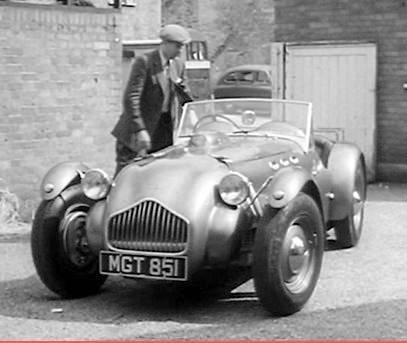
An Allard J2 in The Gambler and the Lady, Movie, from 1952
Allard Safari
 |
|
|
Production period: |
1952 to 1953 |
|
Class : |
Luxury car |
|
Body versions : |
station wagon |
|
Engines: |
Petrol : 3.6 litres (62.5 kW) |
|
Length: |
16 ft. 0 in |
|
Width: |
5 ft, 10 in. |
|
Height: |
5ft, 3 in. |
|
Wheelbase : |
9 ft. 4 in, |
|
Dry weight : |
29 cwt |
The Allard Safari is a was a massive three door woody estate car with three-door, five-seater sports Combinatorial by the British firm Allard from 1952 as a derivative of the model P2 built. The Safari estate car shared the same chassis and the same front end as the Monte Carlo, but had constructed as a woody station-wagon cabin. Surprisingly, it was priced a long way below the Monte Carlo saloon.

Any number of engines could be fitted, but Ford's side valve V8 was the standard, though by now inadequate dated, unit, as was its three-speed gearbox. As on the K3, the gear lever was outboard of the seats. The safari had the same powertrain as the saloon P2. The side-steering V8 engine came from the Ford Pilot, as well as the three-speed gearbox. The engine had a displacement of 3622 cc (bore x stroke = 77.79 mm x 96.25 mm), was 6.1: 1 compressed and made 85 bhp (62.5 kW) at 3500 rpm. Instead, on request could other V8 engines - mostly from US car models can be installed.
- Engine Performance: -3622 cc
- Max. b.h.p. - 85 at 3.500 r.p.m.
- Max. b.m.e.p. - 102 lb./sq. in. at 2,000 r.p.m.
- BHP per sq. in. piston area - 1.44
- Peak piston speed per min. - 2,190

Fitted with a 112in-wheelbase X-type chassis, with a multi-tube layout and coil spring De Dion rear suspension. The front wheels were suspended individually and had coil springs. The driven rear wheels on a De Dion axle. The wheelbase was the same as the Monte Carlo sedan, 2845 mm, the track front / rear 1486 mm. The station wagon was 152 mm longer than the saloon with 5029 mm. At the front, and like the M2X, there was an "A" (for Allard) motif to the grille, and the entire front-end wings,
bonnet and front shroud tilted up for access. The chassis frame was made of steel pipes with aluminium body. At the back of the station wagon was the wooden frame structure of the body, as was the case with many contemporary station wagons in the USA from the time. So, it was a Woodie.
The car at the time was a commercial flop in total, ten copies were made.


